Why Salt in Drinks Improves Coffee, Cocoa and Tonic
Salt suppresses bitterness more effectively than sugar does. A pinch in coffee or cocoa is not a trick, it is the most reliable free improvement available to either.
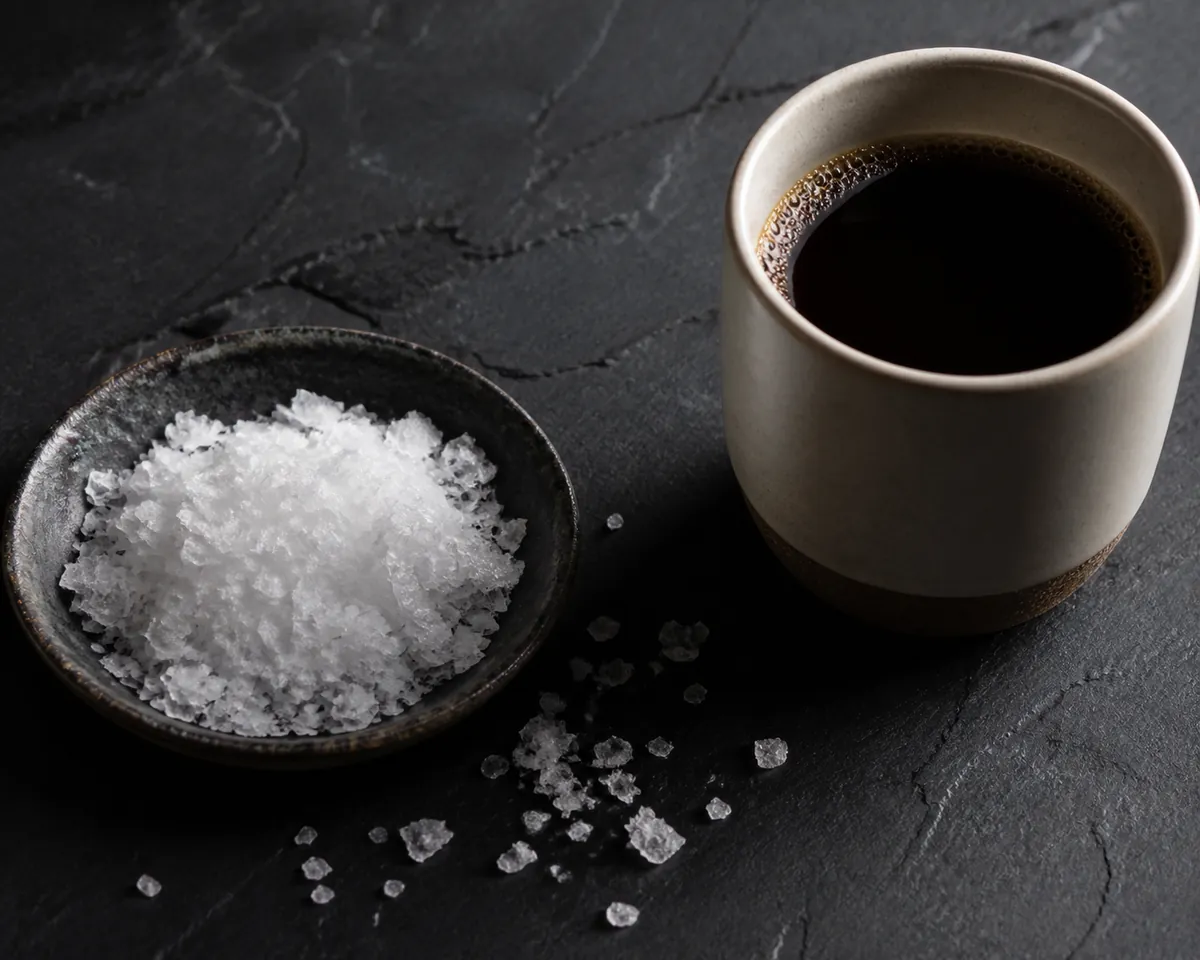
Salt in a drink sounds like a mistake, and it is one of the most reliable improvements available to several of them. The mechanism is not seasoning in the culinary sense.
Sodium suppresses the perception of bitterness, it does so more efficiently than sugar does, and it works at a dose far below the point where anything reads as salty.
That single effect is the whole of it. Which salt to reach for, how much, how to dose something this small repeatably, and the handful of traditions where salt is tasted deliberately all follow from it.
Salt in a drink, at a glance
- Job in the glass
- Suppresses bitterness, and contributes no flavour of its own at working doses
- Working dose
- A few grains per cup, well under 1/16 teaspoon
- Rewards
- Dark roast, instant coffee, cocoa, quinine, bitter greens
- Wasted on
- Delicate infusions that carry no bitterness worth removing
- Type that matters
- Fine and uniodised in a clear drink, anything at all in coffee
- Repeatable delivery
- A 20 per cent saline solution, dosed by the drop
- Wrong place for it
- Brewing water, where sodium does none of the extracting
Why a few grains suppress bitterness
Sodium ions interfere with the way bitter compounds register, and the effect is out of all proportion to the quantity involved. Sugar works by competition, adding a second sensation loud enough to crowd the first one out; salt works by suppressing the bitter signal itself, which is why so much less of it is needed and why the result tastes cleaner.
Two consequences follow. Sweetness appears to rise although nothing sweet went in, because bitterness had been masking whatever sugar the drink already carried, and aroma reads as more pronounced for the same reason.
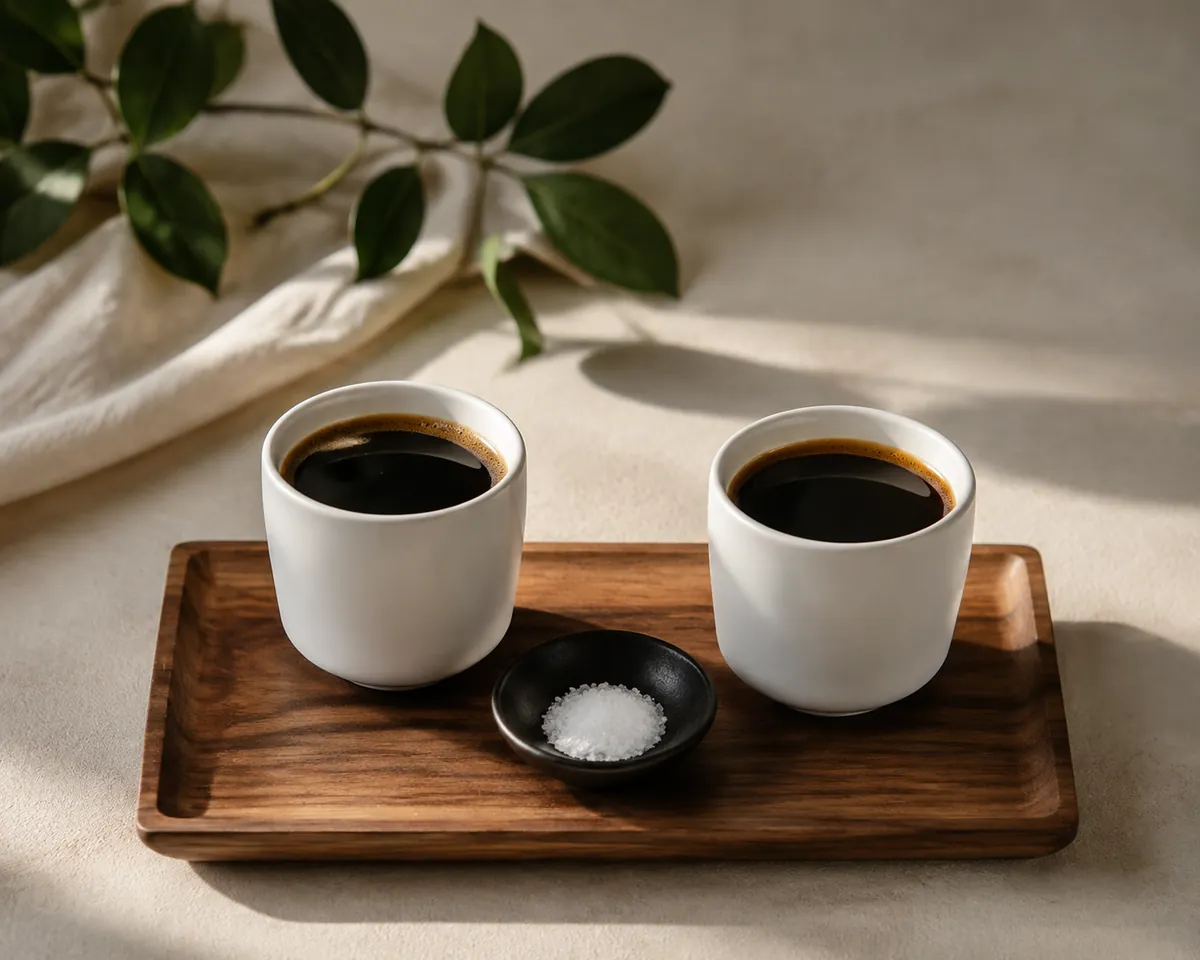
A drink that tastes salty has been overshot, not improved. The whole technique lives below the threshold of detection, which is the part that makes it awkward to teach and easy to ruin.
Testing it takes one pot and two cups. Brew, pour both, drop a few grains into one and taste them together rather than in sequence, because the memory of a sip fades faster than the difference does.
The gap is widest in a cheap bag or a dark roast and narrowest in a good light one.
The drinks with bitterness worth losing
Not everything benefits, and the ones that do share a single feature: bitterness that the drinker would rather not have.
Coffee
Particularly a dark roast or an over-extracted brew. The classic use, and the easiest to verify.
Tonic water
A pinch takes the edge off quinine without the sweetness that a sugar correction brings.
Citrus drinks
Softens sourness as well as bitterness, and is traditional in some lemonades.
Delicate infusions are the exception that proves the rule. A white tea carries almost no bitterness to remove, so salt has nothing to work against and simply intrudes as a foreign mineral note.
The same is true of a well-made sencha or a light-roast filter brewed properly, where the bitterness is already where it should be and any suppression takes character out along with the edge.

The quantity is smaller than anyone expects, and the margin between right and wrong is narrow enough that it is worth writing down rather than trusting to the hand. Doses below are per cup, not per pot, and they assume fine salt going into a hot drink.
Working amounts
- Coffee, per cup
- A few grains. Well under 1/16 teaspoon
- Cocoa, per cup
- A small pinch, roughly 1/16 teaspoon
- Brewing a pot
- A pinch stirred into the dry grounds, before water
- Citrus drink, per litre
- A pinch, dissolved into the syrup rather than the glass
- Overshot
- Detectable saltiness. There is no rescuing it
Fine, flaky, iodised: what reaches the glass
For suppressing bitterness the amount matters and the provenance barely does, which is an unpopular thing to say about an ingredient sold on provenance. A few grains of an expensive finishing flake and a few grains of ordinary table salt do the same work in a cup of coffee, because the mineral differences between them are real at a gram and irrelevant at a tenth of one.
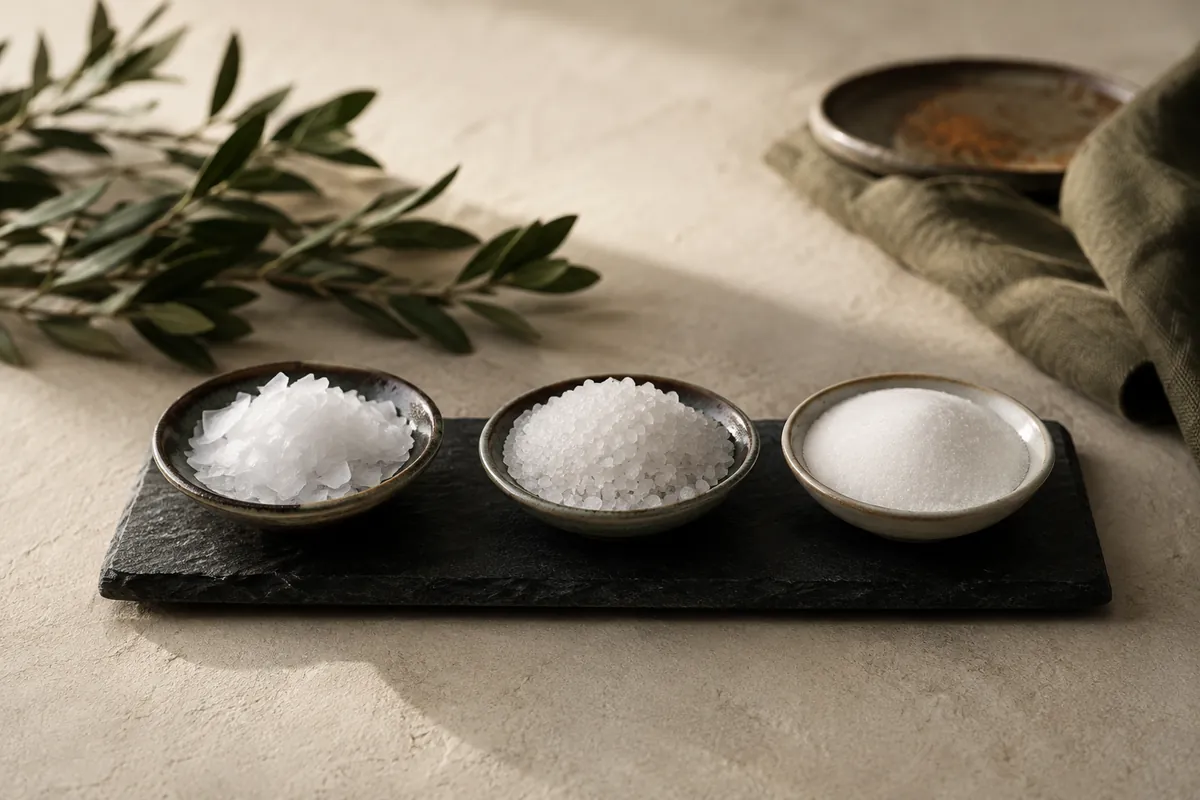
What does matter is the grain size and the ingredients list.
| Sea salt | Rock salt | Table salt | |
|---|---|---|---|
| Source | Evaporated seawater | Mined ancient deposits | Mined or solution-mined, then vacuum-dried |
| Grain | Irregular, flaky or coarse | Irregular, often crushed | Uniform fine cubes |
| Additives | Usually none | Usually none | Frequently iodine and an anti-caking agent |
| Dissolving | Slower where flakes are large | Slow | Fastest |
| In a clear glass | Clean | Clean | Can leave a faint haze |
Iodised salt carries potassium iodide, which leaves a faint metallic edge that coffee hides completely and a glass of plain sparkling water does not. Anti-caking agents are the second thing to check: silicon dioxide and sodium ferrocyanide are present in tiny amounts, they do not fully dissolve, and they leave a slight cloudiness in anything clear.
Invisible in cocoa, visible in tonic held up to the light.
Fine salt is the practical choice for the cup because it dissolves fastest and doses most consistently. For coffee and cocoa, use whatever is in the cupboard.
For a clear cold drink, plain uniodised fine salt is the one that disappears properly.
Dosing in drops instead of grains
A few grains is not a measurement, and that is the practical problem with every instruction above. You cannot repeat it, you cannot adjust it in steps, and the distance between an improvement and a ruined cup is smaller than the smallest spoon in the drawer.

The answer is to stop measuring salt and start measuring saltwater.
A 20 per cent saline solution
- Salt
- 20 g
- Water
- 80 g, warm
- Method
- Stir until fully dissolved, then cool
- Dose
- Two to four drops per cup, from a dropper bottle
- Keeps
- Weeks in the fridge, since nothing grows at this concentration
Four drops carries roughly a tenth of a gram, delivered accurately and already in solution, which matters more in cold drinks than hot ones. A crystal dropped into iced cold brew sits on the bottom of the glass and dissolves at its own pace, so the first mouthful tastes untouched and the last one tastes wrong; saline disperses on contact.
Two drops, taste, then two more. Working upwards costs nothing and overshooting cannot be undone, so there is never a reason to start high.
Bitterness it rounds, and faults it only hides
Suppressing the perception of bitterness is a narrower thing than removing the cause of it, and the difference shows up the moment a drink is bitter for the wrong reason.
An over-extracted brew is bitter because too much came out of the grounds, and much of what came out is also astringent. Salt takes the bitter edge off and leaves the drying, mouth-puckering half behind, so the cup improves and still tastes wrong, which is a more confusing outcome than leaving it alone.
What is behind the bitterness
- Dark roastGenuinely a roast flavour. Salt softens it well
- Instant coffeeProcessing bitterness. Salt helps considerably
- RobustaNaturally higher bitterness. Rounds usefully
- Over-extractionPartly masked, and the dryness stays
- Stale beansBarely. Papery, flat notes are not bitterness
- Burnt or scorchedNot at all. Nothing rescues it
The test is whether the drink has a character or a fault. A dark roast's edge is a character, and salt rounds it honestly.
A channelled espresso shot or a bag of beans opened three months ago is a fault, and the fix belongs where the fault happened, in the grind, the dose, or in how the beans were kept.
Reaching for the dropper every morning is itself a signal. A cup that consistently needs correcting is telling you to change something upstream of the cup.
Sweetness that reads as more than sugar
Alongside the bitterness effect, salt does a second and quieter job in anything already sweet: it makes sweetness read as layered rather than flat. Salted caramel is the familiar demonstration, and the same thing transfers directly to a drink built on sugar.

The efficient route is to salt the sweetener rather than the drink. A quarter teaspoon per 500 ml of simple syrup is enough to register and nowhere near enough to taste, and every drink that syrup touches inherits it without further thought.
The same trick works in a batch of vanilla syrup, where the salt also sharpens the vanilla.
Where it pays best is one-dimensional sweetness. A white hot chocolate or an Italian soda gains a great deal, because sugar is carrying the whole drink alone.
A mocha gains far less, since coffee acidity and cocoa bitterness are already doing the balancing that salt would otherwise do.
Where salt is tasted on purpose
Several traditions treat salt as an ingredient in its own right rather than a correction, and they are worth knowing because they mark the far end of the scale.
Ca phe muoi
Vietnamese salt coffee, from Hue. Strong filter coffee under a whipped, lightly salted cream cap.
Sea salt cream tea
Taiwanese. A salted cream layer floated on iced tea or coffee, drunk through the cap rather than stirred.
Nimbu pani
The Indian lemon drink, salted at least as often as it is sweetened, frequently with black salt.
Salted lassi
Yoghurt, salt and cumin. The savoury half of a drink most people outside South Asia meet only in its sweet form.
Po cha
Tibetan butter tea. Brick tea churned with butter and salt into something closer to a thin broth.
Black salt, kala namak, belongs in a category of its own. Fired with charcoal and seeds, it carries sulphur compounds that taste distinctly eggy, and that is deliberate: nimbu pani made with kala namak tastes nothing like a lemonade made with sea salt, and substituting one for the other produces a drink nobody wanted.

What these share is that the salt is meant to be noticed. That is a different technique from the few grains above, and swapping the two in either direction goes badly.
Making a salted cream cap
The Vietnamese and Taiwanese drinks share one piece of technique, and once the proportions are right it takes two minutes.
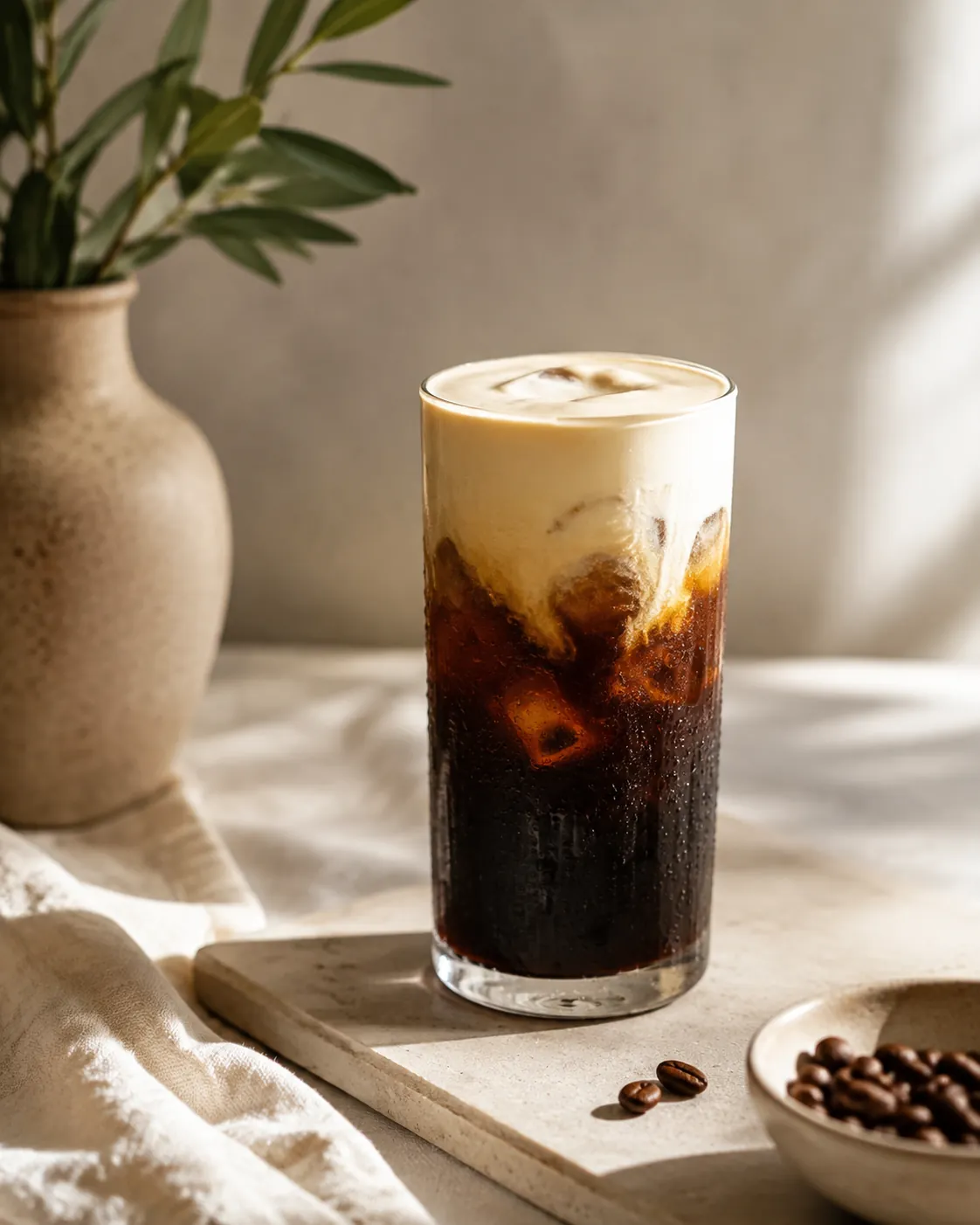
Salted cream, enough for two glasses
- Double cream
- 60 ml
- Whole milk
- 30 ml
- Sugar
- 1 teaspoon
- Salt
- A generous pinch, or 6 drops of saline solution
- Method
- Whisk to a loose, pourable foam that just holds a trail
Consistency is the part people get wrong. Whipped to peaks it sits on the surface as a lid and never mixes; left too thin it sinks straight through and disappears.
What floats and still pours is roughly the texture of unset custard, and a hand whisk gets there more reliably than a milk frother, which tends to overshoot into stiffness.
Pour it over the back of a spoon onto iced coffee or strong cold tea and drink without stirring. The salt lands on the first sip, the coffee underneath reads sweeter than it is, and the two meet somewhere in the middle of the glass.
Fat is what does the floating, which is why milk alone will not hold a cap and why most plant drinks fail here unless they are the high-fat barista formulations. Even oat milk built for foaming makes a thinner, shorter-lived layer than cream.
The kettle is the wrong place for it
Salt in the cup and salt in the kettle are unrelated problems, and confusing them is a common way to make coffee quietly worse.
Calcium and magnesium do the extracting. They bind to the compounds coming out of the grounds, and they are the reason brewing water recipes specify hardness at all rather than simply calling for something clean.
Sodium takes no part in that work.
Adding salt to the water therefore raises sodium without raising either ion that matters, and coffee brewed in it tends to come out flat and slightly dulled, the opposite of the lift the same salt gives in the cup. Water specifications written for brewing target sodium at close to zero for exactly this reason, and a drip machine filled with salted water produces a whole jug of the problem at once.
Salt after the fact, where you can taste what you are doing and stop.
Salt that never enters the drink
Two long-standing uses of salt around drinks put none of it into the liquid at all, and both are worth separating from everything above.
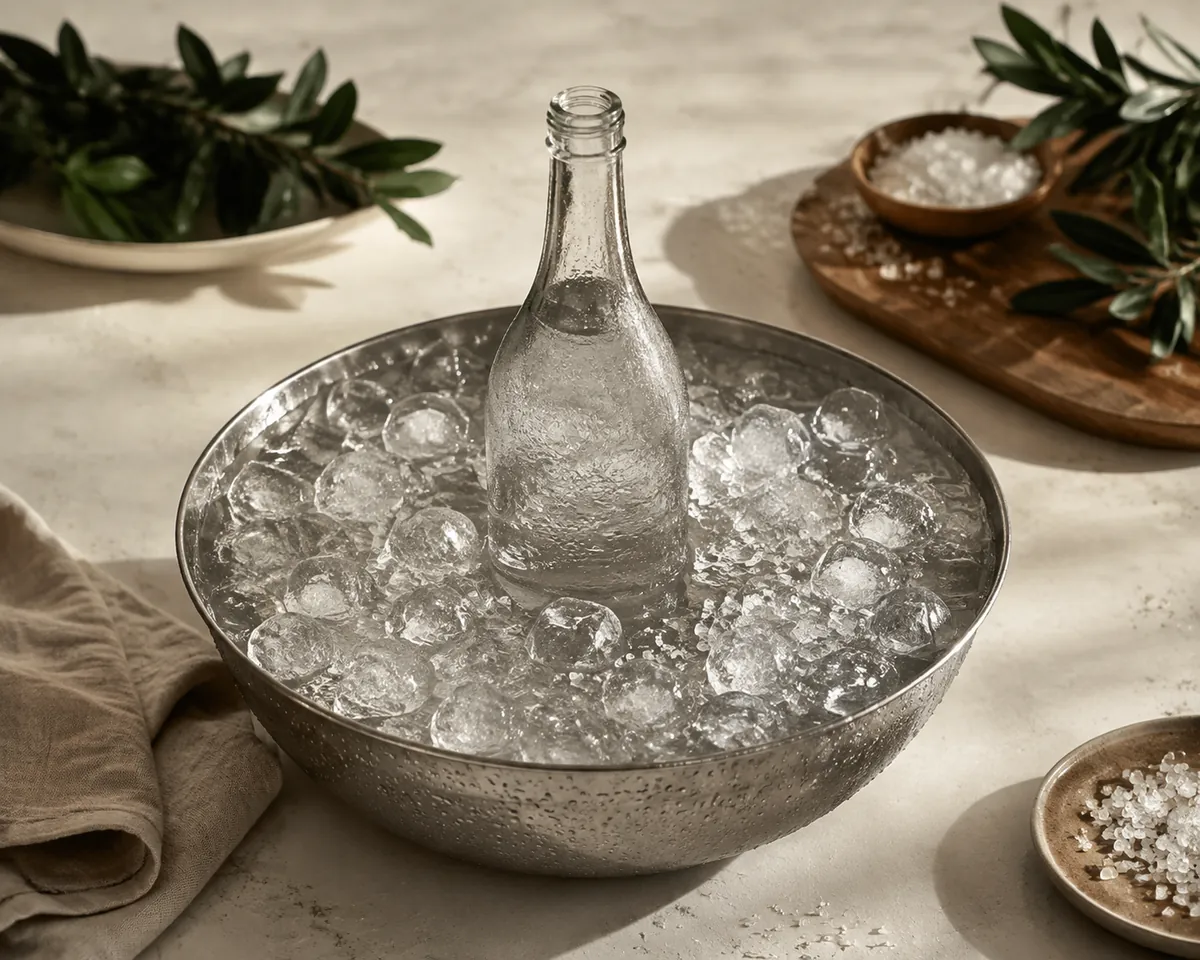
The chilling bath
Ice, water and a few generous handfuls of salt sits nearer minus ten than zero, because salt pushes the freezing point down. A bottle in it reaches drinking temperature in ten to fifteen minutes rather than the hour a freezer takes.
The glass rim
Coarse salt on the lip arrives just before each sip and alters nothing about the drink's own balance, which suits anything sharp and citrus-led.
The bath has to be salty enough to feel unpleasant on the fingers before it works properly, and none of it touches the liquid, which makes it a different matter from the ice that goes into the glass.
Grain size inverts on the rim. Fine salt dissolves on contact with a wet lip and tastes aggressively salty, while a flake releases a little at a time across several sips.
Rim half the glass and leave the rest bare, so the drinker can choose rather than being committed by whoever poured.
Formulated sodium is a different subject
There is a second use of salt in drinks that shares a word and nothing else, and the two get confused often enough to be worth pulling apart explicitly.
In a sports drink or an electrolyte drink, sodium appears in far larger quantities and is part of the formulation rather than a flavour adjustment. It is measured in tens or hundreds of milligrams per serving, it is declared on the label, and it is chosen for reasons that have nothing to do with bitterness.
The few grains discussed on this page would be a rounding error in that context, and the sodium in a formulated drink would be plainly salty if you met it in a cup of coffee.
Common questions
Why does salt improve coffee?
Sodium ions suppress the perception of bitterness, more effectively than sugar does, so the sweetness and aroma underneath come forward. A few grains is enough, and the salt itself should not be detectable.
How much salt should you put in a drink?
Very little: a few grains in a cup of coffee, or about a sixteenth of a teaspoon in cocoa. If the drink tastes salty, too much went in and there is no rescuing it.
Does the type of salt matter?
Not at these quantities. Fine salt is easiest to dose accurately and dissolves fastest, which makes it the practical choice. Mineral differences between salts are irrelevant at a few grains per cup.