What Is an Electrolyte Drink? Water With Salts Dissolved In
An electrolyte drink is water with dissolved mineral salts added, most often sodium and potassium, and usually some carbohydrate. This page describes what is in the bottle, not what anyone should drink.

An electrolyte is a mineral that carries an electrical charge when it dissolves in water. In a drink context the term almost always means one of a small set: sodium, potassium, chloride, magnesium, and calcium.
An electrolyte drink is therefore water with some combination of those dissolved into it, usually as salts, generally with something added for flavour and often with carbohydrate as well. The category name describes what has been added rather than any particular recipe, which is why two bottles sitting beside each other under the same shelf label can differ tenfold in the figure that actually distinguishes them.
An electrolyte drink at a glance
- What it is
- Water with charged mineral salts dissolved into it, plus flavouring
- Dominant mineral
- Sodium, usually the largest single addition by quantity
- Usual form
- Sodium chloride or sodium citrate, sometimes with potassium salts
- Carbohydrate
- Present in some formats, near absent in tablets
- Sodium spread
- Roughly 50 mg to several hundred mg per stated serving
- Formats
- Ready to drink, powder sachet, effervescent tablet, concentrate
- The one outlier
- Oral rehydration solution, built to a specified composition
What dissolves in it, and as which salt
Because a mineral has to arrive in the bottle attached to something, every electrolyte drink is really a list of compounds rather than a list of minerals, and the compound chosen changes both the taste and whether the powder clears the bottom of the glass.
Common components
- Sodium
- Usually the main electrolyte, added as sodium chloride or sodium citrate. Often the largest single addition by quantity.
- Potassium
- Commonly present in smaller amounts than sodium.
- Magnesium and calcium
- Present in some formulations, usually in small quantities.
- Carbohydrate
- Often glucose, sucrose, or maltodextrin. Some products contain a substantial amount, others almost none.
- Flavourings and acids
- Citric acid and fruit flavourings, to make the salt content palatable.
- Sweeteners
- Sugar, or non-nutritive sweeteners in the zero-sugar versions.
Sodium does most of the work, and the other minerals appear in far smaller amounts than the front of a label usually implies. A powder sachet makes that obvious in a way a sealed bottle does not: the whole sachet weighs a few grams, and most of those few grams are salt and sugar rather than magnesium or calcium.
Typical sodium per serving, across the category
- Flavoured electrolyte waterAround 50 mg
- Everyday electrolyte powderRoughly 100 mg
- Sports drinkCommonly 100 to 200 mg
- Oral rehydration solutionFormulated to a specified figure
- Endurance formulationHigher again, and stated on the pack
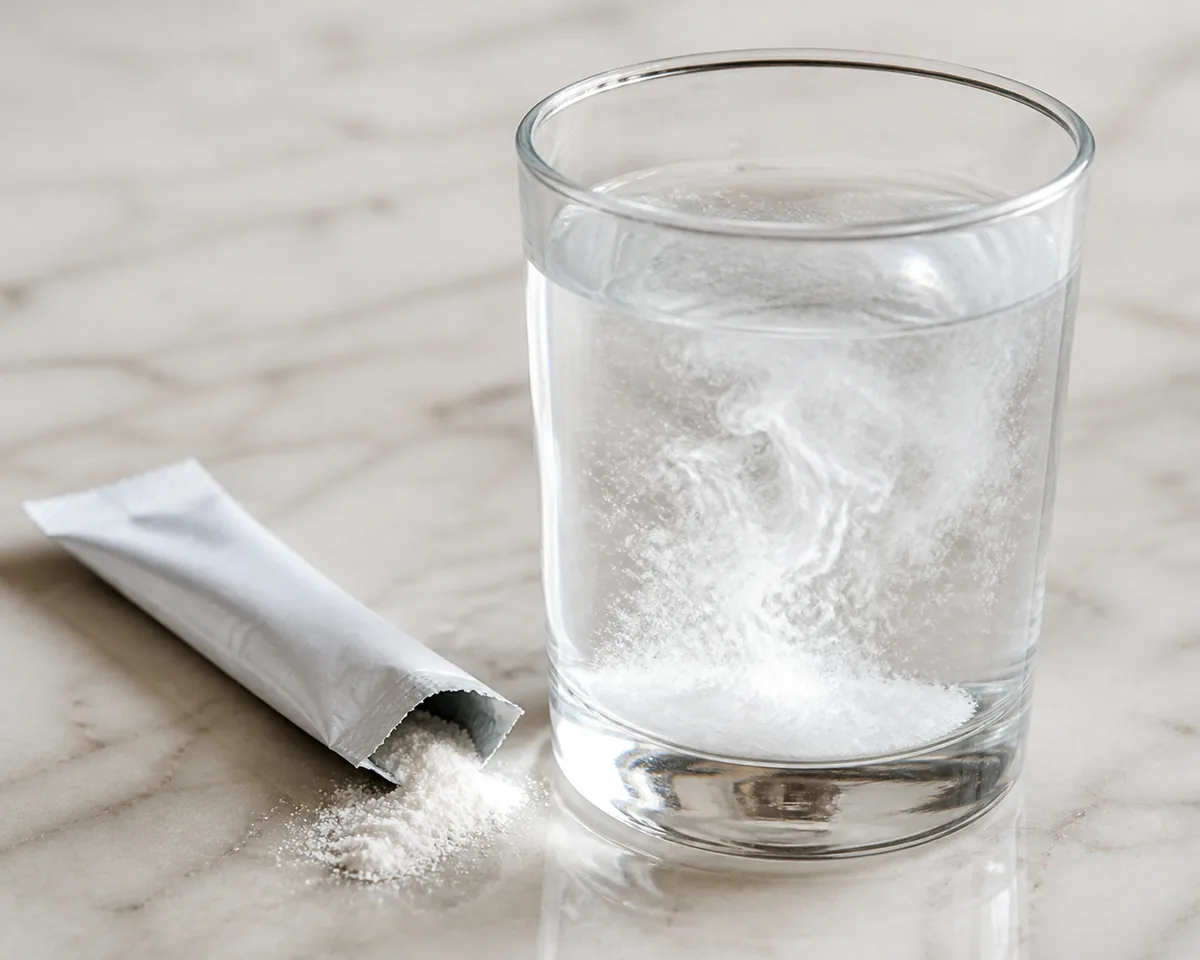
The salts themselves are ordinary food-grade compounds, and the choice between them is made on taste and solubility rather than on the mineral. Chloride salts are the cheapest and carry a hard, slightly metallic edge; citrates cost more, dissolve readily and taste rounder, which is why they dominate the flavoured products.
A version of sea salt is doing the sodium work in most of them, and citric acid is usually doing the work of hiding it.
| Mineral | Usually supplied as | Why that form |
|---|---|---|
| Sodium | Sodium chloride, sodium citrate | Chloride is cheapest; citrate tastes less harsh |
| Potassium | Potassium chloride, potassium citrate | Chloride carries a metallic note, so citrate is common in flavoured products |
| Magnesium | Magnesium citrate, magnesium oxide | Citrate dissolves readily; oxide is cheaper but poorly soluble |
| Calcium | Calcium lactate, calcium carbonate | Lactate dissolves; carbonate tends to settle |
Grit at the bottom of a finished glass is the practical consequence. A powder built around magnesium oxide or calcium carbonate will not go fully into solution at drinking temperature, so part of what the panel lists never reaches the drink at all.
Four kinds of bottle, and the energy drink beside them
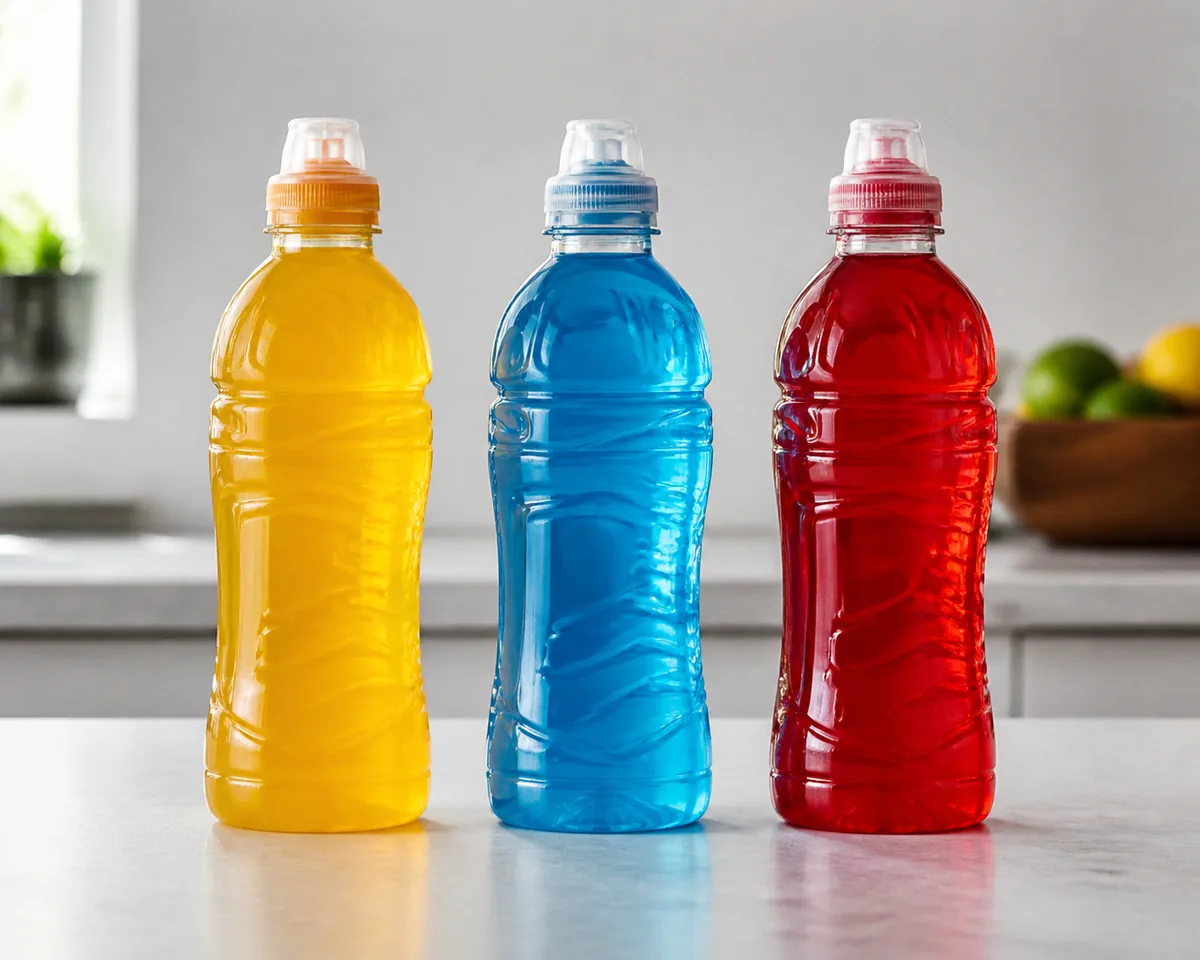
Colour tells you nothing about which category a bottle belongs to, and the front of the label rarely does either. Four distinct product types are sold under overlapping language, and the difference between them lives in the carbohydrate column rather than in the marketing.
| Type | Carbohydrate | Typical framing |
|---|---|---|
| Sports drink | Moderate to high | Sold for use during extended physical activity |
| Oral rehydration solution | Specified ratio of glucose to sodium | Formulated to a defined composition, often to guidance from health bodies |
| Electrolyte powder or tablet | Low to none | Sold to be added to your own water |
| Flavoured electrolyte water | Low | Positioned as an everyday drink rather than a sports product |
An oral rehydration solution is the outlier of the four, formulated to a specific composition rather than to a taste preference. A sports drink sits at the other end, built to be pleasant to swallow at volume, with sugar doing double duty as fuel and as flavour.
The fifth bottle in that aisle belongs to a different category altogether. Energy drinks are shelved alongside these products, in similar packaging, and are built around caffeine rather than salt.
| Sports drink | Energy drink | |
|---|---|---|
| Primary additions | Salts and carbohydrate | Caffeine, often with taurine and B vitamins |
| Electrolytes | The point of the product | Usually minimal or absent |
| Caffeine | Normally none | The defining ingredient |
| Carbonation | Usually still | Usually carbonated |
| Sold for | Use during extended activity | Alertness |
An energy drink is a caffeine product, not an electrolyte product, and the two get conflated because both arrive cold, sweet and brightly coloured. Some products blur the line deliberately by adding a token quantity of salts to a caffeinated, carbonated base that is otherwise closer to cola.
Reading the panel is the only way to tell which one is in your hand.
Salt, sugar and the reason zero-sugar tastes sharper
Dissolved salts at any useful concentration taste distinctly of salt, and on their own that is unpleasant in a cold drink. Sweetness and acidity are what make the product drinkable, which is why almost every electrolyte drink is flavoured and why the zero-sugar versions lean on non-nutritive sweeteners to do the same job.
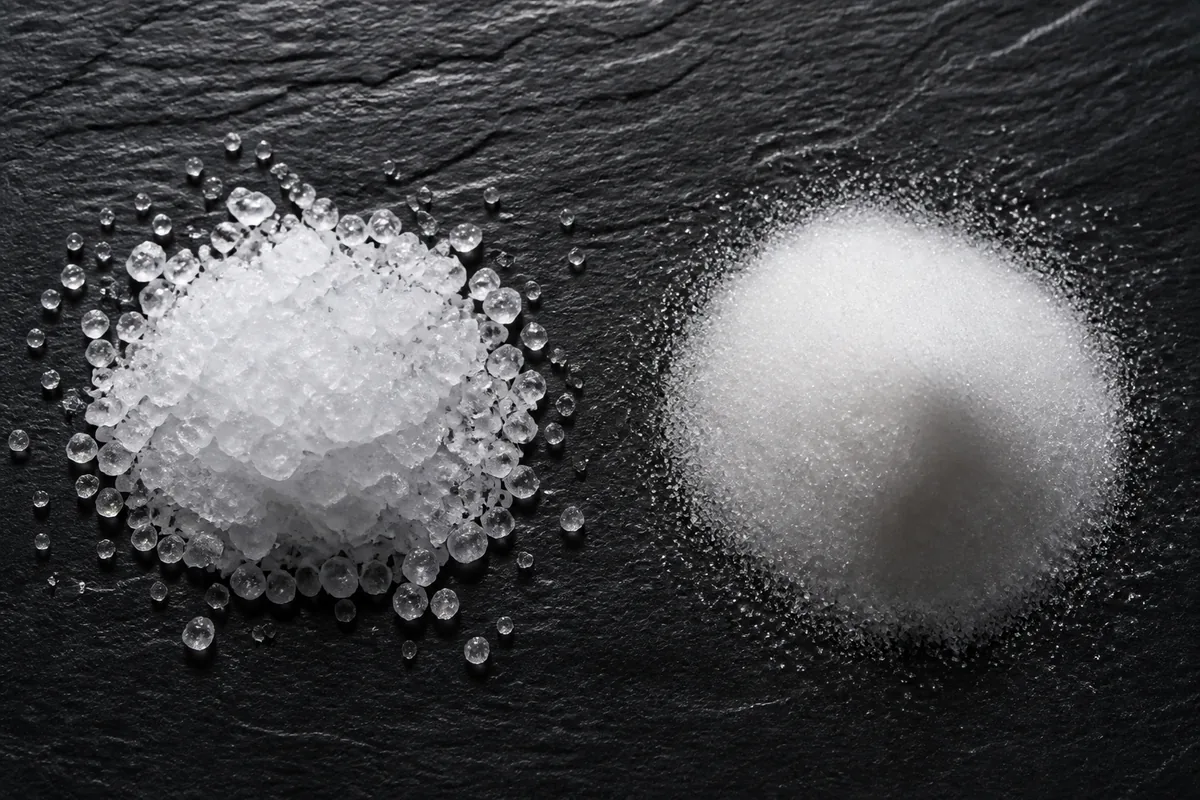
Those two ingredients are most of the formulation by weight, and the balance between them is most of the flavour. Sweetness suppresses the perception of salt, the same trick that keeps quinine tolerable in tonic water.
Remove the sugar and the identical sodium content reads as noticeably saltier, so a zero-sugar reformulation almost always carries more flavouring and more acid to fill the gap.
Sucrose and glucose
Contribute sweetness and bulk, and are also a carbohydrate source in sports formulations.
Maltodextrin
Barely sweet, used to add carbohydrate without making the drink cloying.
Sucralose and acesulfame K
Intensely sweet, no bulk, and a slightly different sweetness curve.
Stevia
Plant derived, with a liquorice-like finish some people notice strongly.
Bulk is the part people forget. Cane sugar contributes body as well as sweetness, so a drink built on it has a faint weight in the mouth that a sucralose version cannot reproduce, and stevia adds a lingering finish of its own on top.
A zero-sugar version is a reformulation rather than a subtraction, and it is fair to judge it as a separate drink rather than as the same one with a number removed.
Powder, tablet, bottle: where the strength is decided
Format changes cost and control far more than it changes composition.

Ready-to-drink bottles are the most convenient and the most expensive per serving, and their strength is fixed by the manufacturer. Powder sachets cost less and hand you the water volume, which means they also hand you the concentration.
Effervescent tablets are usually cheapest and usually lowest in carbohydrate, because there is no room in a tablet for much sugar. Concentrates are rare here, and their figures describe the diluted drink rather than the bottle you are holding.

A tablet or sachet is dosed for a stated volume, commonly 500 ml. Drop it into a 750 ml sports bottle instead and every figure on the tube is a third lower than printed, with nothing on the packaging to warn you.
That single mismatch is the most common way a stated sodium content stops being true, and it is worth knowing before mixing one yourself or diagnosing why a drink tastes wrong.
Getting the concentration you intended
- Read the stated volumeThe panel describes one serving in a specific amount of water, not one tablet in any bottle.
- Measure the waterA bottle marked 750 ml is not the 500 ml the tube assumed.
- Dissolve fullyUndissolved powder at the bottom is dose that never reached the drink.
- Taste as a checkMarkedly saltier than expected usually means too little water.
- Do not top up mid-bottleAdding water to a part-finished drink changes the concentration again.
None of that matters much for a flavoured everyday drink bought for its taste. It matters a great deal if the sodium figure is the reason the product was bought at all.
Reading the panel, and the words on the front that mean nothing
Two numbers carry almost all the information on an electrolyte drink: sodium in milligrams, and the serving size those milligrams refer to. Everything else on the front of the pack is packaging.
- Check the serving size the figures refer to. Many bottles contain more than one serving, and the panel usually describes one.
- Check sodium in milligrams per serving. This varies enormously between products.
- Check total carbohydrate and sugars. Zero-sugar and full-sugar versions of the same brand are very different drinks.
- Check whether the product is a concentrate, a powder, or ready to drink. The numbers refer to different things.
- Marketing terms like advanced or rapid have no defined meaning. The nutrition panel is the part that does.
The spread behind that first number is tenfold across one shelf, which is what makes it worth reading. A flavoured electrolyte water may carry around 50 mg per serving; a sports drink commonly lands between 100 and 200 mg; powders aimed at endurance use go considerably higher again.
That is a tenfold range under one category name, and nothing on the front of the label reliably signals where a given product sits within it. Terms such as advanced, rapid and optimised are defined by nobody, natural is regulated inconsistently between markets, and contains electrolytes is true of milk and tomato juice.
Compare the serving counts before comparing anything else, or the two numbers on the shelf in front of you describe different volumes of liquid. How the result actually tastes against a sports drink is a separate question from what the panel says.
Oral rehydration solutions and the glucose-to-sodium ratio
They look similar on a shelf and are built to a completely different logic.

An oral rehydration solution is formulated to a specified ratio of glucose to sodium, because the two are absorbed together and the proportion between them is the entire point of the composition. The World Health Organization publishes a reference formulation, and products described as ORS are generally built against it rather than against a flavour brief.
That constraint is why they taste the way they do: the salt is not there to be pleasant, and the glucose is not there to be sweet.
A sports drink inverts both priorities. Its composition is chosen to be drinkable in quantity, its sugar is fuel and flavour at once, and its sodium figure is a formulation decision rather than a specification.
The two products are not variants of one another, and the labels stop looking interchangeable once the ratio is the thing you are reading for.
Mixing one in a kitchen, and what a kitchen cannot measure
Home recipes circulate widely, and the honest description is that they are simple to mix and impossible to verify. Water, a small quantity of salt, some sugar and citrus juice is the usual shape of them, and every ingredient is ordinary.

What a home version involves
- Start with waterA litre is the usual base, since the figures scale from it.
- Add saltA small measured quantity, not a pinch, if the amount is meant to mean anything.
- Add sugarBoth for taste and because it changes how the drink is absorbed.
- Add citrusJuice contributes potassium, acidity and flavour in one step.
- Chill itSalt is far more noticeable in a warm drink than a cold one.
Precision is where the kitchen version parts company with the manufactured one. A pinch of salt covers a range of roughly threefold between one pair of hands and another, and juice from lemon varies in acidity and sugar with the fruit, so the figures in a home recipe describe an intention rather than a result.
Temperature does more for palatability than any adjustment to the recipe: served cold, or over plenty of ice, the same mixture reads as faintly savoury, while at room temperature it reads as brine. A home mix is a flavoured salted drink, and calling it equivalent to a formulated product overstates what a domestic scale can control.
Coconut water, mineral water and the rest of the hydration shelf
Several neighbours on the same shelf get described as electrolyte drinks, and only one of them is formulated as one.

Sports drinks
Carbohydrate as well as electrolytes. The sugar is the defining difference, not the salt.
Coconut water
Naturally high in potassium and low in sodium, which is a different profile rather than a natural version.
Coconut water is the one most often promoted as a natural equivalent, and its composition runs close to the reverse: potassium high, sodium comparatively low, sugars its own rather than added. That makes it a different drink rather than an unprocessed version of the same one, which is the whole substance of the comparison between the two.
Mineral water carries whatever the rock gave it, at concentrations nobody chose, and alkaline water is sold on a pH figure rather than on a mineral one. What actually distinguishes a formulated electrolyte drink from all four is that its sodium and potassium content is designed, measured and printed instead of incidental.
The claims that follow the category around
Four assertions attach themselves to these products so persistently that they are worth naming.
The first is that more electrolytes are straightforwardly better. Composition is a formulation decision, and nothing here evaluates what any individual needs from one.
The second is that coconut water is a natural sports drink, which mistakes a high-potassium, low-sodium profile for the same thing in unprocessed form. The third is that any drink containing salt qualifies for the label, which is technically true of milk and tomato juice and tells you how little the phrase constrains.
The fourth is that an electrolyte water and an oral rehydration solution are interchangeable, when one is a beverage and the other is built to a defined composition.
Underneath all four sits the same confusion between a marketing category and a chemical one. The word electrolyte describes a property of a dissolved salt rather than a class of product, and it was doing that job in chemistry long before it appeared on a bottle.
Reading a label as chemistry rather than as a claim resolves most of the disagreement, and the taste of the finished drink turns out to be the honest guide to which formulation you are actually holding.
The water you dissolve it into
A powder or a tablet disappears into whatever water is available, and that water is upwards of 99% of the finished drink by volume, which makes it the ingredient with the largest claim on the taste and the one nobody reads about.

Hard tap water
Already carries calcium and magnesium, which adds a chalkier finish to whatever the sachet supplies.
Softened water
Trades that hardness for sodium, so the base is faintly salty before anything is added.
Chlorinated water
Detectable against a mildly salty drink, and it does not disappear on chilling.
Filtered or low-mineral water
The most neutral base, and the one that lets a flavouring read as intended.
Hard tap water arrives already carrying calcium and magnesium, which adds to whatever the formulation supplies. At these concentrations it rarely shifts the mineral figures much, and it does shift the flavour, usually towards a chalkier finish that shows up most in the lightly flavoured products.
What is dissolved in water before anything is added to it is a subject in its own right, covered under brewing water.
Strongly chlorinated water is the one worth filtering first. Chlorine is easy to detect against a mildly salty drink in a way it is not against a heavily flavoured one, and it survives chilling.
Using a bottled spring water as a base is a defensible choice and an expensive one, worth doing on the strength of the published analysis rather than the price: a high-bicarbonate water tastes markedly different from a low-mineral one under the same sachet. Concentration drifts once the drink is made, too, which is a matter for storing a made-up electrolyte drink rather than for the water underneath it.
Common questions
What are electrolytes in a drink?
Minerals that carry an electrical charge when dissolved in water. In drinks this usually means sodium, potassium, chloride, magnesium, and calcium, added as salts.
What is the difference between a sports drink and an oral rehydration solution?
A sports drink is formulated largely around taste and carbohydrate content. An oral rehydration solution is made to a specific composition, often following guidance from health bodies, and is a different kind of product.
Why do electrolyte drinks taste salty?
Because dissolved salts at any useful concentration taste of salt. Sweetness and acidity are added to make that palatable, which is why almost all of them are flavoured.