Vanilla Syrup, and Why Vanilla Has No Taste at All
Vanilla has no taste at all. It is an aroma, and the reason a drop of it makes plain water seem sweet is the same reason it can round a bitter coffee without the coffee ever tasting sweet.
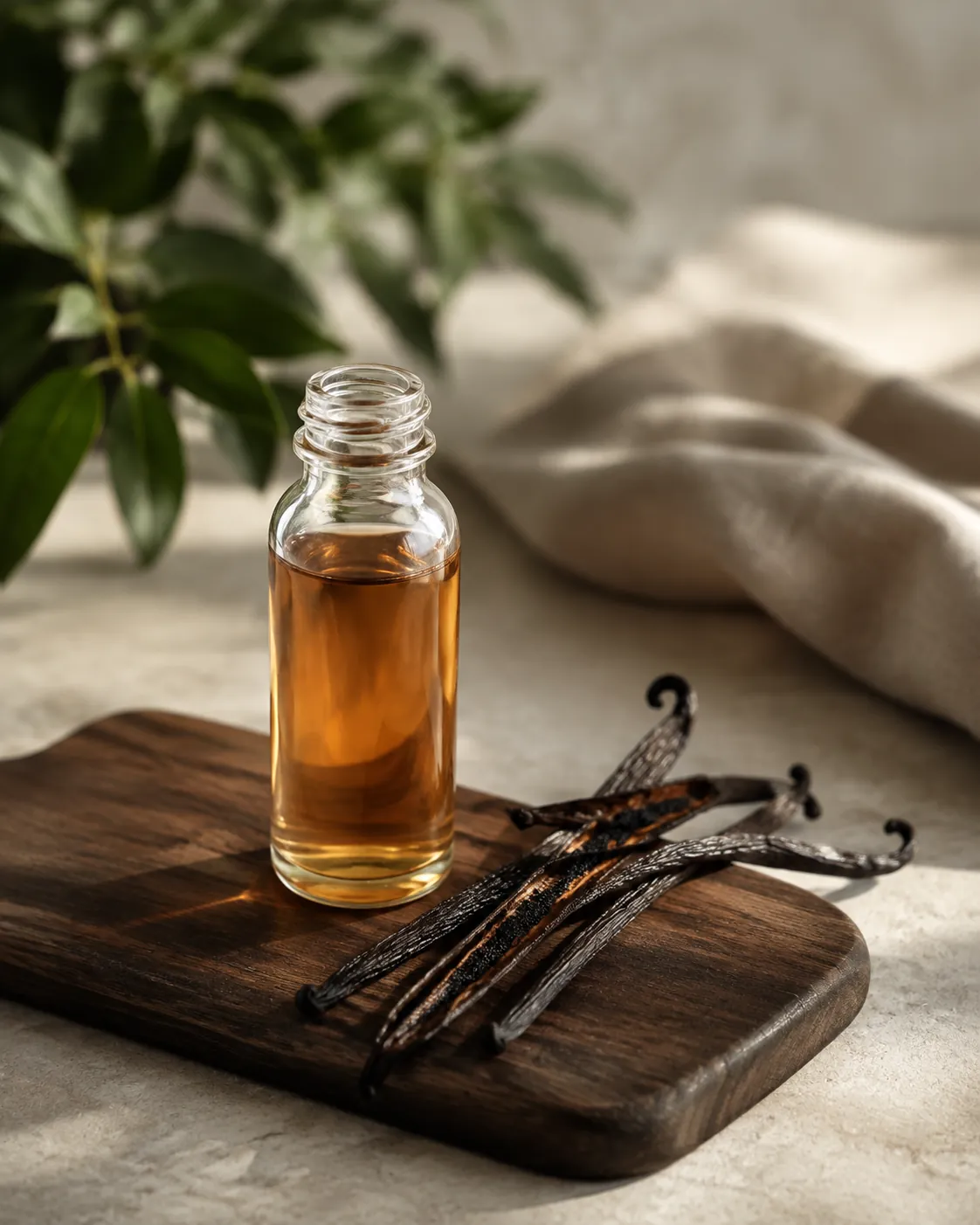
Vanilla syrup is sugar, water and a vanilla flavouring, and by weight it is overwhelmingly the first two. What sets it apart is that the third ingredient behaves like nothing else on a syrup shelf.
Vanilla has no taste. It is an aroma, detected in the nose rather than on the tongue, and it carries no sweetness whatsoever in the way sugar does.
Yet almost everybody describes it as sweet, and they are not being careless.
That gap between what vanilla is and what it seems to be explains most of what it does in a glass, including the one trick it can do that sugar cannot.
Vanilla syrup in a drink, at a glance
- What it is
- A sugar syrup carrying a vanilla flavouring
- Typical sugar
- Around 60 to 65 per cent by weight in a cafe bottle
- The active compound
- Vanillin, roughly 1 to 2 per cent of a cured bean by weight
- Real against synthetic
- Same molecule, but the bean brings a couple of hundred others
- Why it reads sweet
- A learned association. The aroma alone shifts perceived sweetness
- Where it fails
- Boiling, which drives the aromatics off before they reach the bottle
- Related
- The sugar half is covered under a plain simple syrup
What is actually in the bottle
A cafe vanilla syrup is a saturated sugar solution with a flavouring dosed into it, and the proportions are less balanced than the name implies. Sugar and water make up almost the whole volume.
The vanilla is present in fractions of a per cent.
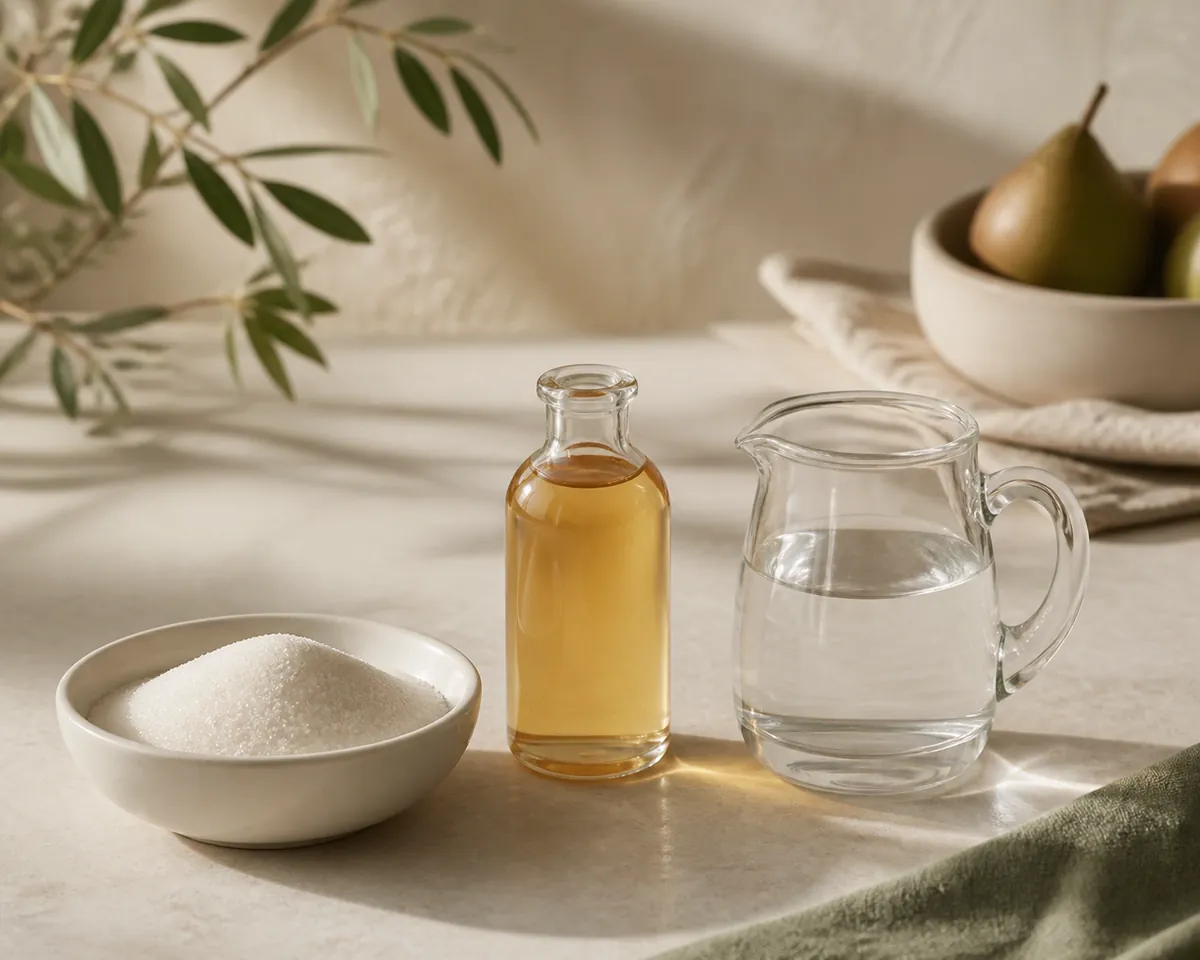
Sugar
Around 60 to 65 per cent by weight, which is why the bottle is heavy.
Water
Most of the remainder, and the reason it pours rather than crystallises.
Vanilla flavouring
Extract, vanillin, or both. Measured in fractions of a per cent.
Preservative
Common in a shelf-stable bottle, since sugar alone is not always enough.
Colour
Sometimes caramel, because a real extract stains a syrup pale brown and a synthetic one does not.
The syrup is a sugar delivery system with an aroma attached, and that ordering matters when you compare it with the alternatives. Swapping a plain syrup for a vanilla one changes the sugar in a drink barely at all, and changes how sweet the drink seems by a surprising amount.
Why vanilla tastes sweet when it is not sweet
Sweetness is a taste, registered by receptors on the tongue. Vanillin never reaches them in any quantity that matters.
It goes up the back of the throat to the olfactory receptors, where it is registered as a smell.
What happens next is the interesting part.
The brain does not keep taste and smell in separate files. It combines them into a single impression called flavour, and where two sensations have always arrived together it will report one when it receives the other.
Vanilla has arrived alongside sugar in almost everything anyone has ever eaten it in, so the aroma on its own is enough to shift how sweet a liquid is judged to be.
That effect has a name in the literature, odour-induced taste enhancement, and vanilla is its standard example precisely because the association is so strong. It is a learned response rather than a chemical one, which is why it varies between people and between cultures and why nobody has ever tasted vanilla for the first time neutrally.
Try it directly if you doubt it. A drop of extract in a glass of plain water makes the water seem faintly sweet, and there is no sugar anywhere in the glass.
How that changes the sugar you actually need
If the aroma is doing part of the sweetening, the sugar does not have to do all of it. That is the practical consequence and it is worth more than any tasting note.
A drink built with a vanilla syrup reaches the same perceived sweetness at a lower sugar load than the same drink built with a plain one. The effect is not enormous and it is not nothing, and it stacks with the other things that shift perceived sweetness in the same direction.
What moves perceived sweetness, at unchanged sugar
- More cane sugarThe direct route, and the only one that adds actual sweetness
- A vanilla aromaA genuine shift, learned rather than chemical
- WarmthSweetness reads higher as a drink warms toward body temperature
- A few grains of saltSuppresses bitterness, which lets sweetness through
- CarbonationWorks the other way and reduces it, which is why flat drinks cloy
The place this matters most is a milk drink, because milk and plant milks already carry their own sweetness. A vanilla syrup in a latte or a matcha latte is often doing half its job before the sugar is counted at all, which is why the same measure that suits a black drink can be too much in a white one.
Why it rounds coffee without making it taste sweet
Here is the trick that no other syrup manages, and it follows directly from the aroma living in the nose rather than on the tongue.
Sweetness suppresses bitterness. That is why sugar goes into espresso and why a dark roast needs more of it than a light one.
Vanilla borrows the same effect through the back door: the aroma raises perceived sweetness, the raised sweetness suppresses the bitterness, and because the sweetness was never a taste in the first place, the coffee does not end up reading as a sweet drink.
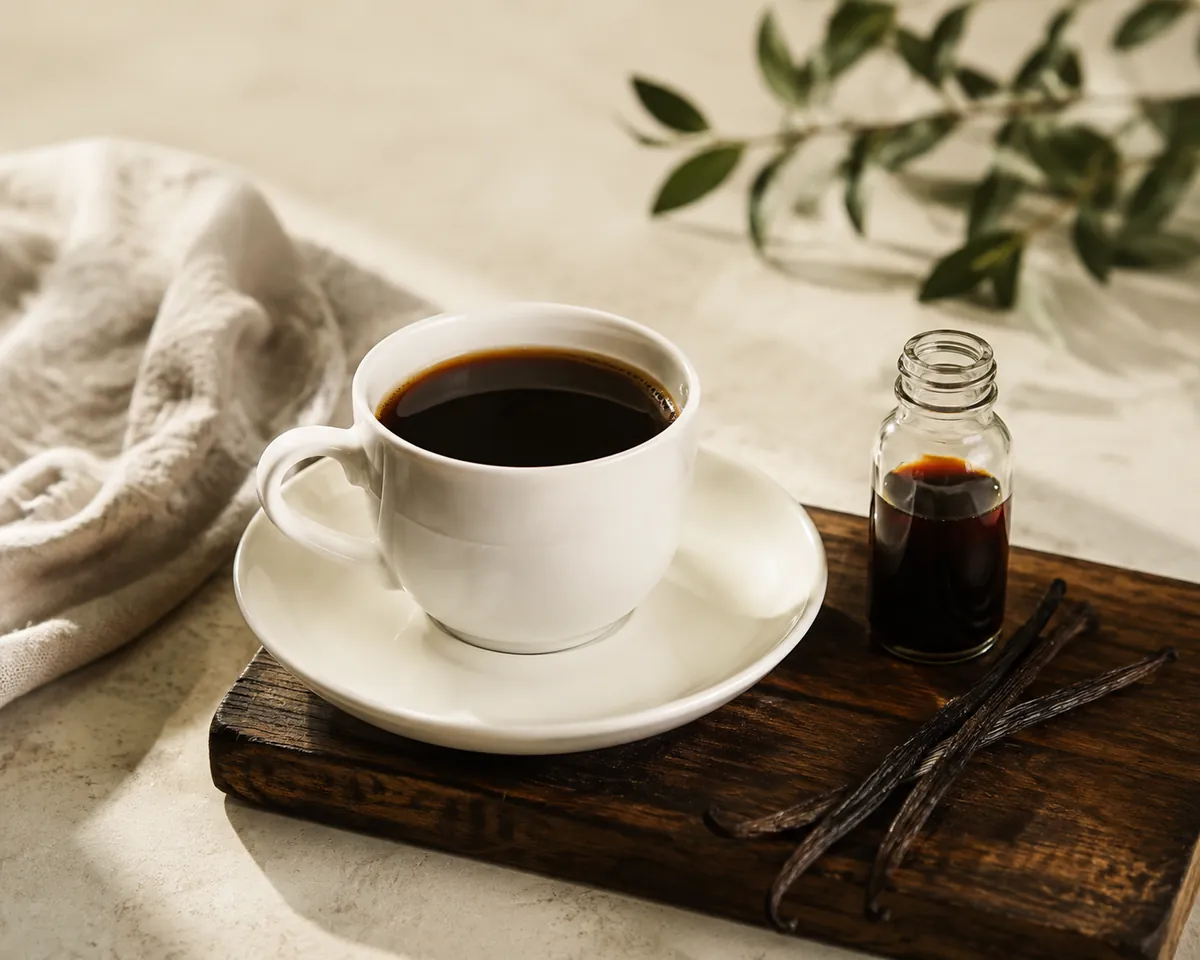
What a drop of vanilla does to a bitter drink
- Aroma arrivesVanillin reaches the olfactory receptors through the back of the throat.
- Sweetness risesThe brain reports more sweetness than the tongue is detecting.
- Bitterness fallsPerceived bitterness drops, as it does against real sugar.
- Body seems fullerThe rounded impression people describe as smoothness.
- Nothing tastes sugaryBecause no additional sugar was ever involved.
This is the honest reason a vanilla note turns up in so many coffee drinks, and why a bare quarter-teaspoon of extract stirred into filter coffee does more for a harsh pot than a spoonful of sugar does. Sugar makes a bitter coffee into a sweet bitter coffee.
Vanilla makes it into a rounder coffee.
Real extract, vanillin, and what the difference costs
Vanillin is the single most abundant volatile compound in a cured vanilla bean, at roughly one to two per cent of its weight, and it is the note everybody recognises. Synthetic vanillin is the same molecule, generally made from wood lignin or from petrochemical feedstock, and a laboratory cannot tell the two apart by structure.
The bean is not only vanillin, and that is the whole of the difference.
| Vanilla extract | Synthetic vanillin | |
|---|---|---|
| The main note | Vanillin | Vanillin |
| Everything else | A couple of hundred other volatiles | Nothing |
| How it reads | Rounded, layered, slightly woody and floral | Single-note, sharp, flat at high dose |
| At low dose | Recognisably vanilla | Recognisably vanilla |
| At high dose | Still pleasant | Turns harsh and slightly chemical |
| Cost | High, and volatile with the harvest | Very low and stable |
Dose is what exposes a synthetic, not a side-by-side sniff. At the level a syrup is used in a cup of coffee the two are hard to separate, and at the level a syrup is used in a milkshake the difference is obvious to anyone.
That is why cheap vanilla products are usually pleasant in small quantities and unpleasant in large ones.
Ethylvanillin is the third thing on this shelf and it is not found in the bean at all. It is a synthetic relative, roughly three times as potent as vanillin, and it is used where a strong vanilla note has to survive a great deal of dilution.
What the words on a label are allowed to mean
The vocabulary here is regulated in some markets and loose in others, so the same phrase carries different weight depending on where the bottle was filled.
- Vanilla extract is made by percolating cured beans, and in the United States a standard of identity sets a minimum bean quantity and at least 35 per cent alcohol.
- Vanilla essence or vanilla flavouring usually means synthetic vanillin, with no requirement for any bean at all.
- Vanilla paste is extract thickened and seeded with the scraped bean, so it carries visible specks.
- Vanilla bean pieces on an ingredients list may be spent beans left over from making extract.
- Natural flavouring permits a vanillin produced from a plant source that is not vanilla.
The last one catches people out most often. Natural is a statement about origin rather than about vanilla, so a natural vanilla flavouring can be vanillin derived from rice bran or from clove oil and never have been near an orchid.
None of that is deception, and none of it means the product is bad. It does mean the word on the front is a poor guide to what you will taste, and the only reliable test is to use the thing at a realistic dose and see whether it stays pleasant.
Why heat is the enemy of a vanilla syrup
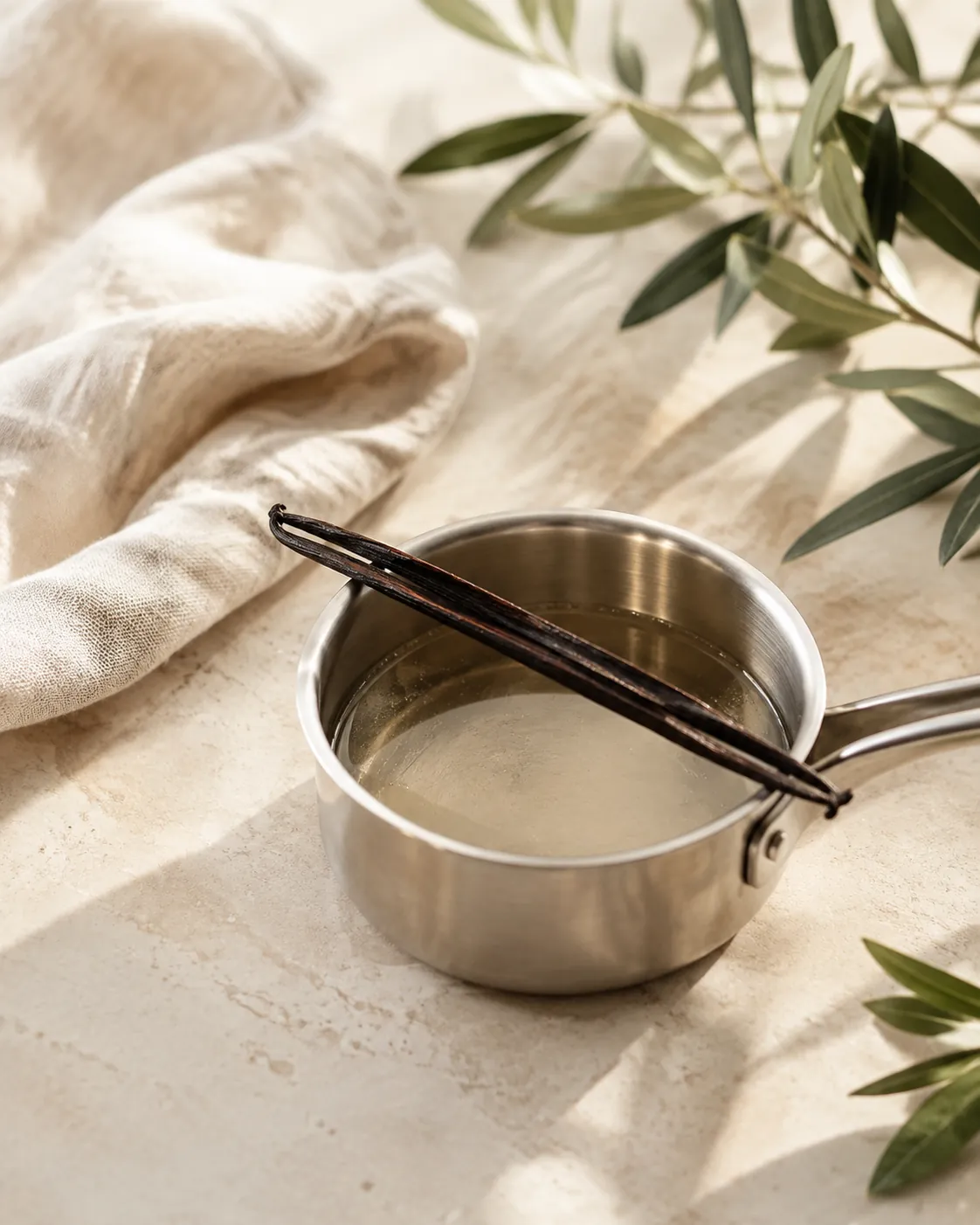
Vanillin is volatile, which is exactly why you can smell it, and volatile compounds leave a hot pan with the steam. Boiling a vanilla syrup is therefore a way of scenting the kitchen at the syrup's expense.
The rule that follows is simple and widely ignored.
The order that keeps the aroma in the bottle
- Dissolve firstHeat the sugar and water only until the sugar has gone, and no further.
- Take it offRemove the pan from the heat entirely before anything vanilla goes in.
- Add extract coldAlcohol-based extract loses most of its character in a boiling syrup.
- Simmer pods insteadA split pod can take gentle heat, because the bean releases slowly.
- Bottle and restA day in the fridge lets the aroma distribute evenly through the syrup.
The exception for pods is worth understanding rather than memorising. A whole bean holds its compounds in tissue that releases them gradually, so gentle heat helps it give them up, where an extract has already done that work and has nothing left to protect it.
Pod, paste or extract, and which to build a syrup from
The four forms give genuinely different results, and the cheapest is not always the wrong answer.
| Form | What it gives | Watch for |
|---|---|---|
| Whole pod, split | The most complete flavour, plus visible seeds | Slow, and expensive per bottle |
| Vanilla paste | Nearly as complete, with the specks | Sinks in a clear drink unless stirred |
| Pure extract | Clean and reliable, added off the heat | Alcohol note if you overdo it |
| Synthetic vanillin | Adequate at low dose, cheap | Harsh at the strength a milkshake wants |
| Spent pods | A useful second extraction | Weak, so use several |
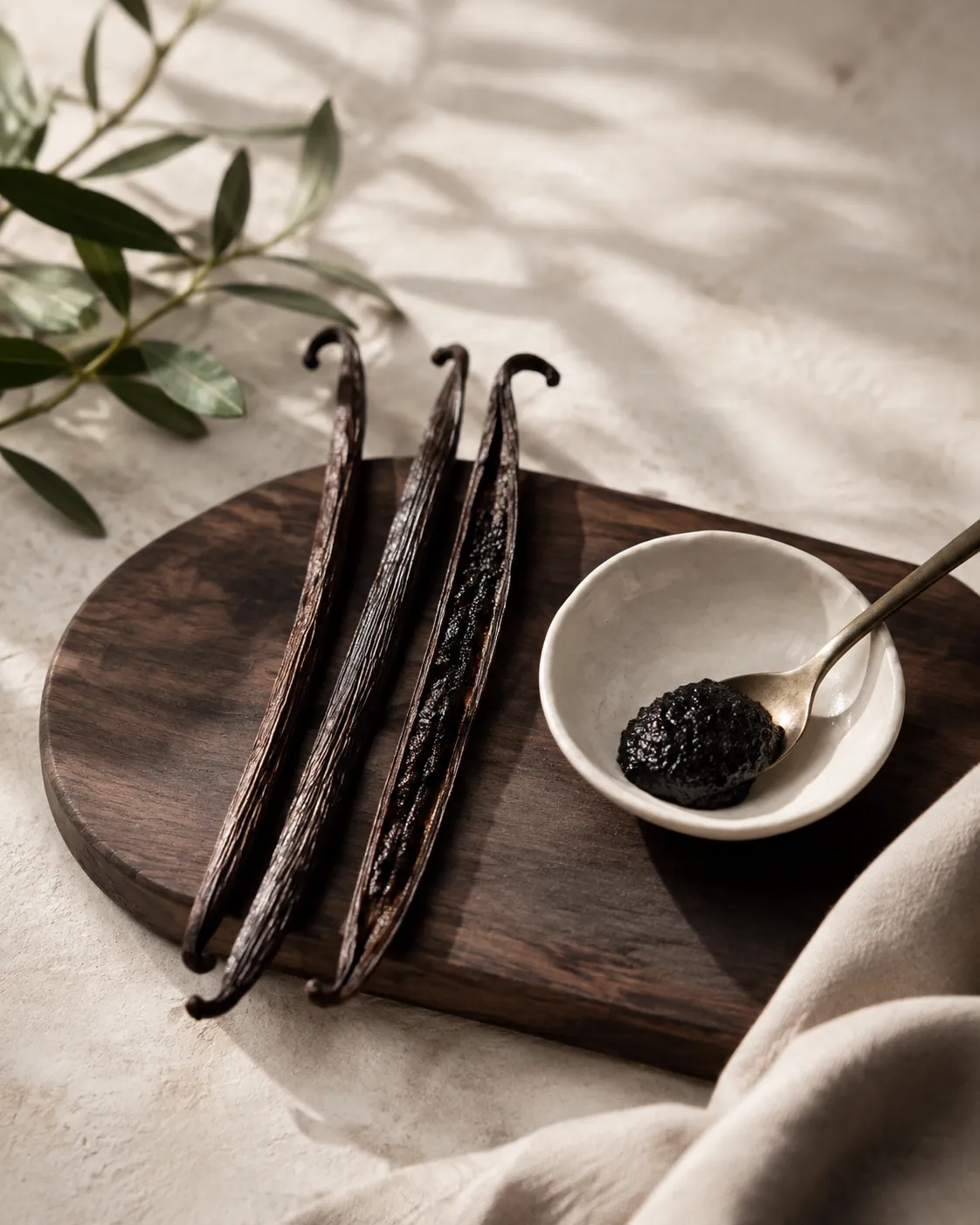
For anything with milk in it, paste or pods repay the cost, because a milk drink is where the extra layers actually register. Fat carries aroma and holds on to it, so the woody and floral notes that a synthetic lacks have somewhere to live in oat milk or almond milk that they do not have in water.
For a clear cold drink the calculation reverses. In an Italian soda or an iced tea the flavour has nothing to cling to and everything is diluted heavily, so a good extract is enough and the specks from a paste look like sediment.
Why vanilla lingers longer than anything else in the glass
Most aromatics announce themselves and leave. Vanilla arrives quietly and then refuses to go, and the reason is that vanillin is a comparatively heavy molecule that evaporates slowly.
That slow release is why it is used as a fixative in blends, holding lighter aromas in place and stretching them out. In a drink the effect shows up as length: a vanilla note is still present a good while after the swallow, sitting underneath whatever else was there.
This is also why vanilla is so hard to remove from a drink once it is in. There is no correcting an over-vanillaed batch by adding more of everything else, since the vanilla will still be there at the end of the mouthful when everything else has gone.
What a cold drink changes about all of this
Cold suppresses aroma, and vanilla is entirely aroma, so a syrup dosed to taste right in a hot drink will read as almost absent over ice.
The gap is wider than people expect and the correction is larger too. A cold drink generally wants noticeably more vanilla than the equivalent hot one, and it wants it as a syrup rather than as an extract, because a syrup disperses through cold liquid and an alcohol extract tends to sit in a layer where it lands.
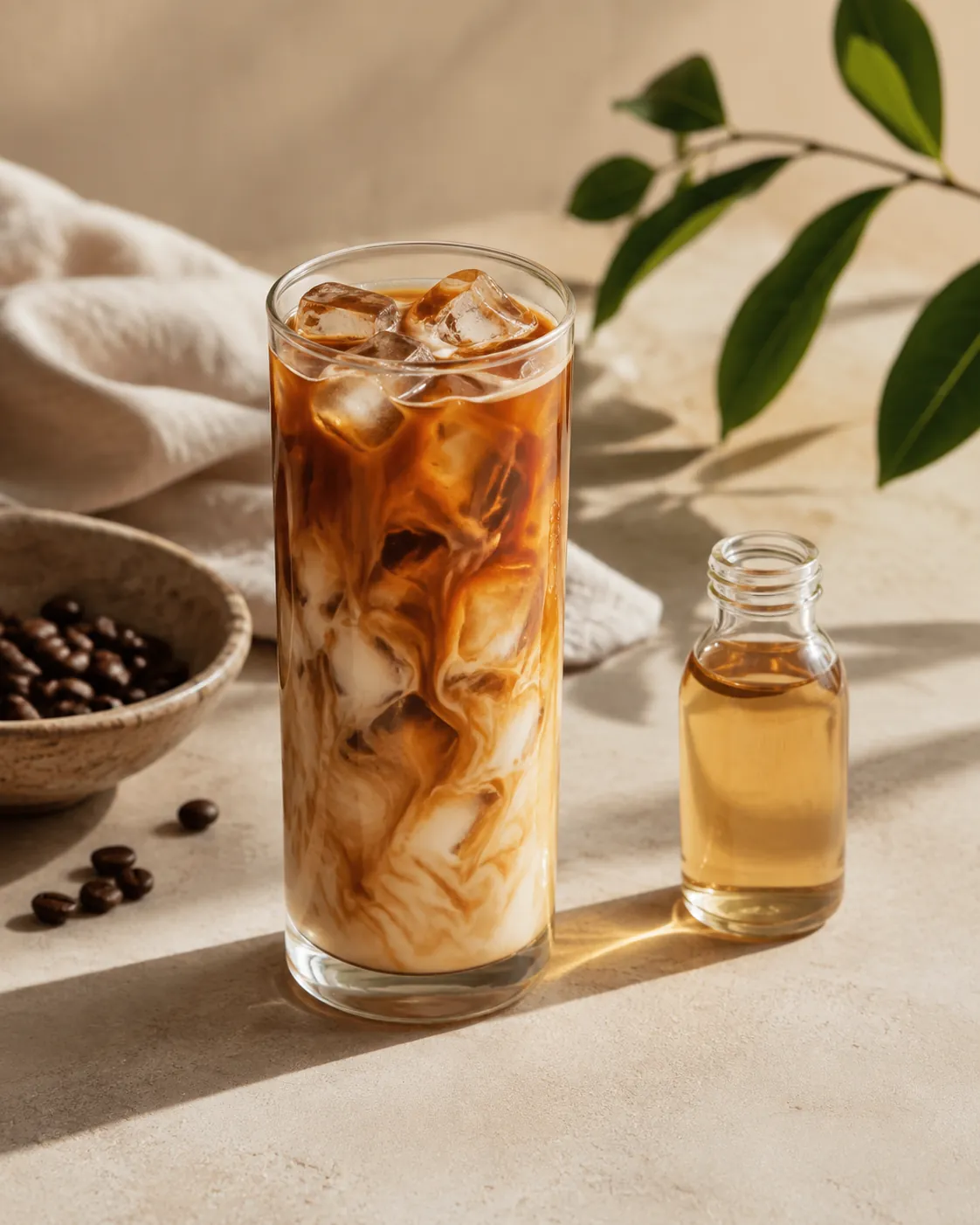
There is a second reason vanilla suits cold drinks despite the handicap. Cold flattens everything, so a drink over ice tends to read thin and short, and vanilla's slow release puts back some of the length the temperature took away.
That is most of why it appears in nearly every iced coffee menu and why it flatters cold brew in particular, where the low acidity leaves room for it.
Dose it in the cold drink itself, never in the hot component before chilling, because the aroma you set while it is warm is not the aroma that will survive to the glass.
Where it belongs, and where it flattens a drink
Vanilla is a rounding ingredient. It fills in, lengthens and smooths, which is exactly what some drinks need and exactly what ruins others.
- Use it where a drink is sharp, bitter or thin and you want it rounder rather than sweeter.
- Use it in milk drinks, where fat gives the aroma somewhere to sit.
- Use less than a recipe suggests in a hot drink and more in a cold one.
- Avoid it where the drink's own aroma is the point, since vanilla will blur it.
- Avoid stacking it with another rounding sweetener such as maple syrup or honey.
The drinks it flattens are the delicate ones. A good single-origin filter coffee, a fine green tea, a bright fruit soda: all of them have top notes that vanilla will sit on top of and dull, and the result is not unpleasant so much as anonymous.
Where it is close to indispensable is anything pale and mild that needs a reason to exist. White hot chocolate without vanilla is warm sweet milk, and vanilla is what turns it into a drink.
The same logic runs through cola and root beer, both of which carry a vanilla note doing quiet structural work that almost nobody notices until it is removed.
Common questions
Why does vanilla taste sweet when it has no sugar in it?
It does not taste of anything. Vanillin is an aroma detected in the nose, not a taste detected on the tongue, but the brain merges the two into a single impression and vanilla has arrived alongside sugar in almost everything anyone has eaten it in. The learned association is strong enough that a drop of extract makes plain water seem faintly sweet.
Is synthetic vanillin the same as vanilla extract?
The vanillin molecule is identical either way, but a cured bean carries a couple of hundred other volatile compounds alongside it. At the low dose a coffee uses, the two are hard to separate. At the higher dose a milkshake uses, the synthetic turns sharp and flat while the extract stays rounded.
Why does vanilla syrup taste weaker in an iced drink?
Cold suppresses aroma, and vanilla is entirely aroma, so a dose that reads correctly in a hot drink can seem almost absent over ice. Cold drinks want noticeably more, added as a syrup into the cold drink itself rather than into the hot component before chilling.