What Is Iced Coffee? Brewed Hot and Then Chilled Down
Iced coffee is brewed with hot water and then chilled, which is the whole of what separates it from cold brew. Everything else about the drink follows from one problem: ice melts into it, so the brew has to be built for the water that is coming.

Iced coffee is coffee brewed with hot water and then made cold. That single sentence carries the whole distinction, because the other cold coffee on the menu never meets hot water at any point.
Hot water is what releases the bright acids and the volatile aromatics that give a filter cup its character. Chilling then has to happen without watering the result down, and the tension between those two demands is what every iced coffee method is trying to resolve.
Get that tension wrong and the drink is pale and thin. Get it right and you have the only cold coffee that still tastes recognisably of the beans it was made from.
Iced coffee at a glance
- What it is
- Coffee brewed hot, then chilled or poured over ice
- Brew time
- Minutes, exactly as for any hot method
- Acidity
- Kept, because hot water extracted it
- The standing fault
- Dilution from melting ice
- The two fixes
- Brew stronger, or brew straight onto weighed ice
- Not the same as
- Cold brew, which steeps cold for hours
- Best drunk
- Within the hour, while the aromatics are still in it
Hot water first, cold second
Any coffee brewed with hot water and then made cold counts as iced coffee, which makes it a serving temperature applied to an ordinary brew rather than a brewing method of its own. Filter, espresso, moka pot and press all qualify.
That matters because it sets what is in the glass before the ice arrives. Hot water extracts far faster than cold and reaches compounds cold water barely touches, so the liquid starts life with the full acidity and the full aromatic range of the beans.

What each stage puts into the glass
- Hot brewAcids, sugars and aromatics dissolve at the usual rate for the method.
- The chillNothing is added or removed. Only the temperature falls.
- The meltWater joins the drink, thinning everything already dissolved.
- The resultA bright, aromatic coffee at a lower concentration than it was brewed at.
The extraction itself is not different in any respect. An iced drip coffee and a hot one from the same batch are chemically the same liquid at two temperatures, which is not remotely true of the cold-steeped alternative and is the reason the two taste like different drinks.
Why melting ice is the real problem
Ice does not chill a drink for free.
Melting a gram of ice absorbs about 334 joules, and warming the resulting meltwater to drinking temperature takes a little more. Cooling water, by contrast, takes only about 4.2 joules per gram for each degree it drops.
Run the arithmetic on a real glass and the answer is uncomfortable. Taking 200 g of coffee from around 90 C down to a few degrees above freezing calls for roughly 200 g of ice, which is to say close to the coffee's own weight, and every gram of it ends up in the drink.

So the standard advice to pour coffee over ice is really an instruction to halve its strength. That is why the same brew that made a good mug makes a watery glass, and why the fault is never fixed by adding more cubes.
More ice cools faster and dilutes more, and the two effects arrive together.
There are only two honest responses. Either build the coffee at a concentration that survives the water, or count the water in advance and brew against it.
How much stronger the brew has to be
Work backwards from the finished glass.
If roughly half of what you drink will be meltwater, the coffee has to leave the brewer at roughly double the strength you want to end up with. A filter ratio of 60 g per litre becomes something nearer 60 g per 500 ml, which is a 1:8 or 1:10 brew rather than a 1:16 one.
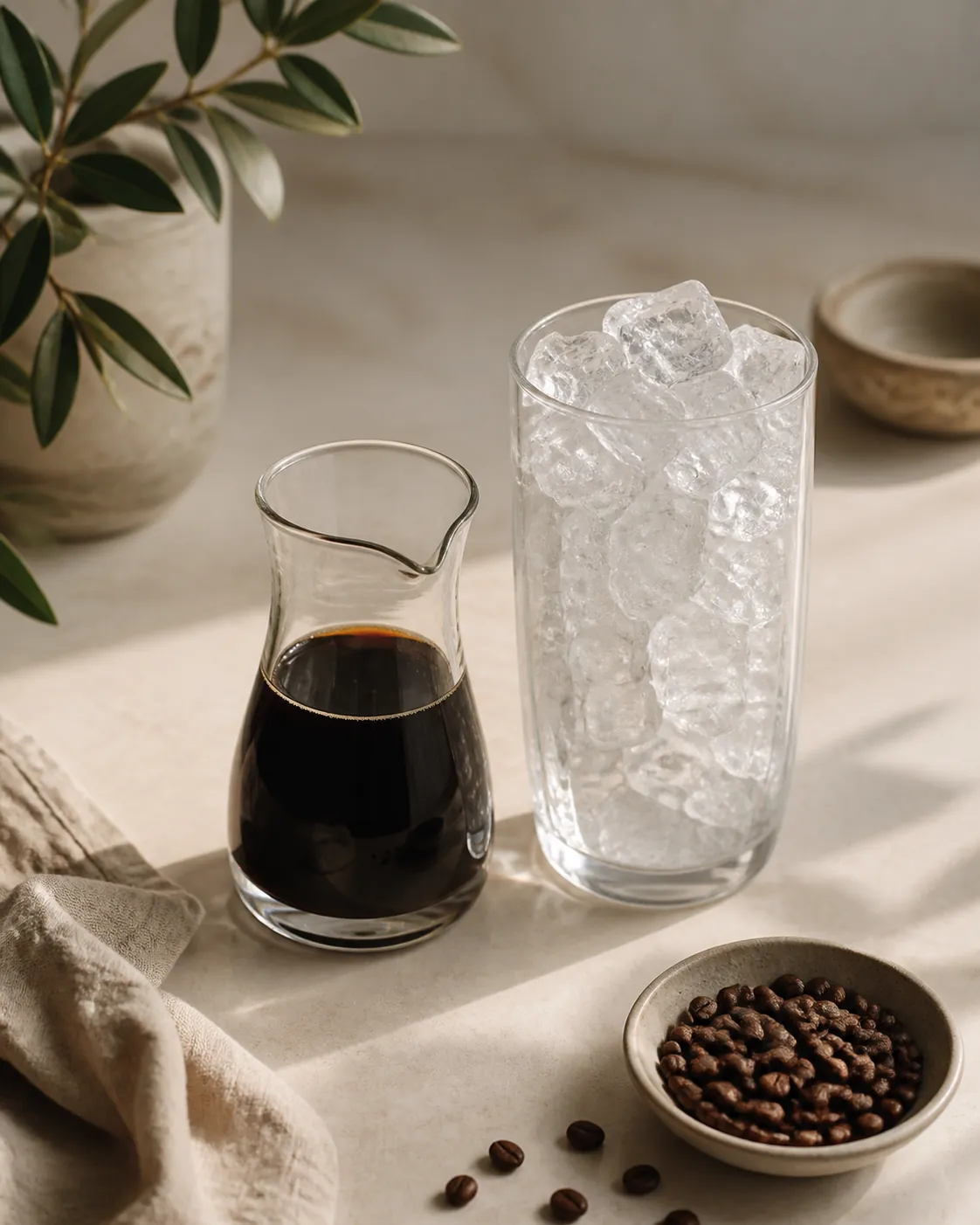
A strong brew built for ice
- Coffee
- 30 g, ground a shade finer than usual
- Hot water
- 250 ml at about 93 C
- Ice in the glass
- 200 to 250 g, filled to the top
- Finished volume
- Around 450 ml
- Effective ratio
- 1:15 once the ice has done its work
The trap is doubling the dose and changing nothing else. Twice the coffee against the same water contacts each ground for the same time but with far less water available per gram, so the yield falls and the cup arrives sour and hollow rather than strong.
Grinding slightly finer is the correction, since it restores extraction by increasing surface area rather than by extending contact. A burr grinder makes that a one-notch adjustment; a blade grinder makes it a guess.
Brewing straight onto the ice
The neatest answer to dilution is to stop treating the ice as an addition to the drink and start treating it as part of the brew water. This is the method usually labelled Japanese iced coffee, and it is a genuine third route rather than a variation on the first two.
Ice goes into the server before brewing starts, and its weight is subtracted from the water you would otherwise have poured. The coffee is brewed at a normal ratio against the total, so it leaves the filter bed strong, hits the ice and reaches drinking strength as the cubes melt.

Brewing onto ice, in order
- Split the waterRoughly 40 per cent as ice in the server, 60 per cent as hot water through the bed.
- Load the ice firstIt has to be in the vessel before the first drops land, or the point is lost.
- Brew as normalSame grind, same dose, same pour as the hot version of the method.
- Swirl at the endThe last cubes melt faster once the liquid is moving.
- Serve at onceThere is no holding stage, and none is wanted.
What this buys is aroma. Volatile compounds leave a hot liquid steadily from the moment it is brewed, so a coffee that takes twenty minutes to cool has been venting the whole time, and one that is cold within seconds has not.
A pour-over cone over an ice-filled carafe is the easiest way to set it up at home.
Leftover unmelted ice is the sign that the split was wrong. If cubes are still rattling when you finish, too much of the water was frozen and the drink is stronger and smaller than intended, which is a ratio error rather than a taste one.
What happens when you let it cool in the fridge
Leaving a jug to cool on its own is the slowest route available, and slow is exactly where the aroma goes. Twenty minutes on a counter is twenty minutes of volatile compounds leaving the surface, and none of them come back when the jug reaches the fridge.
Two other things happen on the way down. Acids continue to oxidise while the liquid is warm, which is the same staling that makes a pot left on a hotplate taste flat, and it does not stop simply because the coffee has been moved somewhere cold.

The second is visible rather than tasted. As the temperature falls, oils and larger roast compounds come out of solution and the coffee turns hazy, which looks like a fault and is not one.
None of this makes the fridge route wrong, only second best. It is still the sensible way to prepare several glasses at once, and the way to limit the damage is to cool fast in a shallow container rather than slowly in a deep jug, then keep it covered so the surface has less chance to breathe.
What that costs the drink over a day belongs to keeping iced coffee.
Why a cold cup tastes sharper than a hot one
Temperature changes what you can taste, not what is in the cup. That distinction is worth holding onto, because iced coffee has a reputation for being sour that the chemistry does not support.

Aroma is released from the surface of a liquid, and release falls steeply as the liquid cools. Perceived sweetness drops with temperature as well.
Sourness is far less affected, so the same coffee served cold has lost two of the three things that were balancing its acidity while keeping the acidity itself.
The pH of a coffee is identical hot and cold; only your access to everything around the acidity has changed.
Aroma
Falls sharply. Most of what people call flavour arrives this way.
Sweetness
Perceived less strongly at low temperature.
Sourness
Barely affected, so it takes up more of the impression.
Bitterness
Slightly softened, which is why cold coffee rarely reads as harsh.
Body
Thinned by dilution rather than by the cold itself.
This is why a delicate light-roast espresso shot that sings hot can arrive thin and tart over ice, and why a small amount of sugar does more for an iced cup than it ever does for a hot one. It also explains the popularity of the cold-steeped alternative, since what cold brew tastes like is largely a story about acidity that was never extracted in the first place.
Which coffees hold their shape over ice
Not every bag survives the treatment.
A medium roast is the safe centre of the range, because it carries enough sugar development to keep the drink from reading as merely sour and enough origin character to be worth chilling. Light roasts are the risk: their acidity is the point, and cold strips out the sweetness that made it pleasant.
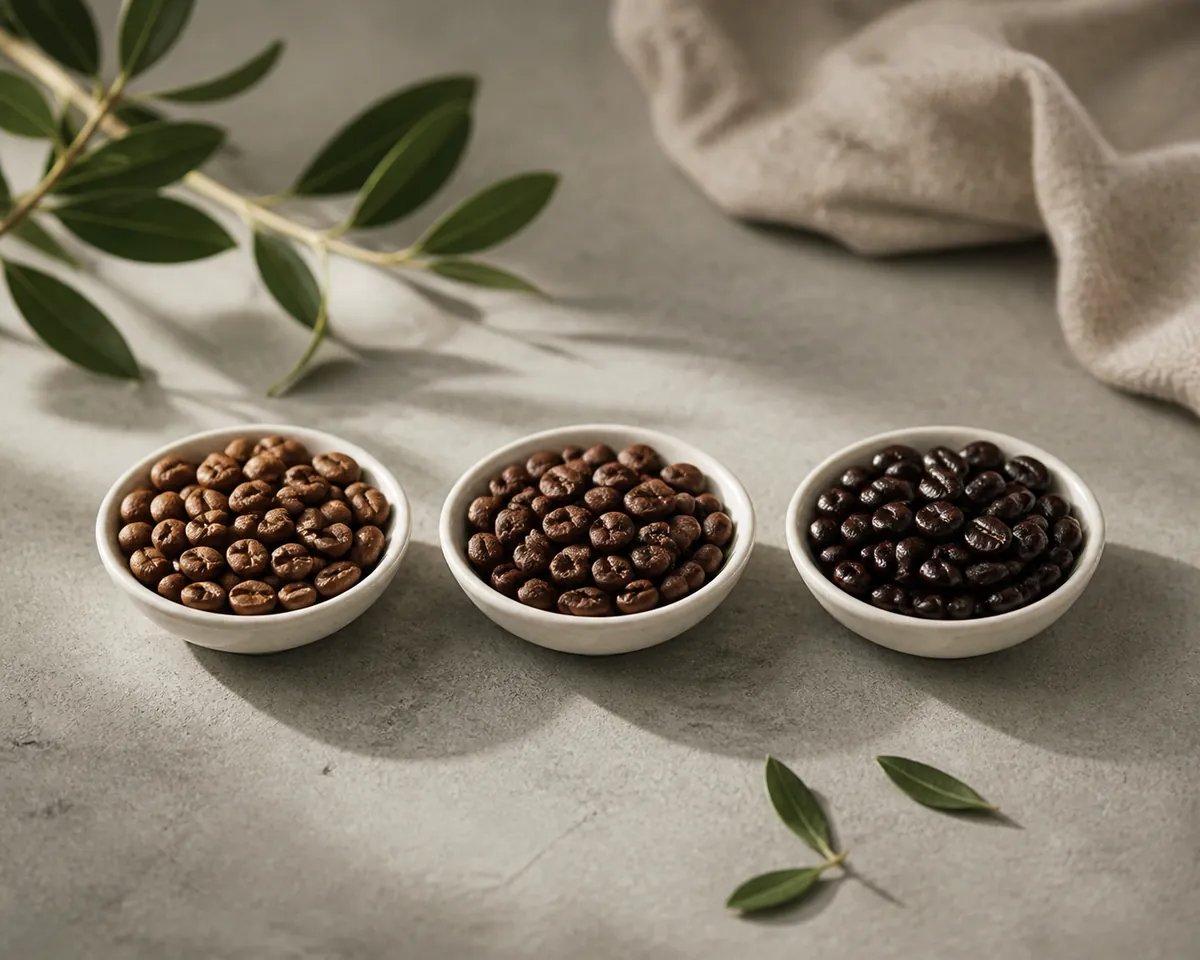
Dark roasts hold their body through dilution better than anything else, which is genuinely useful in a glass full of melt. The cost is that roast character dominates once the fruit notes have been muted by the cold, so a very dark bean iced can taste more of the roaster than of the coffee.
How roast level behaves once the glass is cold
- Dark roastHeavy body survives dilution. Roast note takes over
- Medium-darkSweet, chocolatey, reliable behind milk
- MediumThe usual choice. Balanced, and keeps some origin character
- Medium-lightBright and clean, but needs the ratio to be right
- Light roastHighest risk. Thin and tart unless brewed strong
Species matters less than roast, though not by nothing. A proportion of robusta adds body and a heavier mouthfeel that holds up against melt and milk, where a delicate washed arabica can disappear into the same glass.
Freshness shows more here than in a hot cup, because there is less warmth and aroma to hide behind. Beans kept badly taste flat iced long before they taste stale hot, which makes storing beans more consequential for anyone drinking cold coffee daily.
How sugar and milk behave once the glass is cold
Two things go into most iced coffees after the brewing is finished, and both of them behave differently in the cold than they do in a mug.
Granulated sugar is the first and the more annoying. Sucrose dissolves readily in hot liquid and very reluctantly in cold, so a spoonful stirred into a finished glass largely settles at the bottom and turns the last third cloying.

- Sweeten while the coffee is still hot, before it ever meets the ice.
- Or use a syrup, which is sugar that has already been dissolved for you.
- Stir from the base of the glass, since syrup sinks and stays there.
- Taste after the first melt, not before it, since the drink is still concentrating.
Simple syrup is the standard answer for exactly this reason, and the full account of what the sweetener changes beyond sweetness sits with cane sugar.
Milk is a second dilution arriving on top of the first, and it is cold, so it also does some of the chilling. That is worth planning for: a glass built for black coffee and then topped with milk is thinner than either version was meant to be.
There is one place the cold works in your favour. Splitting is driven by heat acting on acid, so plant drinks curdle far less often in an iced glass than a hot one, and even a thin nut drink that fails in a flat white usually holds here.
A barista oat drink is still the most reliable, and the mechanism itself is set out in plant milk curdling.
The drinks built on top of it
Most of the cold coffee menu is iced coffee with something added, and the useful way to tell the members apart is by asking what the melt is diluting.
Iced filter
Brewed coffee over ice. The plainest and the least forgiving.
The ordering is not arbitrary. A drink carrying milk and sugar has other things for the palate to hold onto as the ice does its work, so an iced latte tolerates being nursed for half an hour and an iced americano does not.
That is also the reason cafés so often serve a black iced coffee in a smaller glass with more ice packed into it. A full glass of cubes melts more slowly than a half-empty one, because the cubes insulate each other and there is less warm liquid per gram of ice.
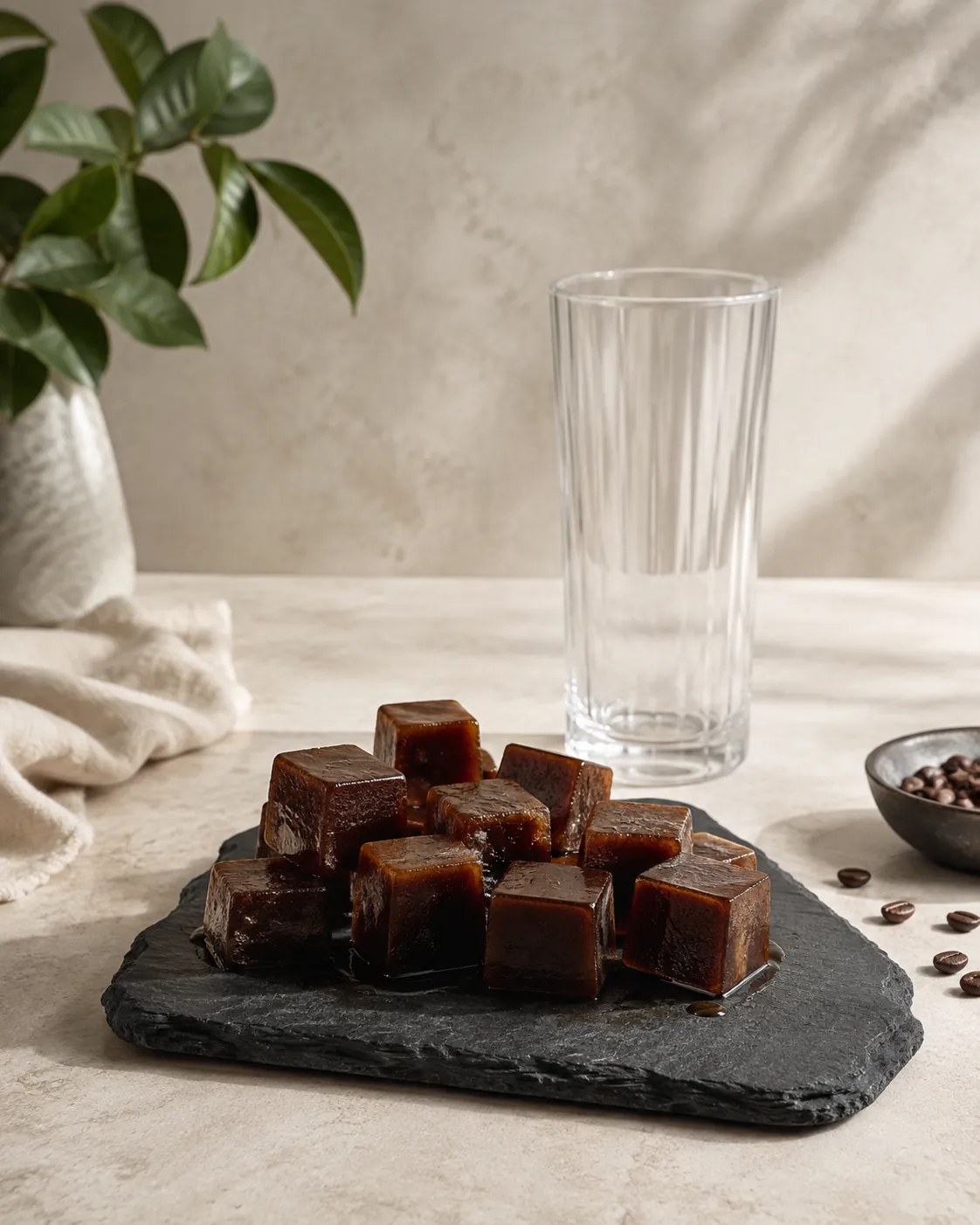
Coffee ice cubes are the other route around the same problem, and they work as advertised. The melt adds coffee instead of water, so the drink holds strength to the last mouthful, with the honest caveat that frozen and thawed coffee tastes duller than fresh and the final mouthfuls show it.
How much caffeine is in a glass
Chilling removes nothing.
Caffeine is highly soluble and thermally stable, so it survives the brew, the chill and the dilution intact. What changes across a glass of iced coffee is concentration rather than quantity: the same caffeine that came out of the grounds is simply spread through more liquid.
Where a typical serving lands
- Large iced filter, double-strength brewAround 150 to 200 mg, from a 30 to 40 g dose
- An 8 fl oz cup of brewed coffeeAbout 80 to 100 mg, per FDA guidance
- Iced latte, double shotRoughly 120 to 150 mg, mostly from the espresso
- Iced latte, single shotAround 60 to 80 mg
- Iced decafA few milligrams, and not zero
The practical consequence is that a large iced coffee is usually not a weaker drink than a mug, only a longer one. It was brewed strong precisely so that dilution would land it in the normal range, which means the dose that went in was often larger than a hot cup's to begin with.
These are descriptive figures about drinks rather than guidance for anybody. Method-by-method numbers are collected in caffeine by brew method, and the detail for this drink specifically belongs to iced coffee caffeine.
When to reach for it rather than cold brew
Both drinks arrive cold and that is roughly where the similarity stops. The choice between them is not a matter of preference in the abstract; it turns on what you want from the beans and how much time you are prepared to give it.

| Iced coffee | Cold brew | |
|---|---|---|
| Time from bean to glass | Minutes | 12 to 24 hours |
| Acidity | Kept, and clearly present | Largely absent |
| Origin character | Comes through | Muted by the method |
| Batch friendly | Poorly, it fades within hours | Well, it keeps for days |
| Best for | Tasting a specific coffee cold | A smooth, low-acid staple |
Choose iced coffee when the coffee itself is the point. A single-origin bag you would drink black and hot deserves a method that keeps its acidity, and chilling it fast is the only way to hear what it was doing.
Choose the cold-steeped route when you want a jug in the fridge on Monday that is still good on Thursday, and accept that it will taste of the method more than of the beans. The full comparison lives at cold brew against iced coffee, the method itself at making cold brew, and the step-by-step build for this drink at making iced coffee.
Common questions
Is iced coffee the same as cold brew?
No. Iced coffee is brewed with hot water and then chilled, so it keeps the acidity and aromatics that heat extracts. Cold brew never meets hot water at all, which is why it reads rounder and flatter than an iced cup of the same beans.
Why does my iced coffee taste weak?
Cooling roughly 200 g of hot coffee down to drinking temperature takes close to its own weight in ice, so ordinary coffee poured over cubes ends up near half strength. Brew at around double concentration, or brew directly onto weighed ice so the melt is counted as part of the recipe.
Why does iced coffee taste more sour than the same coffee hot?
Cold suppresses the perception of sweetness and cuts the aroma released from the surface of the drink, while sourness is affected far less. The pH has not changed, so the coffee is not more acidic; the balance you can taste around the acidity has thinned out.