Ice Keeps Changing the Drink After You Pour It
Ice is the only ingredient that keeps changing the drink after it is served. Treating it as filler is why so many iced drinks arrive good and finish watery.
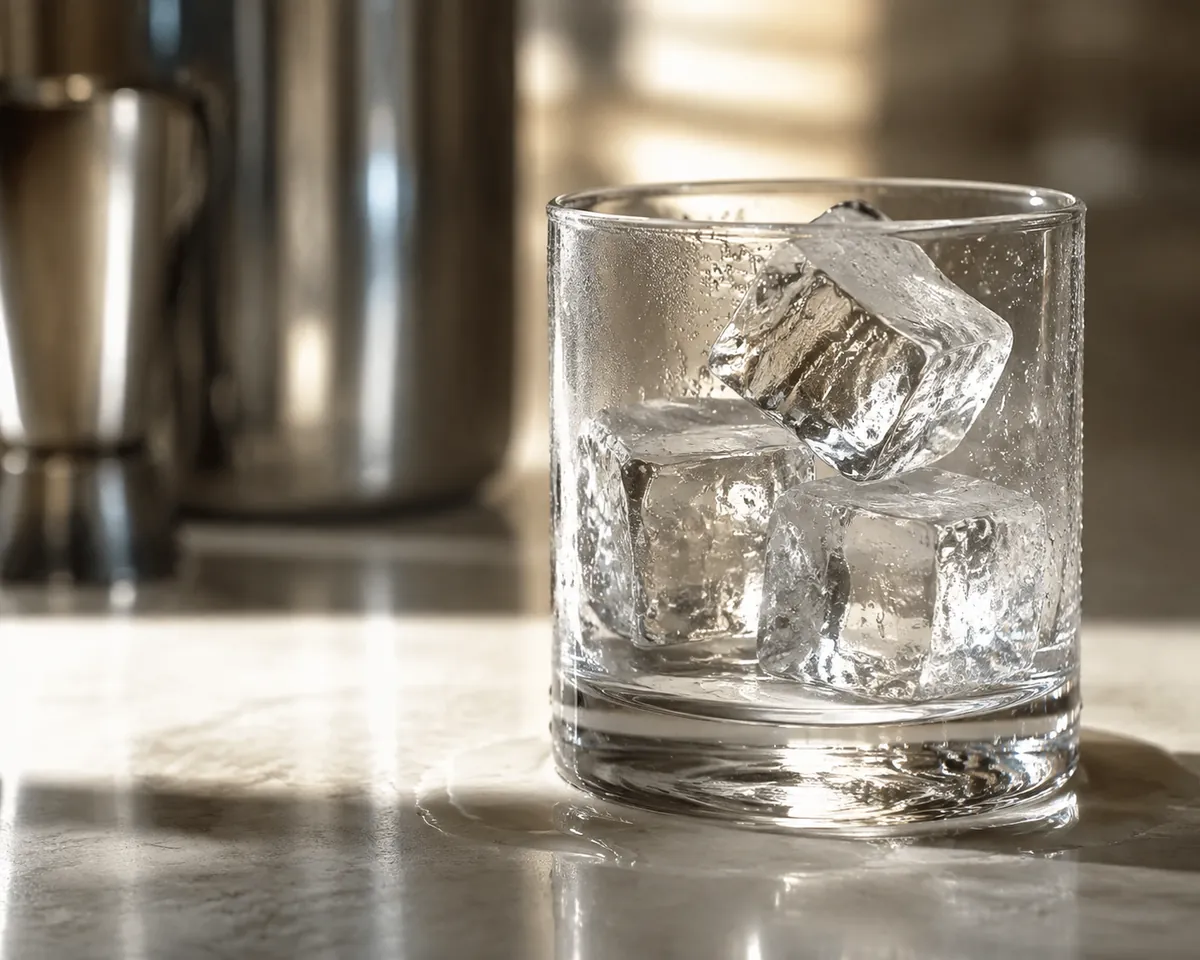
Ice does two things at once: it cools a drink and it waters it down. Those are inseparable, because the cooling is the melting.
Understanding that one point is most of what there is to know, and nearly every practical decision about ice follows from it.
Ice, in short
- What it is
- Frozen tap water, in almost every domestic case
- How it cools
- By melting, not by being cold
- What decides the rate
- Surface area in contact with the liquid, not the temperature of the cube
- Its main fault
- It arrives carrying whatever the water and the freezer gave it
- Where it helps most
- Drinks meant to be finished cold and quickly
- Where it helps least
- Quiet infusions and anything carbonated
The cooling is the melting
A drink does not get cold because cold ice sits in it. It gets cold because the ice absorbs heat in order to melt, and melting a gram of ice takes roughly 80 times more energy than warming that same gram of water by one degree.
What ice is doing in the glass
- Latent heat of fusion
- 334 kilojoules per kilogram, absorbed with no temperature change
- Cooling power
- About 80 times what the same water gives per degree once melted
- Standard cube
- Roughly 20 to 30 g, or 25 ml of water once melted
- A full glass
- 150 to 200 g of ice, which is where the melt-water estimate starts
- Freezer temperature
- Around minus 18 C, so cubes start well below freezing
That latent heat figure is the whole reason ice works, and it is also why a glass with ice in it stays cold while a glass of cold water warms steadily. The energy comes out of the drink at a constant zero degrees, and it is spent turning ice into water that then joins the drink.
It also explains why colder ice dilutes slightly less, since a cube straight from a deep freezer spends part of its budget warming to zero before any of it melts.
How fast ice gives up its water
- One large sphere or cubeLeast surface area for its mass. Slowest dilution
- Two or three large cubesSlow, and the practical choice for a strong drink
- Standard tray cubesThe everyday default
- Small or hollow cubesFast. Common in machines, and it waters a drink quickly
- CrushedEnormous surface area. Chills almost instantly and dilutes as fast
Surface area, not temperature, decides the rate. Ice from a domestic freezer is roughly the same temperature whatever its shape; what changes is how much of it touches the liquid, and that varies by a factor of ten between a sphere and a scoop of crushed.
Crushed ice is a different tool rather than a worse one. It is right where you want fast chilling and deliberate dilution, in a slush or a julep-style drink built on simple syrup, and wrong in anything you intend to hold for half an hour.
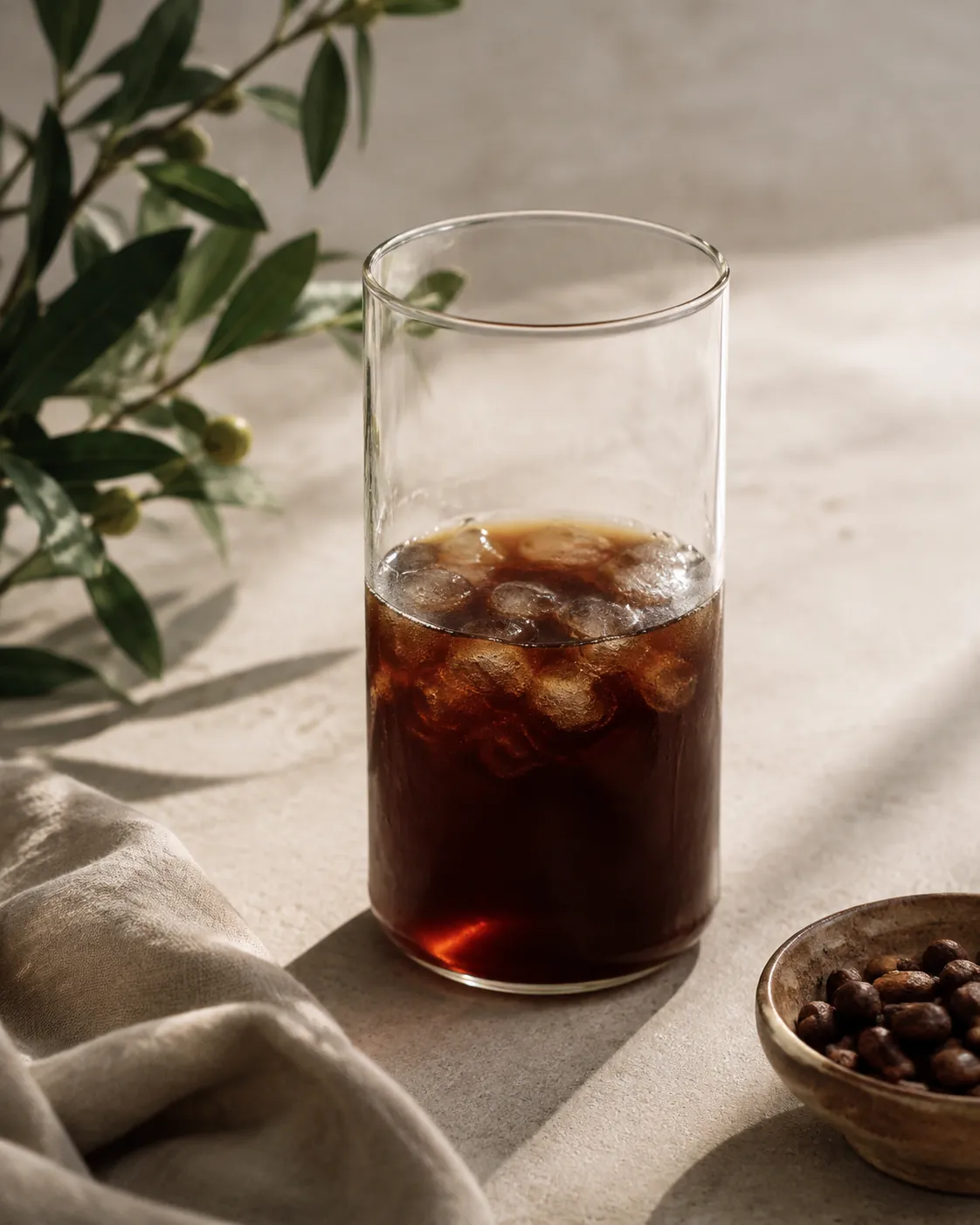
Why a full glass waters a drink less than two cubes do
Because the ice stops melting once the drink has nothing left to give it, a glass packed to the rim reaches its final temperature quickly and then sits there, while a glass holding two cubes has to melt most of both to get anywhere near the same place.
The half-filled glass then keeps melting, because the drink keeps taking heat from the room and there is nothing else to absorb it. Over the ten or fifteen minutes it takes to drink something, the restrained-looking glass produces exactly the watery result it was trying to avoid.
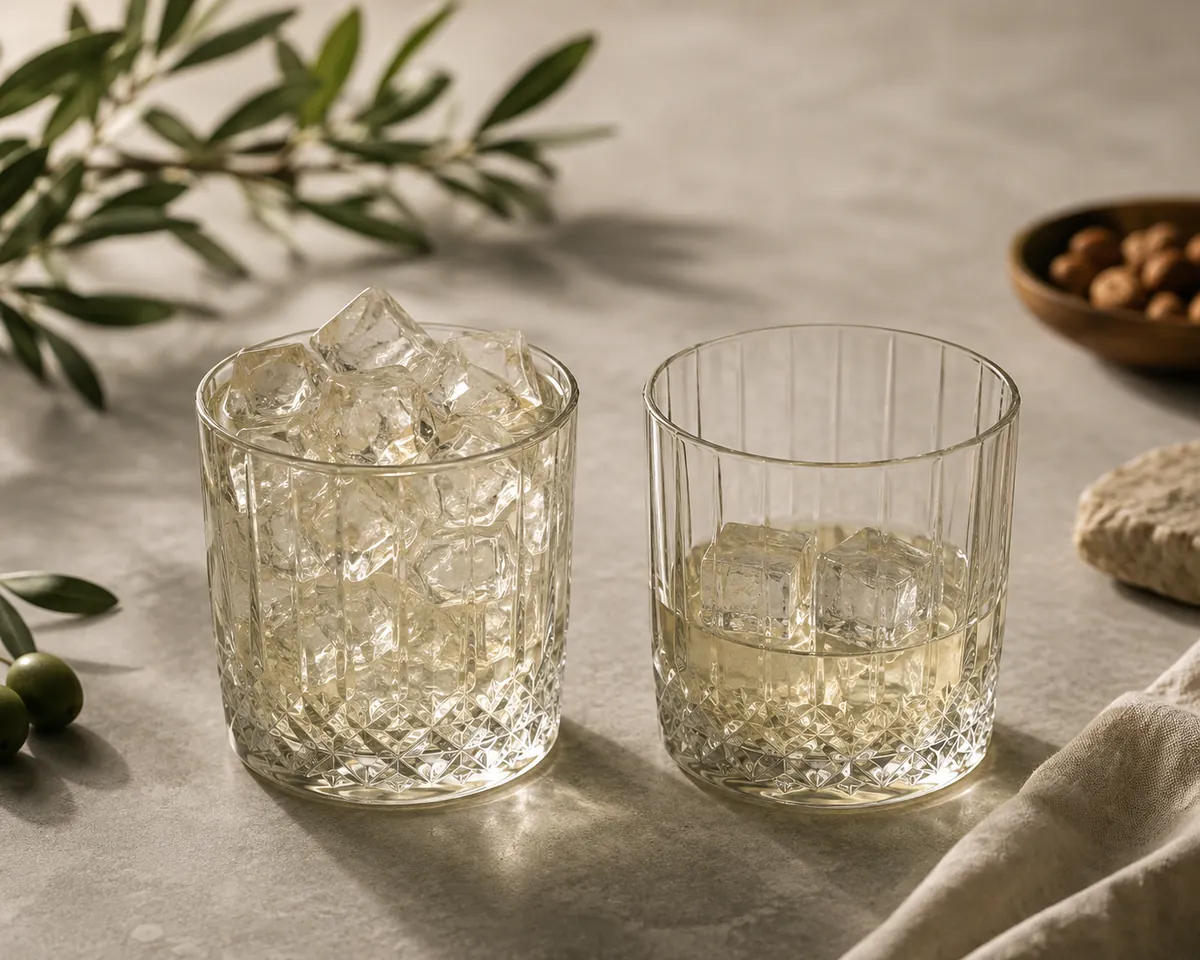
Fill the glass. Less ice makes a weaker drink, not a stronger one.
The corollary is that the glass itself is part of the sum. A room-temperature tumbler takes its share of heat out of the ice before the drink gets any benefit, and a heavy one takes a great deal, which is why a pre-chilled glass measurably reduces how much ice you lose in the first minute.
The white core, and how to freeze it out
The cloud in the middle of a domestic ice cube is dissolved air and minerals, not dirt. Water freezes from the outside in, and as the ice front advances it pushes gas and impurities ahead of it, concentrating them in the centre where they are trapped as microscopic bubbles that scatter light.
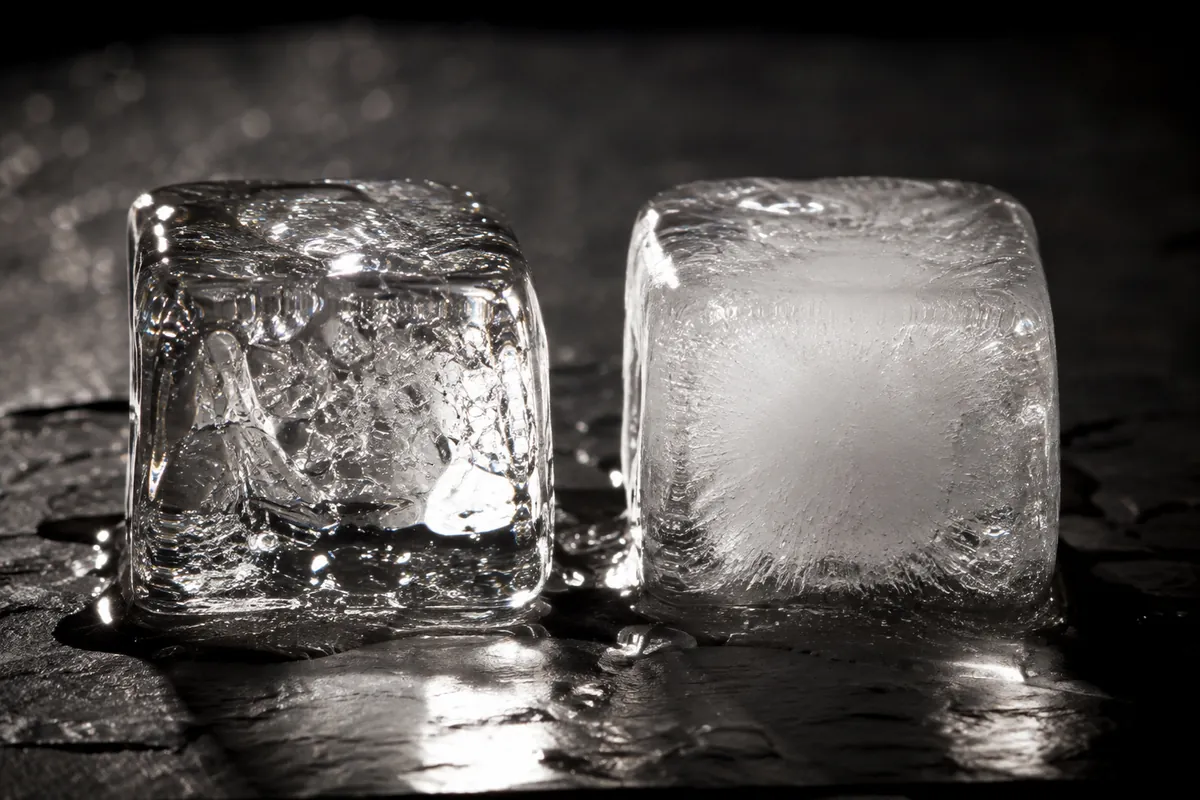
Directional freezing fixes it by giving those impurities somewhere else to go. An insulated container with the lid off, put in the freezer, freezes from the top down only, so everything cloudy is driven into the base, which is cut off and discarded.
Why one-way freezing works
- Ordinary trayCold reaches the water from every side, so impurities are squeezed inwards.
- Insulated boxOnly the top face loses heat, so the ice front travels downwards.
- ConcentrationAir and minerals are pushed ahead of that front into the last water to freeze.
- CutThe cloudy base holds the lot and goes in the sink.
- TemperCut ice sits a few minutes before use, or it cracks when liquid hits it.
A block of clear ice
- Use a small coolerAny insulated box that fits the freezer, with the lid left off.
- Fill it two thirdsWith ordinary tap water. Filtered is marginally better and not necessary.
- Freeze for 18 to 24 hoursUntil the top two thirds is solid and the base is still liquid.
- Tip out the waterWhat remains is a clear block with a cloudy layer at the bottom.
- Temper for ten minutesLet it warm slightly, or it will crack when cut.
- Cut and storeA serrated knife scores it and it splits along the score.
Boiling the water first, twice if you believe the more elaborate versions, is the advice that circulates most and works least. It removes some dissolved gas, which helps a little.
It does nothing about the direction of freezing, which is where the cloudiness comes from.
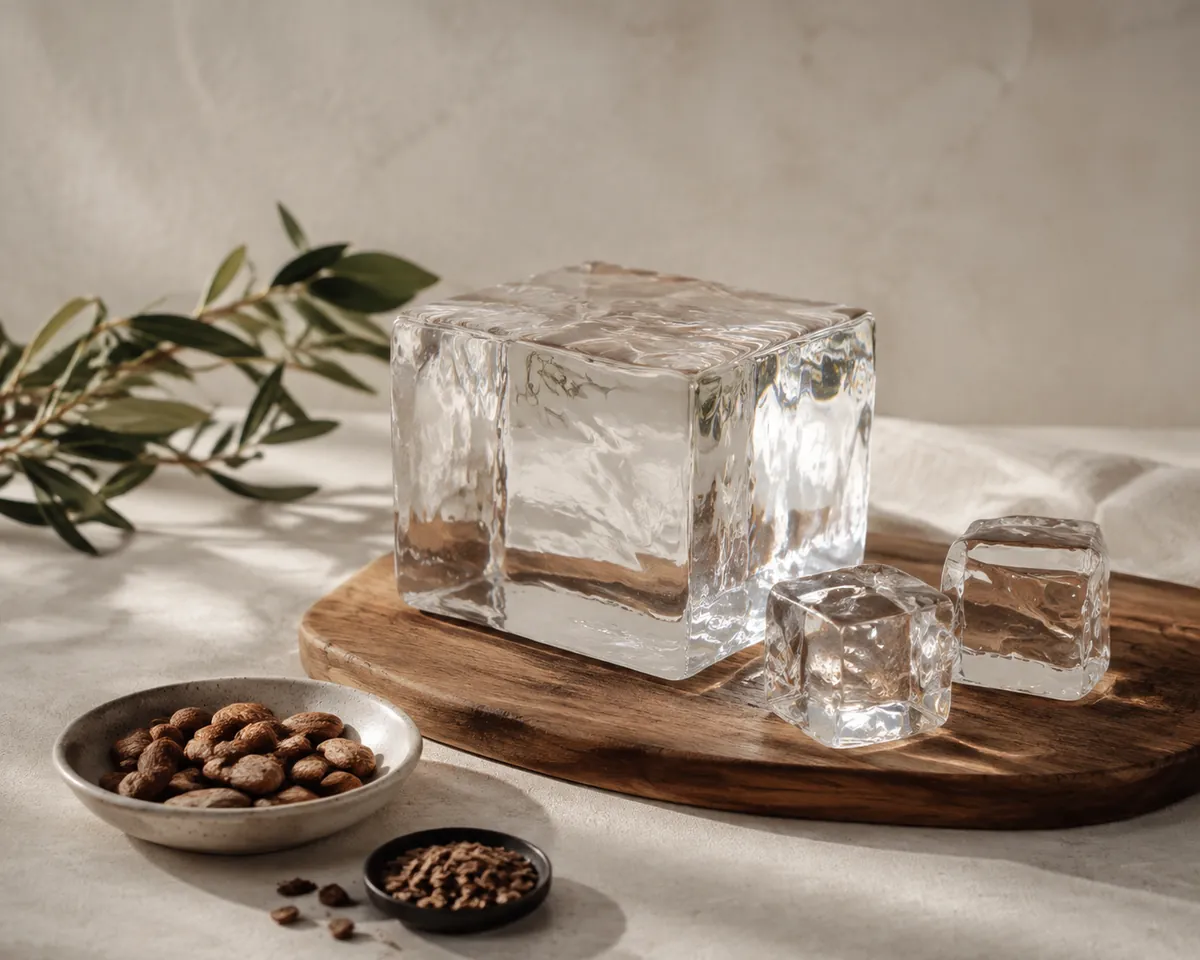
Clarity is mostly cosmetic. Clear ice melts marginally more slowly because it has no bubble-weakened interior to fracture along, and the visible difference is far larger than anything you will taste, so it is worth the trouble for a drink you serve to someone and not worth it for a glass of squash.
What the freezer and the tap put into your cubes
Ice tastes of the water it was made from and of the air around it. It is porous, it sits uncovered for weeks, and it is unusually good at collecting whatever else is in the freezer.
A cube from a tray left open beside strong food will carry that food into the glass, and this is a common and rarely diagnosed reason a home iced coffee tastes subtly wrong. The drink gets blamed, the beans get blamed, and the fault is a tray left open next to last week's curry.
The water matters as much. Chlorinated tap water makes chlorinated ice, and the chlorine arrives in the glass late, as the cube melts, which is why it hides in a strong drink and stands out in sparkling water or a pale iced tea.
Hard water makes ice that leaves a faint chalkiness and a fine sediment behind, and that is the same dissolved mineral content brewing water deals with at length, arriving after the drink is made rather than during it.
- Store ice in a sealed bag or lidded box, never an open tray.
- Make it fresh if it has been in the freezer more than a couple of weeks.
- Keep it away from anything strongly aromatic, which for most freezers means everything.
- Use filtered water if your tap water is heavily chlorinated; the ice concentrates it.
- Discard ice that has visibly shrunk or frosted over, which means it has been subliming.
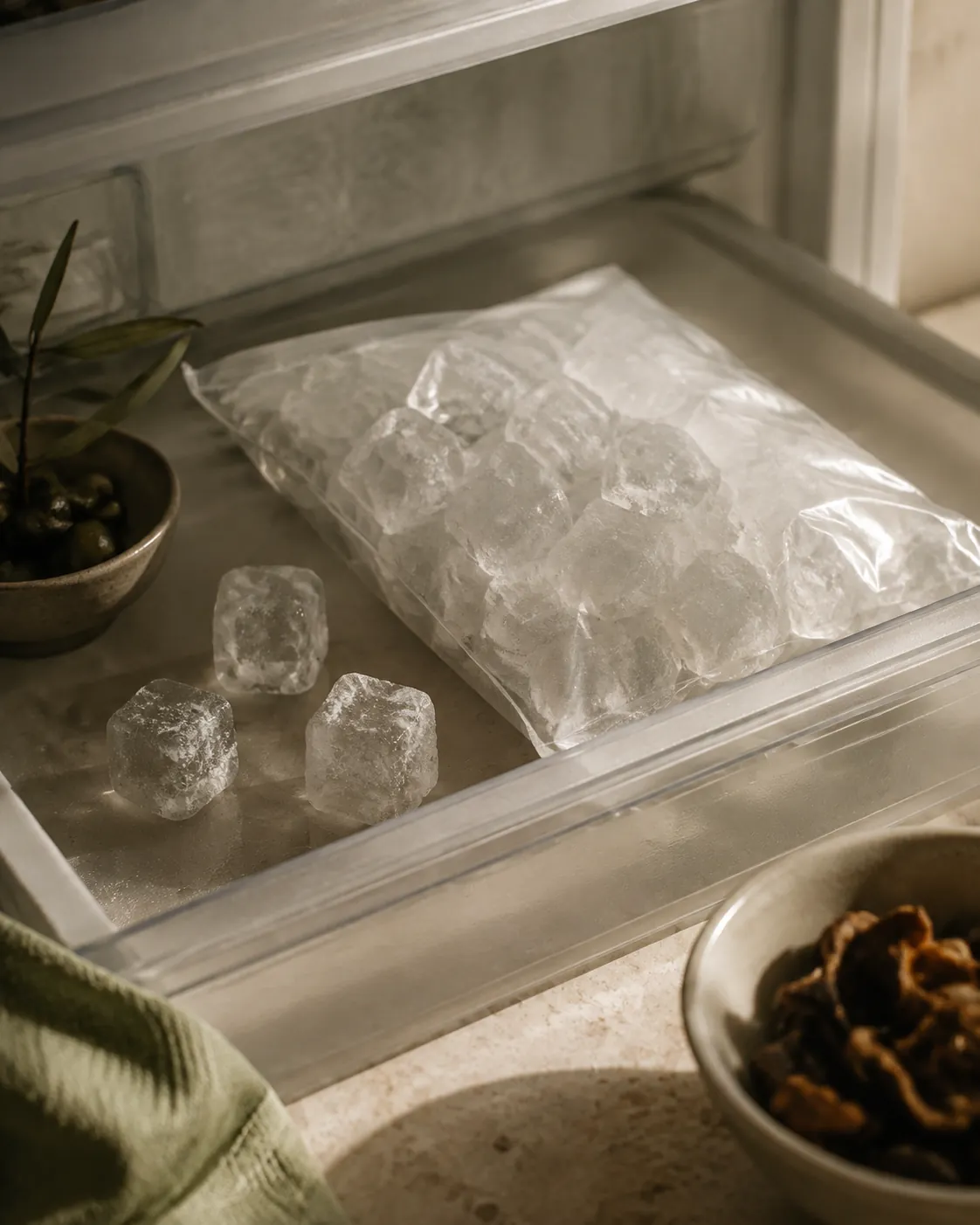
Sublimation is the second way ice degrades, and it is the reason old cubes come out small, pitted and oddly dense. Water leaves the ice directly as vapour without ever becoming liquid, and a sealed bag slows it substantially while dealing with the odour problem at the same time.
Bought bagged ice is made from filtered water in a machine that freezes it directionally, so it is usually clearer and more neutral than anything a kitchen produces, and for more than a few people it is the only practical option, since a domestic freezer makes perhaps a kilogram a day.
Freezing the drink instead of freezing water
The neatest answer to dilution is to stop diluting: make the ice out of the thing you are going to pour over it, so the melt adds more of the same rather than water.
Coffee cubes in an iced coffee and tea cubes in a jug of iced tea both work on that principle, and the drink stays at strength for as long as it takes to finish. It is worth knowing that freezing changes the base slightly, since coffee frozen and thawed tastes marginally flatter than fresh because some aromatics are lost in the process.
Against a drink that would otherwise be watered down over twenty minutes, that is a good trade.
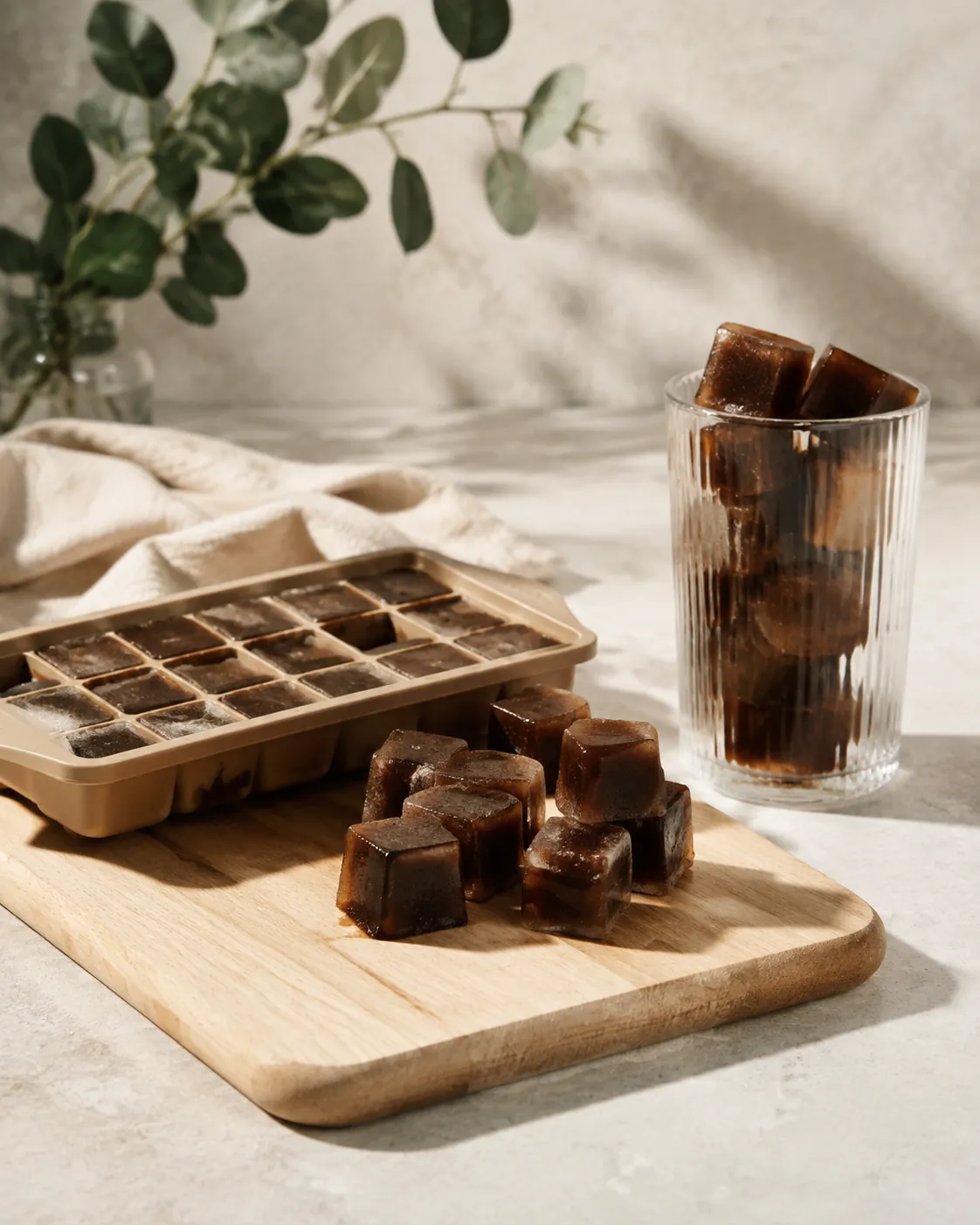
Tea cubes
Brew at normal strength and freeze. No haze problem, because nothing is chilled fast.
The one warning is that flavoured cubes are not interchangeable in a freezer full of them. Coffee ice in a glass of squash is a mistake you make once, and labelling the bag takes a second.
Cube, sphere, crushed and nugget
Shape changes the surface area, and surface area decides how fast the exchange happens, so the form of ice is a way of setting the speed of the drink rather than a matter of presentation.
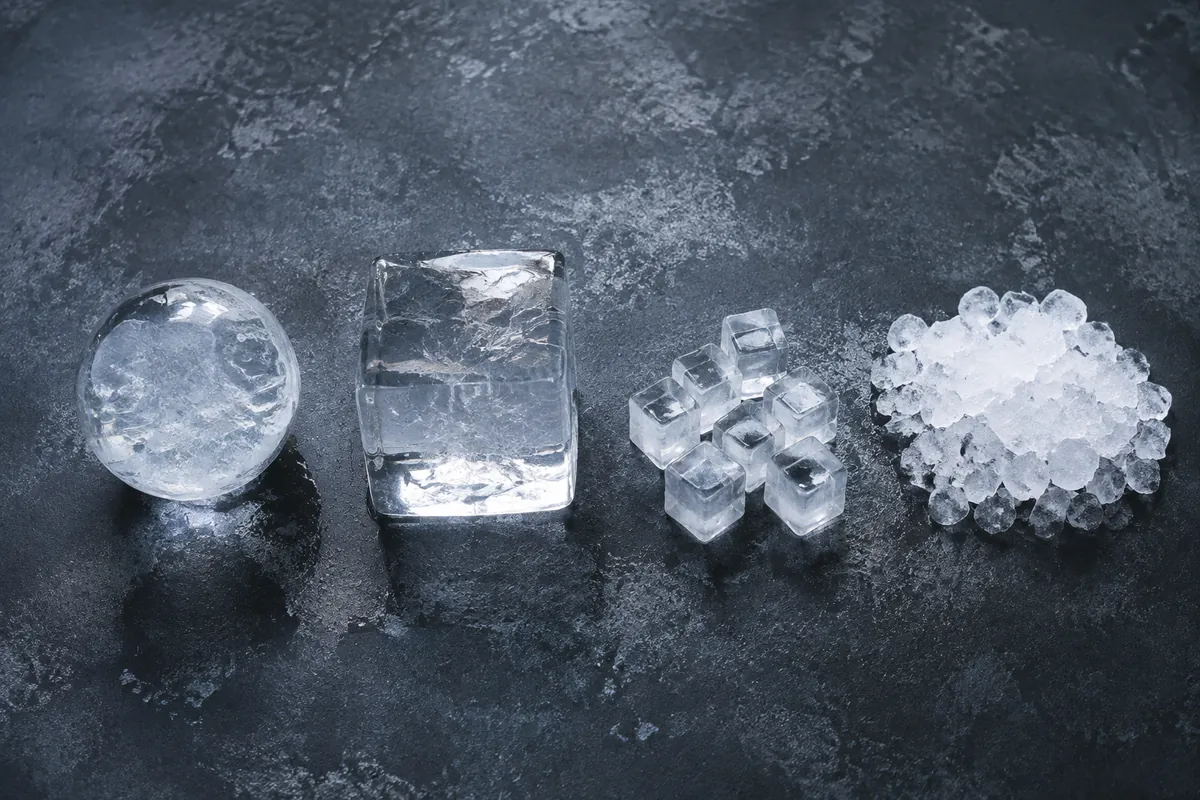
| Form | Melts | Suits | Avoid for |
|---|---|---|---|
| Large cube or sphere | Slowest | Cold brew, anything sipped slowly | Drinks needing fast chilling |
| Standard cube | Moderate | Most soft drinks and iced coffee | Nothing much |
| Crushed | Fastest | Slushes and drinks meant to be diluted | Anything sipped over an hour |
| Cracked | Fast | Shaking and quick chilling | Serving in the glass |
| Pellet or nugget | Fast, and it chews | Soft drinks, iced tea | Long drinks |
Large formats are slower ice rather than better ice, and a drink meant to be finished in five minutes gains nothing from a sphere. It is served better by cubes that get it cold quickly, because a sphere in a fast drink spends the whole time not quite chilling it.
Nugget ice is the odd entry, since its appeal is textural rather than thermal. It is soft, chewable and full of trapped water, which makes it pleasant in a cola or a fountain drink and hopeless in anything you want to stay at strength, because it melts about as fast as crushed.
Drinks that ice makes worse
Ice is close to automatic in a cold drink, and a few categories are actively harmed by it in ways that get blamed on the drink instead.
Carbonated drinks lose their fizz to ice, because every cube is a mass of nucleation sites and dissolved carbon dioxide comes out of solution on surfaces. A seltzer poured over a full glass of ice goes flat noticeably faster than the same bottle poured into a chilled glass, and the rougher the ice, the faster it goes.
That reverses the usual advice about shape. Large smooth cubes are better for anything fizzy than crushed, since fewer and smoother surfaces mean slower loss, and the drink should be cold before it meets the ice rather than after.
A room-temperature bottle poured over cubes is halfway flat before it reaches the table, which is why a drink built from a soda maker is worth chilling in the bottle first.
White tea and delicate infusions
Dilution removes what little there was. Cold brew and chill instead.
Anything already cold
The ice is only holding temperature, so fill the glass rather than half-filling it.
Delicate infusions suffer for the opposite reason to soda: nothing is being driven off, there is simply less and less of what there was. Anything you want to taste rather than merely drink cold is better chilled in the fridge than iced in the glass.
Iced coffee, and the two ways to build it
Iced coffee is where the quantity of ice is most often got wrong, and there are two correct approaches rather than one. Both of them treat the melt as part of the recipe.
What fails is the third approach, brewing as usual and pouring it over whatever is in the tray.
Brewing hot directly onto ice, the Japanese method, weighs the ice as part of the brew water. The coffee is brewed at roughly double strength over a measured quantity of cubes, and the drink arrives at full strength and already cold, with the aromatics captured that a slow chill would have lost.
Two routes to a cold coffee that is not weak
- Hot onto iceWeigh the ice as brew water, brew at double strength, serve immediately.
- Cold from the startBrew cold brew as concentrate, then pour over a full glass of ice.
- The failureOrdinary hot coffee poured over unmeasured ice, which is weak by the time it is cold.
- Why it differsOne route counts the melt in advance, the other has almost nothing left to melt.
Pouring cold brew over ice needs the opposite thinking, because the coffee is already cold and the ice is only holding it there. A full glass dilutes far less than a half-full one over the same twenty minutes, and the concentrate was built expecting some water anyway, which is part of why cold brew tastes rounder over ice than a drip brew does.
Tea cream, and why an iced jug goes hazy
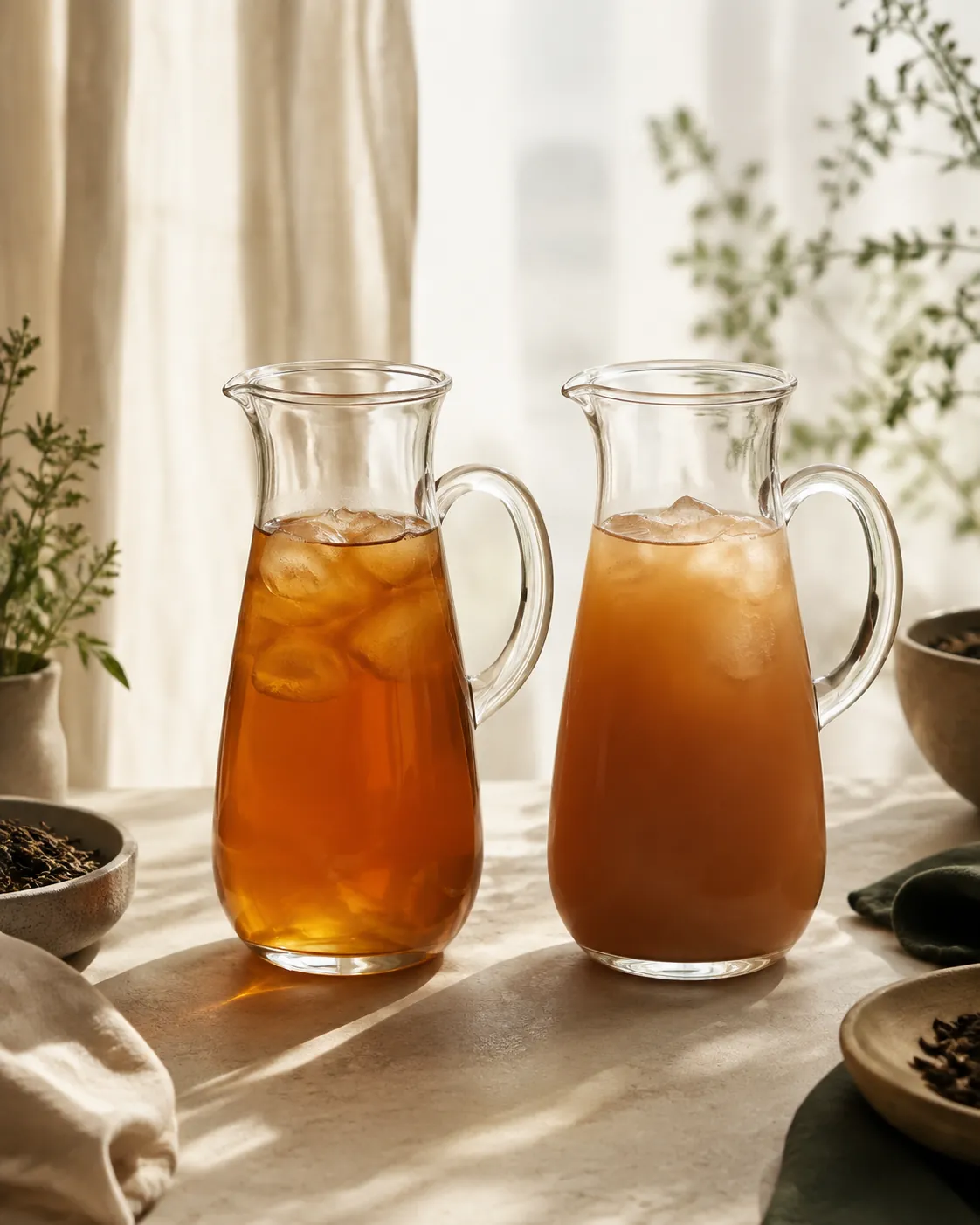
Iced tea has one ice-specific problem beyond dilution, and unlike everything else on this page it is visible rather than a matter of taste: a jug brewed hot and chilled fast turns cloudy and stays that way.
Caffeine and tannins bind to each other as the temperature drops and come out of solution as a fine suspension. It is called tea cream, it is harmless and purely visual, and it looks like something has gone wrong.
Pouring hot tea straight over ice is the fastest chill available in a domestic kitchen and therefore the most reliable way to produce it, which puts black tea, the highest in both compounds, most at risk.
- Cold brew from the start, which never produces the haze at all.
- Let a hot brew cool to room temperature before it meets ice or the fridge.
- Brew at double strength and dilute with cold water rather than chilling fast.
- Add a squeeze of citrus to a jug that has already gone cloudy.
- Keep the jug out of the coldest part of the fridge, where the drop is sharpest.
A little lemon juice clears a cloudy jug by lowering the pH enough to redissolve the complex, which is the unstated reason so many iced tea recipes call for citrus. None of this is a fault in the ice, though.
It is a rate-of-cooling problem, and steeping temperature governs the same chemistry from the other end of the thermometer.
Common questions
Does more ice make a drink more watery?
No, less. A full glass reaches its final temperature quickly and then largely stops melting, while two cubes must melt almost entirely to cool the same drink and keep melting as the room warms it.
Why is my ice cloudy, and does it matter?
Water freezes from the outside in, pushing dissolved air and minerals to the centre where they are trapped as bubbles. It is cosmetic: clear ice melts only marginally more slowly. Directional freezing, not boiling the water, is what produces clear ice.
Why does my iced coffee taste odd?
Often the ice. It is porous and sits uncovered for weeks, absorbing freezer odours which then go into the glass. Store ice sealed, make it fresh, and use filtered water if your supply is heavily chlorinated.