Which Type of Milk Frother Actually Makes Microfoam?
Frothers divide into those that whip air into cold milk and those that steam it. Only the second kind makes the glossy microfoam a latte needs, and most of the cheap ones are the first kind.
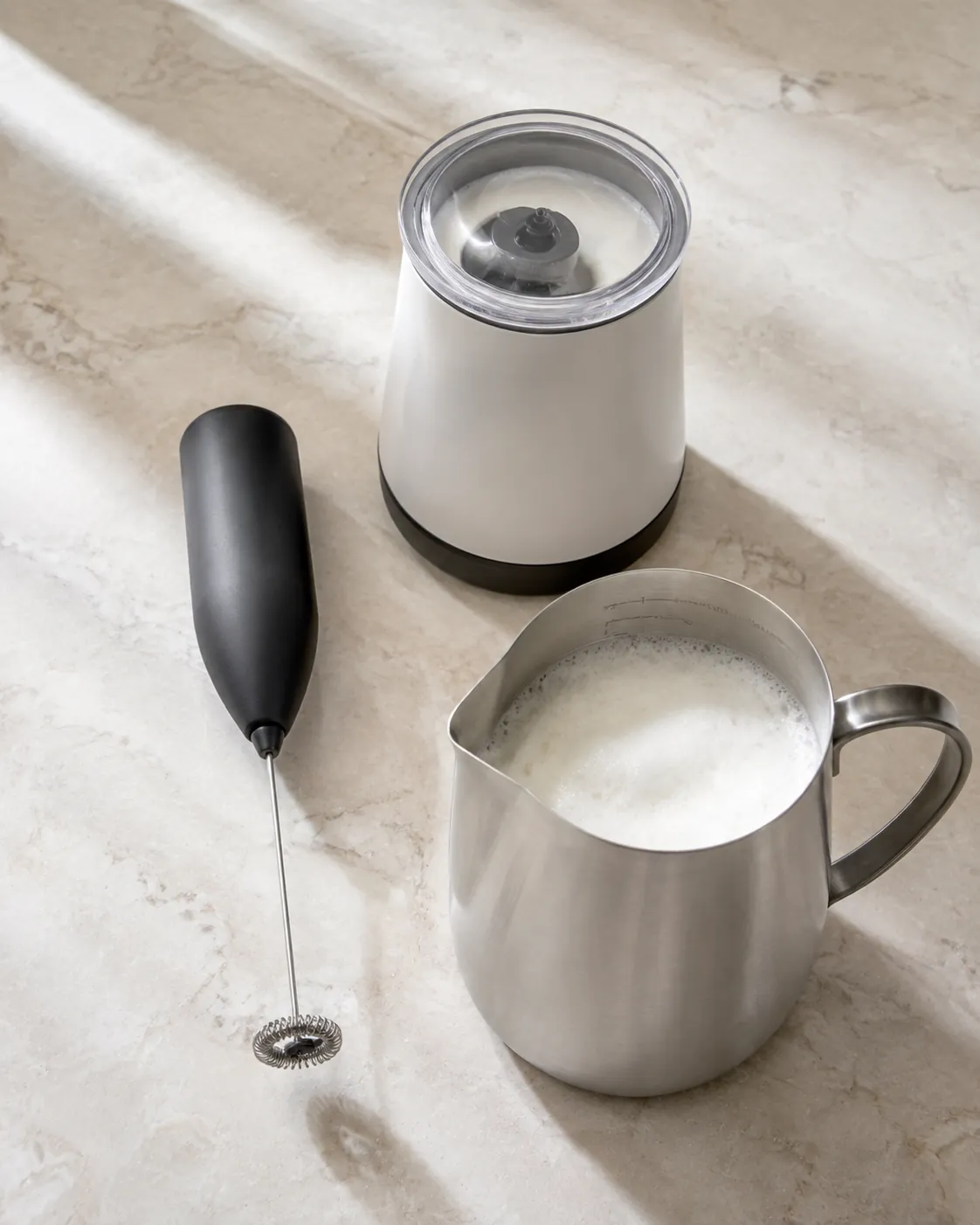
Frothing milk means two separate things, and equipment reviews rarely distinguish them.
Whipping air into milk makes foam.
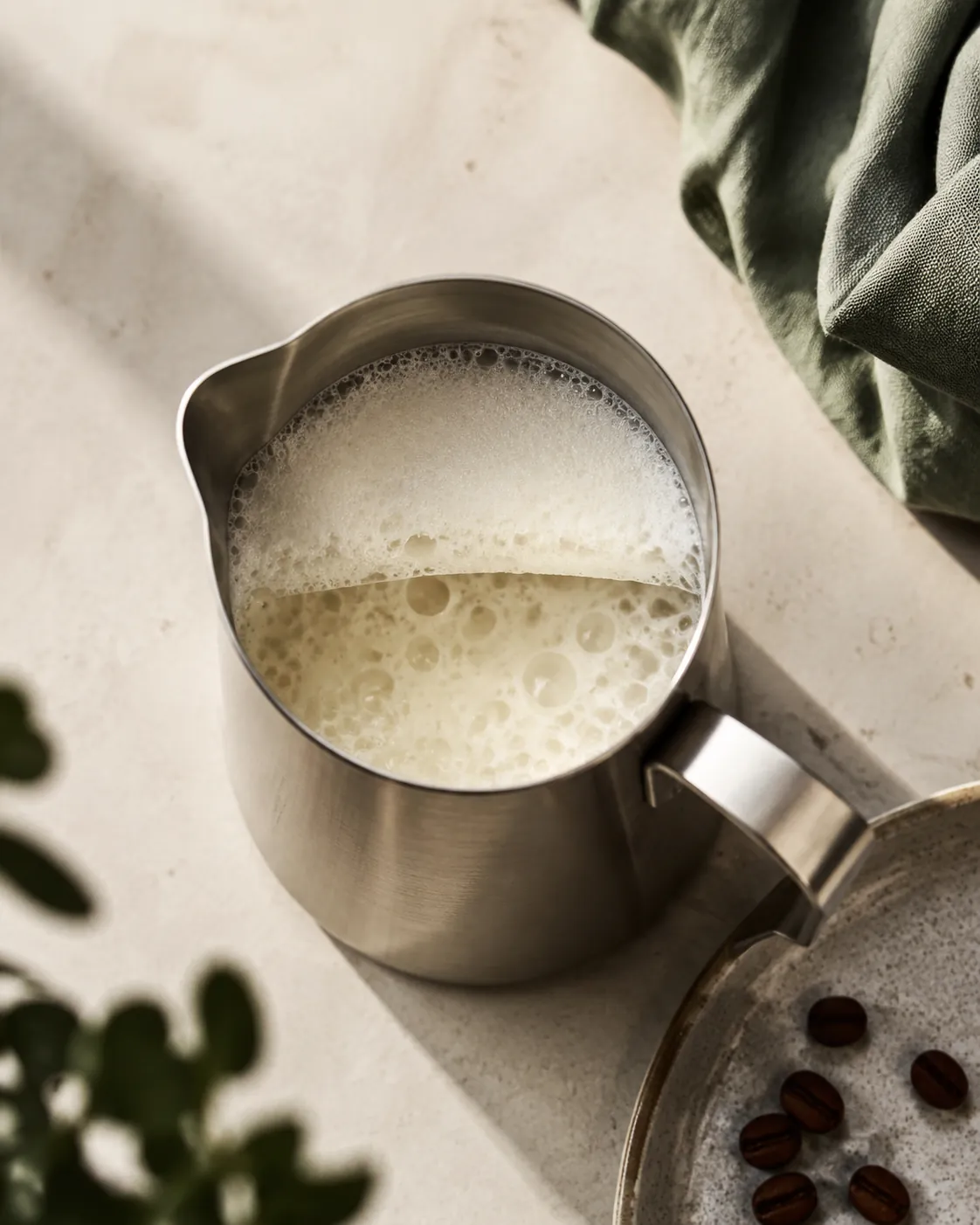
Steaming it makes microfoam, a glossy, paint-like texture that pours as a single liquid. They are not the same, and the second is what a milk coffee actually needs.
The milk frother at a glance
- Foam
- Air whipped into milk. Large bubbles, sitting on top of it
- Microfoam
- Steam-sheared bubbles too small to feel. Pours as one liquid
- The four devices
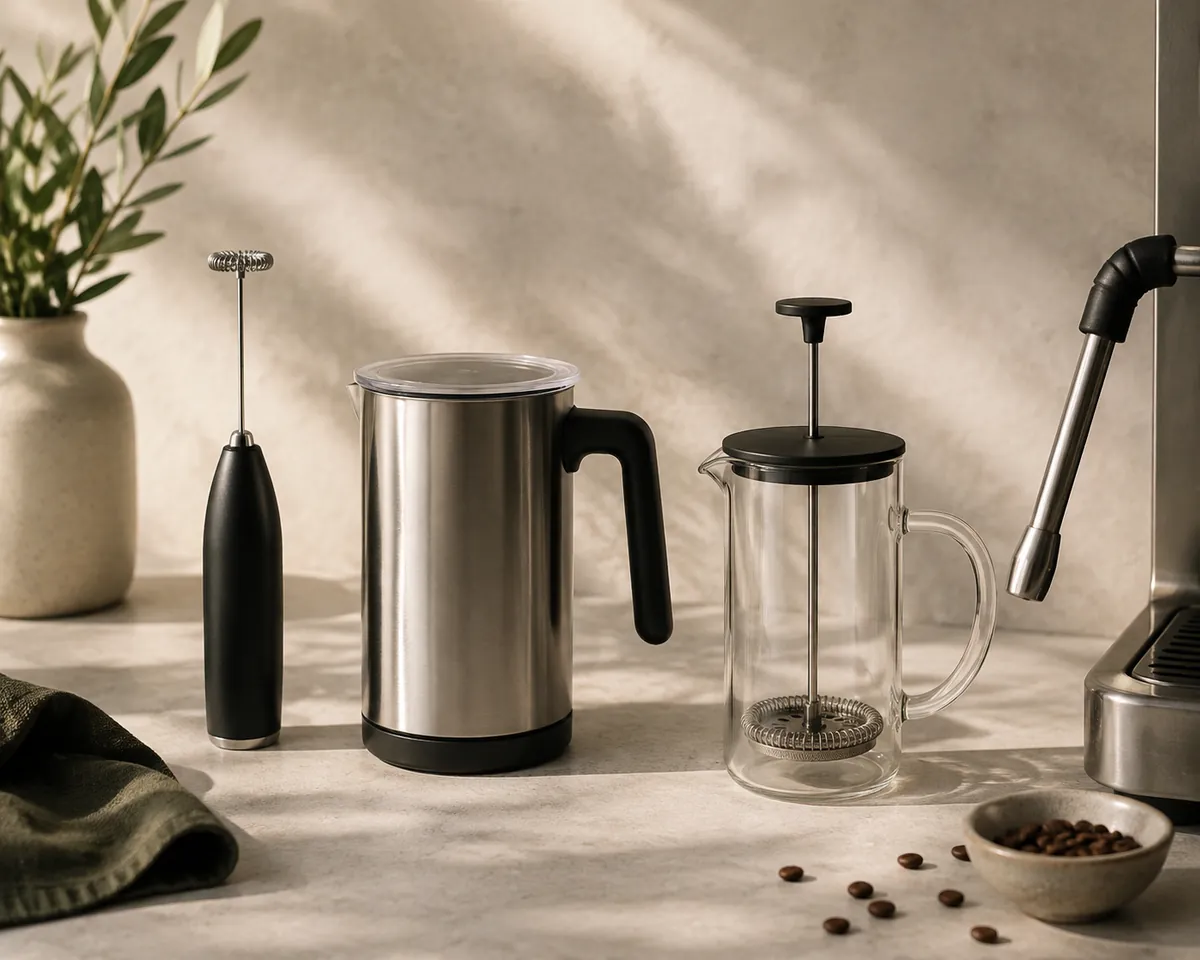
- Handheld whisk, automatic jug, pump frother, steam wand
- Only one makes microfoam
- The steam wand, which means an espresso machine
- Temperature
- 60 to 65 C. Past about 70 C the milk tastes cooked
- What decides the foam
- Protein builds the bubble walls, fat keeps them stable
- Cheapest route
- A jar or an immersion blender, both already in the kitchen
Four devices, and why only one makes microfoam
Four devices cover the whole category, and price is a poor guide to which of them suits a given drink. What separates them is not power but whether the mechanism can shear a bubble after it has made one.
| Handheld whisk | Automatic jug | Pump frother | Steam wand | |
|---|---|---|---|---|
| How it works | Spins a coil at high speed | Heats and whisks together | Manual plunger, like a French press | Injects steam |
| Foam type | Airy, large bubbles | Variable, often stiff | Airy, dense | True microfoam |
| Heats milk | No | Yes | No | Yes |
| Suits a latte | Poorly | Adequately | Poorly | Yes |
| Suits a cappuccino | Reasonably | Well | Reasonably | Yes |
| Cost | Very low | Low to moderate | Very low | Part of an espresso machine |
Only a steam wand makes true microfoam. Everything else produces foam sitting on milk rather than foam integrated through it.
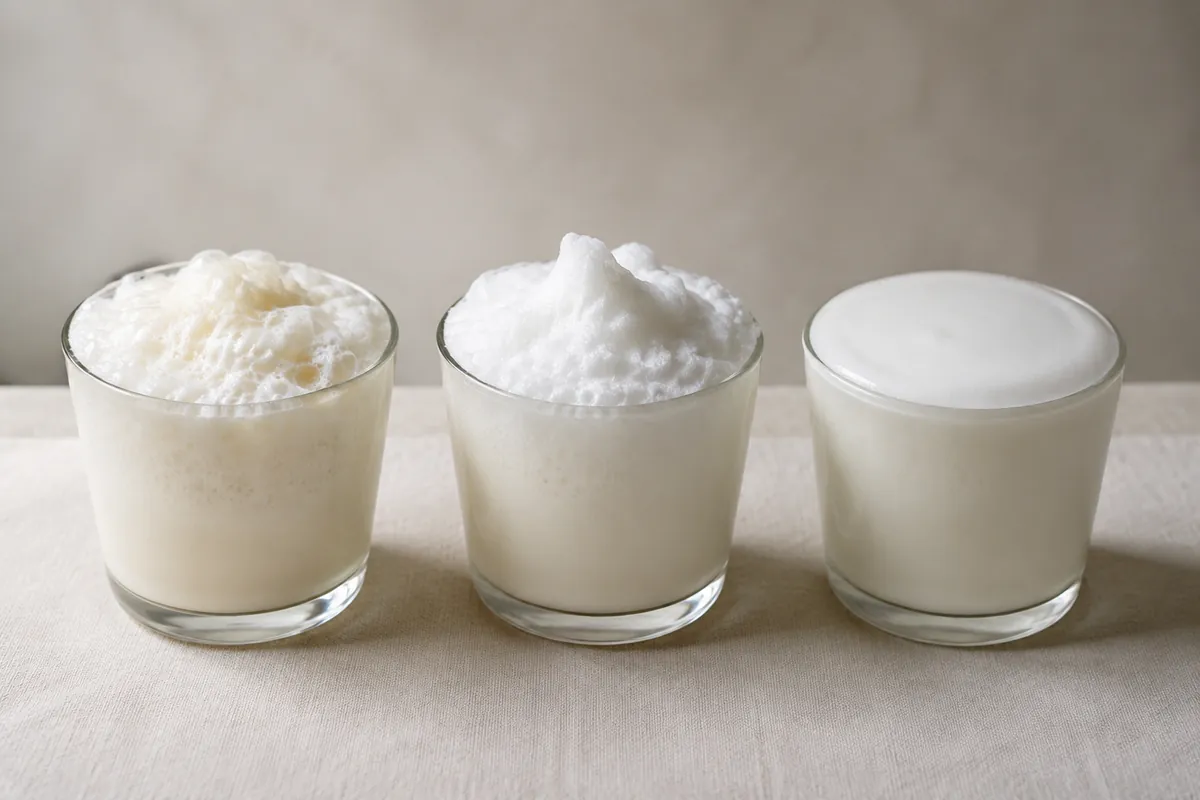
That is not a reason to avoid the others. A cappuccino wants a distinct foam cap and an automatic frother makes a perfectly good one, while a flat white wants milk and foam to arrive as one liquid, and nothing short of a wand delivers that.
The mechanism explains the split. A steam wand injects air in the first seconds while the tip sits near the surface, then drives a vortex that shears those bubbles down to a size the tongue cannot detect, and it heats the milk with the same steam so texturing and heating finish together.
A whisk introduces air and cannot shear it. An automatic frother heats and whisks, and the whisking is not violent enough to raise a true vortex.
Texturing milk on a wand
Because the wand is the only device that makes microfoam, it is also the only one that asks anything of the operator, and its two phases have to run in sequence rather than at the same time.
Air goes in at the start; a vortex then shears those bubbles down until the tongue cannot find them. Running the two together is the usual failure, and it gives a jug of large bubbles that no amount of later spinning will rescue.
One jug, start to finish
- Purge the wandOpen the steam for a second before the jug arrives. Condensed water sits in the wand between drinks and it thins the milk.
- Fill and positionCold milk to just below the base of the spout. Put the tip barely under the surface and off to one side, not in the middle.
- StretchOpen the steam fully. A steady tearing sound means air is going in, and two or three seconds of it is enough for a latte.
- Submerge and spinLower the jug until the tearing stops and the milk turns in a smooth vortex. Everything from here is shearing, not aerating.
- Stop at 60 to 65 CThe jug goes from warm to uncomfortable to hold. Close the steam before lifting the wand clear.
- Purge and wipeImmediately, while the residue is still liquid. Dried milk on a wand bakes on and comes off badly.
- Groove and pourTap the jug once on the counter, swirl until the surface shines like wet paint, and pour without letting it stand.
That tearing sound is the whole diagnostic. Hearing it once the milk has warmed means the tip has drifted back to the surface and large bubbles are going in, and a jug still tearing at 50 C is already lost.
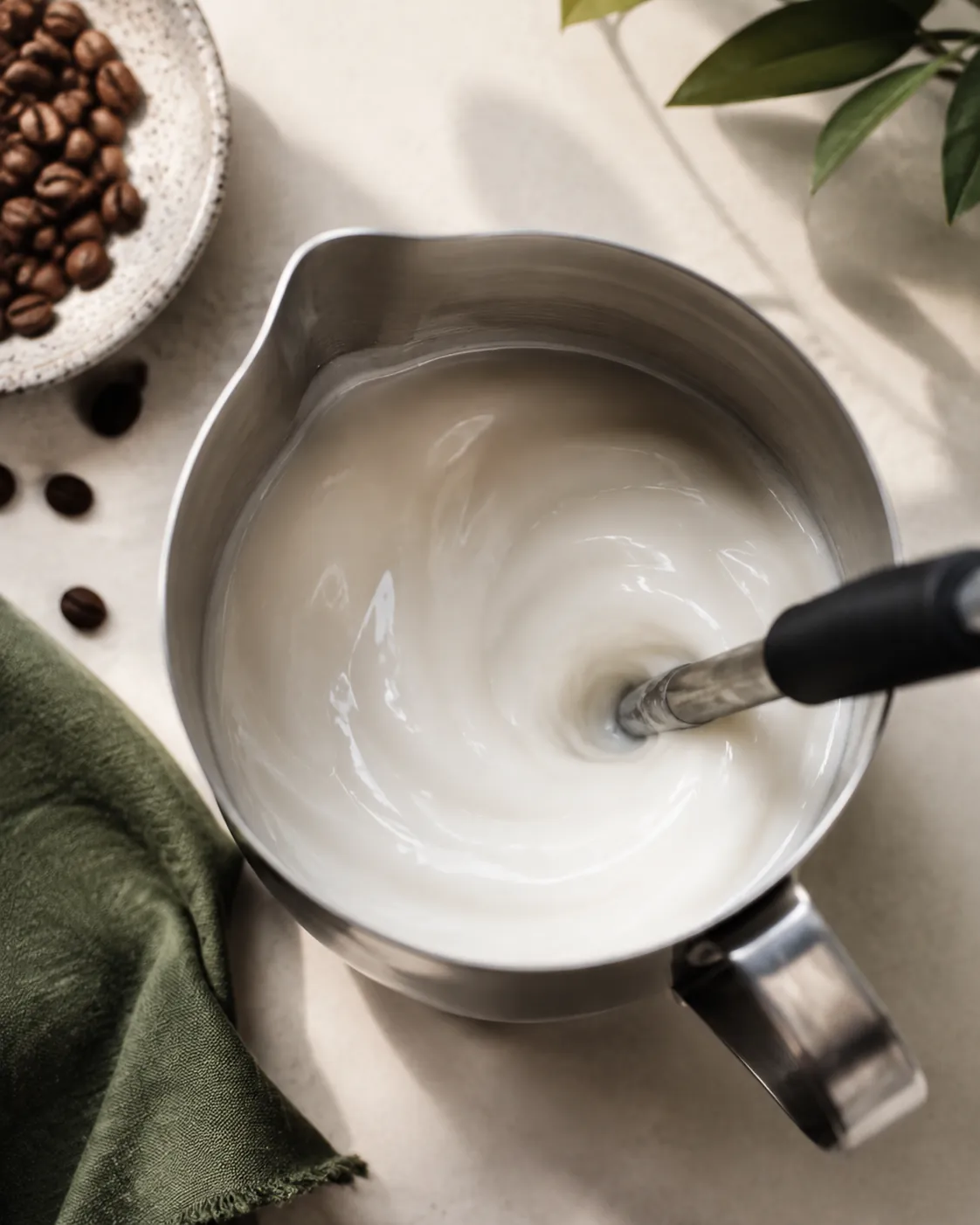
Milk stops accepting air smoothly somewhere around body temperature, so the first few seconds decide the texture of the entire jug. Nothing later in the process adds foam, and the spinning phase can only refine what is already in there, which is why a cortado and a tall milk coffee are textured differently from the opening second rather than adjusted at the end.
The temperature ceiling, and what passing it costs
The same ceiling applies whatever the device.
Milk is at its sweetest around 60 to 65 C, and past roughly 70 C the proteins denature, the milk tastes cooked and the foam turns unstable. Automatic frothers usually stop near 65 C, which is correct.
Handheld frothers do not heat at all, so the milk has to be warmed separately, and a microwave overshoots more easily than anything else in the kitchen.
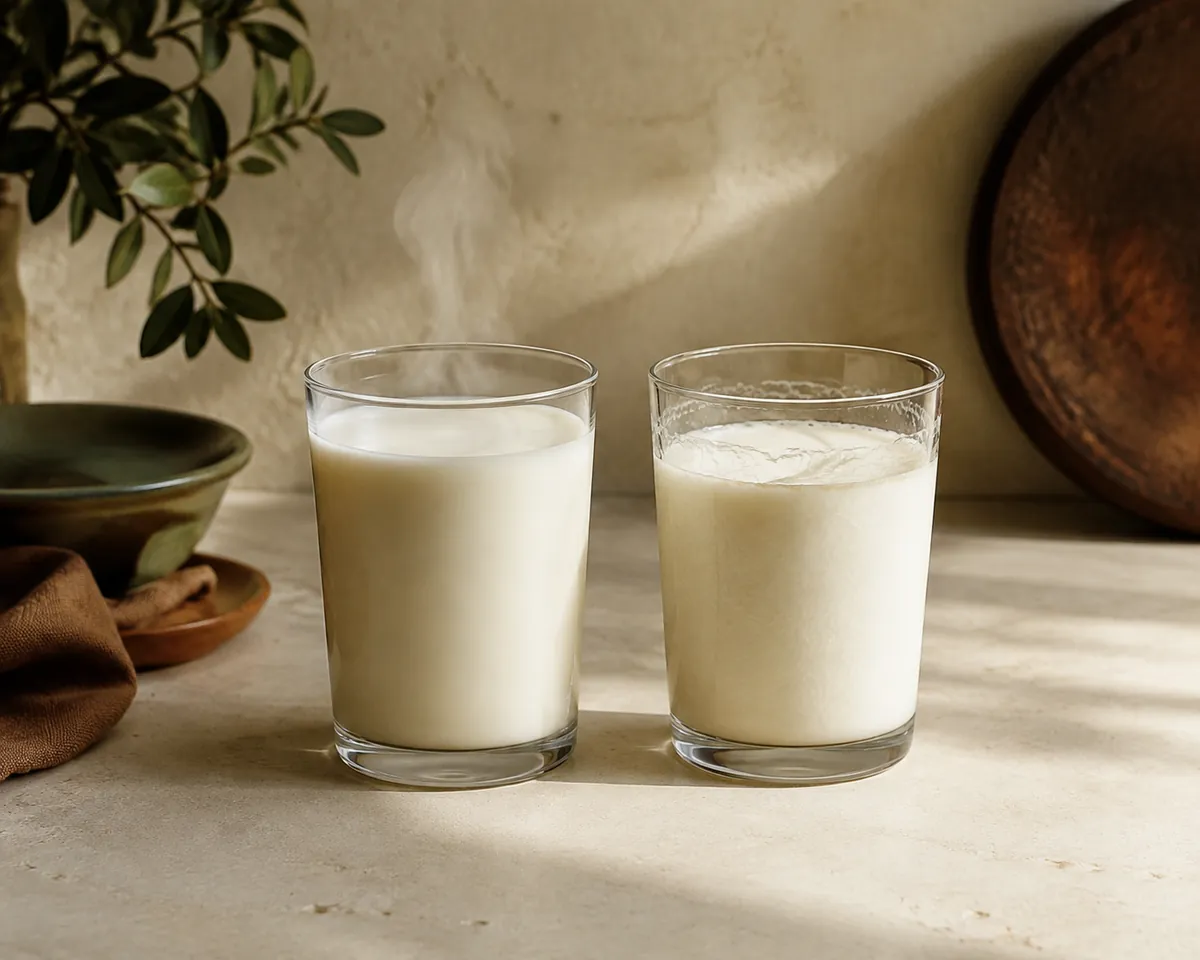
- Warm milk to just too hot to hold the jug comfortably, which is about 60 to 65 C.
- Start with cold milk if you are steaming, so there is time to introduce air.
- Fill any frothing vessel no more than half, since milk expands considerably.
- Swirl and tap the jug after frothing to integrate the foam before pouring.
- Never re-froth milk that has already been textured; the proteins are spent.
That ceiling sits lower for most plant drinks than for dairy, which is where a fixed heating programme causes trouble. A drink that separates in the jug is doing exactly what it does in a hot cup, and why plant drinks curdle in coffee covers the heat and acid combination behind it.
Re-heating is the other dependable way to spoil a jug, since proteins already stretched around one set of bubbles will not stretch around a second.
Which milk foams, and why plant drinks are harder
The device gets the attention and the liquid decides at least as much. Protein builds the walls of a bubble and fat makes those walls stable and the texture rich, so anything short of one or the other foams badly whatever it is put through.
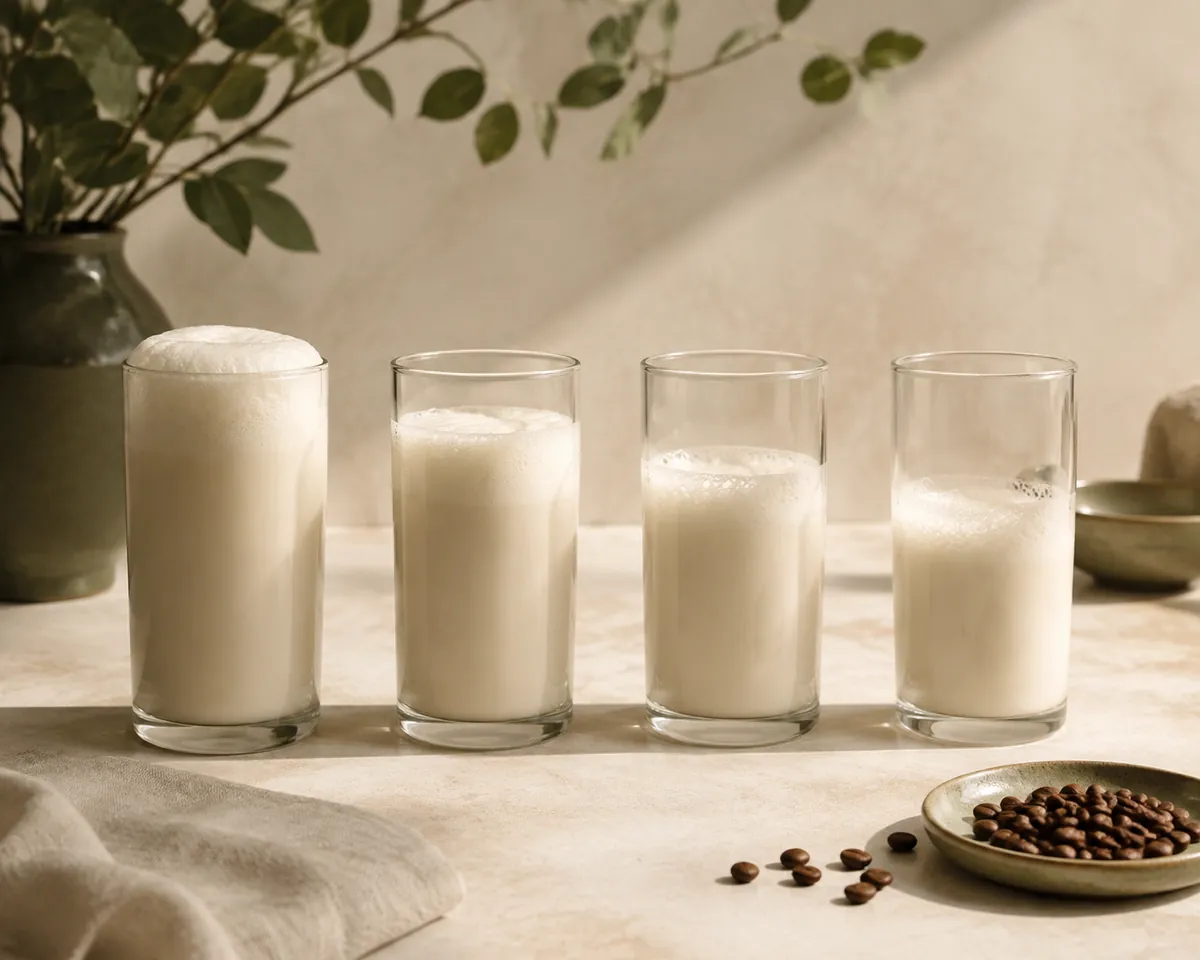
| Foam volume | Stability | Taste | |
|---|---|---|---|
| Whole dairy | Moderate | Very good | Sweetest, richest |
| Semi-skimmed | Good | Good | The common compromise |
| Skimmed | Highest | Poor, it collapses | Thin, and it tastes it |
| UHT dairy | Good | Good | Slightly cooked before it starts |
| Barista oat drink | Good | Very good | Neutral, faintly sweet |
| Standard almond | Low | Poor | Splits readily under heat |
Skimmed milk producing the most foam surprises people, and it is why judging a jug by foam volume alone misleads: big volume with no body is not the goal. Ultra-fresh milk also foams slightly worse than milk a few days old, because the proteins have not yet begun to break down, which is one of the few cases where the older carton is the better one.
Plant drinks divide along the same protein-and-fat line. Soy milk foams on protein and behaves most like dairy, so it does reasonably in any device, and oat foams well on a mix of protein and added fat.
Almond and rice drinks carry almost no protein and foam on fat alone, which gives large bubbles that collapse quickly, so they need a barista formulation and still produce less stable foam. Pea protein drinks sit at the other end of that range and behave more like soy than like a nut drink.
Which one to buy, and what an automatic jug really gives you
The honest answer depends entirely on the drink. Nobody needs microfoam for a cocoa.
Almost nobody gets it without a wand.
For cappuccinos and hot chocolate
An automatic jug frother. Convenient and good enough.
For occasional use
A handheld whisk, or a French press you already own.
For iced drinks
A handheld whisk, since no heating is wanted.
Handheld frothers are excellent value for what they actually do, which is aerate a cold or warm liquid quickly, and they disappoint only when bought in the expectation of microfoam. The automatic jug is the device most households buy, so being straight about its trade matters more here than anywhere else in the category.
Works well for
- Heats and textures in one unattended operation, which no manual method does
- Consistent between drinks, because the programme does not vary with the operator
- A fraction of the cost of anything carrying a steam wand
- Handles hot chocolate, chai and matcha as readily as plain milk
- Most models have a cold setting, which covers iced drinks
Struggles with
- A fixed temperature programme that some plant drinks curdle or thicken at
- Stiff, dry foam rather than glossy microfoam, so latte art is not possible
- A fixed batch size, usually one or two cups, with poor results below the minimum line
- A non-stick interior that scratches, and most are not dishwasher safe
- Slower than a wand, at around two to three minutes per batch
The fixed programme is the limitation that matters most. It is calibrated for dairy, and a drink it heats past its own comfortable range comes out cooked whatever the operator does, which is why a jug that handles chai and cocoa beautifully can still spoil one particular carton every single time.
Cold foam, where the cheap device wins
The one job a handheld whisk does better than a steam wand is the job it is rarely bought for, since steam heats by definition and cold foam is milk aerated with no heat at all.
It is poured over an iced drink so that it floats as a distinct layer before slowly sinking through, which is a texture no heated foam imitates.
Cold foam for one iced drink
- Milk
- 60 ml, cold, whole dairy or a barista plant drink
- Sweetener
- 1 teaspoon of simple syrup, which also stabilises it
- Device
- Handheld whisk, 20 to 30 seconds in a narrow vessel
- Target
- Thick enough to pour slowly, loose enough not to hold peaks
- Timing
- Pour it straight away, since it separates within a few minutes

A narrow vessel matters more than the whisk does. The same device that produces nothing in a wide mug will build a proper foam in a tall narrow jar, because the liquid has nowhere to escape the blades.
Over cold brew that layer is the difference between a drink that looks poured and one that looks assembled, and it holds longest when the glass has been filled with ice first, so the foam is not resting on liquid at room temperature.
Keeping one working
Frothers fail from neglect far more often than from use.
Milk is the reason: it is a protein solution that dries into a film, and the film sours well before it looks like anything worth cleaning.
- Rinse or purge within seconds of finishing, before any residue dries.
- Wipe a steam wand with a damp cloth every single time, not at the end of the session.
- Never scour a non-stick jug; a scratched coating starts catching milk and burning it.
- Descale an automatic frother on the same schedule as a kettle, more often in a hard-water area.
- Check the whisk seal and the lid gasket, where soured milk collects unseen.
The smell test settles it. A frother that smells faintly of old milk when dry has residue somewhere inside it, and that carries into the next drink as a flat, slightly cheesy note most people blame on the coffee.
Scale is the second failure and it arrives at a speed set by what comes out of the tap rather than by how often the device is used.
When the foam is wrong
Most failures come from a small set of causes. The symptom usually names which one, which makes this the rare piece of kitchen equipment you can diagnose without opening it.
| Symptom | Cause | Fix |
|---|---|---|
| Large loose bubbles | Air added too long, or the wand tip too high | Stretch for two or three seconds only |
| No foam at all | Milk too warm at the start, or too little in the jug | Start cold; fill to the minimum line |
| Foam collapses within a minute | Skimmed milk, or a plant drink without a barista formulation | Change the milk, not the technique |
| Milk tastes cooked | Taken past about 70 C | Stop while the jug is merely uncomfortable to hold |
| Foam sits as a separate lid | Not swirled before pouring | Tap and swirl until the surface shines |
Two of those rows are milk problems wearing an equipment costume, which is why a new frother so often fails to fix a disappointing milk coffee. Changing the carton is the cheaper experiment and it should come first.
The last row is the one misread as a device fault most often: foam that sits as a separate lid was made correctly and then left standing, and a jug tapped and swirled the moment it stops will pour as one liquid where the same jug left half a minute pours as two. A macchiato is the drink that wants that separation deliberately, and it is the exception rather than the standard.
Frothing with no frother at all
Three things already sitting in most kitchens produce usable foam, and one of them beats the cheap devices outright, which is worth knowing before anyone spends anything on the category.
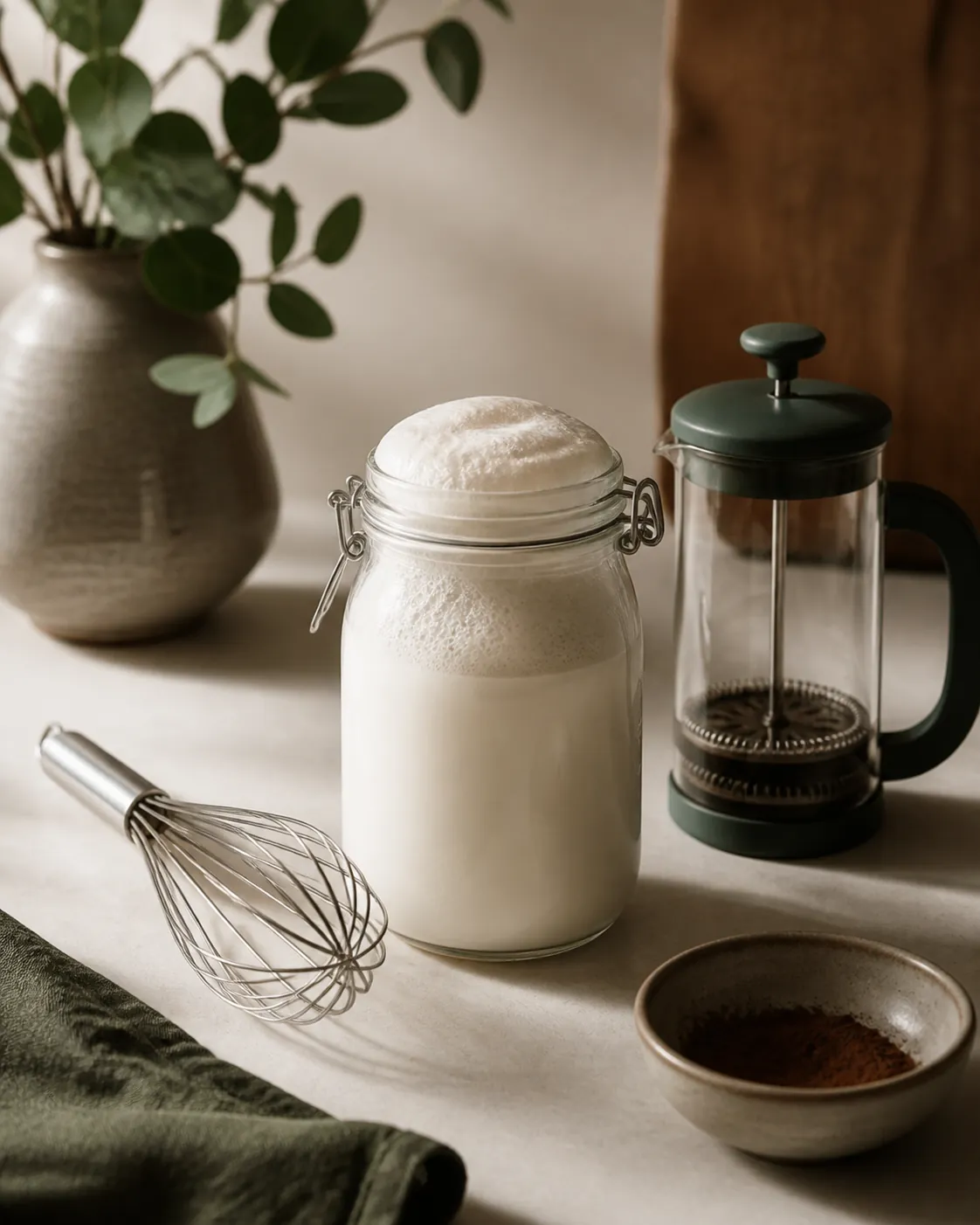
A jar with a tight lid is the simplest: fill it a third full with warm milk, screw the lid on, shake hard for thirty seconds, then take the lid off and microwave it for another thirty so the foam sets instead of collapsing. A balloon whisk works if the milk is warm and the bowl is narrow, though it takes a minute of real effort and gives looser foam than any device does.
An immersion blender is the surprise of the three: held just under the surface of warm milk in a jug it does something close to what a wand's vortex does, and it makes the densest foam available without a machine.
None of these reaches microfoam, for the same reason no whisk does: they add air without shearing it down afterwards. What they do reach is a perfectly good cappuccino cap, which is what most people were after in the first place.
Common questions
Can a milk frother make microfoam?
Only a steam wand does. Handheld whisks, pump frothers and most automatic jugs whip air in but cannot shear the bubbles finely enough, so they produce foam sitting on milk rather than the glossy integrated texture a latte needs.
What is the best frother for plant milk?
Soy and oat foam reasonably in any device because they carry protein. Almond and rice foam on fat alone and need a barista formulation. Automatic frothers can struggle because their fixed heating programme is set for dairy.
Can you froth milk with a French press?
Yes, and it works better than most gadgets. Warm the milk, fill the press no more than a third, and plunge briskly twenty or thirty times. The mesh shears bubbles surprisingly finely.