What Is a Macchiato? One Name Now Carried by Three Drinks
Macchiato means marked, and the name describes a stain of milk on espresso. Three different drinks now carry it, one of them is nearly the reverse of the original, and ordering the wrong one is the most common mistake on any coffee menu.
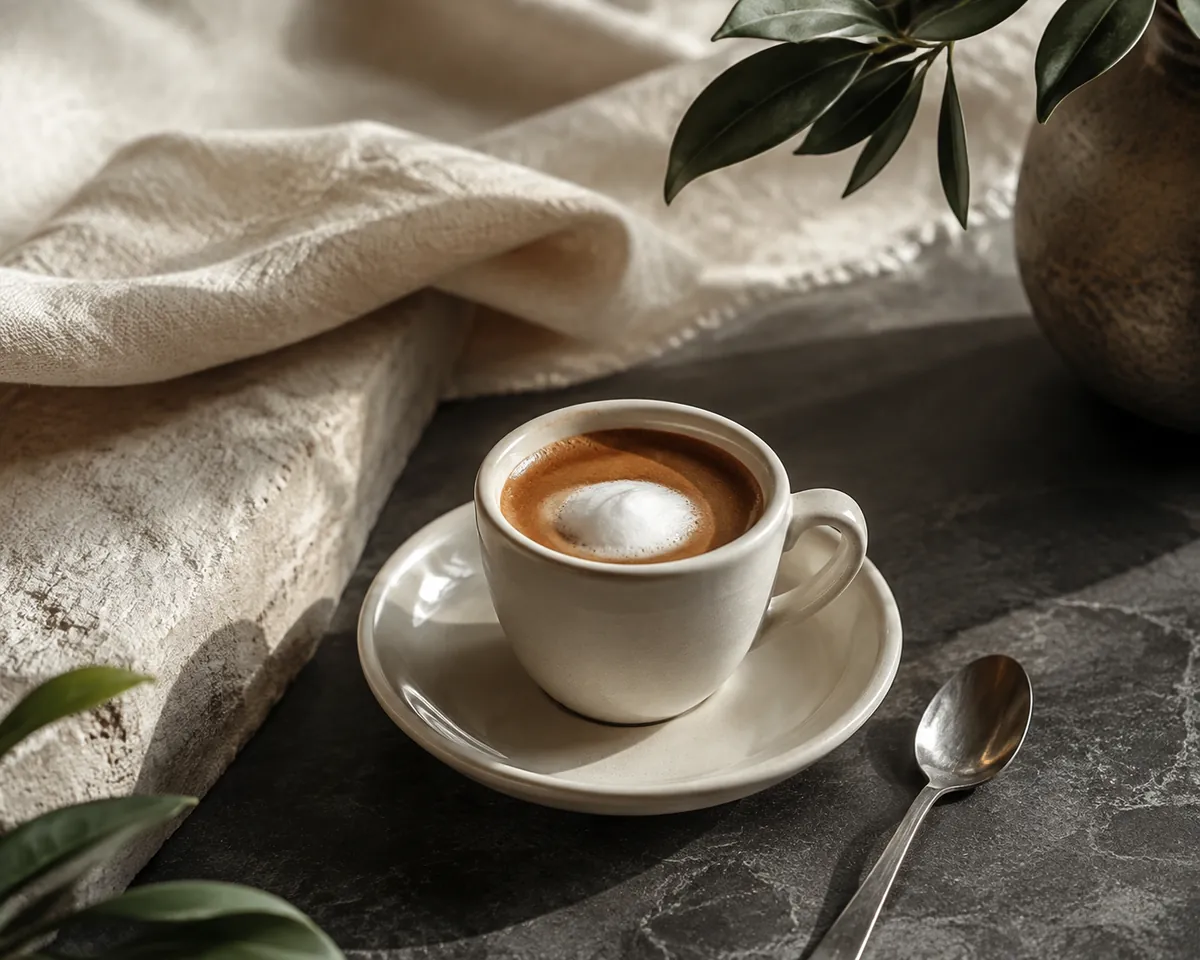
Ask for a macchiato in Rome and you get a shot of espresso with a spoonful of foam on it, in a cup that fits in a palm.
Ask for one in a chain and you may get a 470 ml glass of milk with syrup in it.
Both are called macchiato and neither name is wrong, because the word describes a marking rather than a drink. What changed is which thing is being marked.
Macchiato at a glance
- What the word means
- Marked or stained. It is an adjective that lost its noun
- The Italian drink
- One shot with a teaspoon of foam, 40 to 60 ml in total
- Latte macchiato
- The reverse: a tall glass of milk marked with a shot
- Caramel macchiato
- A large flavoured milk drink, 350 to 470 ml, with the shot on top
- Caffeine
- Similar across all three. Only the volume changes
- How to order
- Say espresso macchiato or latte macchiato in full
What a macchiato is actually marking
Macchiato is the past participle of macchiare, to stain or to mark.
| Name | Full form | What is marked | What arrives |
|---|---|---|---|
| Macchiato | Caffe macchiato | Espresso, marked with milk | A shot with a spoon of foam, 40 to 60 ml total |
| Latte macchiato | Latte macchiato | Milk, marked with espresso | A tall glass of steamed milk with a shot poured through it |
| Caramel macchiato | A trade name | Neither, reliably | Milk, syrup and a shot, usually with the espresso on top |
Read that table once and the confusion resolves. The espresso version marks coffee with milk, the latte version marks milk with coffee, and it is the same two words in the other order.
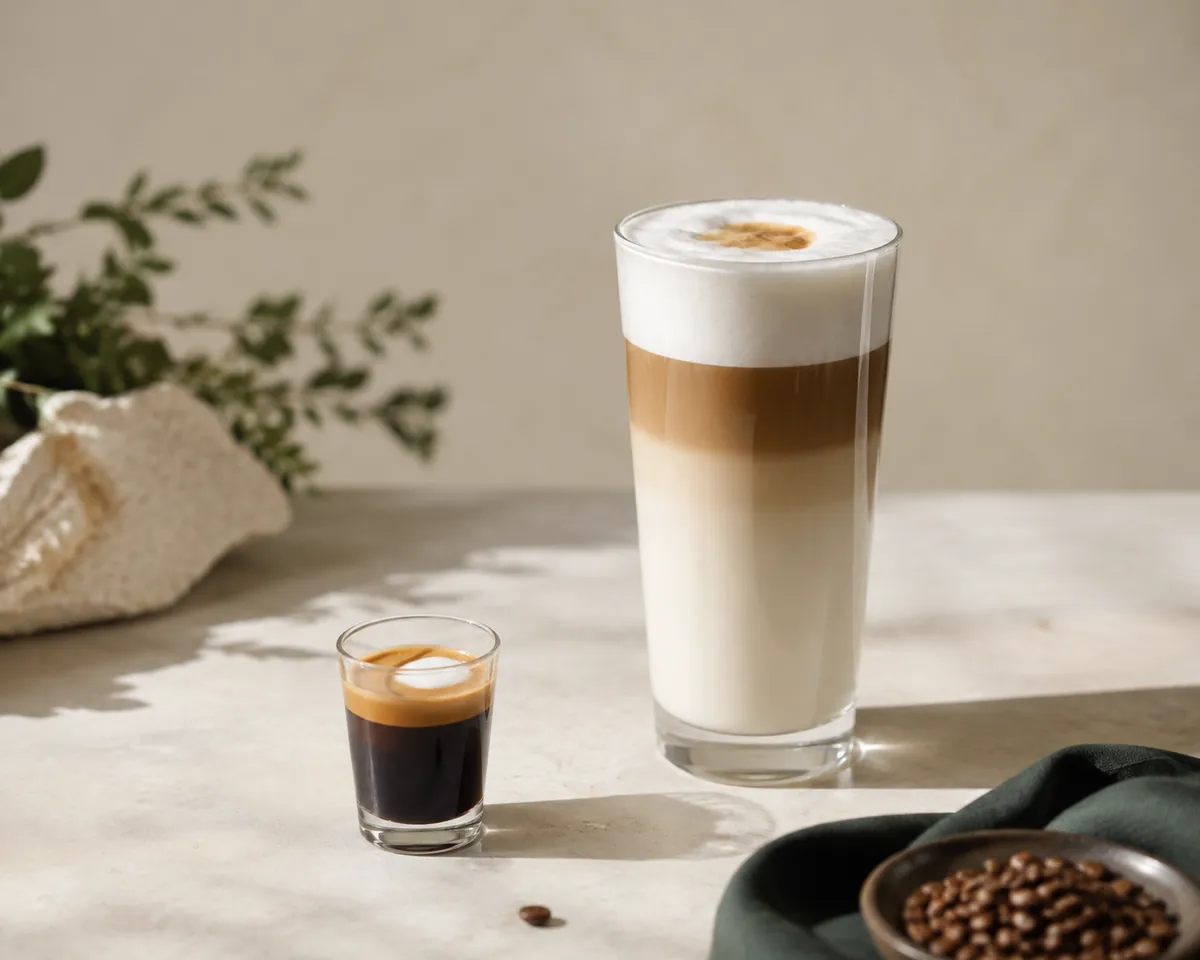
Nothing about the word tells you a size, which is the root of every ordering mistake on this page. A marking can be a teaspoon on a shot or a shot on half a pint of milk, and both descriptions are honest.
Italian does not need the size because the noun is implied. Caffe macchiato is a coffee that has been marked, and a coffee in Italy is an espresso, so the volume is settled before the adjective arrives.
English took the adjective and dropped the noun entirely, which left the word free to attach to anything a shot could be poured onto.
The espresso macchiato
This is the original, and the smallest milk coffee on any menu.
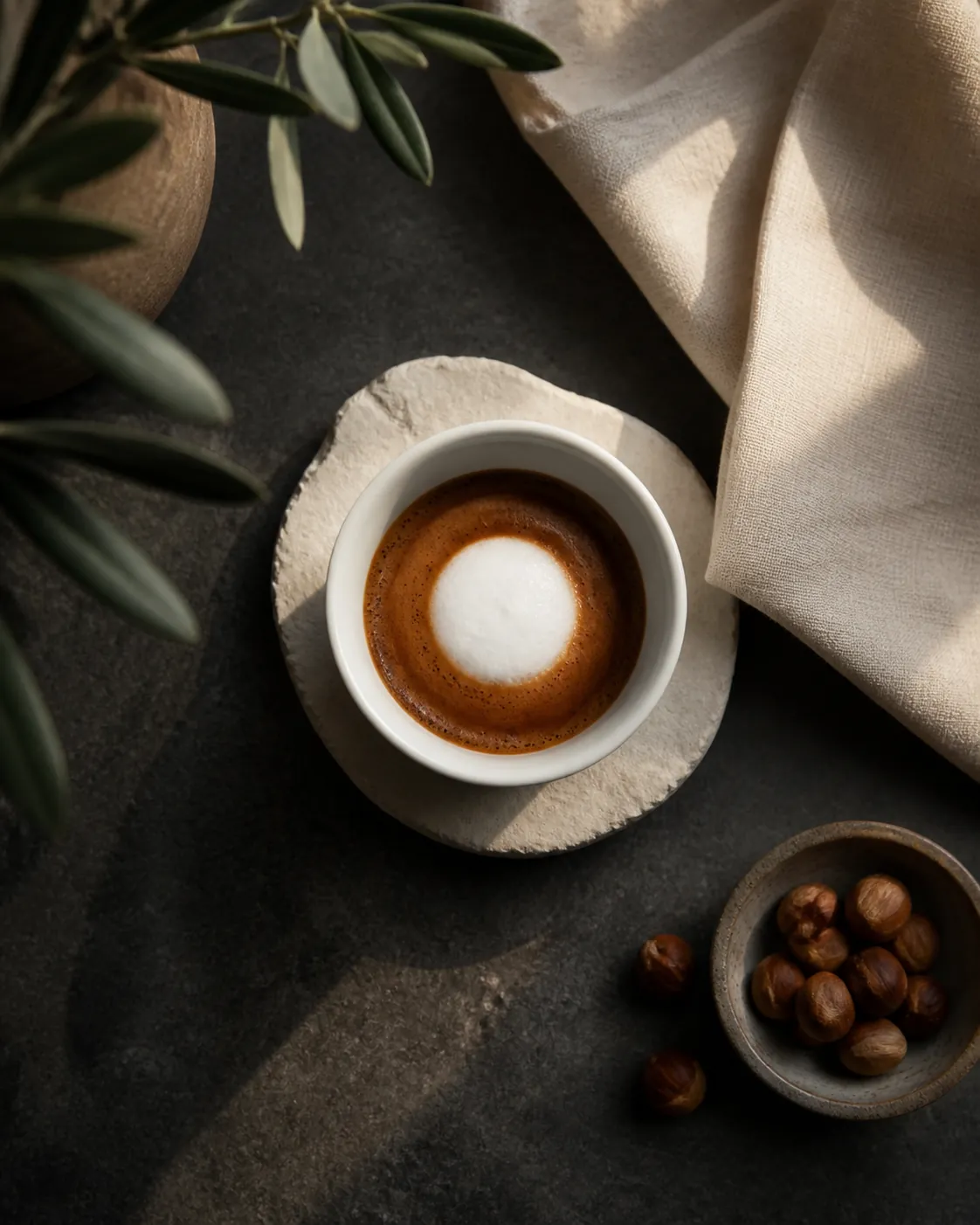
An espresso macchiato
- Espresso
- 1 shot, about 30 ml, or a double where doubles are standard
- Milk
- A teaspoon or two of foam, 10 to 20 ml at most
- Total
- 40 to 60 ml
- Cup
- An espresso cup, warmed
- Sugar
- Common in Italy, added by the drinker
The foam is doing a specific job. A spoon of it softens the sharp front edge of a shot without lengthening the drink, so what you taste is espresso with the corners taken off rather than coffee with milk in it.
That is why it is ordered by people who find espresso slightly too aggressive and a cortado too long. It sits between the two and is much closer to the first, and what a macchiato tastes like takes that narrow gap apart properly.
A doppio macchiato is two shots with the same spoon of foam, and it is the order most people want after their first single. The foam does not scale with the coffee, so twice the espresso under the same spoonful reads as noticeably sharper.
That is also the more common default outside Italy, where machines are set up for doubles. If a macchiato arrives darker and larger than expected, that is usually why rather than a mistake.
The latte macchiato
A milk drink that happens to contain coffee.
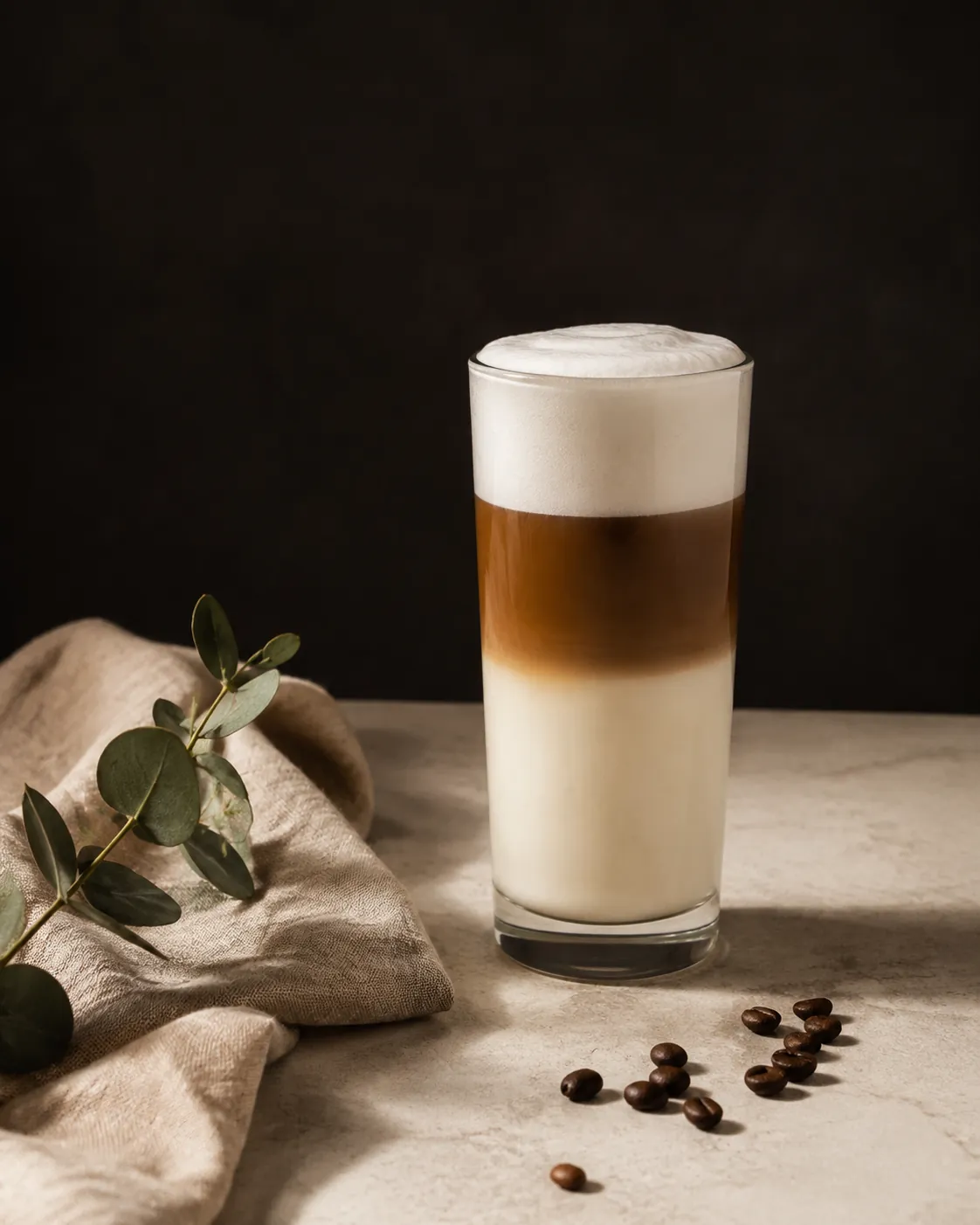
It is built in the opposite order from everything else on the menu. Steamed milk goes into a tall glass first and is left to settle, so the denser liquid milk sits below the foam, and the shot is then poured slowly through, where it sinks part way and stops.
Why the layers hold
- Milk firstSteam it slightly wetter than for a cappuccino, pour it in and let it stand for thirty seconds so the foam separates and floats.
- Pour the shot slowlyA thin stream down the centre. Espresso is denser than foam and less dense than the sugars in warm milk, so it settles between the two.
- Do not stirThe bands are the drink. Stirring gives you a weak latte in a glass that shows it.
- Serve with a long spoonThe layers are meant to be broken by the drinker, in their own order.
It is a genuinely different drink from a latte despite the shared word. A latte is mixed and a latte macchiato is not, so the first mouthful is milk and the last is coffee.
That sequence is the whole appeal, and it is also why the drink disappoints anyone who stirs it out of habit. Stirred, it is a weak latte served in glassware that advertises what it used to be.
The caramel macchiato, and how the name spread
The chain drink is a third thing, and the name is doing marketing rather than description.
It is built as vanilla syrup, steamed milk, then espresso poured on top so the coffee marks the surface, then caramel sauce. The marking is real, which is where the name has a foot to stand on, and the proportions are those of a flavoured latte built on flavoured syrup rather than on chocolate as a mocha is.
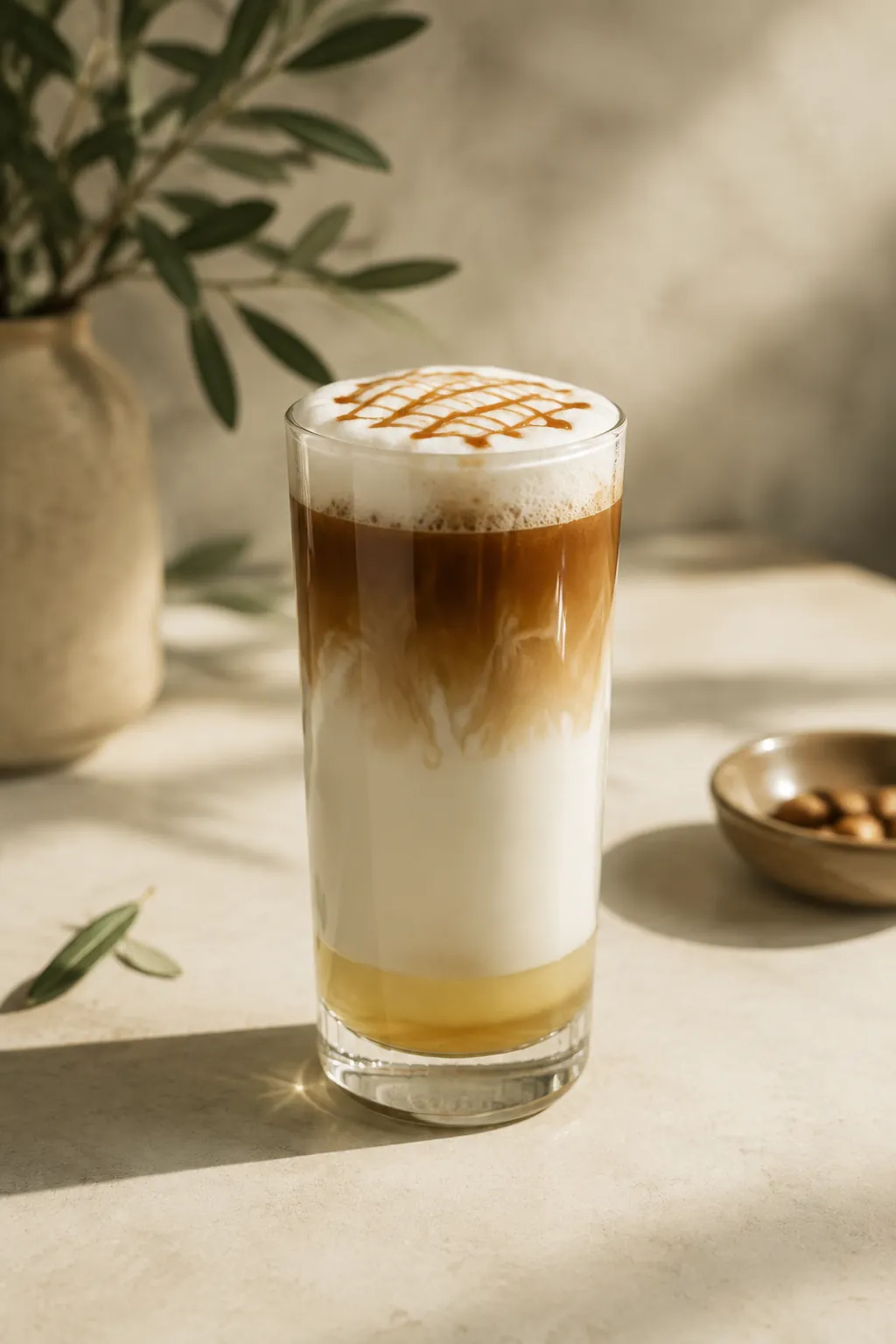
What it is
A large flavoured milk drink, typically 350 to 470 ml, with one or two shots.
Why it is called that
The espresso goes in last and marks the milk, rather than being mixed through.
What it is not
An espresso macchiato. The two differ by a factor of eight in volume.
How to order the small one
Ask for an espresso macchiato by that full name, or for a shot with a spoon of foam.
The word reached most of the world through a chain menu rather than through Italy, and that decided what people expect. A drink named for how it is assembled is easy to extend: once macchiato meant espresso poured on last, any large flavoured milk drink could take the name, and several did.
The Italian sense survived in Italy and in specialty cafes, which is why the two meanings now sit at opposite ends of the same menu in some cities. Neither side is going to give the word up.
None of this makes the chain drink bad. It is a sweet milk coffee and it is sold as one, and the only problem it creates is at the counter, when someone wanting 50 ml is handed 470.
How to order the one you meant
Menu wording is unreliable, so the safest orders are descriptive.
| If you want | Say | What tells you it is right |
|---|---|---|
| The Italian one | An espresso macchiato | It arrives in an espresso cup |
| A little more milk | A wet espresso macchiato | Still under 70 ml, slightly paler |
| The layered glass | A latte macchiato | Tall glass, three visible bands |
| The sweet one | A caramel macchiato | It comes with syrup and a lid |
In Italy the single word means the espresso version and nothing else. Elsewhere the single word is a coin toss, and adding espresso or latte in front of it costs nothing.
When a barista asks you to be specific, it is neither pedantry nor upselling. A cafe serving both the Italian drink and the chain-style one has no way to guess which you mean, and the two differ by a factor of eight in volume and by several times in price.
Getting it wrong wastes a drink either way. Saying espresso macchiato or latte macchiato in full settles it in three words, and in a place that only serves one of them the extra word costs nothing.
How to make a macchiato at home
The espresso version is the easiest milk coffee to make well, because the quantity of milk is too small to get wrong.
An espresso macchiato without a wand
- Warm the cupA 60 ml cup holds very little heat. Rinse it with boiling water first.
- Froth a small amount40 ml of milk in a jar or a hand milk frother, 20 seconds. You need a spoonful, not a jug.
- Pull the shotStraight into the warmed cup.
- Spoon, do not pourTake the foam off the top with a teaspoon and place it on the crema. Pouring sinks it and lengthens the drink.
A moka pot works as the base if you have no machine, though the result is closer to a marked strong coffee than to a marked espresso, since there is no crema for the foam to sit on. An espresso machine is the only route to the real thing, and making a macchiato covers both bases in more detail.
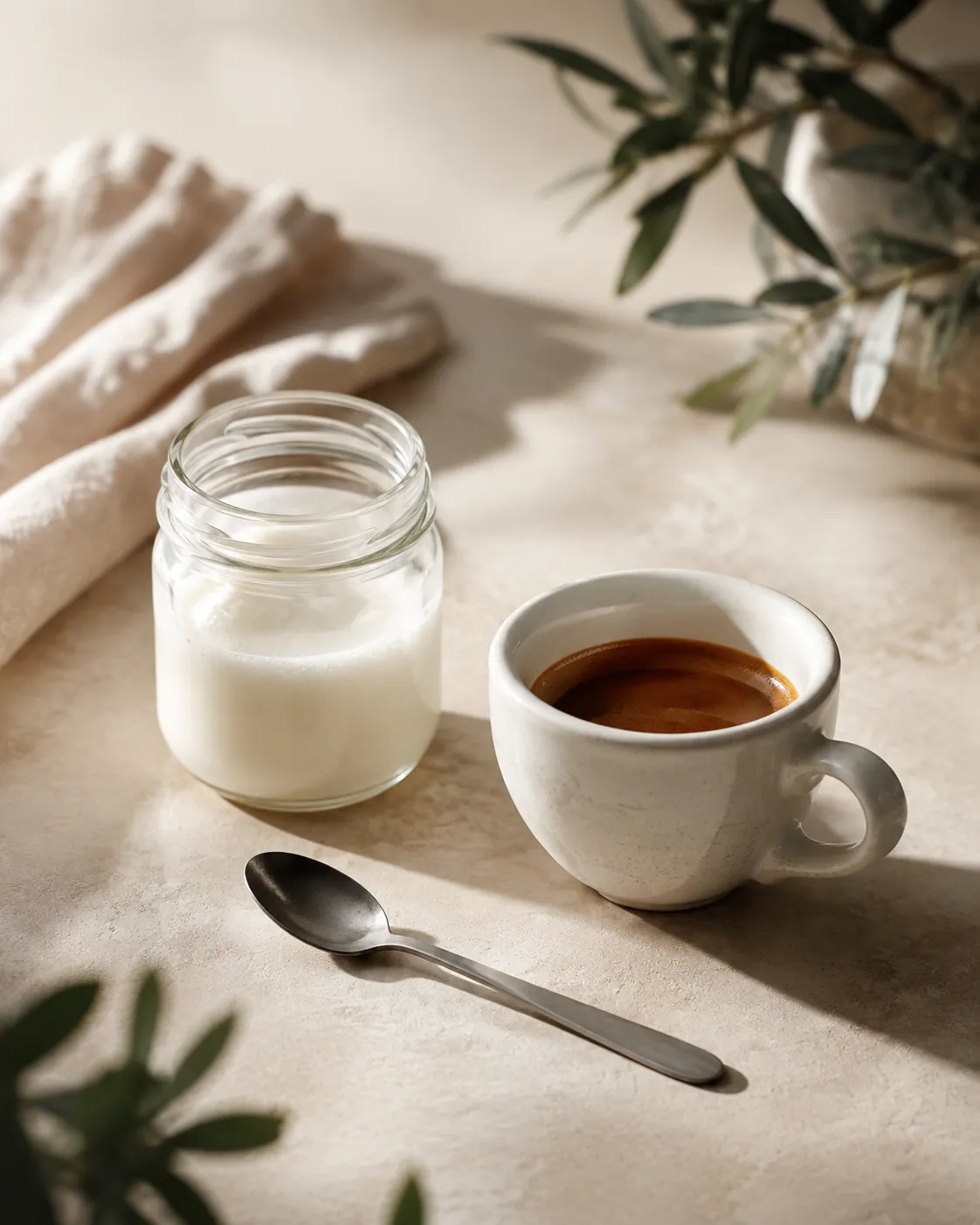
A spoon of foam is the least demanding job any milk is asked to do here, and almost anything manages it. Splitting is the only real risk, and it is at its highest in this drink: a hot, fresh, acidic shot with a very small quantity of milk on top is the exact condition that curdles a carton.
Soy splits most readily and oat least, which is the reverse of how they rank for foam. Why that happens, and how to stop it, is set out under why plant milk curdles in coffee, and it heads the list in macchiato problems.
Why the cup size is fixed, and why Italy adds sugar
An espresso macchiato lives in an espresso cup and stops working in anything bigger.
The drink is 40 to 60 ml. In a 60 ml cup that fills it, the foam sits against the rim and the crema is held under it, so the two stay in contact until the last mouthful.
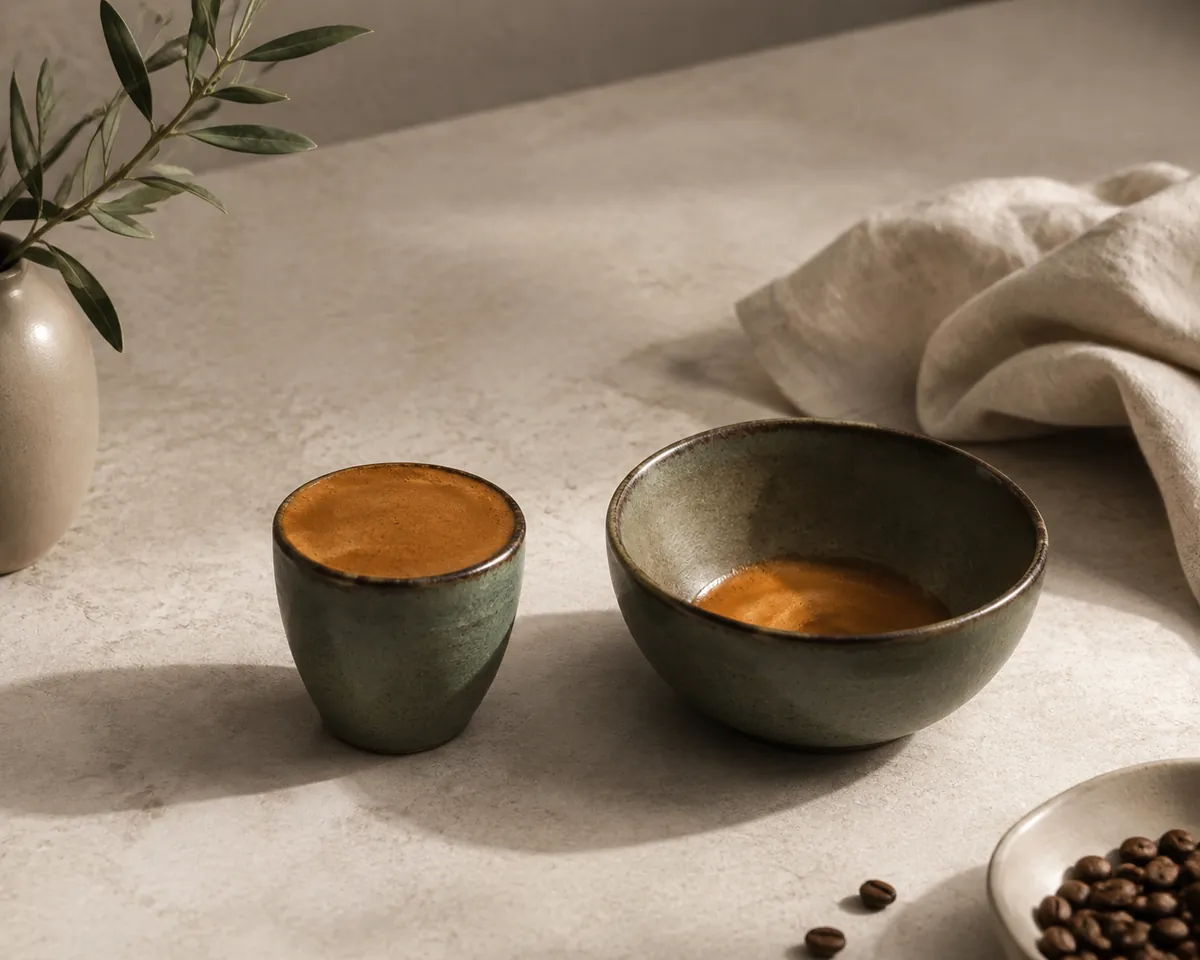
Put the same drink in a 150 ml cup and the foam spreads thin across a wide surface, cools within a minute and drains into the coffee. What you are left with is a cold espresso with milk stirred through it.
That is also why a warmed cup matters more here than for any larger drink. There is so little liquid that a cold ceramic cup takes several degrees out of it before it reaches the table.
The same arithmetic explains the sugar. A teaspoon in 50 ml is a much higher concentration than the same spoon in 180 ml, so it registers immediately and the drink is finished before the sugar settles, where in a larger milk drink it reads as faintly sweet and sinks.
A 60 ml cup
Foam meets the rim, crema stays under it, and the two hold together to the last mouthful.
A 150 ml cup
Foam spreads thin, cools in a minute and drains into the coffee.
A cold cup
Takes several degrees out of 50 ml before it reaches the table.
A teaspoon of sugar
Reads as sweet immediately at this volume, and faintly at latte volume.
The foam holds that sugar at the top for the first mouthful, which is part of why the drink is drunk quickly and standing up.
How much caffeine is in a macchiato
Similar across all three, and they taste nothing alike.
Ordering the large sweet one because the small one felt strong does not reduce the caffeine. It dilutes it, which changes how the drink tastes and not what is in it.
That surprises people more than any other fact on this page, because volume reads as strength on a menu. A 470 ml macchiato and a 50 ml one built on the same double shot carry the same coffee.
What changes is the rate. Fifty millilitres is finished in two mouthfuls and 470 takes twenty minutes, so the same caffeine arrives over very different spans and feels different for that reason alone.
Shot count is the only number worth reading on a menu, since everything else on the cup is milk, ice and syrup. Caffeine in a macchiato sets the three versions against each other, and caffeine by brew method puts an espresso shot against everything else on this site.
The iced versions, and the same confusion again
Every one of the three drinks has a cold form, and they diverge further than the hot ones do.
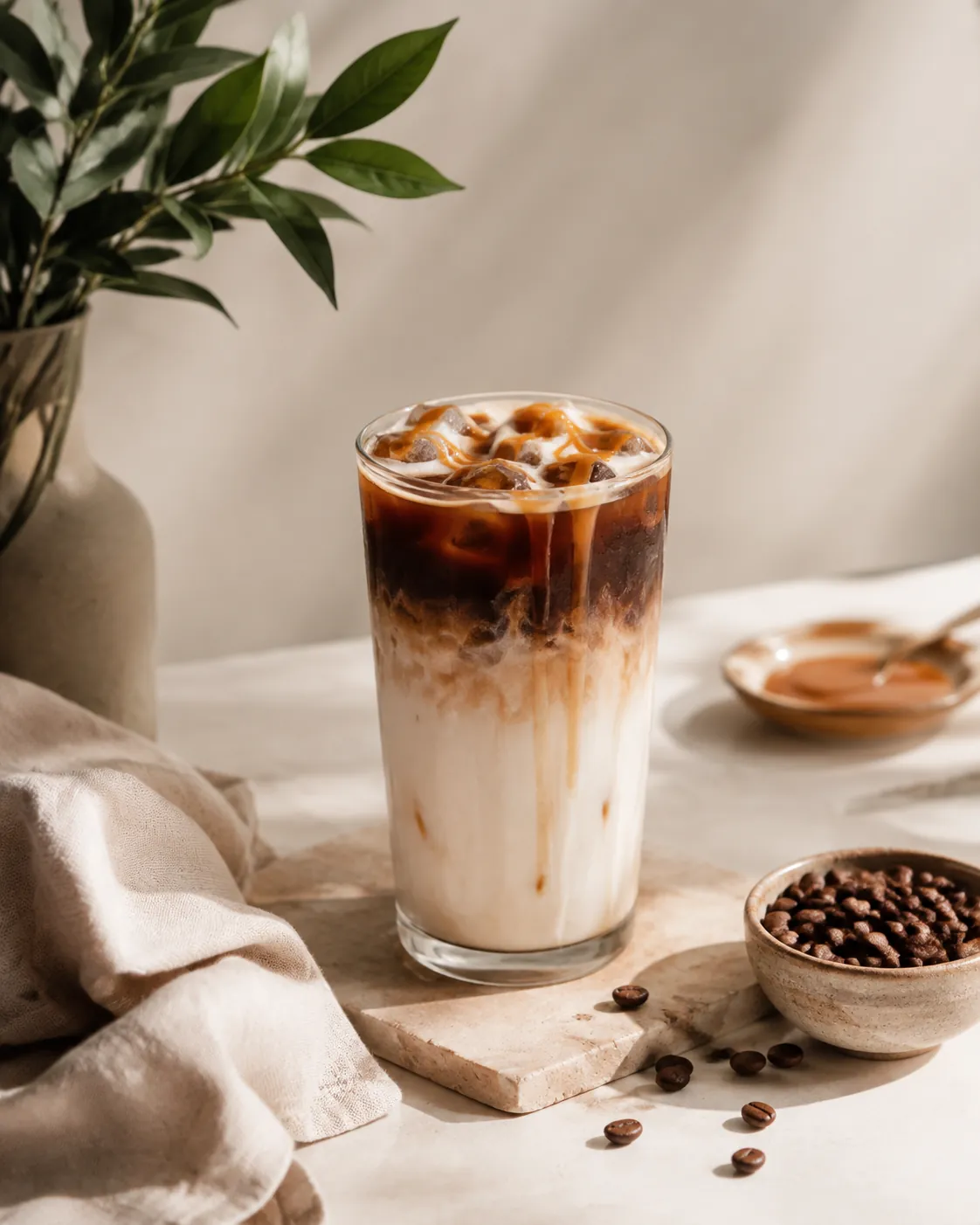
| Order | Built as | Volume |
|---|---|---|
| Iced espresso macchiato | A shot over a little ice, a spoon of cold foam on top | 80 to 120 ml |
| Iced latte macchiato | Cold milk and ice, shot poured through, unstirred | 300 to 400 ml |
| Iced caramel macchiato | Syrup, milk, ice, shot on top, sauce over | 350 to 470 ml |
The cold foam is the interesting part. Milk whipped cold holds because of protein rather than heat, so it is denser and stiffer than steamed foam and sits on ice without draining.
That is why the iced versions keep their layers better than the hot ones do. A hot latte macchiato loses its bands within a few minutes, and an iced one holds them until it is stirred.
Ice does the rest of the work. It keeps the milk dense and the shot floating on top of it, where in a hot glass the whole thing slowly equalises as it cools.
The iced espresso version is the one most cafes will not have heard of. Asking for a shot over a little ice with a spoon of cold foam describes it in a sentence and gets it made.
Where a macchiato sits on the menu
Lined up by how much milk each drink carries, the macchiato is at one end and its own namesake is near the other.
Milk, least to most
- EspressoNone
- Espresso macchiatoA spoon of foam
- CortadoAbout equal parts
- Flat whiteRoughly twice the coffee
- CappuccinoTwice the coffee, a third of it air
- Latte and latte macchiatoFour times the coffee or more
A cappuccino and a flat white sit in the middle of that scale and differ from each other by air rather than by milk. The macchiato is the only entry that is still recognisably a shot.
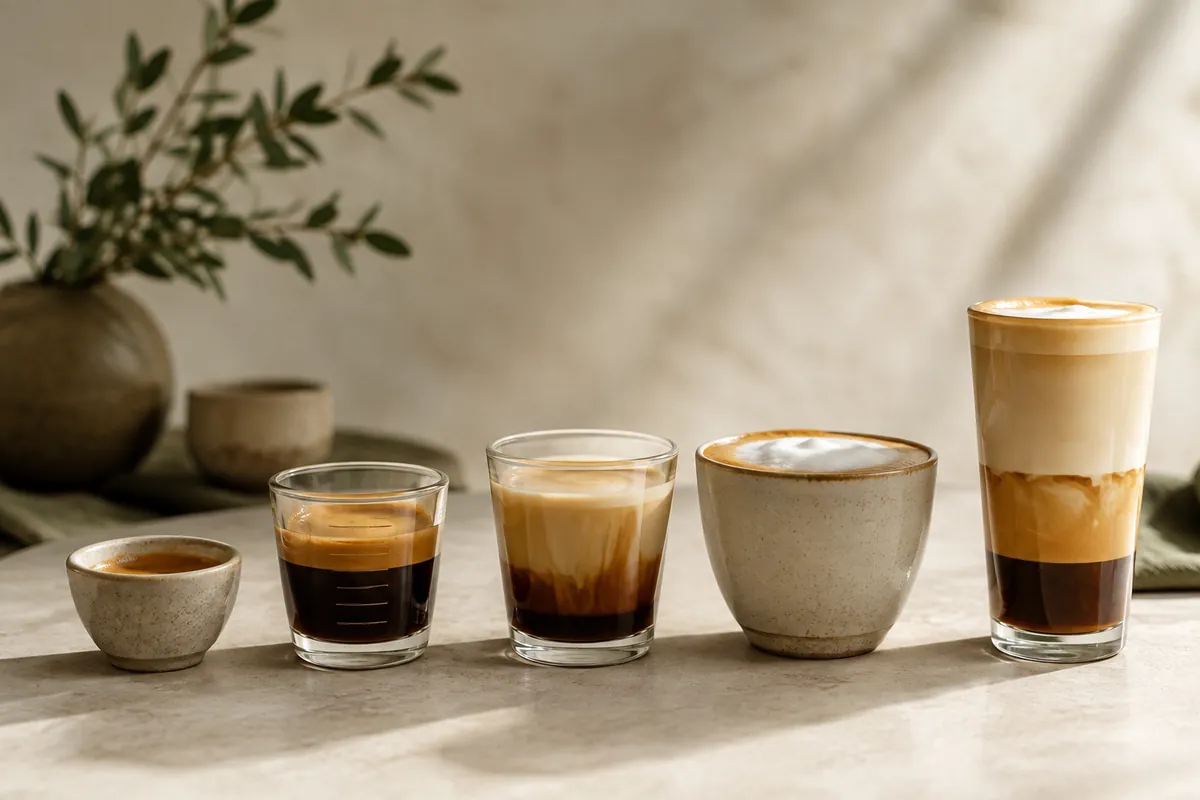
That position is the reason it survives on specialty menus at all. Every other milk coffee is a way of making espresso longer, and this one is a way of making it slightly gentler without making it bigger.
Common questions
What is the difference between a macchiato and a latte macchiato?
They are opposites. An espresso macchiato is a shot marked with a spoon of foam, about 50 ml in an espresso cup. A latte macchiato is a tall glass of steamed milk marked with a shot poured through it, and it is four to six times the volume.
Is a caramel macchiato a real macchiato?
It is a flavoured milk drink named for the way it is assembled: the espresso goes in last and marks the milk. It shares the marking and nothing else with the espresso version, which is roughly an eighth of its size.
How much milk is in an espresso macchiato?
A teaspoon or two of foam, 10 to 20 ml. The whole drink is 40 to 60 ml, and the milk is there to soften the front edge of the shot rather than to lengthen it.
Why do the layers stay separate in a latte macchiato?
Density. The foam floats, the liquid milk sits at the bottom, and espresso poured slowly settles between them. Stirring destroys the effect and leaves a weak latte.
What should I order to get the small Italian one?
Ask for an espresso macchiato by that full name. Outside Italy the single word is unreliable, and the full name arrives in an espresso cup rather than a tall glass.