Cappuccino vs Latte
Cappuccino vs Latte: Where the Foam Stops and the Milk Starts
A cappuccino gives about a third of a small cup to foam. A latte lets the milk run to 250 ml and folds a thin cap through it. Axis by axis, those two decisions explain the cup, the drinking window and the plant drinks, and on caffeine neither one wins.
A cappuccino is 150 to 180 ml with 1 to 2 cm of foam standing proud of about 60 ml of liquid milk. A latte is 240 to 350 ml with 200 ml or more of liquid milk and roughly 5 mm of foam folded through it. The shot is the same in both, so the caffeine is the same, and the espresso meets two or seven times its own volume in liquid milk depending on which cup it went into.
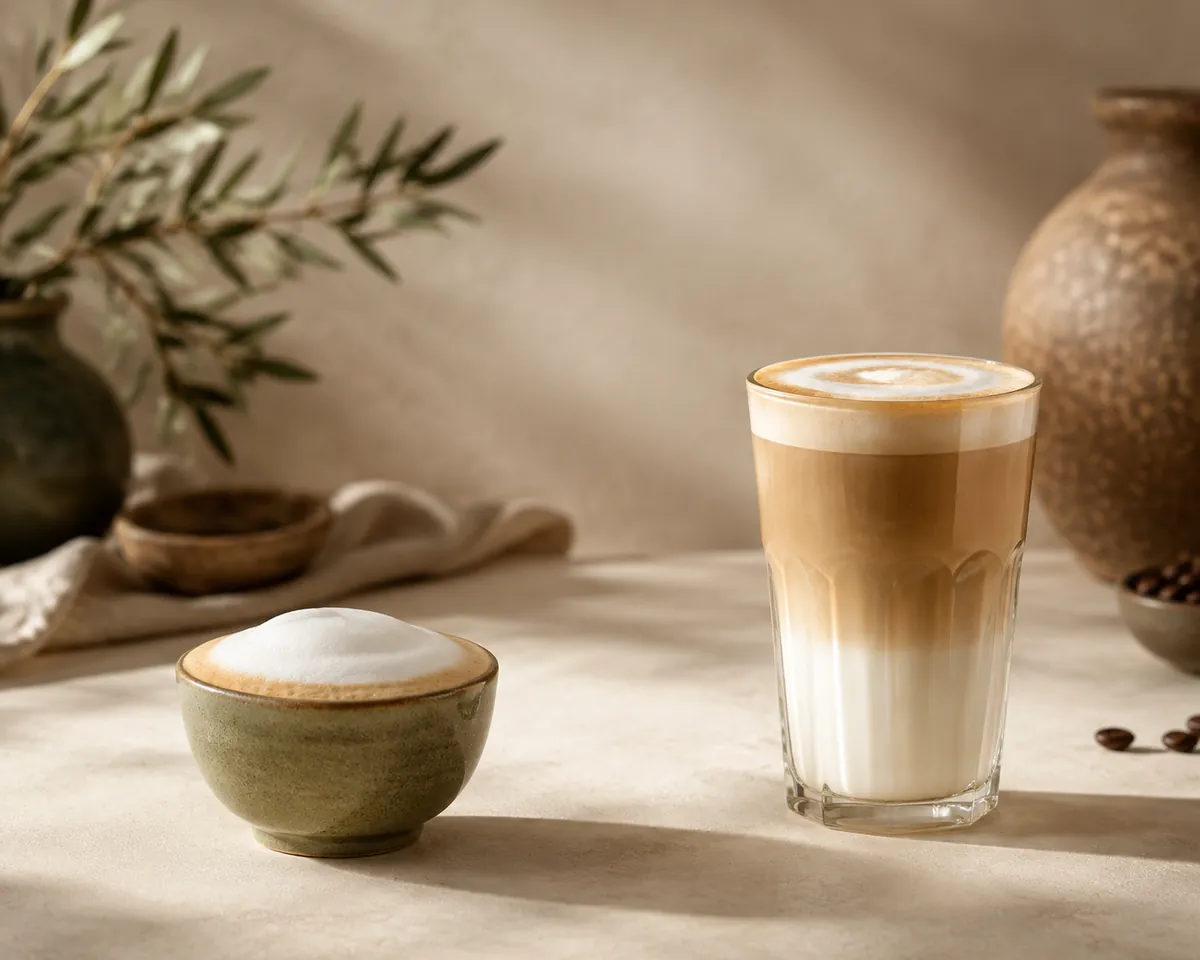
Side by side
| Attribute | Cappuccino | Latte |
|---|---|---|
| Total volume | 150 to 180 ml | 240 to 350 ml |
| Foam depth | 1 to 2 cm, standing proud of the liquid | About 5 mm, folded through the milk |
| Liquid milk | Around 60 ml | 200 to 250 ml |
| Espresso to liquid milk | Roughly 1:2 on a single shot | Roughly 1:7 on a single shot |
| Caffeine | Set by the shot count | Set by the shot count, and identical for identical shots |
| Vessel | Wide, short and thick-walled | Tall glass or a large cup |
| Scales to a large size | Poorly, since the foam has a ceiling | Well, since the extra volume is milk |
| Plant drink asked for | One that builds a stable cap | One that resists splitting against a hot shot |
| Iced version | Barely exists without rebuilding the drink | A standard item, made with no texturing |
| Holds up on a desk | Poorly, since air cools fast | Well, with 250 ml of liquid behind it |
The same shot, and then two different decisions about the milk
Both drinks begin in exactly the same way. A shot of espresso goes into a warmed vessel, milk is steamed in a jug, and the two are put together.
Everything that separates them happened between those two moments, in choices about air and about volume.
A cappuccino keeps the total down to roughly 150 to 180 ml and hands about a third of that to foam. A latte turns the other dial instead: the milk runs to 200 or 250 ml, and the foam is folded in at about 5 mm rather than stacked on top.
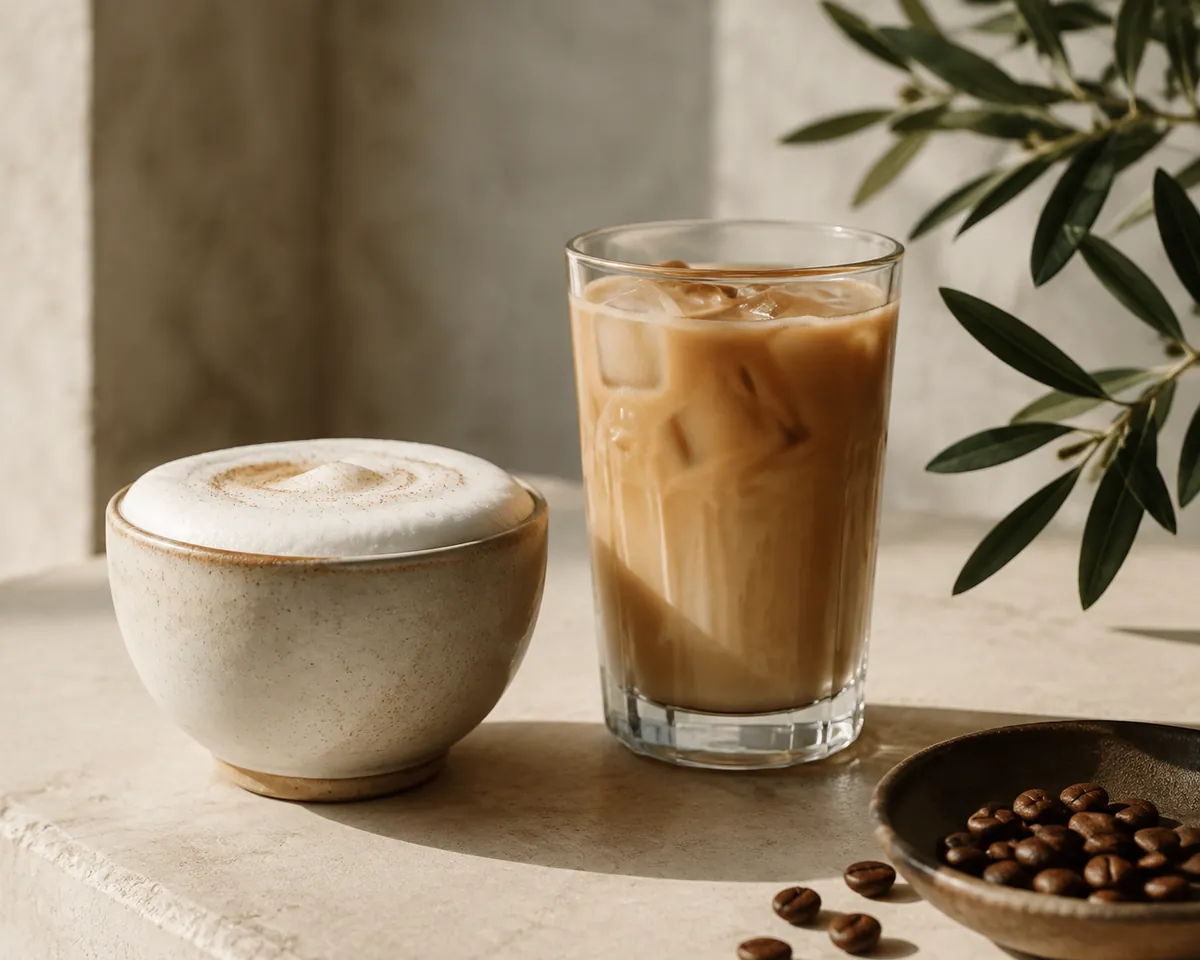
So there are two dials here, air and volume, and each drink turns up one of them while leaving the other where it was. That one sentence predicts the cup shape, the drinking window, the behaviour of plant drinks in each, and the reason one of the two refuses to be sold large.
One espresso, built two ways
- Espresso, cappuccino
- 1 shot in Italy, a double almost everywhere else
- Espresso, latte
- 1 or 2 shots, depending on the size of the glass
- Liquid milk, cappuccino
- Around 60 ml, poured under the cap
- Liquid milk, latte
- 200 to 250 ml, which is most of the drink
- Foam, cappuccino
- 1 to 2 cm, standing proud of the liquid
- Foam, latte
- About 5 mm, folded through rather than resting on it
- Total volume
- 150 to 180 ml against 240 to 350 ml
Neither dial is a quality setting. More air is not better milk, and more milk is not a longer drink in any sense the coffee cares about, which is why this pairing is a fork in the road rather than a ranking.
How much foam actually sits between them
Foam depth is the measurable difference, and in absolute terms it is tiny. One drink carries a centimetre or two standing proud of the liquid beneath it, and the other carries five millimetres worked into the body of the milk.
That centimetre changes what the mouth meets first. Foam is mostly air across an enormous surface area, so the cappuccino gives a light, almost dry first impression and then the liquid underneath arrives a moment later.
The latte comes as one continuous liquid with a slight softness at the lip and nothing sitting above it.
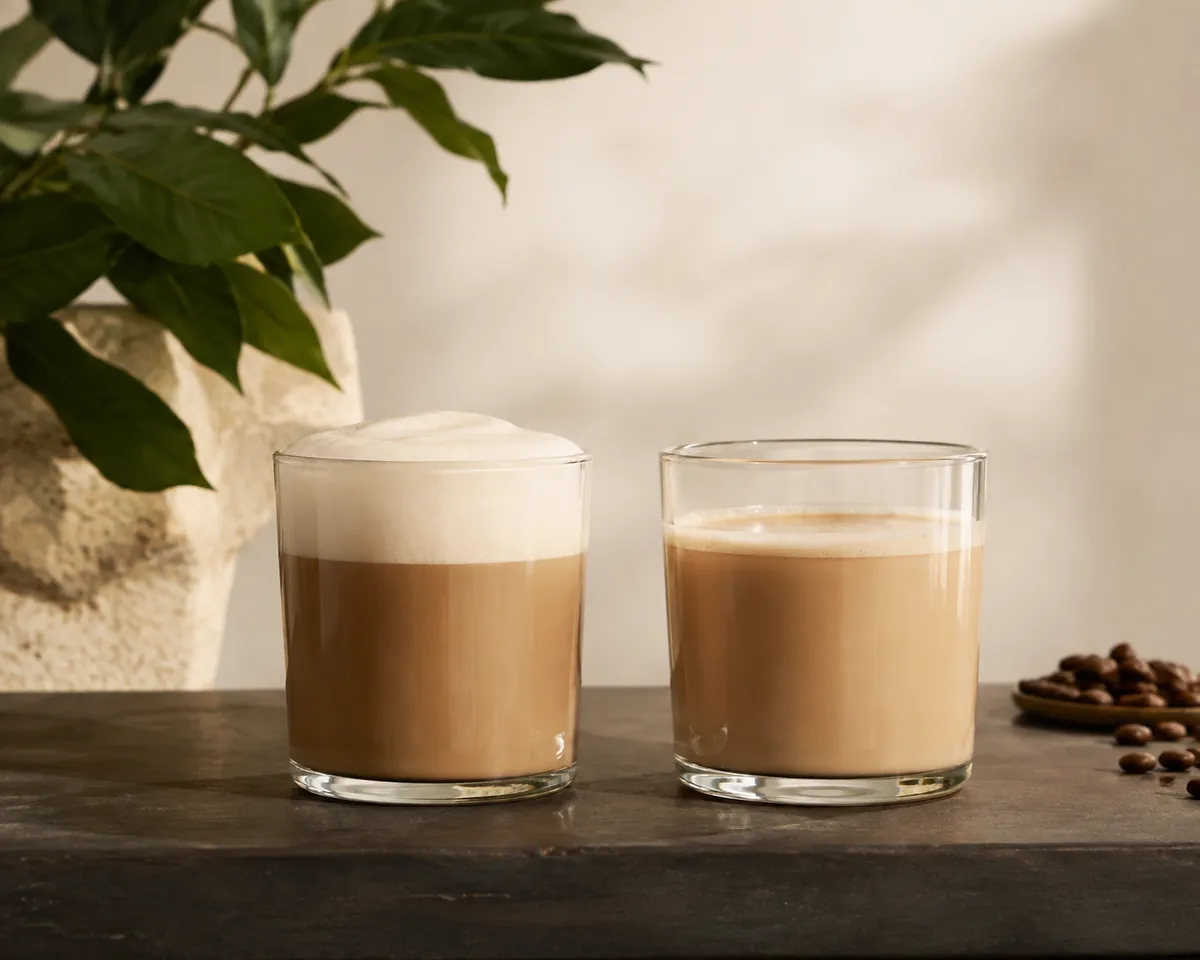
| Cappuccino | Latte | |
|---|---|---|
| Foam depth | 1 to 2 cm | About 5 mm |
| Where it sits | Proud of the milk, as a distinct cap | Folded into the milk as it pours |
| Bubble size | Too small to see, in a good one | Too small to see, in a good one |
| First impression | Airy, then the liquid | One continuous liquid throughout |
| Survives ten minutes | Poorly, since air has no thermal mass | Better, since there is far more liquid |
Both are microfoam when they are made properly, which is the part most descriptions get wrong. Bubble size is identical in the two jugs and only the depth differs, so calling one frothy and the other smooth misdescribes what the milk frother or the steam wand was asked to do.
A stiff matt cap that holds a peak is a fault in either drink. Milk aerated into large visible bubbles drains back within a minute and leaves warm milk under a collapsing crust, and the same jug would have poured an equally poor latte.
Why one of them scales to a large cup and the other does not
Milk holds only so much air before the bubbles grow big enough to see, and that ceiling belongs to the protein rather than to the person holding the jug. It is the constraint that decides how each drink behaves on a chain menu.
Doubling a latte means doubling the milk. That is a bigger jug, a longer steam and a slightly harder pour, but the drink at the end is recognisably the same thing scaled up, because the thin cap is a small fraction of a large volume either way.
Doubling a cappuccino means doubling the foam as well, and a 300 ml jug textured to the same fineness is a genuinely harder job than 150 ml.
Most large cappuccinos quietly solve this by adding liquid milk instead of air, at which point the proportions have gone and the name is doing work the drink is not.
How each survives being made larger
- Latte, 350 mlUnchanged in character. More milk, same thin cap
- Latte, 240 mlThe reference size, and the easiest pour of the four
- Cappuccino, 180 mlThe volume the thirds were drawn for
- Cappuccino, 300 mlUsually more milk rather than more foam, so the cap goes thin
- Cappuccino, 450 mlA latte with a hat, whatever the board says
Scale is the honest tiebreaker when a menu offers only large sizes. Ordering the smallest cappuccino available gets you closer to the drink than ordering a large one, and a large latte loses nothing at all.
Which one tastes more of coffee
Same shot, different amount of milk around it, so this is arithmetic before it is preference. The direction is not in doubt, and the size of the gap is what surprises people.
Count liquid rather than volume, because foam is air. A single-shot cappuccino puts roughly 30 ml of espresso against about 60 ml of liquid milk.
The same shot in a 240 ml latte sits against 200 ml or more.
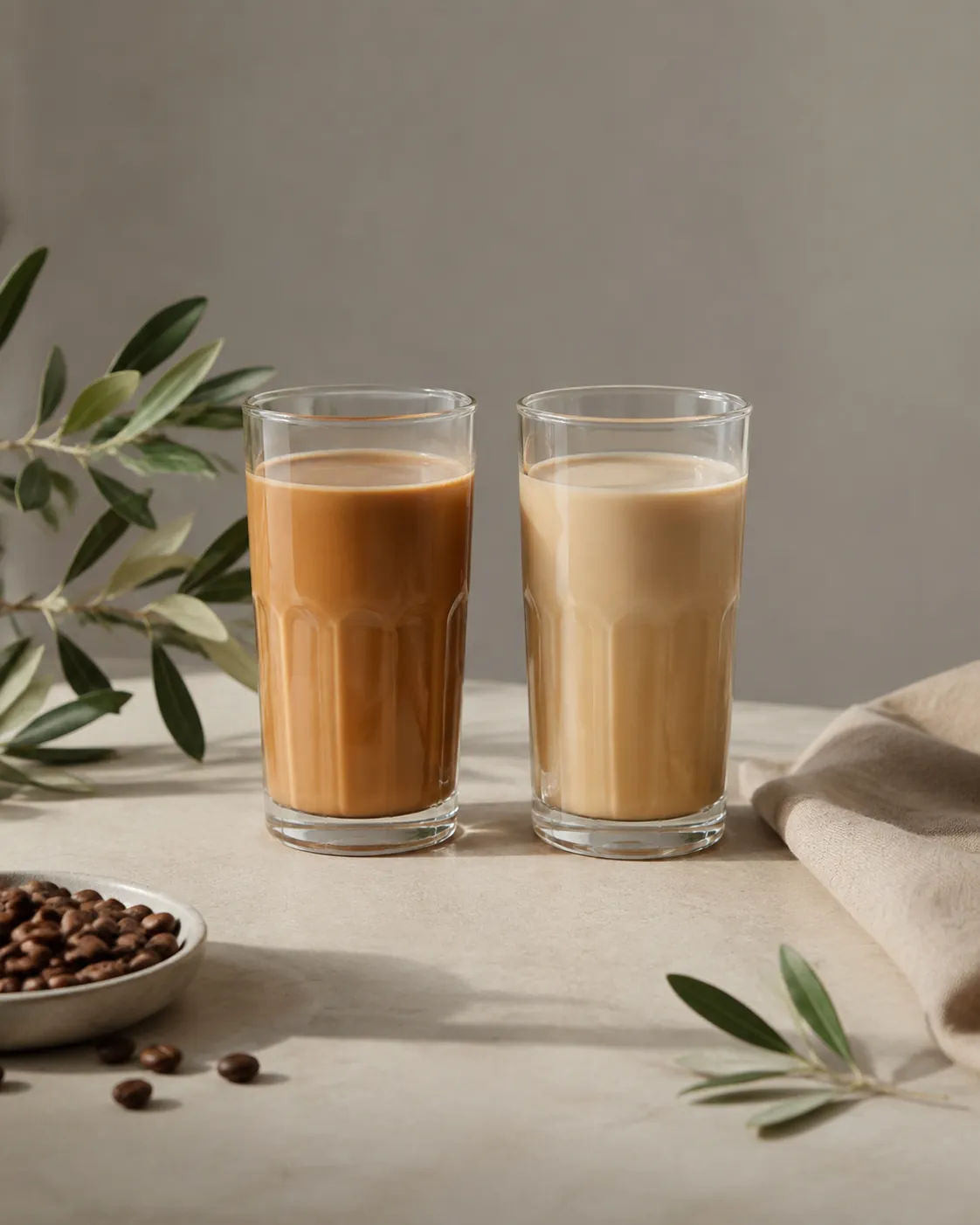
The colour reports it before you taste anything. A correct cappuccino reads as a warm brown through the foam and a latte reads pale, which is why anyone who finds a latte weak has usually ordered the wrong size rather than the wrong drink.
Where this stops being a straight comparison is shot count. Two shots in a small cappuccino and two shots in a large latte are still a long way apart, but two shots in a latte and one in a cappuccino land much closer together than the names suggest, and a flat white sits deliberately in that overlap.
What the cup is doing in each case
Cup shape is not decoration in either drink. Each one is a solution to a different problem, which is why the two vessels look nothing alike and do not swap.
A cappuccino cup is wide, short and thick-walled. The width gives the foam the surface area it needs to settle as an even layer instead of a dome, the height keeps the volume near 180 ml, and the wall thickness slows the heat loss that would otherwise collapse the cap.
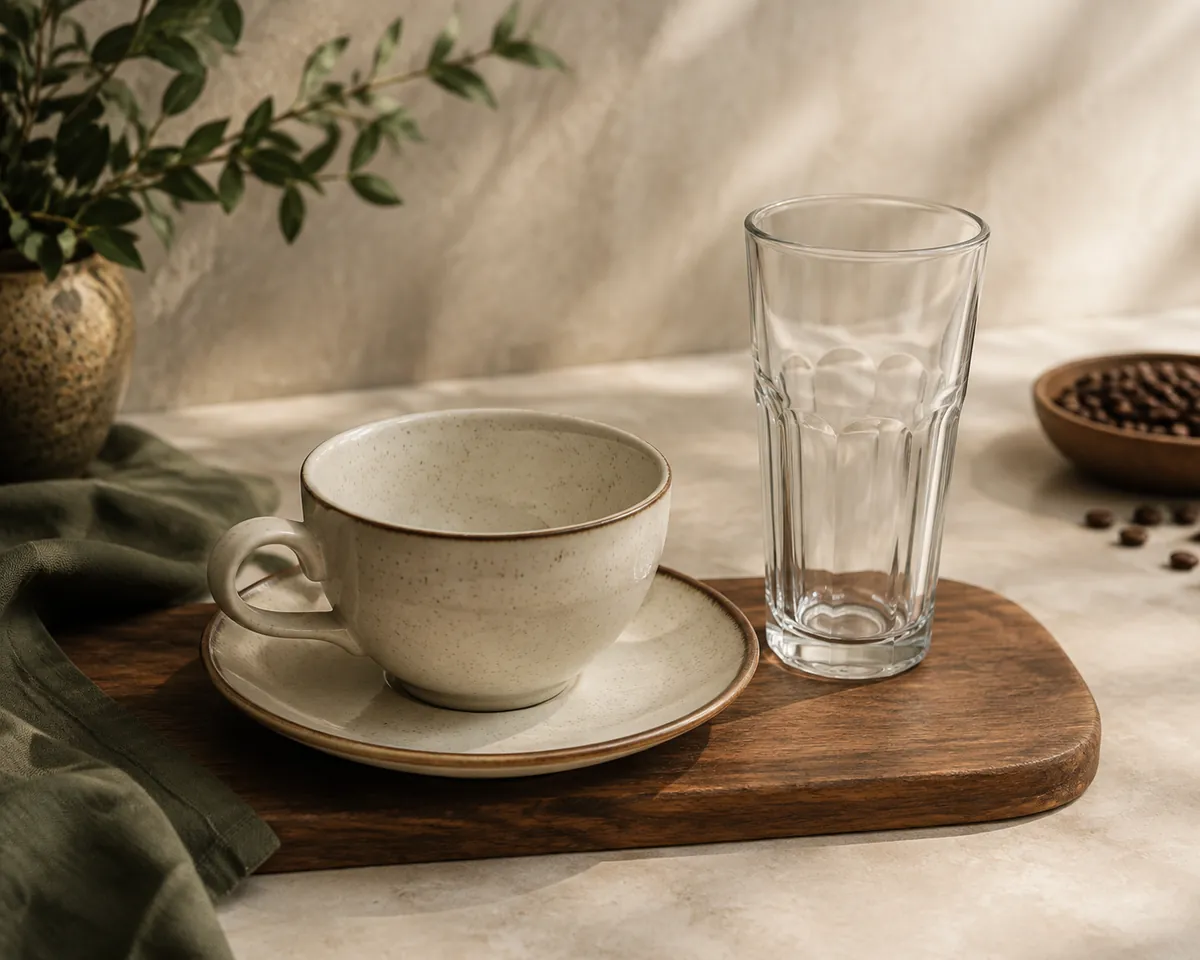
Wide and short
The cappuccino answer. Surface area for the foam, and a volume the proportions still fit
Tall and clear
The latte answer. Shows the milk running through the coffee, and holds 300 ml without looking absurd
Thick ceramic
Holds heat around a small drink that has very little thermal mass of its own
Thin glass
Loses heat faster, which matters less when there is 250 ml of hot milk in it
Warmed, either way
A cold vessel takes several degrees out of a cappuccino before it reaches the table
Handled or bare
A latte glass is often served without a handle, and reaches the table cooler for it
Time is the axis nobody mentions. A cappuccino is a drink to finish, because air cools fast and a flat cap is a different drink from the one that was poured.
A latte will sit on a desk for twenty minutes and still be a latte, which is a genuine practical advantage and has nothing to do with flavour.
How each behaves once the dairy comes out
Plant drinks do not fail in one general way, they fail in two specific ways, and these two cups ask about different ones. That is the most useful thing to know before ordering either without dairy.
A cappuccino is a question about foam. It needs a drink with enough protein to build a stable cap, and it will expose anything that produces large bubbles within seconds of the pour.
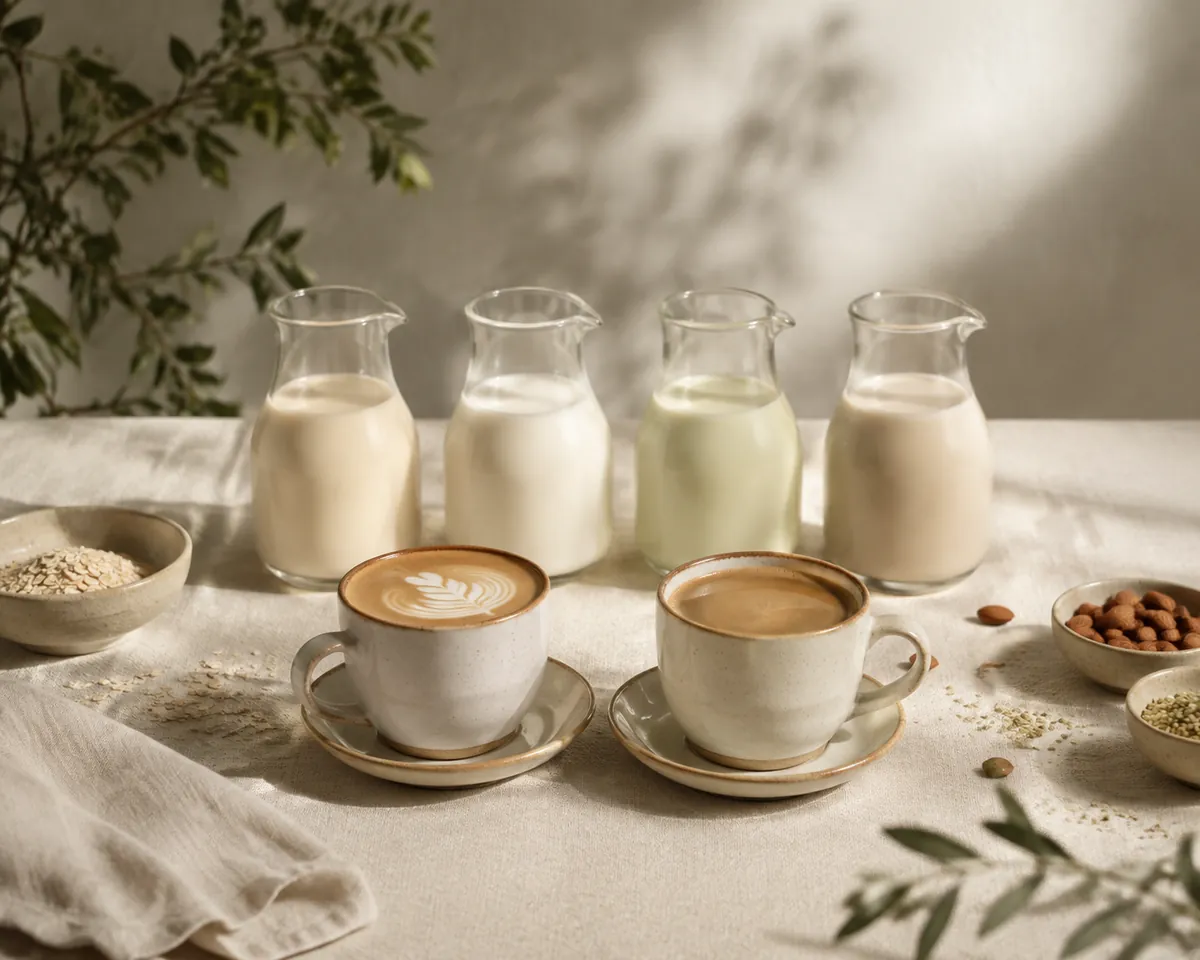
A latte is a question about splitting. There is far more liquid in the glass and it sits against an acidic shot for longer, so what matters is whether the drink curdles rather than whether it foams, and why plant milk splits in a hot cup is the mechanism behind that.
| Drink | In a cappuccino | In a latte |
|---|---|---|
| Whole milk | The benchmark cap | The benchmark body |
| Soy | Foams best of the plant drinks | Splits most readily against a hot shot |
| Oat | Good cap, slightly softer | The most forgiving of the group |
| Almond | Large bubbles, collapses quickly | Thin, and prone to separating |
| Barista formulations | Built to hold a cap | Built to resist the split |
Soy is the best foamer and the worst splitter, which is why it wins one of these drinks and loses the other. Anyone choosing between the plant options is really choosing which failure they mind less, and the oat against almond question resolves differently in a small cup than in a large glass.
Latte art belongs to whichever cap is thinner
The pattern people photograph is not evidence of a good drink, and it is not equally available in both cups. It is a consequence of foam depth, and the drink it is named after is the one it works in.
Pouring a rosetta requires the white milk to be laid onto the crema in thin passes. That needs foam integrated into the liquid and moving with it, at a depth of a few millimetres.
A traditional cappuccino cap is too thick and too separate to take a pattern, and what arrives instead is a dusting of cocoa powder or a plain white dome.

Modern cafes have narrowed this considerably. A wet cappuccino, made with a thinner and more integrated cap, will hold a pattern perfectly well, and most high street cappuccinos are now poured this way rather than spooned.
What the art proves is therefore limited but real, and it is a fact about the jug rather than about the coffee.
Caffeine is identical, and the milk moves nothing
This is the axis where the answer is a flat draw, and saying so plainly is more useful than manufacturing a difference. Caffeine comes from the coffee, and the coffee is the same in both.
One shot is one shot. A single-shot cappuccino and a single-shot latte carry the same caffeine, and a double-shot latte carries twice what a single-shot cappuccino does regardless of which vessel it went into.
Bean choice moves the number much further than either drink does. A robusta-heavy blend carries roughly twice the caffeine of a comparable arabica, and grind, dose and extraction all shift it further, which is the ground that caffeine by brewing method covers.
Switching to decaffeinated beans is the only change that alters the figure substantially, and it works identically in either cup.
What happens to each one over ice
Chilled, the two drinks stop being siblings. One is a standard item almost everywhere and the other barely exists, and the reason is the foam again.
An iced latte is straightforward: espresso, cold milk, ice, and no texturing at all. The drink was mostly liquid milk to begin with, so losing the steam costs it the sweetness that heat developed and very little else.

An iced cappuccino has nothing left once the heat goes. Steam builds the foam and cold milk will not hold it, so what is sold under that name is usually a blended drink, a scoop of cold foam whipped separately, or a very milky iced coffee with a label attached.
Why the cold versions diverge
- Hot latteSteam sweetens the milk and folds a thin cap through it
- Iced latteNo steam, no cap, and the drink survives the loss
- Hot cappuccinoA third of the cup is air, built by the steam wand
- Iced cappuccinoThe air has no way in, so the drink has to be rebuilt as something else
- Cold foamWhipped separately from low-fat milk, and a different texture entirely
The layers in the photographs are a density effect rather than a technique. Cold milk sits under a shot poured slowly onto it because the two differ in density, and stirring collapses the picture without changing the drink, which is a habit iced coffee shares.
Where the two drinks meet in the middle
Several of the axes people expect to separate these two do not separate them at all, and the middle ground between them is wider than either name admits.
Ask for a wet cappuccino and you get less foam folded through more liquid milk, which lands somewhere very close to a small latte. Ask for a small latte and you arrive at much the same drink from the other direction.
The two categories overlap in the middle, and the person making them knows it even when the board does not.

Bean and roast
Identical in both. Whatever the machine is dialled in on
Milk temperature
60 to 65 C for either, and cooked past 70 C for either
Sweetness
A property of correctly steamed milk, not of the drink built from it
Which tastes better
A preference about air, and not a fact about either cup
Price
Usually the same on the board, since the coffee cost is the same
The rest of the espresso family fills in the gaps between them. A macchiato is the shot with a spoonful of milk, a cortado is equal parts with almost no air, and a mocha is a latte with chocolate in it, so the two drinks here are two points on a line rather than opposite poles.
Which to order in a cafe you have not been to
What remains is a short list of questions that can be answered from the counter, and each of them is about the drink in front of you rather than about taste in the abstract.
If you want the coffee forward, the cappuccino gives you the same shot in a third of the liquid. If you want something to sit beside for twenty minutes, the latte survives that and the cappuccino does not.
If the only sizes are large, the latte is the safer order, since it is the drink that scales without changing.
- Want the coffee to lead: order the cappuccino, and order it small.
- Want a drink that keeps for twenty minutes: order the latte.
- Only large sizes available: the latte loses nothing, the cappuccino does.
- Unsure about the cafe: a wet cappuccino fails towards a small latte.
- Without dairy in a small cup: soy or a barista oat will hold the cap.
- Without dairy in a large glass: oat splits least against a hot shot.
There is one more test, and it takes a second. Look at the colour through the side of the cup before picking it up: a cappuccino that arrives white was built as a latte, and a latte that arrives dark was built in a cup too small for it.
Places that get the espresso machine right usually get both cups right as well, and the ones that do not tend to fail on the same drink every time.
Common questions
Is a cappuccino stronger than a latte?
With the same shot in both, yes, because foam is air rather than liquid. A single-shot cappuccino puts about 30 ml of espresso against roughly 60 ml of liquid milk, while the same shot in a 240 ml latte meets 200 ml or more. The colour through the side of the cup reports the ratio before you taste anything.
Does a latte have more caffeine than a cappuccino?
No. Caffeine comes from the coffee and the milk adds none, so a single-shot cappuccino and a single-shot latte carry the same amount. Where a larger size carries more, it is because a second shot was added, so the figure follows the shot count rather than the millilitres.
Why is there no proper iced cappuccino?
The foam is built by the steam wand, and cold milk will not hold it. An iced latte loses only the sweetness that heat develops, since it was mostly liquid milk to begin with, whereas an iced cappuccino has nothing left once the air cannot get in, which is why the name is usually attached to a blended drink or a separately whipped cold foam.