What Is a Latte? A Long Milk Drink, and How It Compares
A latte is espresso with a large volume of steamed milk and a thin cap of foam. Every other espresso-and-milk drink is the same two ingredients in a different proportion, which is the whole of the difference.
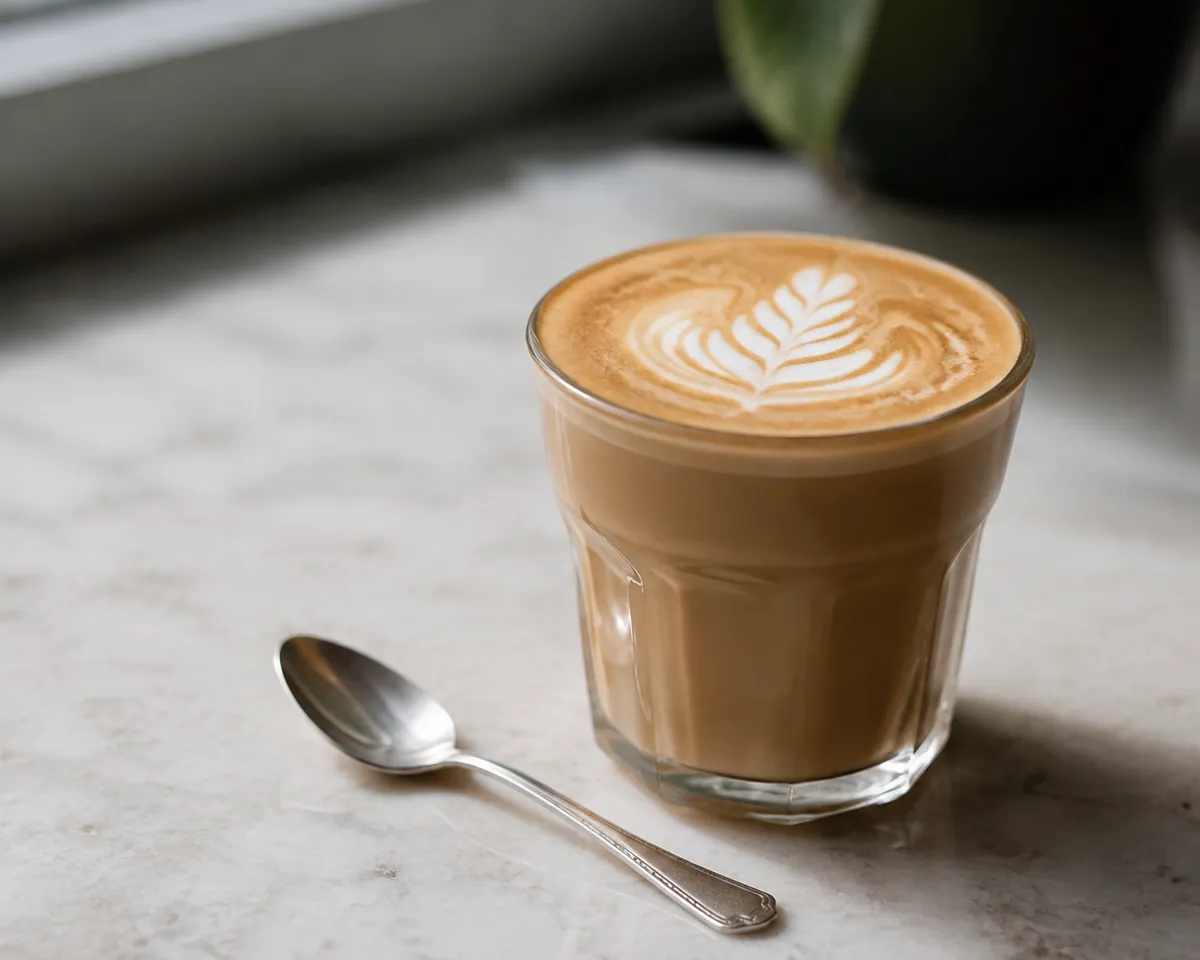
A latte is espresso combined with a large volume of steamed milk and finished with a thin layer of foam, usually around 5 mm. The name is short for caffe latte, which means coffee milk, and that is an honest description of the proportions rather than a piece of branding.
Milk is the variable this drink is built on. Everything else on the espresso menu holds the milk down to keep the coffee legible, and a latte does the opposite: it lets the milk run to 240 ml and more, then relies on the shot count to keep up.
That single decision explains its size, its cup, its sweetness and the fact that it is the drink latte art is poured into.
A latte at a glance
- What the name means
- Coffee milk, shortened from caffe latte
- Espresso
- One or two shots, depending on the cup
- Steamed milk
- 200 to 250 ml, which is most of the drink
- Foam
- About 5 mm, folded through rather than sitting on top
- Total volume
- 240 to 350 ml
- Milk temperature
- 60 to 65 C, where steamed milk is at its sweetest
- Served in
- A tall glass or a large cup, warmed
The family, by how much milk
Every drink in this group is espresso and steamed milk. What separates them is how much milk went in and how much air went into the milk, and the latte sits at the far end of the first of those two scales.

| Drink | Espresso | Milk | Foam | Typical volume |
|---|---|---|---|---|
| Macchiato | 1 shot | A spoonful | A little | 40 to 60 ml |
| Cortado | 1 shot | Equal volume | Almost none | 60 to 90 ml |
| Flat white | 2 shots | Moderate | Thin, glossy | 150 to 180 ml |
| Cappuccino | 1 to 2 shots | Moderate | Thick, 1 to 2 cm | 150 to 180 ml |
| Latte | 1 to 2 shots | Large | Thin, about 5 mm | 240 to 350 ml |
A cappuccino and a flat white differ in foam rather than in size, and a latte differs from both in volume rather than in either. The first of those pairs is worked through in full under cappuccino beside latte.
Read down the milk column and the ordering makes sense in a way the names never do. Two shots in 90 ml and two shots in 350 ml are not variations on a theme, they are drinks with different jobs: one is coffee made drinkable, the other is milk made interesting.
Anyone who finds a latte weak has usually ordered the second while expecting the first, and the fix is a smaller cup rather than a different bean.
Microfoam, and why steamed milk tastes sweeter
Texture has a name here: microfoam. It is steamed milk in which the bubbles are too small to see individually, and it gives a glossy surface that pours as a single liquid rather than as milk with froth sitting on it.
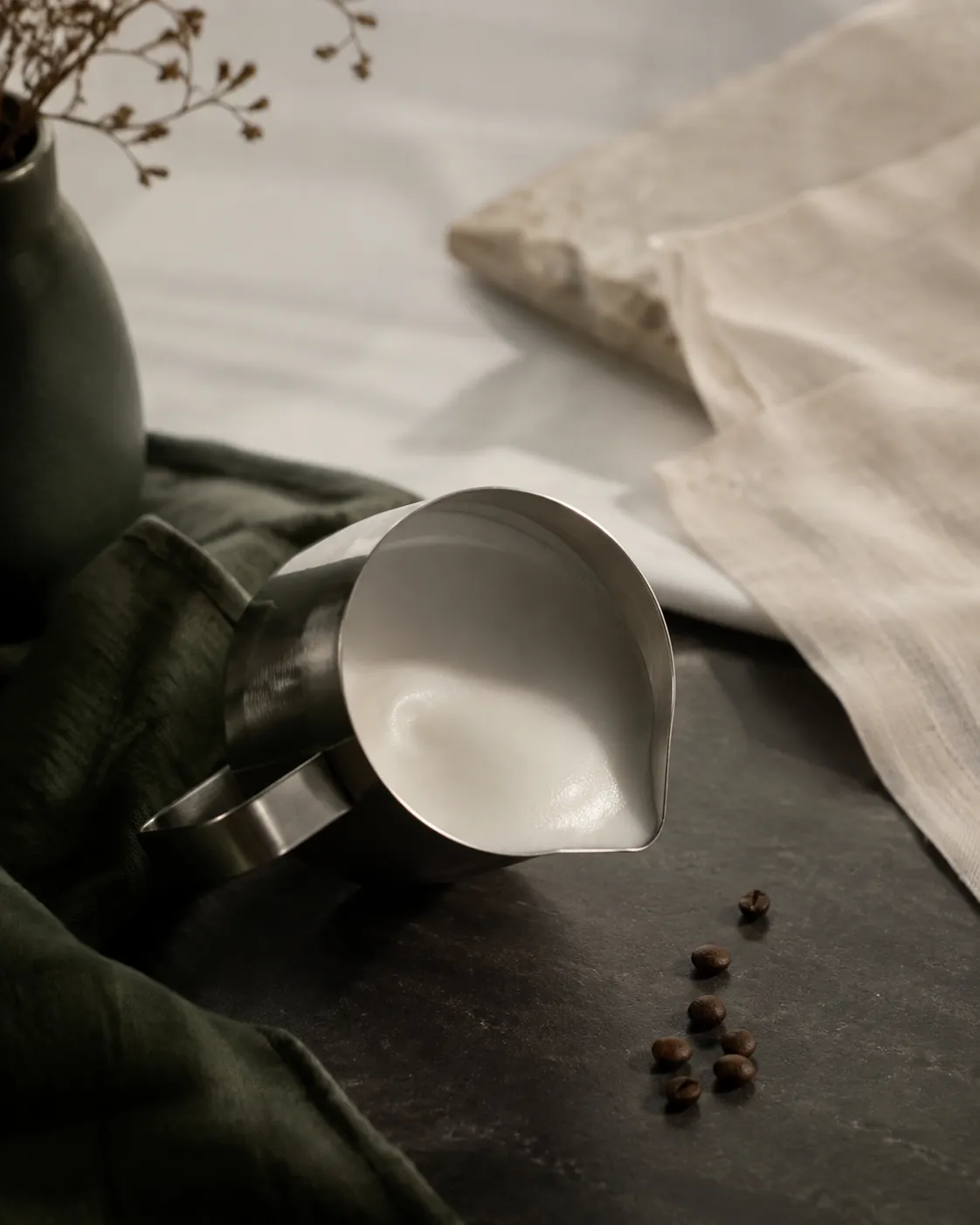
What happens when milk is steamed
- StretchAir is introduced in the first few seconds, with the tip just below the surface.
- TextureThe wand is submerged and the milk is spun into a vortex, breaking bubbles down.
- HeatTemperature climbs through the process and sets the endpoint.
- StopAt about 60 to 65 C. Beyond that the proteins denature and the sweetness goes.
- SettleA tap and a swirl integrate the foam before pouring.
The vortex is the technique made visible, and it is the part to watch rather than the clock. If the milk is not turning, the bubbles are not being broken down and no amount of extra time will fix them.
Heat is doing something to the flavour at the same time. Warming releases lactose from the protein structure it sits in, and perceived sweetness climbs steadily up to about 65 C, which is why correctly steamed milk tastes sweet with nothing added.
Past roughly 70 C the proteins change, the milk takes on a cooked flavour and the sweetness goes with it. Milk cannot be re-steamed either, because the proteins that built the foam have already done their work, so a second pass gives thin bubbly milk however carefully it is handled.
Milk choice, fat, and the plant drinks
Fat and protein do different jobs in a steamed jug, and the balance between them decides both the texture and how much of the coffee survives. Protein builds the foam structure.
Fat softens it, adds body and carries flavour, and too much of it destabilises the bubbles.
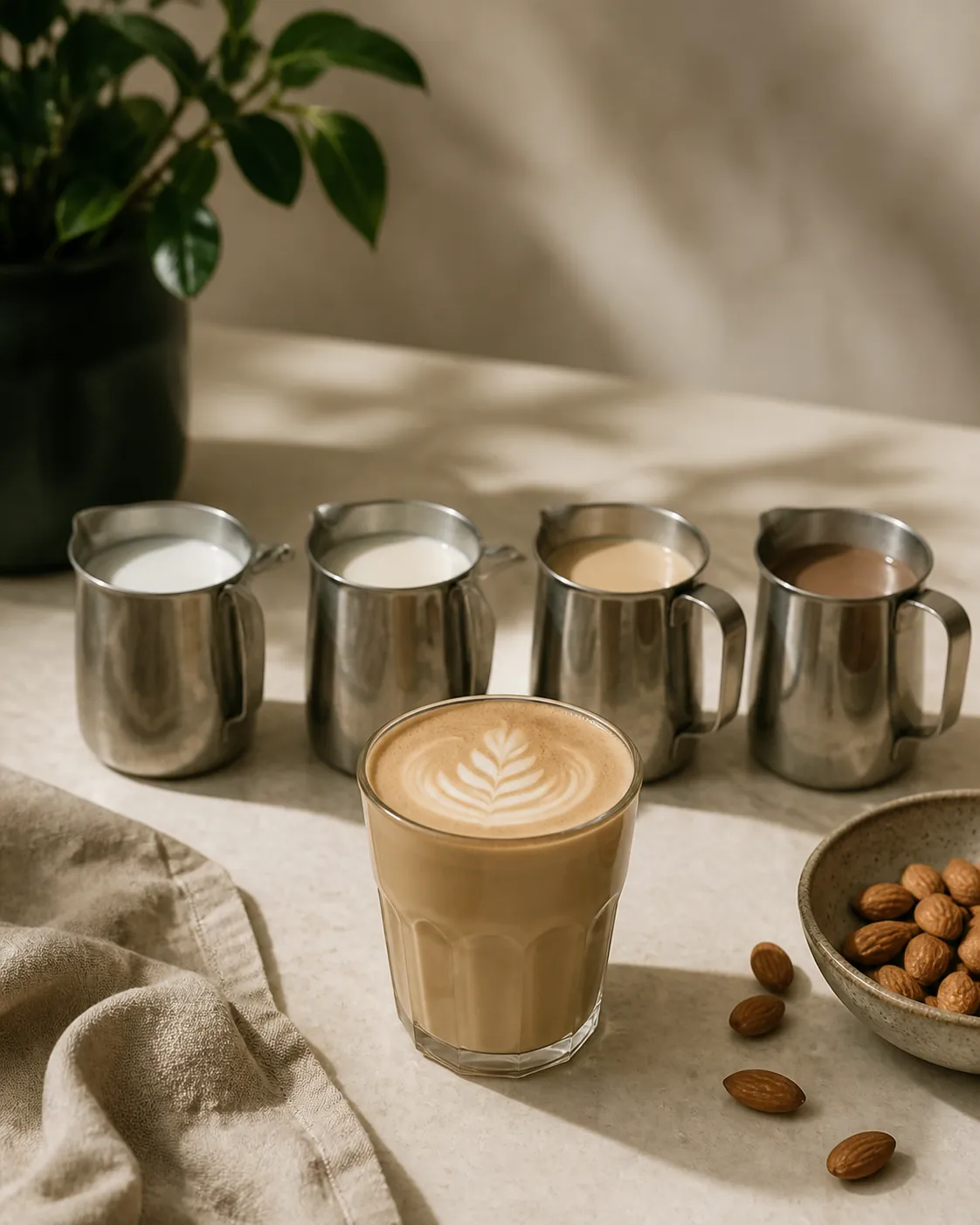
What each milk gives
- Whole milk
- The benchmark. Good foam, full body, sweet
- Semi-skimmed
- Foams more easily and holds longer, with less body
- Skimmed
- Foams very easily into stiff dry foam. Thin and less sweet
- Jersey or high-fat
- Rich and sweet, though the foam is softer and collapses sooner
- Barista plant drinks
- Formulated with added fat and stabilisers to imitate whole milk
Skimmed milk foams best and tastes worst, which is the trade-off people find counterintuitive, and whole milk is standard precisely because it balances the two rather than winning either.
How well each one foams
- Dairy whole milkProtein and fat together. The benchmark
- Soy, baristaHigh protein, and the closest plant drink to dairy for foam
- Oat, baristaGood foam and body, and the most forgiving against espresso
- CoconutModerate, held up by fat rather than protein
- Almond and ricePoor. Large bubbles that collapse quickly
Barista formulations exist because espresso is acidic and plant proteins coagulate near their isoelectric point, which is what why plant milk curdles sets out. Soy milk both foams best of the plant drinks and splits most dramatically, while oat milk trades a little foam for far better behaviour against a hot shot, and in a drink this size the second quality matters more than the first.
Latte art, and what it does and does not prove
Latte art is a pouring result. Well-textured milk produces it on the way into the cup, and nothing is applied afterwards, which is the useful thing to know about latte art.

Art is only possible when the milk is right. If it is, a basic heart takes very little practice, since the pattern forms because glossy milk sinks under the crema and then floats back up through it in a controlled way.
If the milk is wrong, no amount of skill in the hand produces a pattern, because there is nothing in the jug that will float.
That makes a poured pattern a fair proxy for milk quality and no proxy at all for the espresso underneath it. A cafe with beautiful rosettas and a poorly dialled grinder is a common combination, and the drink will look right and taste sour.
A latte is also the easiest drink in the family to pour into, which is worth saying because the opposite is often assumed. The large volume of liquid milk gives more to work with and a more fluid surface than a cappuccino's thick cap allows, so the pictures people photograph tend to come from the drink that made them easiest rather than from the hardest one.
A wide cup rather than a tall glass helps further, which is why cafes that care about the pour serve lattes in bowls.
Iced lattes, and the layers in the photographs
Hot espresso poured straight over ice melts a good part of it at once. The drink undergoes immediate dilution before it reaches the counter, and two routes avoid that.
Pull the shot directly onto the ice and stir hard so the melt is mixed in, or start from something that was already cold.
Shot over ice
Fast, and the standard cafe method. Some dilution is unavoidable.
Cold milk, no steaming
An iced latte has no microfoam in it at all, which changes the taste as much as the temperature does.
Cold brew base
Smoother and less acidic, though it makes a different drink rather than a cold version of this one.
Cold milk is the difference that catches people out. None of the sweetness that steaming develops is present in an iced latte, so at the same ratio it tastes less sweet and more acidic than the hot version, and that is the reason iced versions are so often sold with syrup in them.
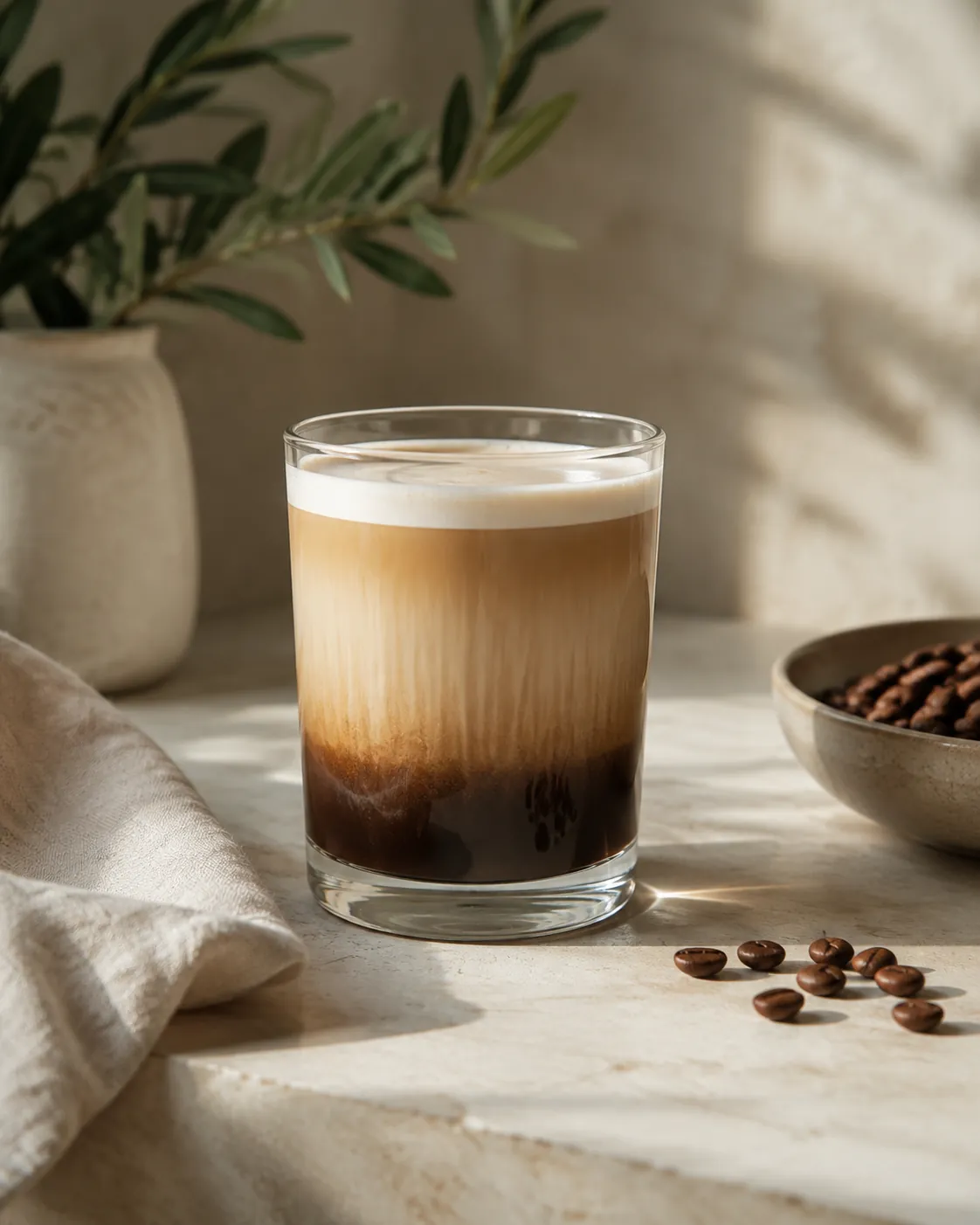
Photographs of banded lattes are either iced or staged. A hot latte poured properly is integrated all the way down, with the foam cap as the only genuine layer, whereas cold espresso and cold milk have different densities and will sit apart until somebody stirs them.
Drinking an unstirred iced latte gives milk for the first half and a mouthful of concentrate at the end, which is a real fault rather than a style.
Names, sizes, and the point at which the ratio fails
The same words mean different drinks in different countries, and the confusion is worth naming precisely. In Italy a latte is a glass of milk and the coffee drink is a caffe latte.
In Australia and New Zealand the flat white is standard and tightly defined, while elsewhere it is often a latte in a smaller cup. A macchiato is an espresso with a spot of milk in most of Europe and a large sweet drink under some chain menus.
| Cup | Milk to coffee | What it reads as |
|---|---|---|
| 180 ml | About 2 to 1 | Coffee, softened. A flat white by another name |
| 240 ml | About 3 to 1 | A standard latte, balanced |
| 350 ml | About 5 to 1 | Mild, and the coffee is a background note |
| 450 ml | About 7 to 1 | Warm sweet milk with a trace of coffee in it |
Cafes handle the drift by adding shots as the cup grows, and a large latte that tastes of nothing is usually one that did not get the extra shot. Asking for it restores the proportion rather than changing the drink, and a decaf shot does the same job for anyone avoiding caffeine.
Ordering by volume rather than by name removes the ambiguity entirely, since a double in a 180 ml cup describes one drink in any country and one language.
Building one at home
A double shot and 200 to 250 ml of cold whole milk is the whole recipe, and the milk is where almost every home attempt goes wrong.
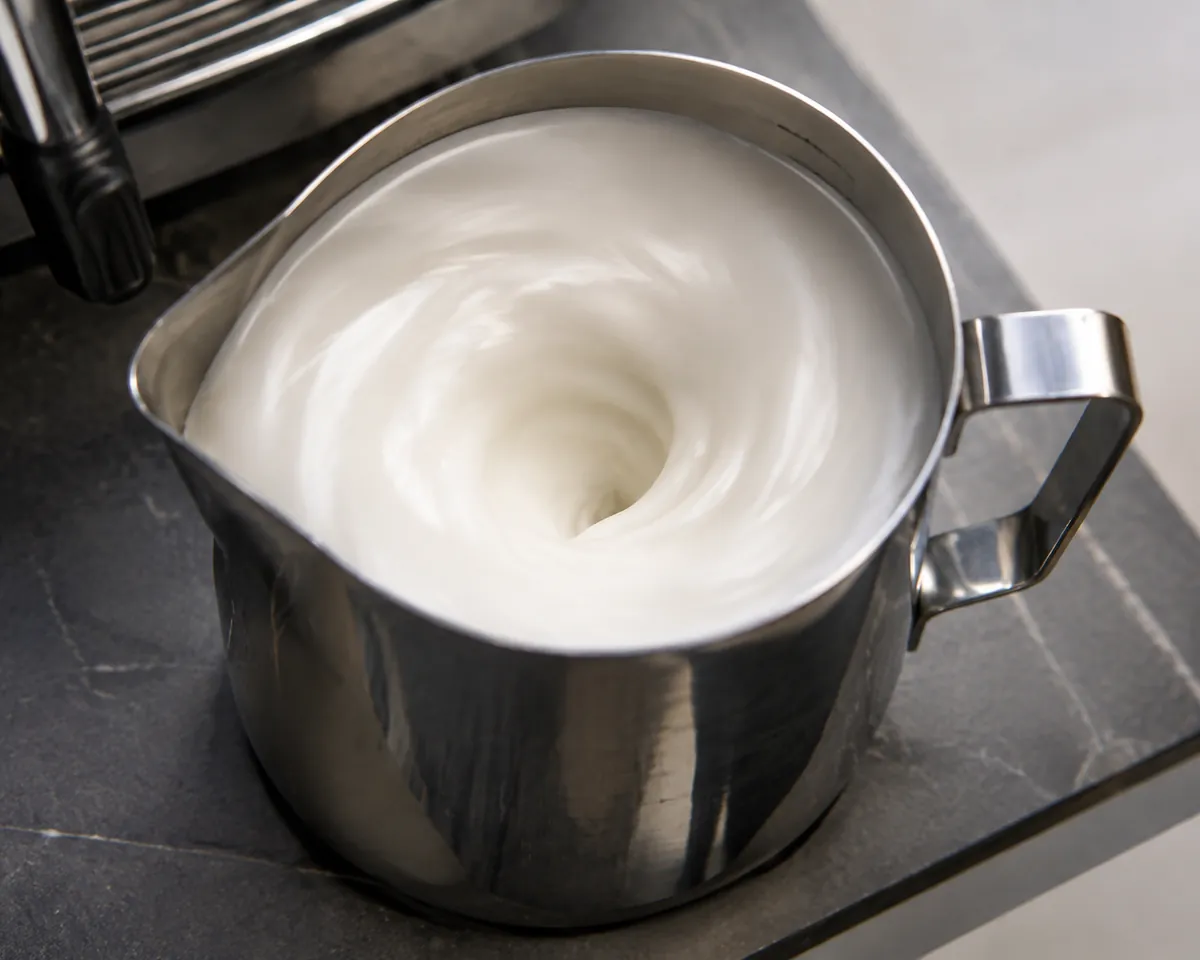
A standard latte
- Espresso
- A double, 36 to 40 g in the cup
- Milk
- 200 to 250 ml whole milk, cold to start
- Steam to
- 60 to 65 C, no hotter
- Foam depth
- About 5 mm, integrated rather than sitting on top
- Cup
- 240 to 350 ml
Starting cold buys working time. Air can only be folded in before the milk passes about 37 C, and a jug that begins at room temperature reaches that point before the air has gone in, which is why a warm jug straight out of the last drink produces bubbles rather than texture.
Fill the jug no more than half full. Milk expands as it takes air, and a full jug either overflows or, more often, leaves no headroom to spin, so the vortex never forms and the bubbles never break down.
The jug matters more than the machine in this one respect, and a 350 ml jug for a 250 ml drink is the right proportion, which making a latte covers alongside the pour. A hand milk frother is a workable substitute at this volume, better here than in the smaller drinks, since a latte wants quantity of textured milk rather than a fine glossy skin.
Syrups, chocolate, and when the sugar goes in
Timing beats quantity with all three. Syrup, chocolate and plain sugar behave differently in a latte, and what decides the result is the moment each one arrives rather than the amount of it.
Sugar syrups do not affect the foam much, and acidic flavourings do: anything citrus or fruit-based can curdle milk in the same way espresso curdles a plant drink, and adding it to a finished latte is the fastest way to find that out. Syrup into the cup first, then espresso, then milk is the order that works, because syrup poured onto already-textured milk collapses the foam that was just built.
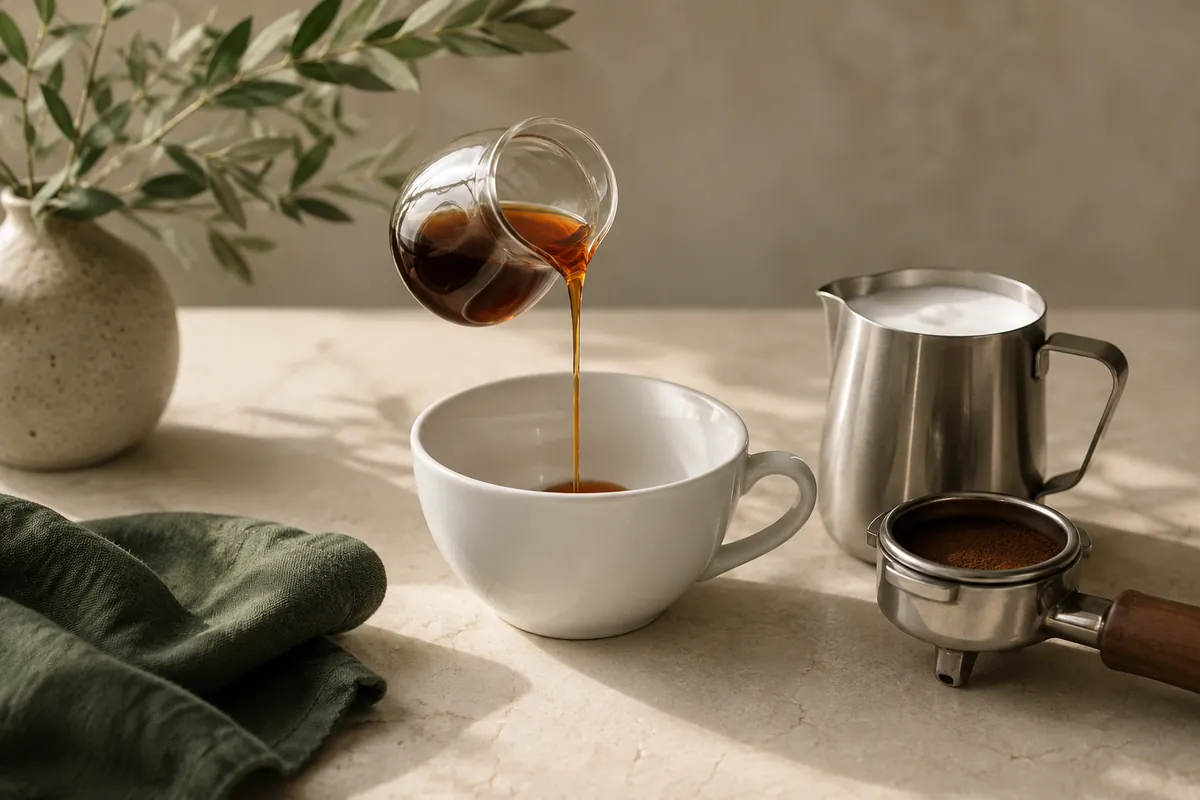
Well-steamed milk is noticeably sweet on its own, which is worth tasting for before reaching for anything, since a latte that needs sugar is often a latte whose milk was overheated past the point where the sweetness survives.
Chocolate is the flavouring that becomes a drink in its own right. Espresso, chocolate and steamed milk is a mocha, where the cocoa changes the texture as well as the sweetness, and cocoa powder needs a paste step first exactly as it does when making hot cocoa from scratch.
What hot chocolate explains from the other direction applies here too.
What goes wrong, and the extra-hot request
Home lattes fail in five predictable ways. All five are milk problems rather than coffee ones, and every one of them is visible before the first mouthful.

- Large visible bubbles, from introducing air throughout the steam instead of only at the start.
- Stiff dry foam sitting on top, which is the same fault taken further.
- Scalded, flat-tasting milk, from steaming past about 70 C.
- Foam separating from the milk in the cup, from failing to swirl before pouring.
- Thin, watery milk, from re-steaming milk that has already been textured once.
Almost every one of those is a timing error rather than a technique secret. Air in the first three seconds, texture until the jug is too hot to hold, swirl, pour, and common latte faults covers what remains.
Temperature is the fault worth arguing about, because customers ask for it. Milk at 60 to 65 C in a pre-warmed cup stays pleasant for the ten minutes most people take over a latte, while the same drink at 75 C is undrinkable for the first five and flat by the time it has cooled enough to taste.
Warming the cup rather than the milk solves the problem the request was aimed at, since a cold cup takes several degrees out of the drink immediately, and that drop is what most extra-hot orders are really responding to.
Is a latte the same as café au lait?
The two drinks can contain similar amounts of coffee and milk, but their foundations are different. A latte begins with espresso and integrated microfoam, while café au lait combines brewed coffee with hot milk and usually carries little or no deliberately textured foam.
That difference changes both the equipment and the cup. Espresso gives a latte a concentrated base beneath a smooth milk texture; brewed coffee spreads its flavor through a larger liquid volume and gives café au lait a softer, less layered structure.

| Feature | Latte | Café au lait |
|---|---|---|
| Coffee base | Espresso | Brewed coffee |
| Milk | Steamed into fine microfoam | Heated, usually with little deliberate foam |
| Texture | Glossy and integrated | Soft and comparatively flat |
| Typical vessel | Cup or glass | Cup or wide bowl |
| Key equipment | Espresso machine or espresso-style setup | Filter brewer, press, or another brewed-coffee method |
Espresso is the boundary even when both drinks arrive pale and milk-forward. Replacing a latte's espresso with ordinary brewed coffee produces a credible café au lait, but changing the name does not restore the concentration, crema, or microfoam structure that the espresso drink was built around.
The rest of the espresso menu
One point on a menu built from a single shot, a latte differs from its neighbours in what was added rather than in the coffee, and knowing which variable moved makes the whole board readable.
Americano
Hot water instead of milk. It dilutes without softening, so the shot is exposed rather than covered.
Cappuccino
The same volume of milk as a flat white with a third of it turned to air.
Cortado
Equal parts, in a glass, and the smallest step away from a straight shot.
Macchiato
A spoonful of foam and nothing else, which is where the milk side of the menu starts.
The shot underneath all of them is identical, which is why the quality of an espresso governs every drink on the list. A poorly extracted shot makes a poor latte and a poor americano in exactly the same way, and the milk changes how loudly the fault is heard rather than whether it is there.
A latte hides more than any of them, which is a reason to judge a new cafe by something smaller before ordering the largest cup on the board.
Caffeine follows the shot count rather than the cup size across the entire menu, as caffeine by brew method sets out. Milk changes everything about a drink except that one number, and no amount of it makes a single shot into a double.
Common questions
What is the difference between a latte and a cappuccino?
Milk volume and foam. A cappuccino is around 150 to 180 ml with a thick 1 to 2 cm foam cap; a latte is 240 to 350 ml with a thin 5 mm layer of foam integrated into the drink.
What is the difference between a flat white and a latte?
Size and foam texture. A flat white is smaller, around 150 to 180 ml, usually on a double shot, with a thin glossy microfoam. A latte is larger with proportionally more milk, so the coffee reads as weaker.
Why does steamed milk taste sweeter?
Heat releases lactose from the milk's protein structure and the perception of sweetness rises up to about 65 C. Past roughly 70 C the proteins denature, the milk tastes cooked and the sweetness disappears.