The French Press, and What a Metal Mesh Leaves In
A French press steeps grounds in the full body of water, then holds them back with a metal mesh. No paper filter means the coffee's oils reach the cup, which is where its heavy body comes from.
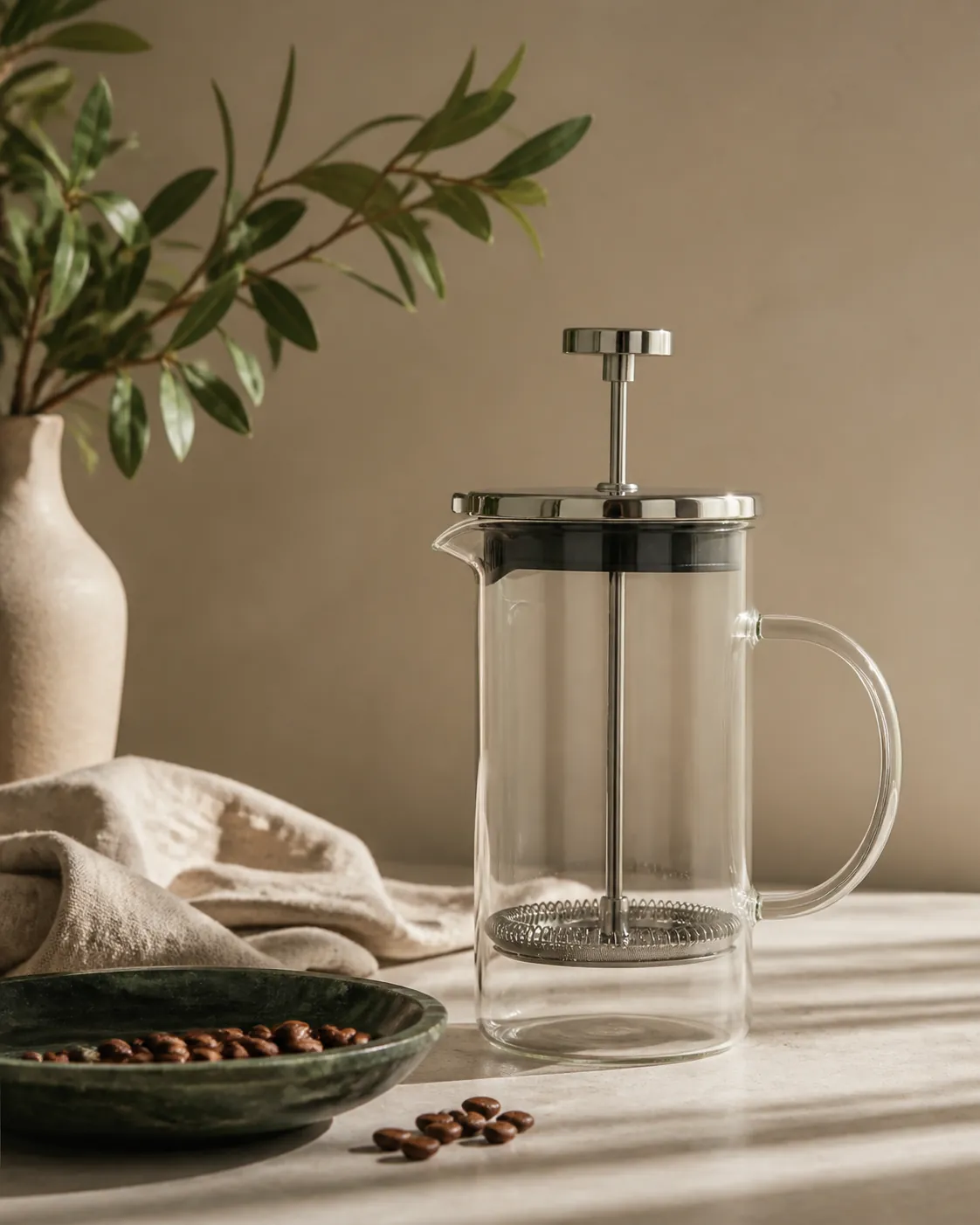
A French press, also called a cafetiere or a press pot, is the simplest form of immersion brewing. Grounds and water sit together in one vessel for the whole brew, then a plunger pushes a fine metal mesh down to hold the grounds at the bottom while you pour.
It has almost nothing to go wrong mechanically. There is no pump, no paper, no electricity and no moving part beyond the plunger rod, which is why a press bought twenty years ago still works and why the only parts that ever need replacing are the beaker and the screen.
That simplicity is also why it is the brewer most often recommended to someone buying their first one. The variables it exposes are dose, grind and time, and nothing else.
The press as a piece of equipment
- Mechanism
- Full immersion, with a mesh screen separating grounds from liquid at the end
- Filter
- Woven or perforated metal, typically around 0.2 mm aperture
- Materials
- Borosilicate glass, double-walled steel, or plastic
- Common size
- 8 cup, around 1 litre, which pours roughly three mugs
- Parts that wear
- The mesh screen and the spiral spring around it
- Consumables
- None
- Also brews
- Loose-leaf tea and cold brew, in the same vessel
Immersion, and what the water never does in one
Brewing methods divide by how the water meets the coffee, and this one sits at the far end of that division.
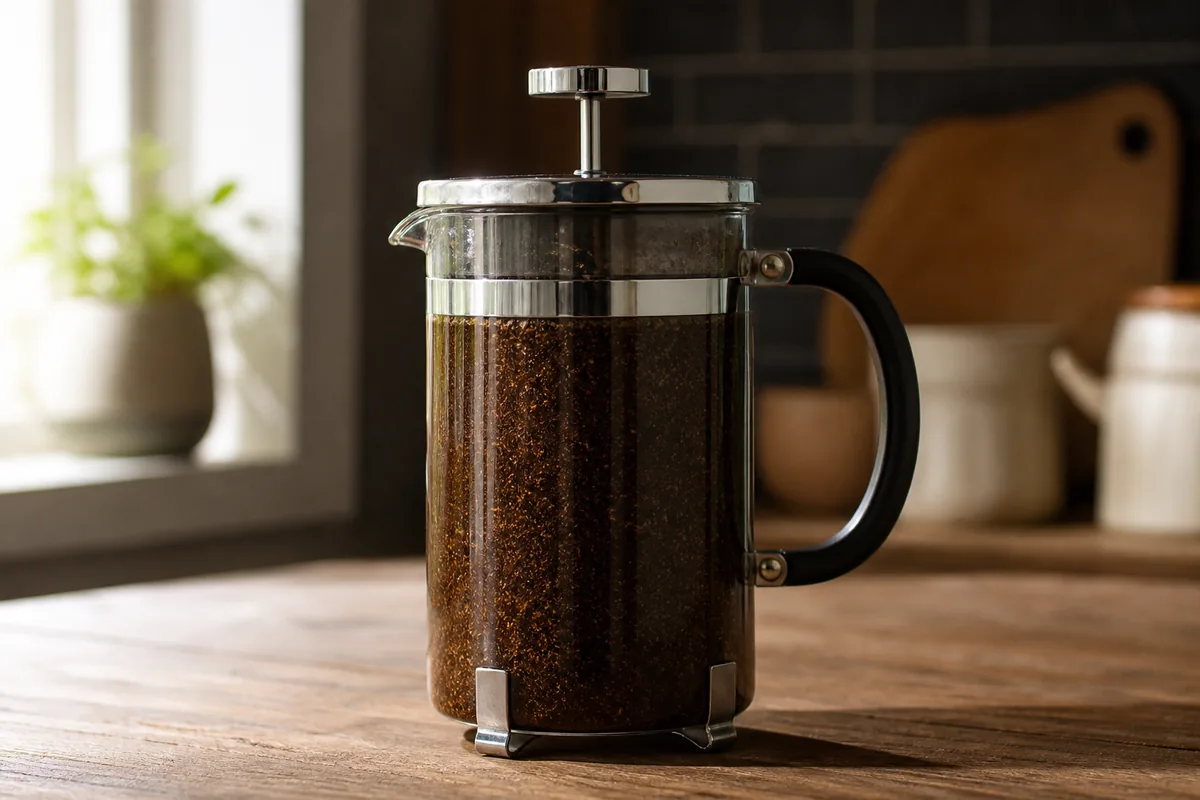
The water level in a press never drops and the grounds never drain. Every particle sits in the same body of water from the moment you pour until the moment the mesh goes down, so nothing is being rinsed and nothing is passing through anything.
| Immersion | Percolation | |
|---|---|---|
| How it works | Grounds sit in a fixed body of water for the whole brew | Fresh water passes through a bed of grounds and drains away |
| Examples | French press, cold brew, cupping | Pour-over cones, drip machines, espresso |
| Extraction | Even, because every ground sits in the same water | Uneven by nature, and controlled by pouring technique |
| Forgiving? | Considerably. Timing errors of 30 seconds barely register | Less so. Pour rate and distribution change the result |
Immersion is what makes a French press easy to be consistent with. No pouring skill has to be acquired, because there is no pour to get wrong: every particle meets the same water for the same length of time whatever your hand does.
The practical consequence is that this brewer is very hard to ruin by inattention. A pour-over abandoned for thirty seconds is a different drink; a press left the same thirty seconds is the same drink very slightly stronger.
For anyone who has fought with a cone, that difference is the whole argument for owning one, and a drip machine buys the same forgiveness only by adding a pump and a heater to do the pouring for you.
The mesh, the oils it lets through, and the silt at the bottom
A paper filter traps coffee oils and almost every fine particle on the way past. A metal mesh does not, and that single mechanical fact explains everything people love and dislike about the cup.
Roasted coffee carries lipids that dissolve into the brew, and paper holds most of them back. A woven screen has no mechanism for doing so, and its aperture is the entire filter: anything narrower than the holes ends up in your cup.
What passing the oils through does
- Body
- Noticeably heavier and rounder. This is the quality people either love or dislike about French press.
- Aroma
- Fuller, since many aromatic compounds are oil-soluble and a paper filter removes them.
- Clarity
- Lower. Delicate floral and citric notes are muddied by the heavier body.
- Sediment
- A fine layer settles at the bottom of the cup. Normal, and unavoidable with a mesh.
Sediment is the part people notice first and mind most, and it never disappears entirely. The screen stops grounds rather than fines, and fines are the microscopic particles every grinder produces, small enough to walk through a filter sized to hold back coffee.

Where fines come from, and what reduces them
- The grinder
- A blade grinder produces enormous quantities; a burr grinder far fewer
- Grind size
- Anything finer than coarse multiplies fines sharply
- The plunge
- Pressing hard forces fines through the mesh and stirs the bed back up
- Pouring
- Tipping the last centimetre into the cup pours the silt with it
- Standing
- A minute between plunging and pouring lets fines settle
A paper disc cut to sit inside the screen removes almost all of it and removes the oils with it, which is spending the reason to own a press in order to fix a symptom of owning one. Choosing between silt and clarity is the real decision here, and French press against pour-over sets the two out properly.
Grind size, and why one grinder setting cannot serve two brewers
Aperture decides everything, so a press needs a coarse grind at roughly the texture of raw sugar for two connected reasons.
Particles smaller than the holes pass straight through, which puts silt in the cup and leaves coffee extracting in the jug after the plunge. Fine grounds also give up their solubles far faster, so a steep suited to coarse coffee will badly over-extract them and hand you a harsher drink from the same beans and the same clock.
Where a press sits on the grind range
The press and an espresso machine sit at opposite ends of that scale, which is why one grinder setting cannot serve both and why a household owning both spends its life turning a collar back and forth.
Glass, steel or plastic, and the size to buy
Presses come in three materials and several sizes, and both choices are about heat and capacity rather than about flavour.
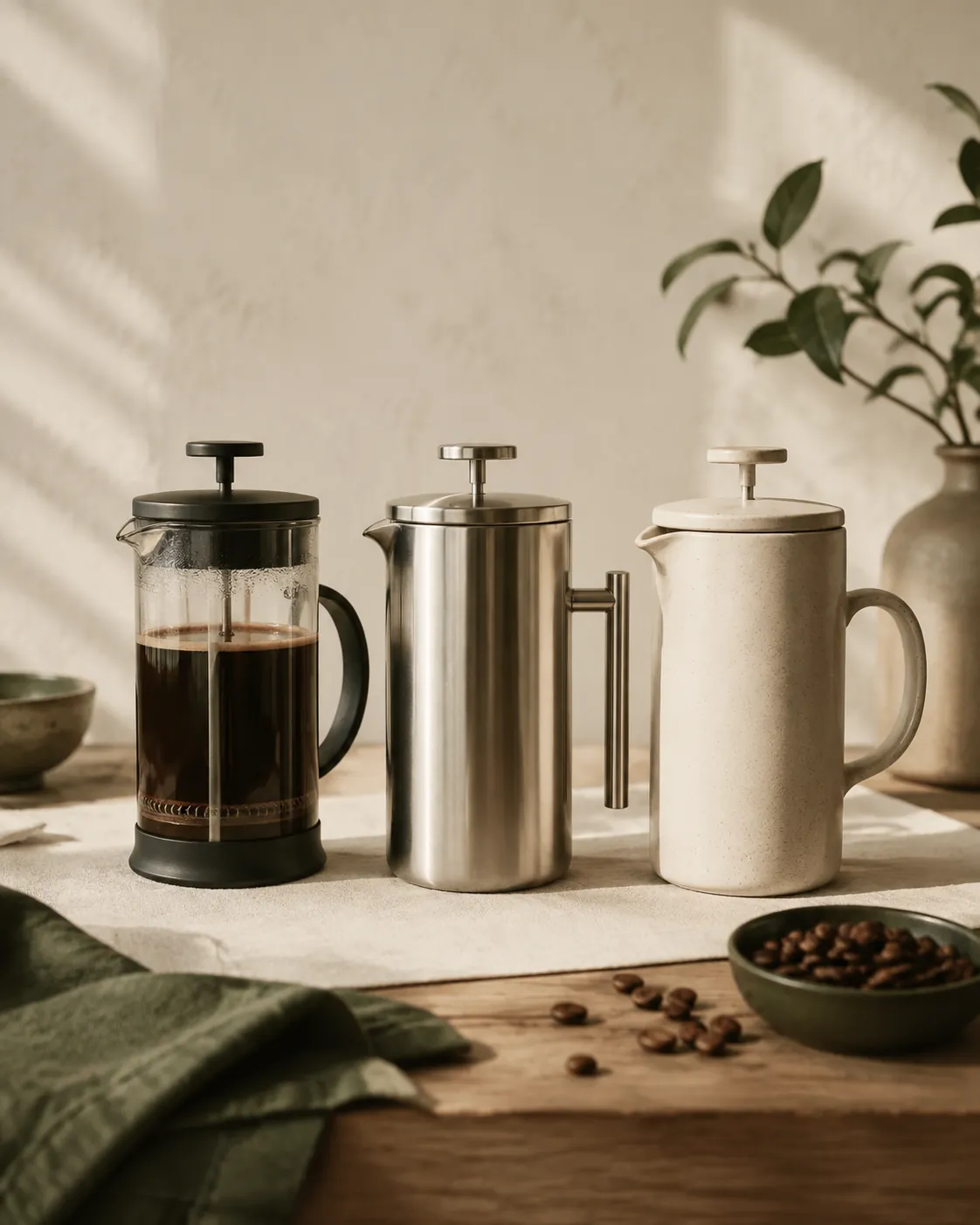
- Borosilicate glass. The standard. It shows the brew, adds nothing to the taste, and loses heat fastest.
- Double-walled stainless steel. Holds temperature far longer, survives being dropped, and hides the brew so you cannot watch the plunge.
- Plastic and tritan. Light and effectively unbreakable, which suits camping, though scratches hold old oils.
Heat loss matters more than the list makes it sound. A glass press holding three mugs will be noticeably cooler by the third, which is an argument for decanting into a warmed flask rather than for buying a different press.
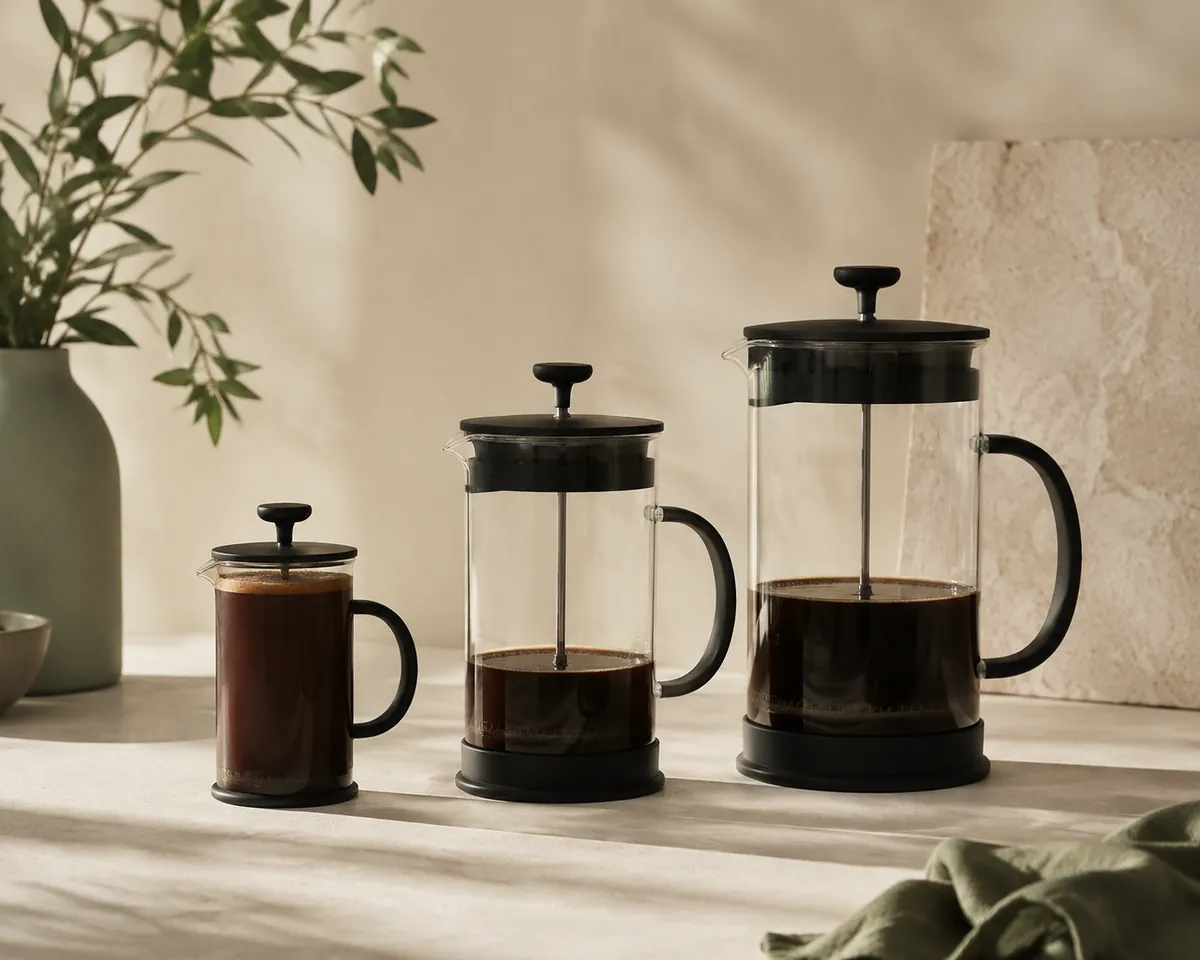
| Nominal | Actual volume | Coffee at 1:15 | Suits |
|---|---|---|---|
| 3 cup | About 350 ml | 23 g | One large mug |
| 8 cup | About 1 litre | 66 g | Two to four mugs. The common size |
| 12 cup | About 1.5 litres | 100 g | A group, and heavy to plunge |
The "cup" printed on a press is around 120 ml rather than a mugful, which is why an eight-cup press pours roughly three mugs and why most people buy one size too large. Half-filling a large press brews badly: a plunger wants liquid beneath it rather than air, and a shallow bed spread across a wide diameter loses heat and extracts unevenly.
A household drinking one or two cups at a time is better served by the small press than by the big one run at half capacity.
What the press does well, and what it will not do
Nothing about this brewer is neutral, and its faults and virtues come from the same two design decisions.
Works well for
- Very forgiving of timing, so it is easy to be consistent
- Full body and strong aroma, from the unfiltered oils
- No paper filters or capsules to buy
- Scales easily to several cups at once
- Works equally well for steeping loose-leaf tea
Struggles with
- Sediment in the cup
- Flattens delicate, high-grown, lightly roasted coffees
- Glass loses heat quickly, so a large press cools while you drink it
- Wet grounds are awkward to clean out and should not go down a sink
Because body is what the method adds, it rewards coffee that has body to amplify, and a darker or heavier roast is where it is strongest. A bright, delicate, lightly roasted arabica is the one thing it flatters least, since the qualities that coffee was bought for are exactly the ones a heavy mouthfeel covers over.
The absence of consumables is the quiet advantage: no papers, no capsules, nothing to run out of at seven in the morning, which is also why a press is the brewer that survives in a holiday cottage. What it asks in exchange is a grinder, and how to store beans matters here as much as the equipment does.
Steeping leaf tea in the same vessel
Tea is the second job this vessel does well, and the reason is the width of the chamber rather than anything to do with the plunger.
Whole leaf needs room to open, and a cramped ball infuser holds it closed so half the leaf never brews. A press gives it the whole beaker, and the mesh holds back anything larger than dust when the time comes to pour.
Use it as a vessel rather than as a press: lower the plunger only far enough to keep the leaf under the surface, since crushed leaf releases the astringency you were steeping carefully to avoid.
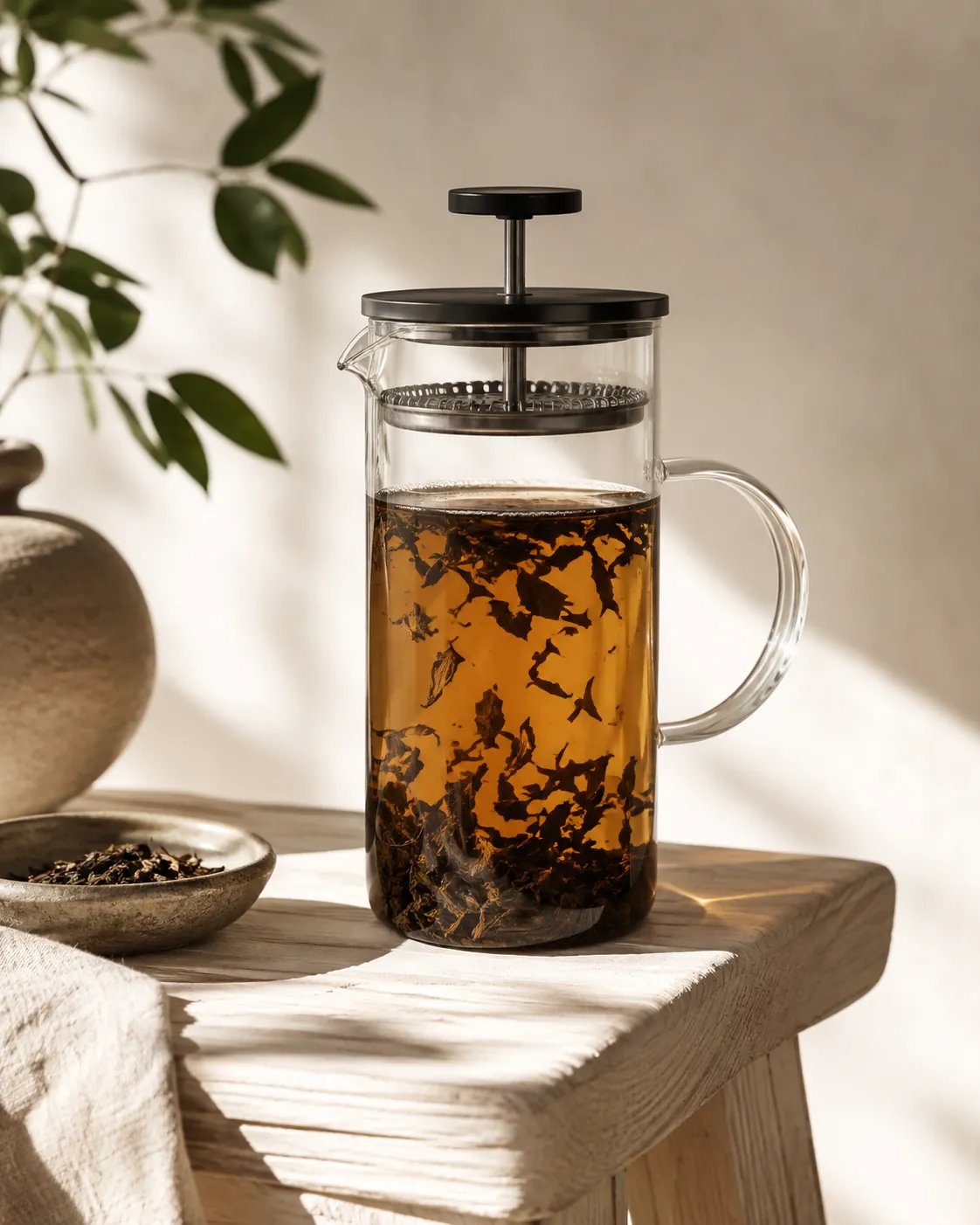
The caveat is the coffee one, arriving faster. Tea left standing on its leaf keeps extracting, and with green tea that turns bitter within a couple of minutes rather than ten, so decant the moment it is ready.
A robust black tea is more tolerant and still better off out of the pot. Steeping temperature basics covers the times, and a dedicated infuser earns its place only if you want coffee and tea kept apart.
Stripping the plunger down, and why the screen decides everything
Neglect is the commonest reason an old press makes worse coffee than a new one, and the culprit is almost always the part nobody removes.
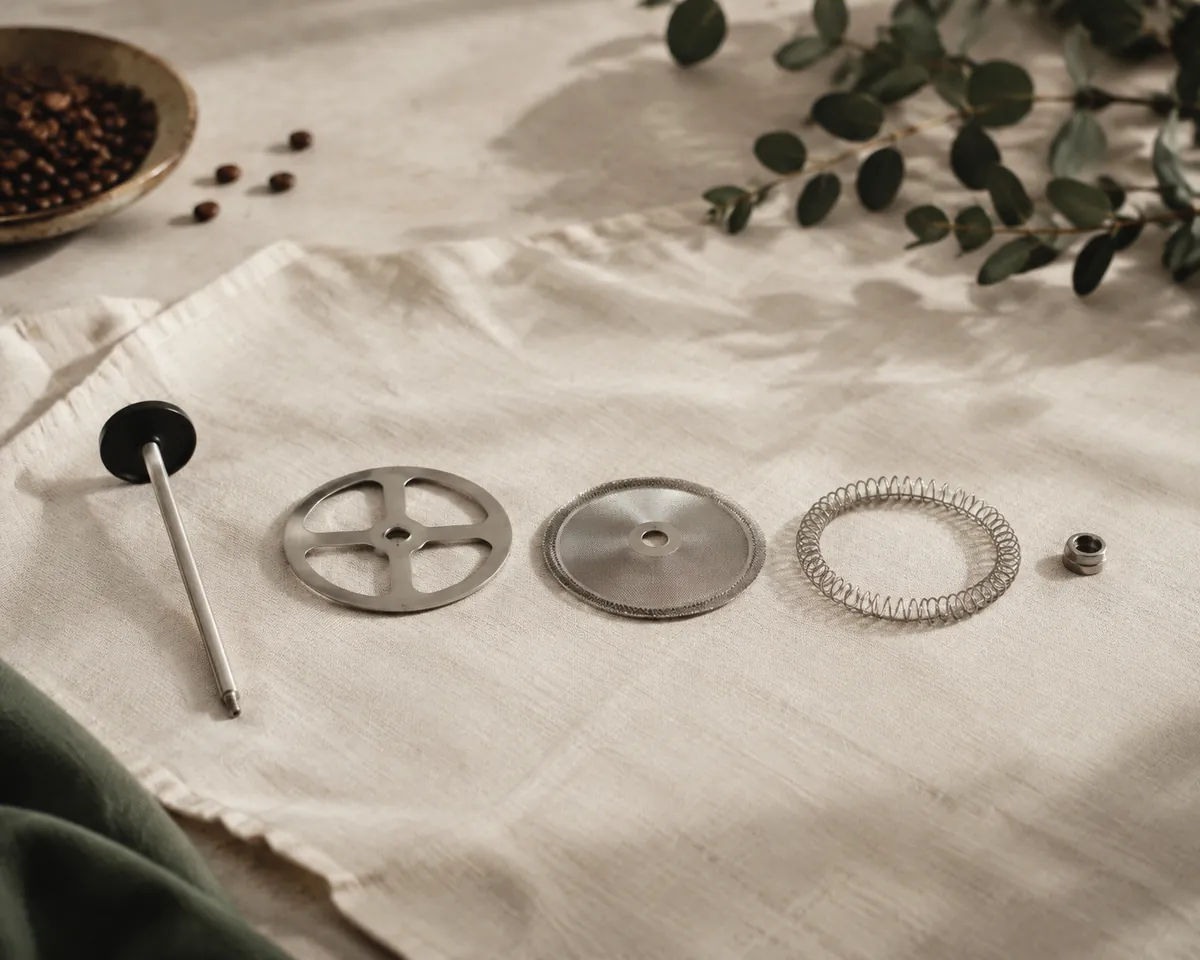
A full clean
- Scoop the groundsA rubber spatula clears the beaker in one pass. Rinsing them down a sink is how a drain blocks.
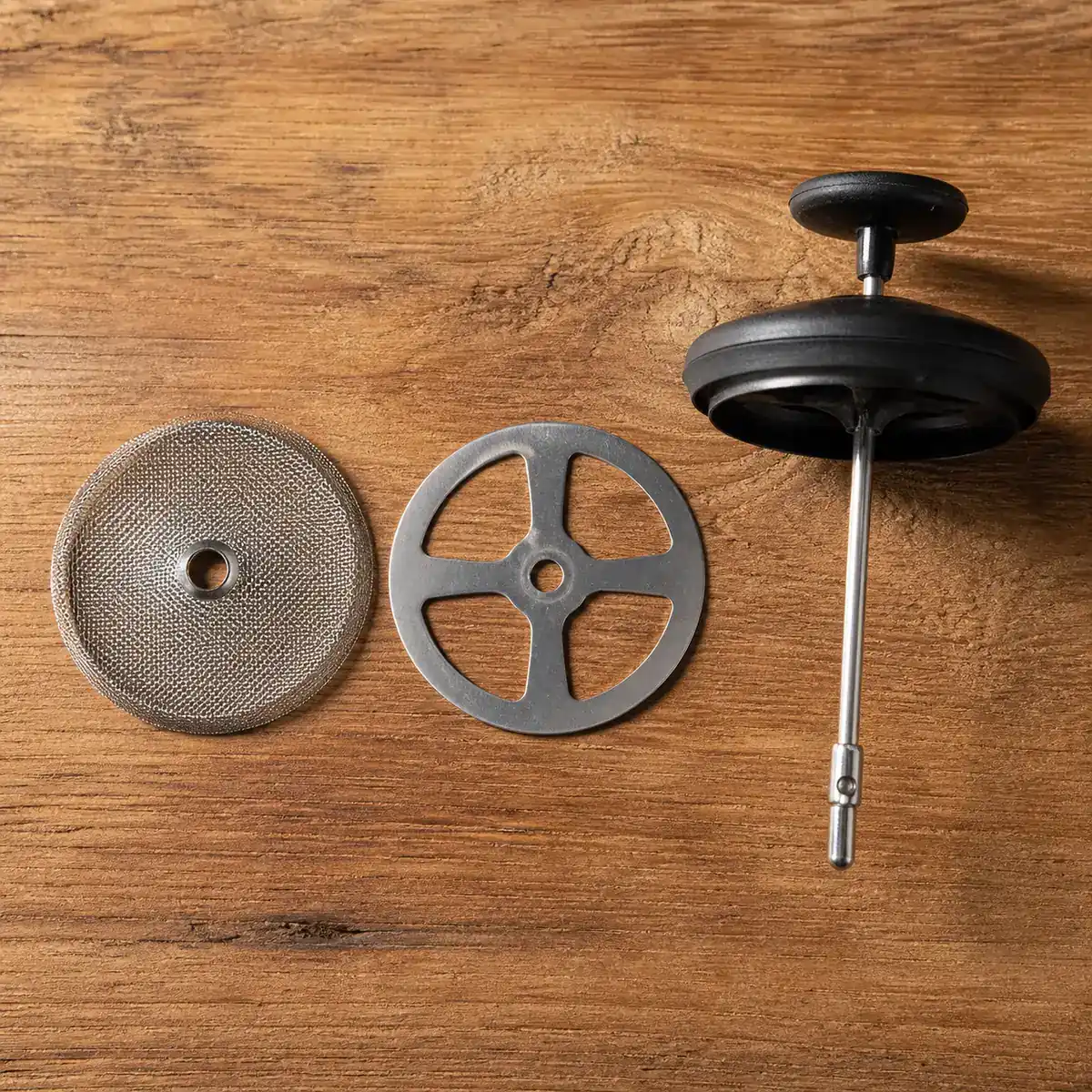
- Unscrew the plungerThe rod, the cross plate, the mesh, the spiral plate and the nut come apart by hand. Lay them out in order.
- Wash the mesh separatelyOils collect on the screen and go rancid there. This is the part that matters and the part nobody removes.
- Check the spiralThe coiled spring around the edge holds the seal against the glass, and a stretched or bent one lets grounds past.
- Check the beaker for chipsA cracked beaker under a plunger is worth replacing rather than risking.
- Wash the beaker with detergentNot just a rinse. Coffee oils are not water soluble and a rinsed beaker stays coated.
- Dry everything before assemblyA press stored damp and assembled develops a stale smell within days.
- Store it apartPlunger out of the beaker, so air moves through both.
A full strip-down is a fortnightly job rather than a daily one, with a rinse and a shake between times. A screen carrying months of oxidised oil adds a flat, waxy note to every brew, and drinkers reliably blame the beans for it.
Borosilicate beakers are dishwasher safe and the plunger assembly generally is not, since repeated hot cycles soften the spiral spring, and a slack spring is precisely what lets sediment into a cup that used to be clean.
When the cup is wrong, and which part of the press caused it
Almost every disappointing press coffee traces back to one of five causes, and only two of them are the brewer's doing.
| Symptom | Likely cause | Fix |
|---|---|---|
| Silty and gritty | Grind too fine, or pressed hard | Coarser grind, gentle plunge, decant and rest |
| Bitter and drying | Left on the grounds after plunging | Decant immediately |
| Sour and thin | Under-extracted: too coarse, or too short | Finer grind, or longer steep |
| Weak but not sour | Too little coffee for the water | Weigh it. Around 1:15 by weight |
| Cold by the third cup | Glass beaker, unwarmed | Preheat, or use an insulated body |
The first two rows are the common pair, pulling against each other, which is what makes them hard to escape: a coarser grind cuts the silt, and the reflex of steeping longer to make up for it brings the bitterness straight back. Change grind and time together and record what you changed, as making French press coffee sets out step by step.
One symptom belongs to the equipment rather than the recipe. If a press that used to pour clean has started delivering grounds, look at the spiral spring rather than at the grinder, because a spring that no longer holds the screen against the glass lets whole grounds round the edge, and no adjustment to the coffee will fix a gap.
The press as a cold brew vessel
Cold brew is immersion followed by separation, which is a description of this device rather than of a different technique, and that is why the press is probably the most widely used cold brew vessel in the world.
Coarse grounds and cold water go in, the press spends the night in the fridge, and the plunger does the separating in the morning with no filter to buy and nothing to rig up.
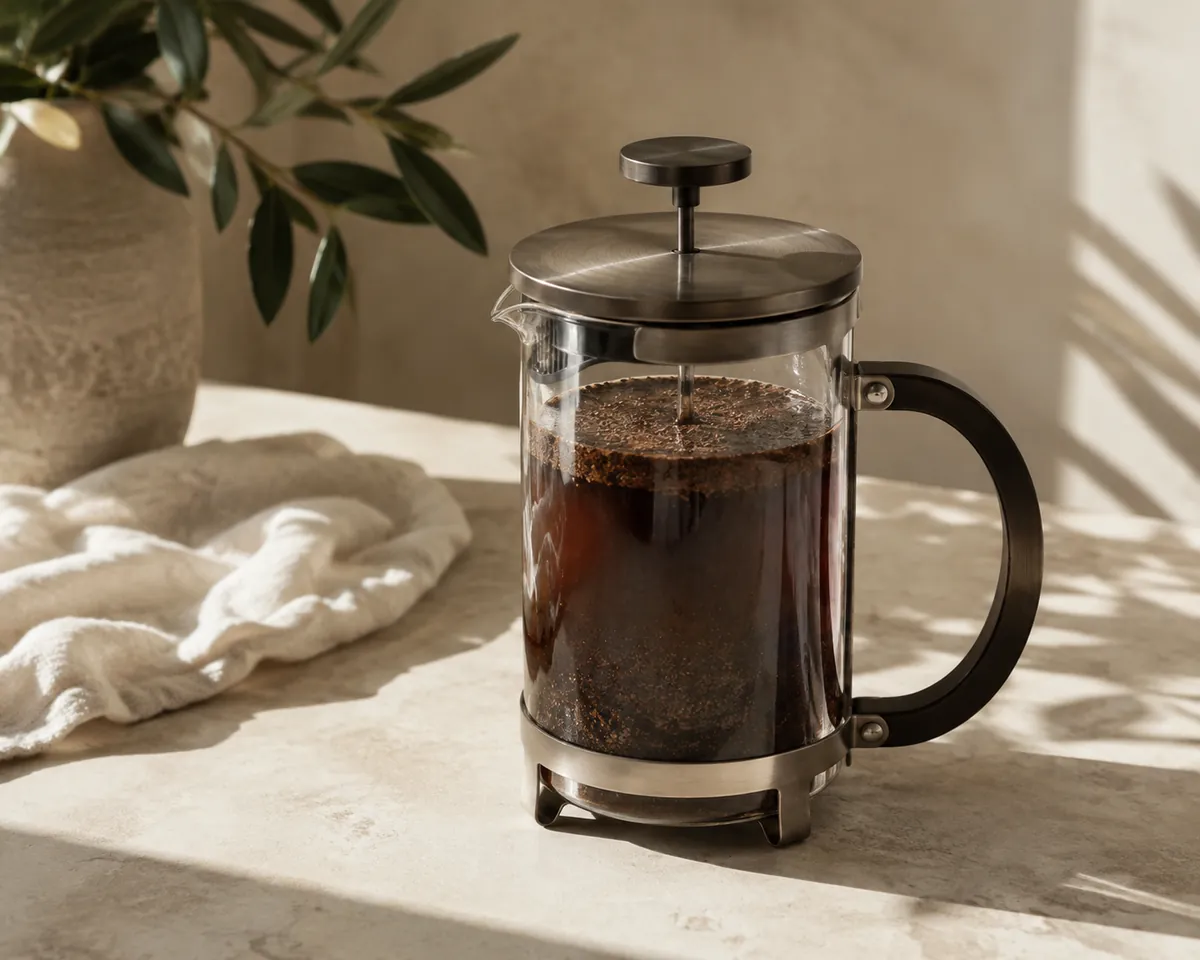
Cold brew in an 8 cup press
- Coffee
- 100 g, coarse
- Water
- 800 ml, cold
- Steep
- 12 to 18 hours in the fridge
- Plunge
- Slowly, then decant immediately
- Result
- A concentrate. Dilute roughly 1:1 to serve
The mesh passes fines cold exactly as it does hot, so a second pass through a paper filter is worth the minute when you want the glass clear. Twelve hours of contact also leaves far more oil on the screen than a four-minute brew does, which makes a full strip-down after every cold batch worth the trouble rather than optional.
Do not leave the concentrate standing on the grounds after plunging, and see making cold brew for dilution and keeping, along with caffeine by brew method for what the long steep does to the figures.
Common questions
What grind size does a French press need?
Coarse, roughly the texture of raw sugar. Finer grounds slip through the metal mesh, leaving sediment in the cup and coffee that carries on extracting after you pour.
Why is French press coffee heavier than filter coffee?
The metal mesh lets the coffee's oils and some fine particles through, while a paper filter traps them. Those oils are what give the cup its rounder, heavier body.
Can you make tea in a French press?
Yes, and the wide chamber suits whole-leaf tea better than a cramped ball infuser. Decant it when the time is up, because leaf left in the pot keeps extracting.