How to Make a Flat White, and Why the Foam Is the Whole Job
Almost every failed flat white is decided in the first two seconds of steaming, long before the milk reaches the cup.

A flat white is a double shot of espresso under about 140 ml of milk, textured until it pours as a thin glossy layer rather than a cap of foam.
Pulling the espresso is the same work as for any other shot. What makes this drink difficult is the half centimetre of foam on top, which is decided in the first two seconds of steaming.
What goes into a flat white, and in what proportions?
Volumes come before technique here.
A flat white is built on a double shot of roughly 60 ml against about 140 ml of milk, poured into a cup that holds the two without leaving a gap at the rim.
Flat white baseline
- Espresso
- About 60 ml, a double shot
- Milk
- About 140 ml
- Foam
- About half a centimetre
- Cup
- 150 to 180 ml
- Milk temperature
- 60 to 65 C
The foam depth is the number that makes it this drink. Roughly half a centimetre sits on top, where a cappuccino carries a deep cap and a latte carries a lighter layer over far more milk.
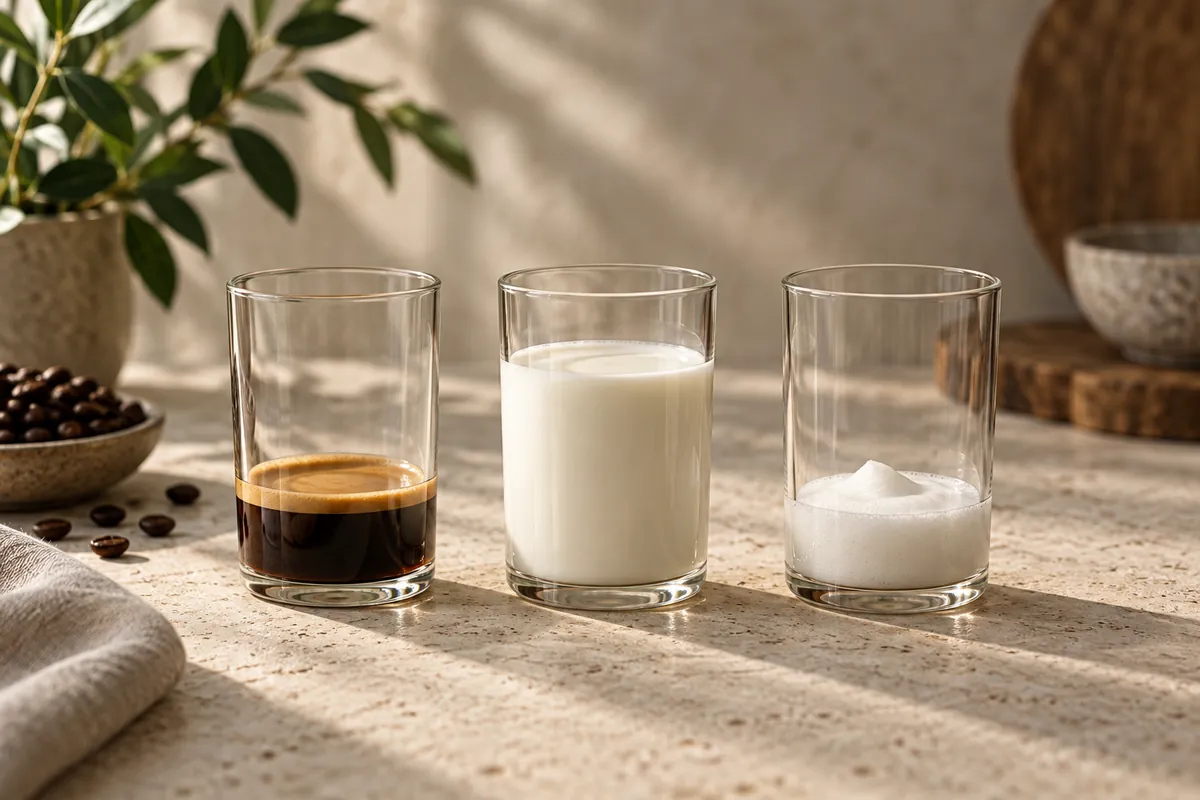
Written as parts, the drink runs about 2 parts coffee to 3 parts milk to 1 part foam. A latte built on the same shot runs closer to 1 part coffee to 4 parts milk, which is why the flat white tastes more strongly of coffee.
The cup is part of the recipe rather than a serving preference. Pour that same milk into a 250 ml cup and you have made a latte, whatever you intended.
Serving sizes do vary. A flat white poured in Australia or New Zealand is not always the same volume as one poured in the United Kingdom, and some cafes build theirs on a ristretto, which shortens the coffee side.
How do you texture milk for a flat white?
Steaming is two actions, not one.
The first adds air, and the second folds that air into bubbles small enough to disappear. A flat white needs almost none of the first and all of the second.
Set the wand tip just below the milk surface and open the steam. You want a second or two of quiet hissing, no more, and then the tip goes under.
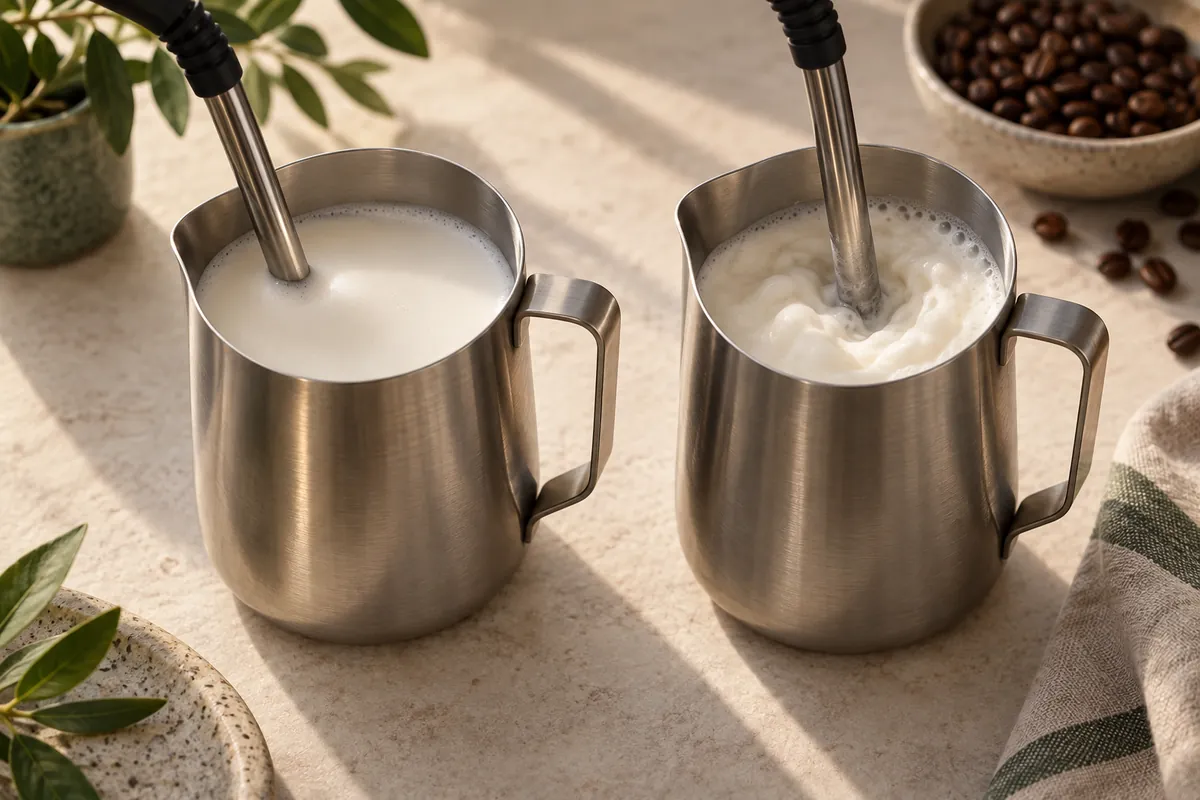
Once the tip is submerged, the milk should spin. That rolling motion is what breaks the bubbles you already made into smaller and smaller ones, and it does not add any new air.
The window for adding air closes quickly. Above roughly 38 C the bubbles that form are large and separated, and no amount of rolling afterwards will fold them down.
Steaming a flat white, in order
- PurgeOpen the wand briefly to clear condensed water before it reaches the milk.
- PositionSet the tip just below the surface, slightly off centre so the milk can turn.
- AerateOpen the steam and count one or two seconds of hiss.
- RollSink the tip and let the milk spin until the jug is too hot to hold.
- SwirlStop the steam, wipe the wand, and keep the jug moving.
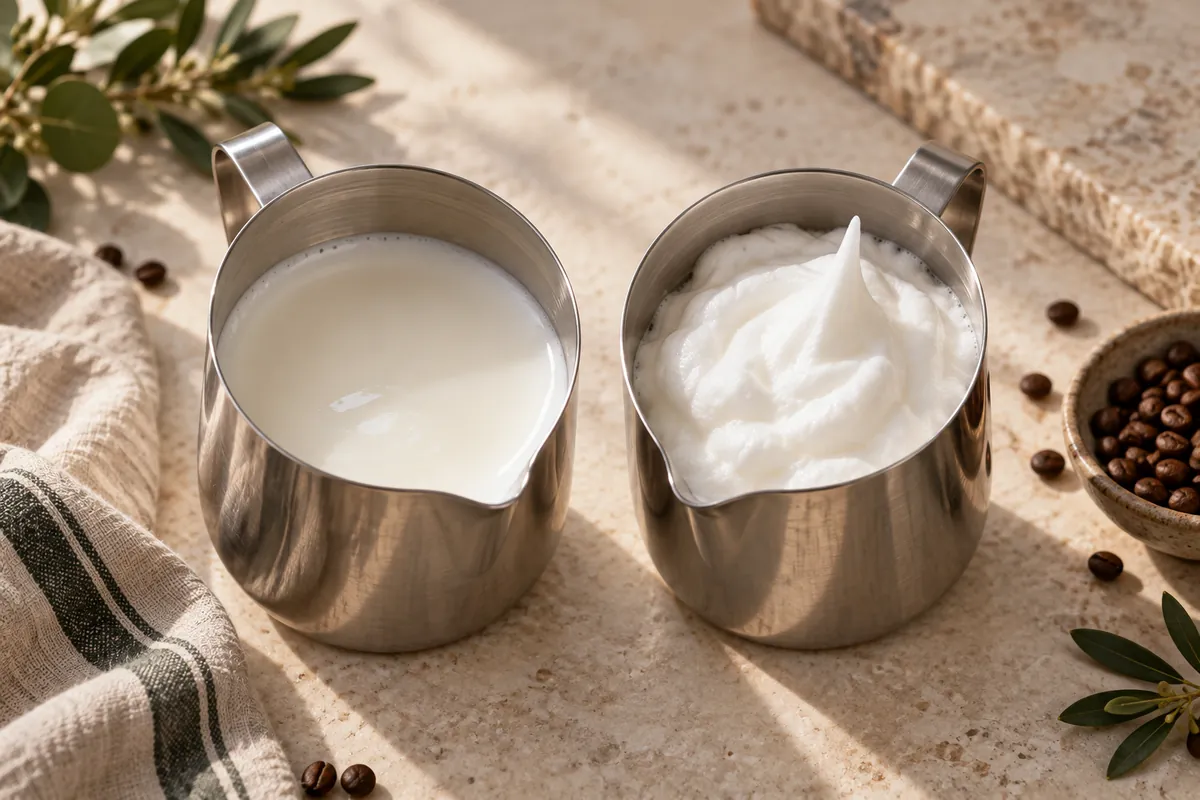
Finished flat white milk looks like wet paint. It should be glossy and slightly heavy, moving as one body when you tilt the jug.
If you are working with a jug frother rather than a steam wand, air still enters at the surface, but you have far less control over the moment it stops.
Timing is machine-specific. A single-hole domestic wand aerates more slowly than a four-hole commercial one, so the count is something you calibrate on your own machine rather than a rule.
How hot should the milk get before you stop?
Milk has a narrow band where it tastes best.
Sweetness peaks around 60 to 65 C, where lactose reads most strongly on the palate and the foam bubbles also distribute most evenly.
Milk temperature and what happens to it
- Under 55 CThin and flat, the sweetness never arrives
- 60 to 65 CSweetest, and the bubbles sit most evenly
- Above 70 CProteins denature, the milk turns grainy and tastes burnt
Past about 70 C the proteins have denatured far enough to taste scalded, and the texture turns slightly grainy in the mouth. Nothing later in the build recovers that.
You do not need a thermometer for this. The jug becomes uncomfortable to hold at roughly the right moment, and that is the test most people end up using.
Calibrate the test once against a probe if you can, because a thin-walled jug reads hotter in the hand than a thick one holding milk at exactly the same temperature.
If you are steaming until the wand hisses loudly and the milk climbs, you have gone past the band. The flat white will taste flat no matter how well the shot was pulled.
How do you pour it so the surface stays flat?
Swirl the jug first.
Milk separates the moment the steam stops, and even thirty seconds standing on the bench will leave foam sitting above the liquid. Swirling folds it back together.
Start the pour high and into the centre of the cup. A stream falling from a height pushes milk underneath the crema instead of spreading it across the top, which is what keeps the foam in the jug for now.

As the cup fills, bring the spout down close to the surface. The foam that has been held back now comes out, and because the cup is nearly full it stays as a thin layer instead of a cap.
A correct flat white surface is level and satin. It should look flat enough to slide a saucer across, which is where the drink gets its name.
Pour close from the start and the opposite happens. Foam floods out first, sits on top, and the drink you have made is a small cappuccino.
How is a flat white different from a latte or a cappuccino?
The three drinks differ on two things: how much milk, and how much of that milk is foam.
| Drink | Rough proportions | Foam | Coffee strength |
|---|---|---|---|
| Flat white | 2 coffee : 3 milk : 1 foam | Thin, about half a centimetre | Strongest of the three |
| Latte | 1 coffee : 4 milk : 1 foam | Light, over much more milk | Mildest |
| Cappuccino | 1 coffee : 3 milk : 2 foam | Deep cap | Between the two |
Coffee strength follows from the milk volume rather than from the shot. All three can be built on the same double espresso, and the latte simply dilutes it most.

Knowing which one you are aiming at lets you correct mid-build. Milk that came out too foamy is a cappuccino you can still pour well, rather than a ruined flat white.
A cortado sits shorter again, cutting the same espresso with an equal part of milk and almost no foam at all.
The definitions do drift. Cafes in different countries draw these lines differently, and a flat white and a small latte can arrive almost identical when the cup sizes converge.
Where the foam stops is the line that actually separates them, and it is a line cafes draw in slightly different places.
Why is my milk full of big bubbles?
Large bubbles are a timing fault, not a technique fault.
By the time you see them in the jug the mistake has already happened, which is why tapping and swirling never quite fixes them.
- Air went in after the milk had already warmed past about 38 C
- The wand tip sat too deep, so the milk churned instead of aerating
- A high-pitched screech meant the tip was buried and the milk was scorching
- The milk had already been steamed once and will not texture again
The first cause is the common one. Aeration has to happen while the milk is still cool, and a reader who opens the steam with the tip too high and leaves it there for five seconds has made cappuccino milk before the jug is even warm.

The screech is worth learning as a signal. It means the tip is buried and the steam is heating rather than texturing, and the milk on the surface is being scorched while the middle churns.
Reheated milk is the cause people miss. Once milk has been steamed, its proteins will not build a stable foam a second time, so a jug topped up from a previous drink is beyond repair before you start.
Tapping the jug on the bench pops a few surface bubbles and does nothing to the rest. It is a finishing touch on good milk, not a rescue for bad milk.
Can you make a flat white with plant milk?
Yes, with the right carton.
Barista formulations of plant drinks carry added protein and stabilisers precisely so the foam holds its structure under steam, and the difference against a standard carton is not subtle.
Soy
Holds its foam longest, helped by the highest protein of the three.
Protein is what the foam is built on. Almond drinks are mostly water and a small amount of nut solids, so the bubbles have very little to hold on to and the layer falls apart within a minute of pouring.

Splitting is a separate problem from foaming. Those pale flecks come from acid and heat meeting a low-protein drink, so they are caused by the espresso and the temperature rather than by anything you did with the wand.
Stop the steam a few degrees earlier than you would for dairy. Plant drinks scorch lower, and an oat flat white taken to 70 C tastes noticeably more burnt than dairy does at the same point.
If it keeps splitting, change the carton before you change the technique. That is the faster of the two fixes, and a barista oat drink against a bright, acidic roast solves most of these cups.
Flat white method
- Makes
- 1 cup, about 200 ml
- Ratio
- About 60 ml espresso to about 140 ml milk
- Water temp
- Milk stopped at 60 to 65 C
- Total time
- 4 min
What you need
- 1 double espresso, about 60 ml
- About 140 ml cold whole milk or a barista plant drink
Equipment
- Espresso machine with a steam wand
- Stainless milk jug
- Flat white cup of 150 to 180 ml
- Scale or a marked jug
Method
- PrepareWarm the cup and pull a double espresso into it.
- PurgeOpen the steam wand briefly to clear condensed water.
- AerateSet the tip just below the surface and count one or two seconds of hiss.
- RollSink the tip and spin the milk until the jug is uncomfortable to hold.
- SwirlStop the steam, wipe the wand, and keep the jug moving.
- PourStart high into the centre, then drop the spout close as the cup fills.
Common questions
Can you make a flat white without a steam wand?
A jug frother or a hand pump will texture milk, though with less control over when the air stops going in. Aim for the same glossy surface rather than for a stiff foam.
Should a flat white use a ristretto?
Some cafes do, which shortens the coffee and sweetens the drink. A normal double is the more common base and the one these proportions assume.
Why does my flat white have no shine?
Dull milk usually means the roll stopped too early or the milk sat still after steaming. Swirl the jug hard before pouring and the surface should come back.
Does milk fat change the foam?
Whole milk gives a heavier, sweeter texture, and skimmed milk foams more but holds it less well. Both work, and the aeration timing does not change.