What Is Orange Juice? Several Products Under One Name
Orange juice covers several genuinely different products sold under one name. The gap between freshly squeezed and reconstituted concentrate is larger than most shelves suggest.
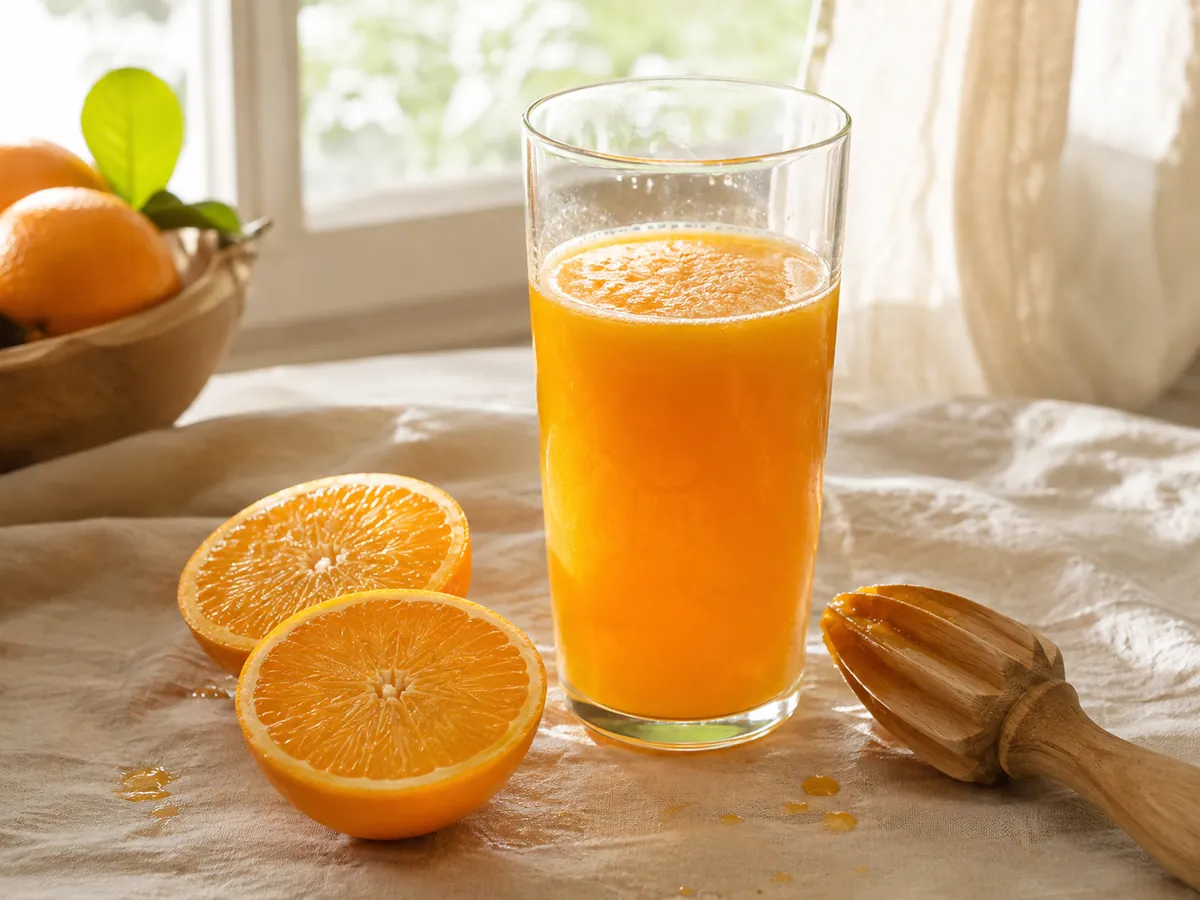
Orange juice is the liquid pressed from oranges. What reaches a carton, however, has usually been through several processes that change it substantially, in a way cold-pressed juice is specifically formulated to avoid.
The categories on a shelf are legally distinct and taste distinct, and telling them apart is most of what a buyer needs. It is also the one drink in this section where the processing, rather than the fruit, decides almost everything about the glass.
Orange juice at a glance
- What it is
- Juice pressed from oranges, then usually pasteurised and stored
- The juicing variety
- Valencia, low in limonin and available across a long season
- The eating variety
- Navel, which turns bitter within half an hour of squeezing
- Sugars
- 8 to 10 g per 100 ml, all of it from the fruit
- Acidity
- Around pH 3.5, which is why it can be sold fresh
- Fresh life
- An hour at its best, a day at a push
- Opened carton
- Three to five days before the flavour flattens
Four labels, and the line that predicts the taste
Four descriptions cover almost everything sold, none of them interchangeable with another, and the phrase on the front of the pack predicts more about the glass than the price does.
| Freshly squeezed | Not from concentrate | From concentrate | Juice drink | |
|---|---|---|---|---|
| Processing | None beyond pressing | Pasteurised, often stored | Water removed, then added back | Diluted, usually sweetened |
| Shelf life | Days, chilled | Weeks, chilled | Months, often ambient | Months |
| Flavour | Brightest, most variable | Good, fairly consistent | Flatter, very consistent | Dominated by added sugar |
| Juice content | 100 per cent | 100 per cent | 100 per cent | Often under 50 per cent |
| Price | Highest | High | Lower | Lowest |
All three of the first columns are 100 per cent juice. The differences between them are about processing rather than dilution, which is why the labels matter more than the percentage does.
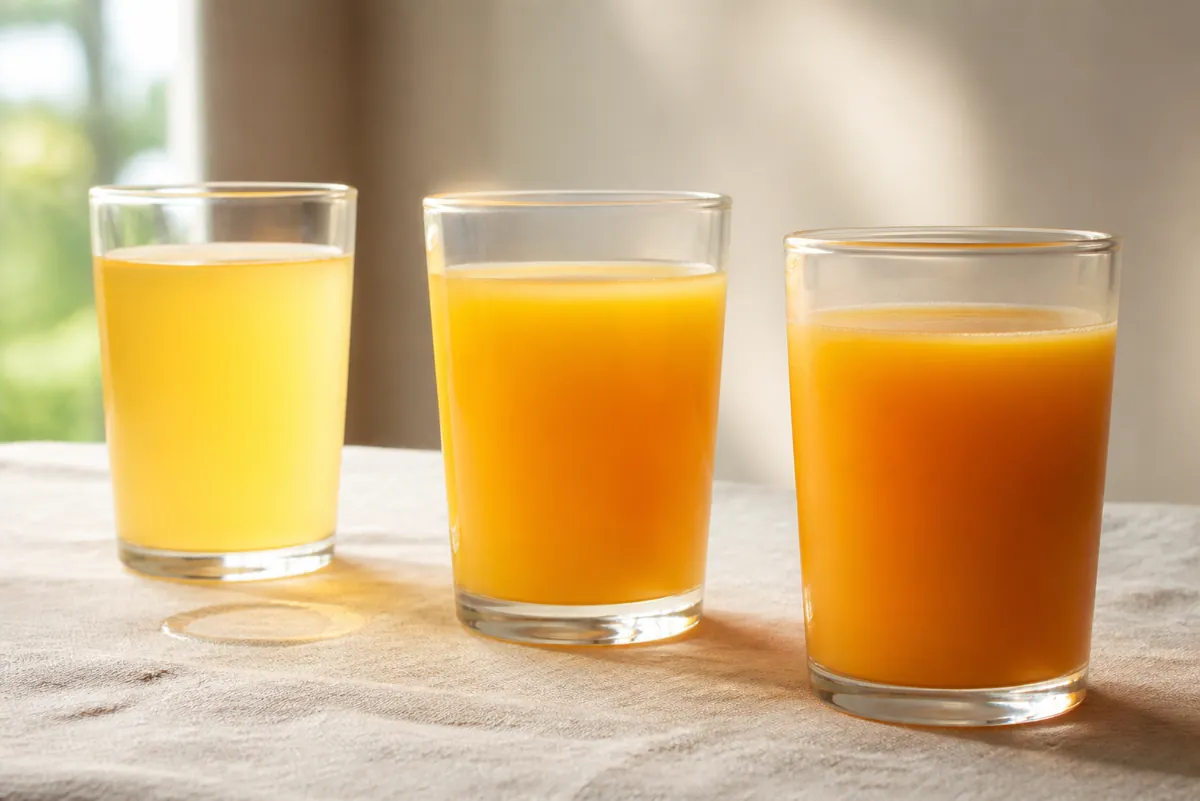
Juice drink is the outlier and the only one of the four that is not simply juice. The ingredients list settles it in a second: a pure juice names one ingredient, while a juice drink lists water, sugar and flavourings alongside it and prints a percentage.
A juice percentage on the front is itself the answer. Full-juice products have no reason to print one, so the number is only ever there because it is below a hundred.
That is the whole of a carton read in ten seconds. Why the three genuine juices taste so different from one another, and from what it tastes like straight off the fruit, is the harder question.
Variety accounts for some of it, in the same way that apple varieties account for the difference between two clear pressed bottles.
Heat, storage tanks and the aroma added back
Nearly all shop-bought orange juice is heat treated. The treatment is most of why it tastes different from fresh, and the storage that follows it accounts for the rest.
Heating deactivates enzymes and microorganisms, extending shelf life from days to weeks or months. It also drives off volatile aroma compounds, which are exactly the ones that make fresh juice smell and taste vivid.
What happens to juice after pressing
- PressJuice is extracted, and it begins losing aromatics immediately.
- PasteuriseHeat treatment for safety and shelf life, which costs more aromatics.
- De-aerateOxygen is removed so the juice does not degrade in storage.
- StoreOften held in large tanks for months before packing.
- PackAroma is restored before filling, which is where flavour packs come in.
The storage step is the one people do not expect. Not-from-concentrate juice is commonly held in deaerated tanks for many months so that a year-round supply can be sold from a seasonal crop.
Because that processing and storage strip the volatile aromas, producers capture those compounds during pressing and dose them back before packing. The recovered material comes from oranges, so the product remains 100 per cent juice and the addition never appears on an ingredients list.
The practical consequence is consistency. A branded juice tastes the same in March and October because the aroma is dosed to a specification, which is not something a seasonal fruit can do on its own.
Low-acid juices cannot be handled this way at all, which is why carrot juice is either pasteurised into flatness or high-pressure processed at expense. Orange's acidity is what gives producers the option of a gentler route, and it is also why a vegetable blend built on green juice is never sold ambient in a carton.
Valencia against Navel
Two groups dominate the shelves, and only one of them belongs in a juicer.
Valencia
The main juicing orange. Sweet, well balanced, low in limonin, and available across a long season.
Navel
An eating orange. Excellent flavour but high in limonin, so juice from it turns bitter quickly.
Blood oranges
Deep red, more berry-like, and a short season. Excellent juice, rarely sold as such.
Bitter or Seville
Used for marmalade rather than juice. Very high acid and bitterness.
Valencia is the commercial standard for reasons that have nothing to do with flavour alone: high yield, balanced acidity, a long picking window, and a juice that holds its character through a tank. Most branded orange juice is Valencia or a blend built around it.
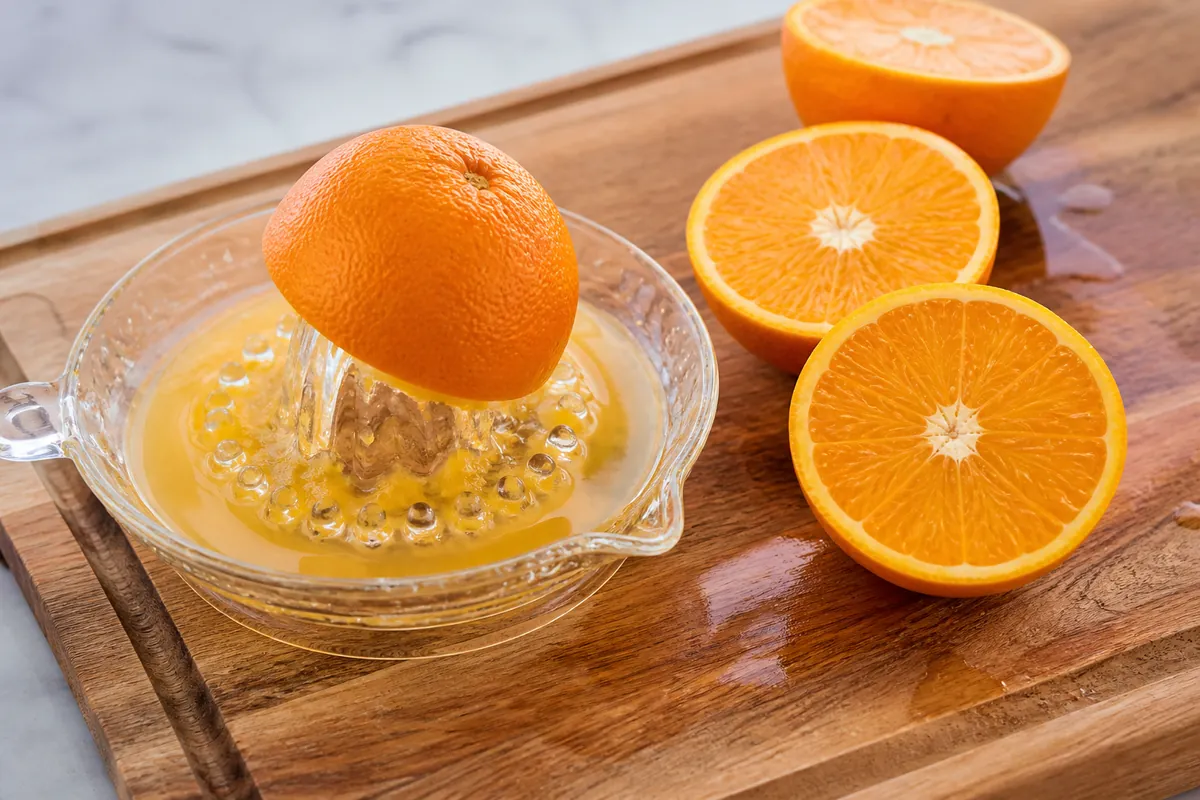
The Navel property is the reason home-squeezed juice so often disappoints. Supermarkets stack Navels as eating oranges because they peel cleanly and have no seeds, and juice made from them is fine immediately and unpleasant twenty minutes later.
Nothing about that is a fault in the fruit or the technique, and it is the most common of the what goes wrong cases that people blame on their press. Look for Valencias or anything labelled as a juicing orange, and the problem disappears without any change in method.
Blood oranges make an excellent and short-lived juice, deeply coloured and lower in acid than an ordinary orange. Like anything freshly squeezed it wants drinking within the hour, which is a large part of why squeezing them at home is worth doing at all.
The hour after squeezing
Set a freshly squeezed glass beside a carton and the differences arrive in order: aroma first, then variability, then a bitterness that was not there when it was poured.
Fresh against packaged
- Aroma
- Fresh is far more volatile and complex
- Bitterness
- Fresh develops it over an hour; commercial juice is treated to avoid it
- Consistency
- Fresh varies by fruit; commercial is dosed to a specification
- Pulp
- Fresh carries whatever you let through; commercial is adjusted deliberately
- Shelf life
- Fresh is a day or two; commercial is weeks or months
That bitterness comes from limonin, which develops in the juice over the hour or so after pressing through a reaction with the fruit's own acid. Drink fresh juice within the hour, and the compound never has time to form in any quantity worth noticing.
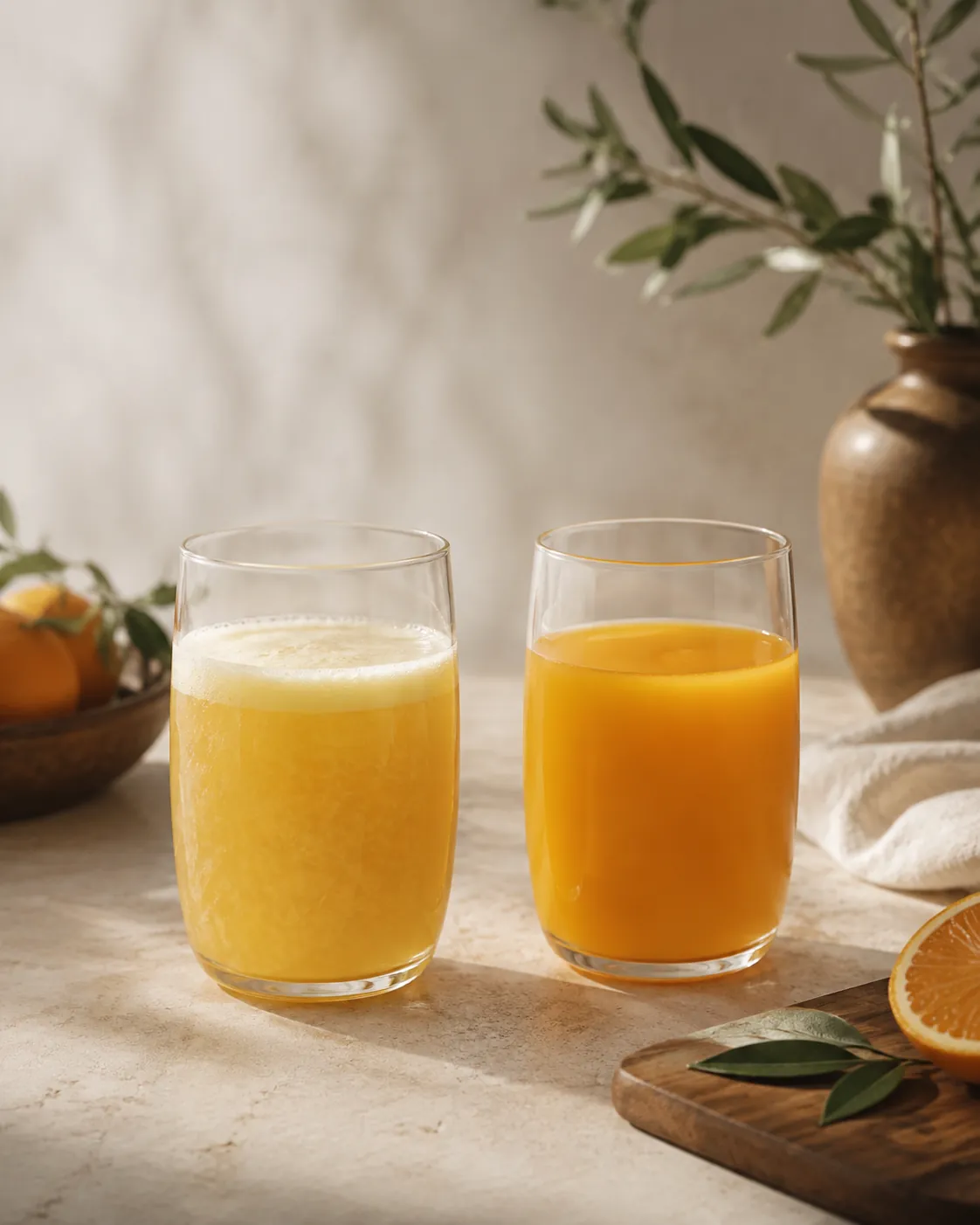
Home-squeezed orange juice
- Oranges
- Roughly 3 medium oranges per 250 ml glass
- Variety
- Valencia or a stated juicing orange, not Navel
- Temperature
- Room temperature fruit yields noticeably more than fridge-cold
- Method
- Roll the fruit firmly under your palm before cutting, which breaks the segments
- Serve
- Immediately, before limonin bitterness develops
Rolling the fruit firmly under a palm first is the step most often skipped, and it takes about five seconds per orange. It ruptures the juice sacs against each other so the flesh gives up its liquid to a reamer instead of resisting it.
A squeeze of lemon is the usual save when juice has to stand, and it works by acidity rather than by flavour. The same logic drives pressing without heat commercially, where the aim throughout is to extract without giving the juice a reason to change.
Pulp, shaking and the glass you pour into
Pulp content is a formulation decision rather than an accident, and it changes rather more than the texture, since a proportion of the aroma travels in the solids rather than in the liquid around them.
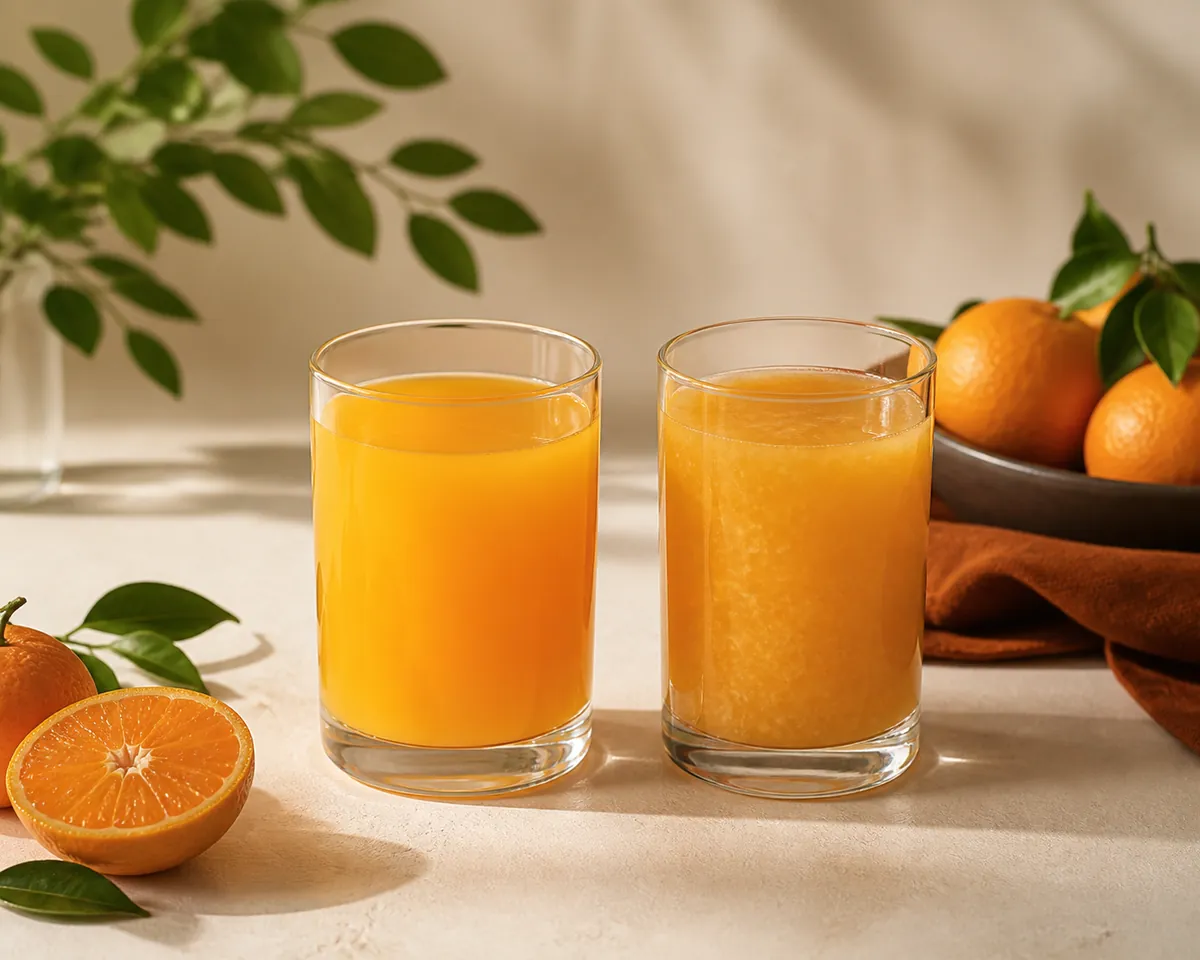
Commercial juice is filtered to a controlled level and then has pulp added back to a specification, which is why the descriptions on the carton are consistent between batches. Fresh juice carries whatever the press let through, so a centrifugal machine gives more pulp and more foam than a citrus reamer does.
Keeping every solid rather than adjusting them is what makes a green smoothie a different drink rather than a thicker one, and the same axis runs through every juice on this site.
- Serve it cold but not ice cold, which mutes the aroma along with the acidity.
- Shake the carton. Pulp and solids settle, and the first glass differs from the last.
- Pour into a narrow glass, which concentrates the aroma at the rim.
- Drink fresh juice immediately rather than making it in advance.
- Do not add ice to fresh juice; dilution flattens it faster than chilling helps.
Shaking the carton is the point most often skipped and the one with the largest effect for no effort. The solids settle within a day of standing, so the first glass out of an unshaken carton and the last one are noticeably different drinks.
Cloudiness in a pressed juice works the same way, and cloudy against clear is a filtration decision rather than a sign of quality in either direction.
Oxygen, the fridge door and the right temperature
An opened carton fades faster than most drinks in the fridge, and two separate things are doing it.
Oxidation is the first. Air degrades both the aroma compounds and the colour once the seal is broken, and the wider the surface exposed to it the faster that runs, which is why decanting into an open jug is the worst thing you can do to a half-used carton.
- Keep it cold and sealed. Oxygen degrades both the vitamin C and the aroma.
- Finish an opened carton within three to five days; the flavour flattens noticeably after that.
- Store it upright, and in the body of the fridge rather than the door.
- Do not decant into a wide jug for storage, which increases the surface exposed to air.
- Fresh juice should be drunk the same day, and ideally within an hour of pressing.
Temperature is the second, and it works on perception rather than on the juice. Very cold suppresses both the aroma and the sweetness, so the glass reads thin; warm brings the sweetness forward and turns the acidity from bright to sour.
Left on a table for twenty minutes, the same glass tastes duller and sweeter at once.
Straight from the body of the fridge and drunk promptly is close to right, and the fridge door is the one place it should not live, because the temperature there swings every time the door opens. Storing orange juice covers the rest of the fridge question.
Freezing preserves flavour far better than a week of refrigeration does, and frozen orange portions are also the basis of a great many berry smoothies. What ruins a glass is the compromise between the two: a fresh juice diluted with ice loses more to the water than it gains from the cold.
Sugars, and what the figures are good for
Orange juice is naturally sweet, and the figures are worth having in one place.
Those sugars are inherent to the fruit rather than added, unlike those in a cola drink, which is a compositional fact and not a claim about anything else.
What the numbers are good for is comparison between products on a shelf. That is the one thing a reference page can honestly offer, and the panel does it better than the front of the pack.
A juice drink at 40 per cent will often carry sugar figures close to a full juice, because what was taken out as water came back as sweetening.
The figures are also why from-concentrate and not-from-concentrate juices read almost identically on a label while tasting nothing alike. Sugar and acid survive the water-removal step intact; aroma does not, and no nutrition panel has ever had a column for it.
Why water is the expensive part
Orange juice spans a wide price range for what appears on the shelf to be a broadly similar product, and the supply chain rather than the fruit explains almost all of it.
From-concentrate juice is cheap to ship, because the water is removed at origin and added back at the destination. Water is heavy, and moving it around the world is the single largest avoidable cost in the category.
Not-from-concentrate has to travel as liquid, chilled, in bulk tanks, and that cost is carried straight through to the shelf. Freshly squeezed skips the storage entirely and has days rather than months of life, so waste is priced in, which is most of why it costs several times what a carton does.
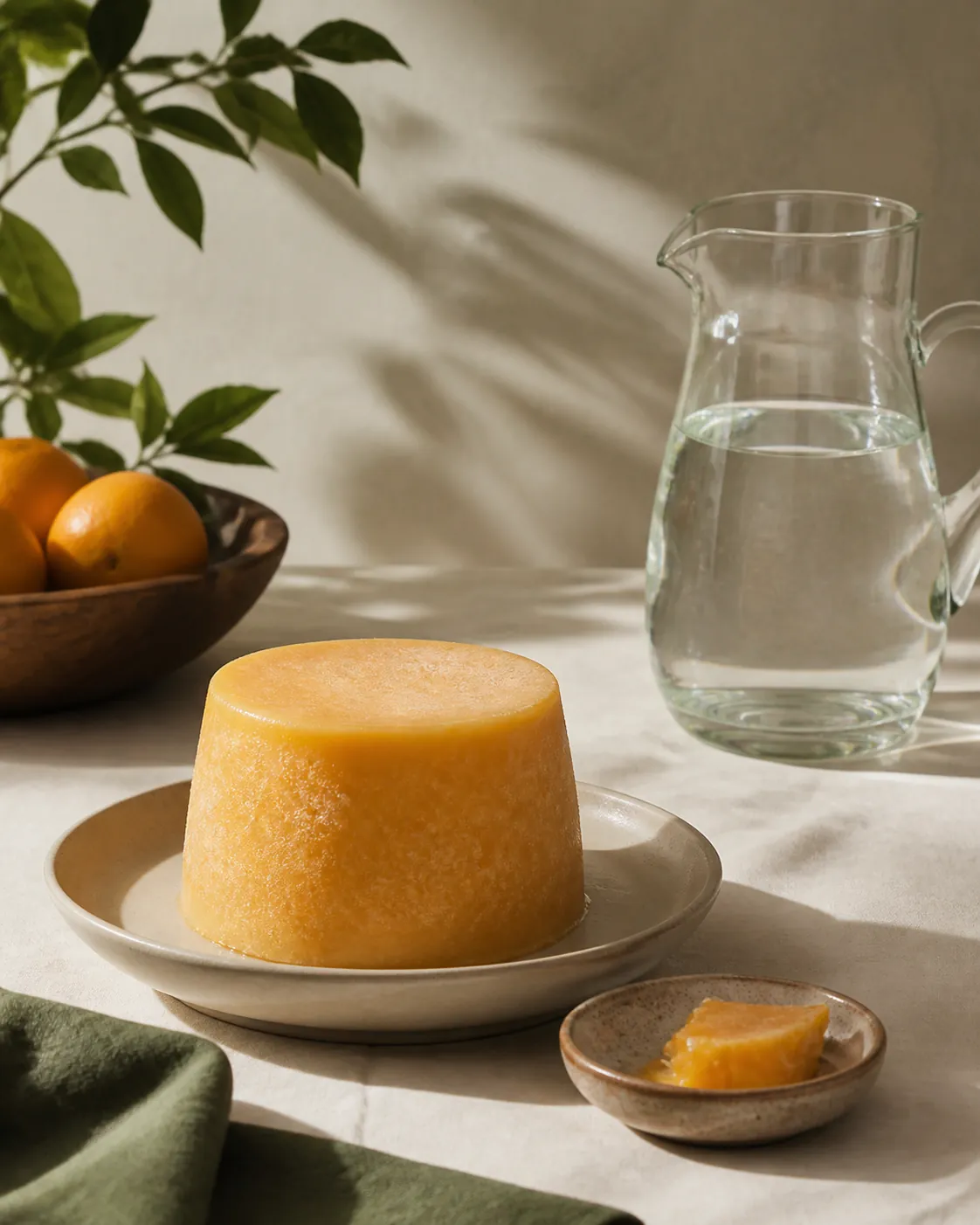
One format takes the same logic to its conclusion and has largely vanished from European shelves. Frozen concentrated orange juice is the industrial concentrate sold in small tubs for the buyer to dilute at home, and it was once the dominant way the drink was bought.
Its advantages are real: months in a freezer, less per litre, and the strength mixed to taste. Its disadvantage is the flatness that affects any reconstituted juice, the same flatness that shows in concentrate-based apple juice and for exactly the same reason.
Tasted beside a chilled not-from-concentrate carton, the difference the water-removal step makes is unmistakable, which makes a tub worth buying once for the comparison even if never again.
Blood orange, grapefruit and mandarin
Orange is one of several citrus juices on sale, and the other three fail in different directions.
Blood orange juice takes its deep red from anthocyanins, the same pigment family that colours berries and turns a hibiscus infusion ruby, and it tastes noticeably more berry-like than an ordinary orange does. Its season is short and it is rarely sold pure.
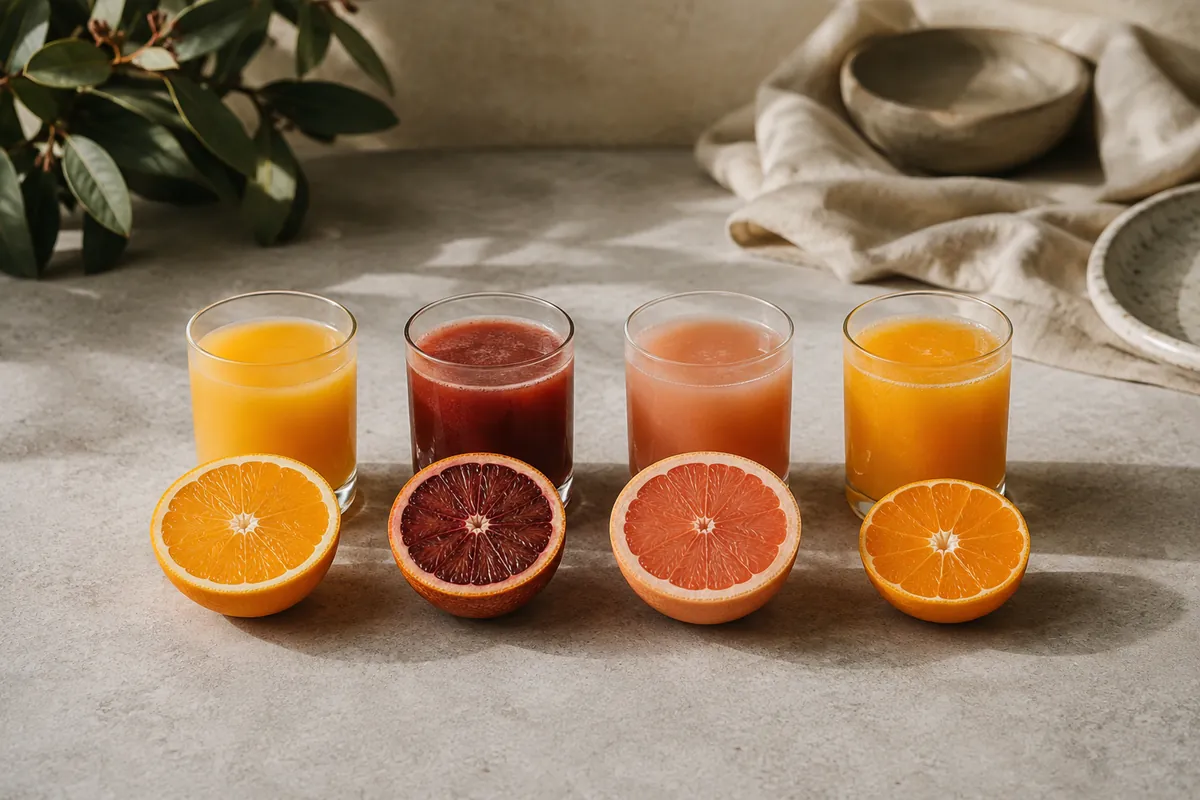
Grapefruit is sharper and carries a distinct bitterness from naringin, which is a different compound from the limonin that spoils a standing orange juice. The perception is the same sort of thing that makes tonic water bitterness divide people so cleanly, and it is the reason grapefruit juice is almost always sold on its own terms rather than blended into something else.
Mandarin and clementine juice runs sweeter and lower in acid, which makes it pleasant and slightly flat. It is usually blended rather than sold alone for that reason.
| Orange | Blood orange | Grapefruit | Mandarin | |
|---|---|---|---|---|
| Acidity | Moderate | Moderate | High | Low |
| Sweetness | High | High | Low | Highest |
| Bitterness | Low, unless it stands | Low | Noticeable, from naringin | Very low |
| Season | Long | Short | Long | Short |
| Sold pure | Commonly | Rarely | Commonly | Rarely |
Almost every citrus juice benefits from blending. A single variety is either too sharp or too flat, and the balance that makes a juice taste finished is generally constructed rather than found in one fruit.
At breakfast
Orange juice occupies a fixed place at a table, and the reason it holds that place is acidity rather than sweetness.
Acid is what makes it work against fat and against a sweet breakfast, cutting through both instead of adding to them. The same acid is why it fights anything already sour, and why a glass alongside a grapefruit half or a yoghurt reads as harsh when the same juice with toast reads as bright.
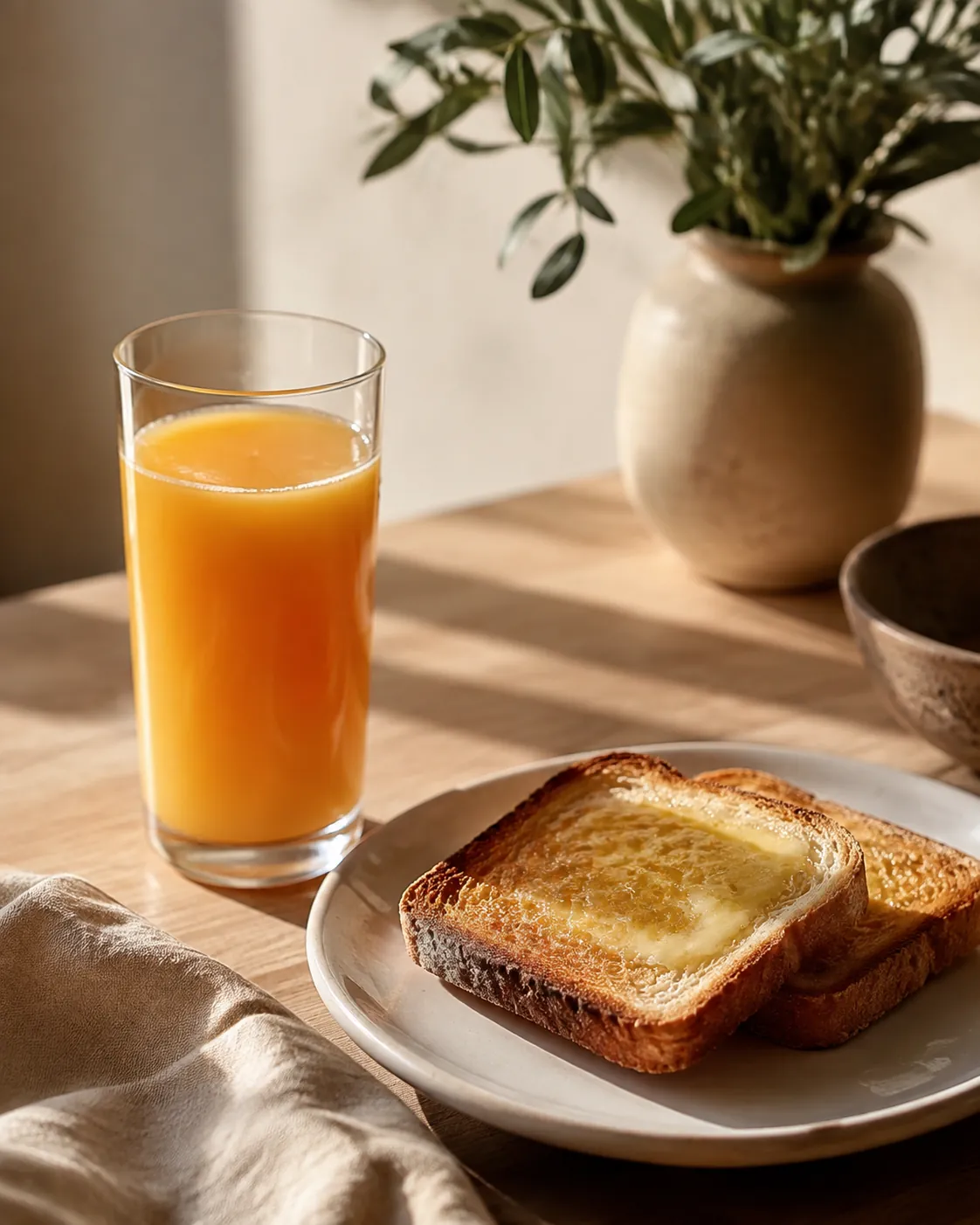
Temperature and timing matter more at breakfast than anywhere else, because the glass usually sits through a meal rather than being drunk at once. Poured cold and left for the length of a breakfast it warms, flattens and sweetens, which is most of why the last mouthful is rarely as good as the first.
Toast and butter
The classic pairing, and the one the acidity was made for. It cuts the fat cleanly.
Eggs
Works, though the juice reads sharper against a savoury plate than a sweet one.
Yoghurt or grapefruit
Two acids at once. The juice turns harsh and the fruit turns sour.
Pastry
The strongest case for orange over anything milder, since sweetness needs cutting.
Porridge
Awkward. The juice is thin and cold against something hot and thick.
Apple juice is the mild alternative on the same table: sweeter, far less acidic, and much easier alongside strongly flavoured food. A pressed bottle of either costs several times as much and tastes closer to the fruit, and whether that is worth it alongside food rather than tasted on its own is a fair question to ask before subscribing to one.
Common questions
What is the difference between from-concentrate and not-from-concentrate juice?
From-concentrate juice has had its water removed for storage and shipping, then added back before packing. Not-from-concentrate is never concentrated, though it is usually pasteurised and often stored in tanks for months. Both are 100 per cent juice.
Why does my home-squeezed orange juice turn bitter?
Limonin, which develops in the juice over the hour after pressing through a reaction with acid. Navel oranges are high in it, which is why juice from eating oranges goes bitter fast. Use Valencias and drink it quickly.
What is a flavour pack in orange juice?
Aroma compounds recovered from oranges during processing and added back before packing, because pasteurisation and storage strip them out. They are orange-derived, which is why the juice still counts as 100 per cent juice.