How to Make Iced Coffee That Is Still Coffee After the Ice Melts
Melting ice is brew water nobody measured, which turns a taste complaint into a piece of arithmetic.

Brew iced coffee at 1 part coffee to 15 parts total water, with about 40 per cent of that water weighed into the glass as ice before you start.
Almost every weak iced coffee is the same mistake, and it is arithmetic rather than technique. The ice is water, and nobody measured it.
Why does hot coffee taste weak over ice?
The ice is a second dose of brew water that never appeared in the recipe.
Depending on glass temperature, cube mass, and drinking time, a substantial share of the finished drink may arrive as melted ice rather than brewed coffee.

Pouring hot coffee straight onto ice is the worst version of this. Hot liquid melts ice fast, so the dilution happens all at once and the drink is already thin before it reaches the table.
That is why iced coffee has to be brewed stronger than the same coffee served hot. Not because cold changes the extraction, but because there is more water in the finished drink.
Strength also drifts while you drink it. A glass finished in five minutes is noticeably stronger than the same glass nursed for half an hour.
How do you brew for ice rather than for a mug?
Split the water into two measured parts before you begin.
Total water stays at roughly 15 times the weight of the coffee, which is an ordinary pour-over ratio. What changes is that only about 60 per cent of it goes through the kettle.
Iced coffee, split ratio
- Coffee
- 30 g
- Hot water
- 270 g
- Ice in the carafe
- 180 g
- Total water
- 450 g
- Final ratio
- 1:15
The hot side works out at around 1:9, which is a concentrate rather than a drink. Taste it before the ice melts in and it will be far too strong, which is exactly right.
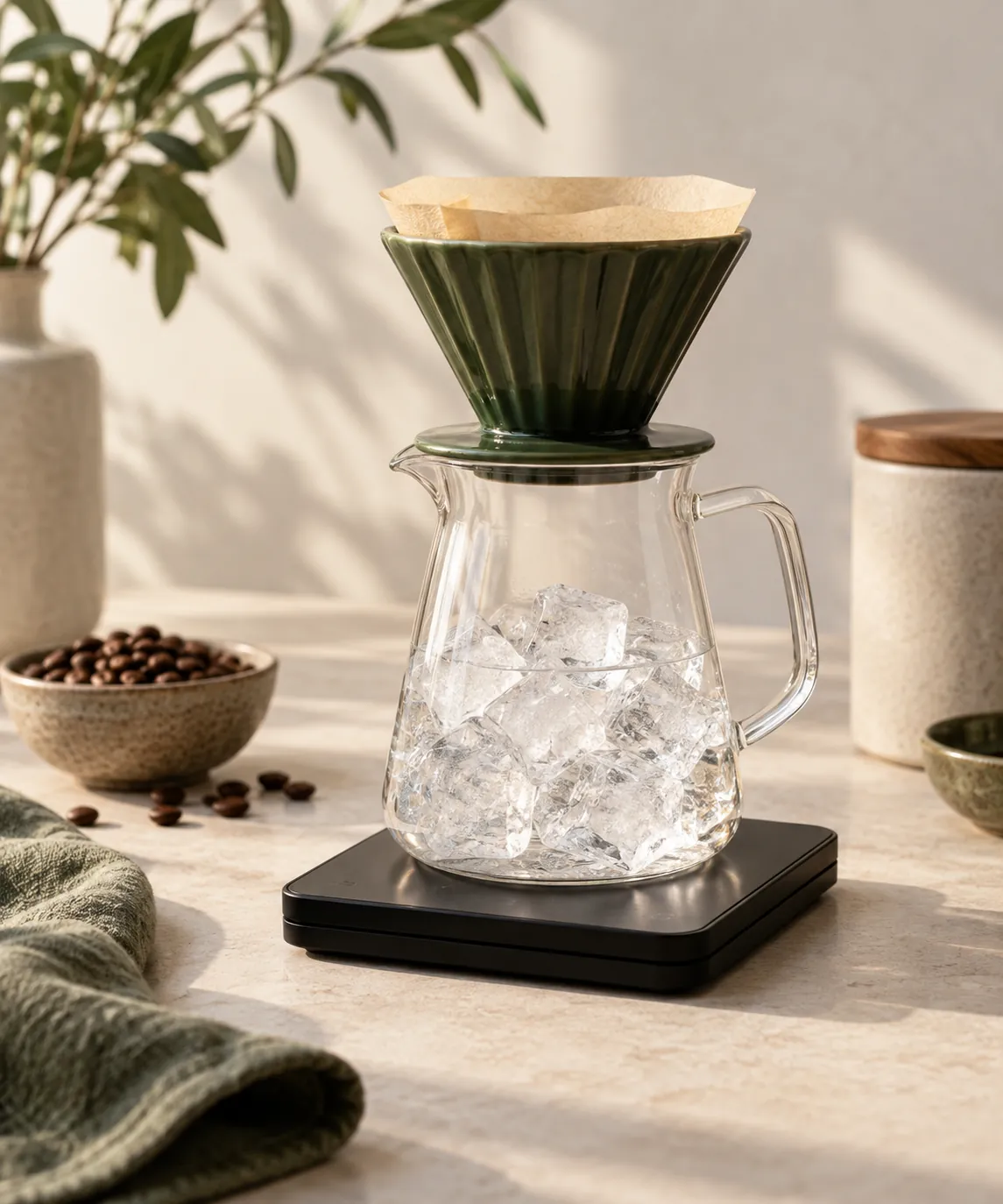
Weighing the ice is the whole discipline.
A tray of cubes varies by a surprising amount, and a handful is not a measurement.
Two things shift the numbers. Ice sitting out in a warm kitchen has already lost weight by the time you brew, and a very dark roast can read harsh at concentrate strength before the melt has softened it.
Choosing a brewer for the result you want
Flash brewing is easiest with a paper dripper because the coffee can fall straight onto measured ice, but the water split works with more than one device.
The brewer changes body and clarity. It does not remove the need to account for melt.
| Method | How to adapt it | Result in the glass | Main limit |
|---|---|---|---|
| Pour-over | Replace part of the brew water with ice in the carafe | Bright, aromatic, and clear | Reduced hot water makes pouring discipline important |
| Automatic drip | Put measured ice in the carafe or brew a covered concentrate | Clean and practical for a batch | Small batches may not wet the basket evenly |
| AeroPress | Press a short concentrate directly over ice | Full and quick for one glass | Small chamber limits volume |
| French press | Brew strong, decant fully, then chill quickly | Heavier body with more sediment | Hot glass must not meet a sudden thermal shock |
| Instant coffee | Dissolve a stronger dose in a small amount of hot water | Fast and consistent | Flavor ceiling belongs to the powder |
A paper filter removes fines and much of the oil, so it makes the clearest cold glass. Immersion from a French press keeps those materials and can taste rounder, but sediment becomes more obvious as the drink sits.
Do not pour a boiling brew into a refrigerator-cold glass vessel.
Use heat-safe glass, leave enough headroom for the ice, and swirl only after the initial ice has melted enough to move freely.
The smaller hot-water allowance can make a normal grind drain differently. Start near the setting used for hot coffee, watch whether all the water crosses the bed, and adjust the next brew by taste and flow rather than treating one grinder number as universal.
The finished ratio stays constant even when the brewer changes. Coffee, hot water, and ice should still add up before the first pour begins.
How do you make Japanese flash brew?
Brew the coffee directly onto the ice.
It sounds wrong, and it is the whole method: the hot coffee lands on the ice as it drips, chills within seconds, and never spends time cooling slowly on a counter.
Flash brew, in order
- WeighPut 180 g of ice into the carafe and zero the scale.
- RinseSeat the cone, rinse the filter, and discard the rinse water.
- BloomAdd about 60 g of hot water and wait 30 seconds.
- PourAdd the rest of the 270 g in stages, finishing around three minutes.
- SwirlStir the melt through before pouring over fresh ice.

What the speed buys you is aroma. Volatile compounds escape as coffee cools, so a brew that goes from 93 C to cold in seconds keeps things a slow cool loses.
The whole process takes about four minutes. That is the same time as a normal hot brew, with no planning the night before.
Two practical limits. You need a brewer that drips rather than one that steeps in a closed vessel, and the carafe has to hold the ice and the coffee together without overflowing.
What about brewing hot and chilling it in the fridge?
It works, and it costs you something.
Coffee cooling slowly on a counter or in a fridge loses aromatics the whole way down, which is precisely what flash brewing avoids.
| Route | Time to drink | Aroma | Best for |
|---|---|---|---|
| Flash brew | About 4 minutes | Bright, aromatic | One or two glasses, made now |
| Fridge chilled | 1 to 2 hours | Duller, flatter | A batch held for several servings |

The route still needs the stronger brew. Chilled coffee poured over fresh ice dilutes a second time, so the concentrate arithmetic applies here just as much.
Where it wins is volume. Making two litres by flash brew means standing over a cone repeatedly, and a batch chilled in a jug is simply more practical.
A drip machine is the easiest way to make that batch.
Brew it at the concentrate strength above, chill it covered, and pour over fresh ice.
Cover it. Coffee left open in a fridge picks up whatever else is in there within a day, and that is a faster spoiler than staling.
Bitter, muddy, or cloudy iced coffee needs a different correction
Cold temperature can hide sweetness while leaving bitterness and rough texture easy to notice. Taste a spoonful after the planned ice has melted, because judging the hot concentrate sends you toward changes the finished drink may not need.
| What you notice | Likely cause | First controlled test |
|---|---|---|
| Sharp and thin | Too little extraction from the reduced hot-water phase | Grind slightly finer or extend contact without changing total water |
| Dry and bitter | Too much extraction or a roast that is harsh at concentrate strength | Grind coarser and shorten the final pour |
| Muddy texture | Fines or sediment from the brewer | Use paper filtration or decant an immersion brew carefully |
| Cloudy but clean-tasting | Oils and suspended material changed as the brew cooled | Treat it as appearance, not an automatic flavor fault |
| Flat after refrigeration | Aroma changed during holding or the jug was left open | Brew a smaller covered batch and use it sooner |
A stalled pour-over deserves its own branch.
With less hot water available, aggressive swirling can drive fines into the filter and leave the last part of the bed sitting in water, so reduce agitation before making a large grind change.
Cloudiness is not a reliable extraction meter. A clear glass can taste hollow and a hazy one can taste balanced, especially when roast level and paper type change how much oil and fine material reach the carafe.
For bitterness, separate roast character from brewing error. A dark coffee can retain a pleasant cocoa-like bitterness over ice, while an acrid or drying finish that grows as the glass warms points toward extraction or stale coffee oils.
Change one variable on the next brew. Moving grind, coffee dose, ice mass, and pour time together may improve the glass, but it leaves no repeatable explanation for why.
How is this different from cold brew?
The dividing line is brewing temperature, not serving temperature.
Brew temperature
Iced coffee is brewed hot. Cold brew never sees heat at all.
Brew time
Four minutes against 12 to 24 hours in the fridge.
What survives
Acidity and aroma against smoothness and low bitterness.
Cold brew steeps ground coffee in cold water for the better part of a day, and the low temperature simply does not extract the acids that make a hot brew bright.
That is why the two taste so different despite arriving in the same glass. One keeps the fruit and the sharpness, the other rounds everything off.
If you want the two set against each other properly, the head-to-head runs through the attributes that actually separate them.
Serving temperature is a poor guide. Cold brew is often served hot, and iced coffee is always served cold, so the word cold in both names points at different stages.
Concentration differs too. Cold brew concentrate runs around 1:4 to 1:6 and is cut at serving, where the iced coffee above is already at drinking strength once the ice melts.
How do you stop it going watery in the glass?
The recipe handles the first dilution. It cannot do anything about the twenty minutes afterwards.
Cube size, glass temperature, and serving time act after the coffee is brewed, so they change later dilution without repairing a weak starting ratio.
- Use larger cubes, which carry less surface for the same mass
- Use clean-tasting ice made from water you would willingly brew with
- Freeze coffee into cubes so the melt adds coffee rather than water
- Chill the glass first, so the ice is not spent cooling glassware

Size is the biggest lever. A single large cube has far less surface exposed than the same mass split into a dozen small ones, and melting happens at the surface.
Clarity is mainly an appearance choice. Cube size, starting temperature, and exposed surface matter more to melting than whether the centre looks cloudy, so do not buy special ice when a larger ordinary cube solves the practical problem.
Ice also tastes of whatever it was frozen from.
Brew water good enough for the kettle is worth putting in the tray as well.
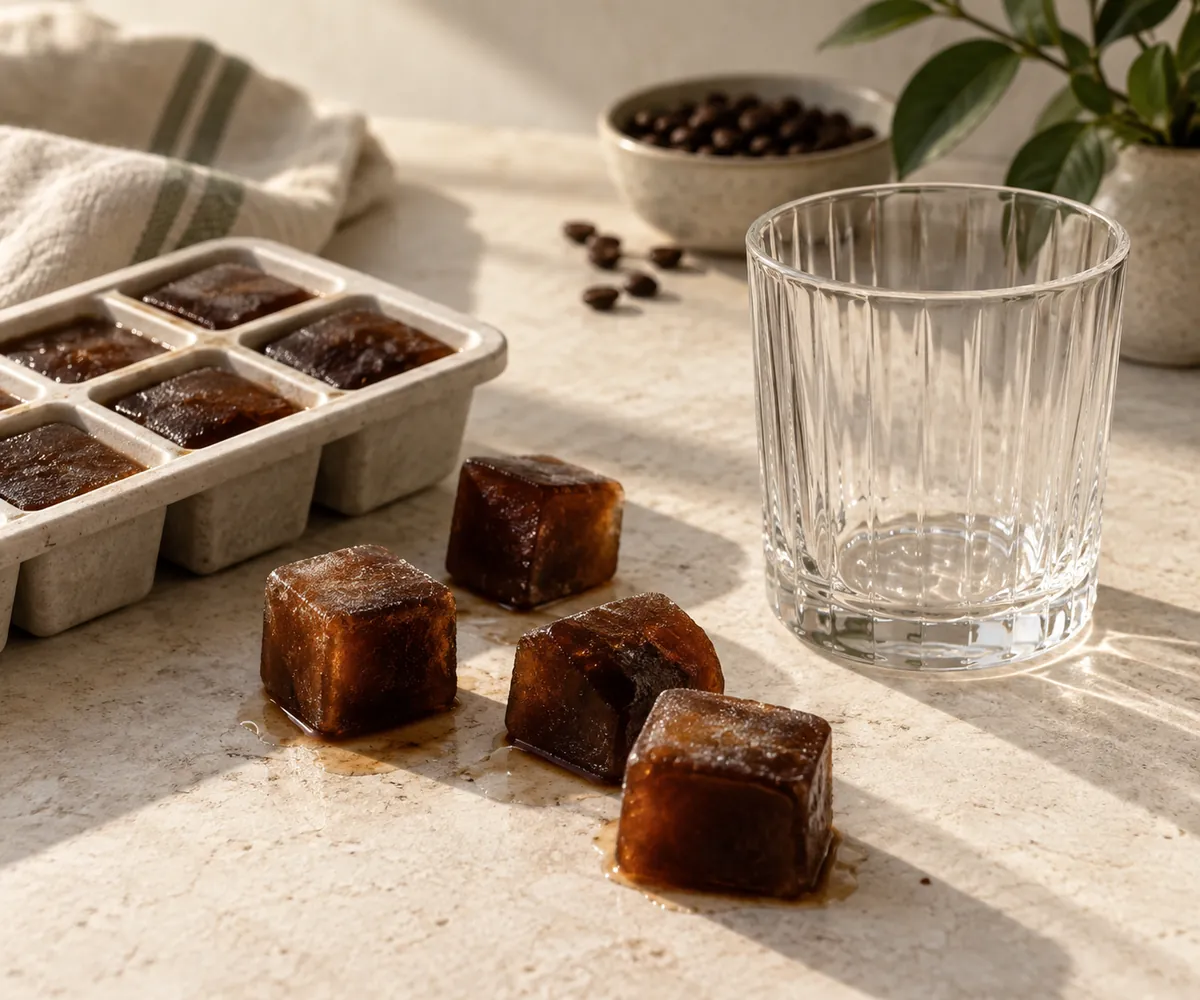
Coffee cubes are the complete answer, with one cost. They take hours to freeze, so they need the same planning as cold brew and stop being the quick option.
One large cube has a small drawback. It chills more slowly at the start, so the first mouthfuls arrive warmer than they would from a packed glass.
Holding a batch without turning it into yesterday's coffee
A batch brewed for later should go into a clean, covered vessel and into the refrigerator once it is no longer throwing off heavy steam.
Use a container that leaves little empty space, because every opening exchanges fresh air and every uncovered minute invites refrigerator odors.
Brewed coffee's volatile profile and sensory quality change with time, and refrigeration only slows those changes compared with room temperature. For a home batch, one day is a useful quality window, not a claim that the coffee suddenly becomes unsafe or unusable at a precise hour.
Add milk when serving rather than storing it in the whole jug. That keeps the black coffee easier to judge and avoids giving every glass the same milk ratio before you know how much ice each one will take.
- Use a clean covered bottle or jug
- Mark the brew date when making more than one day at a time
- Chill the coffee without leaving it open beside strong-smelling food
- Pour the serving before adding milk or syrup
- Discard it if contamination, an off odor, or an unfamiliar surface film appears
Reheating and chilling the same batch repeatedly spends aroma without improving anything.
Pour only what you need, return the covered container promptly, and make a smaller batch next time if the last glass is consistently dull.
Flash brew avoids this entire holding problem for one or two servings. A refrigerated batch earns its place when volume matters more than the freshest possible aroma.
How do milk and sugar behave in cold coffee?
Sugar barely dissolves in a cold glass.
You can stir granulated sugar into iced coffee for a full minute and most of it will still be sitting at the bottom when you finish drinking.
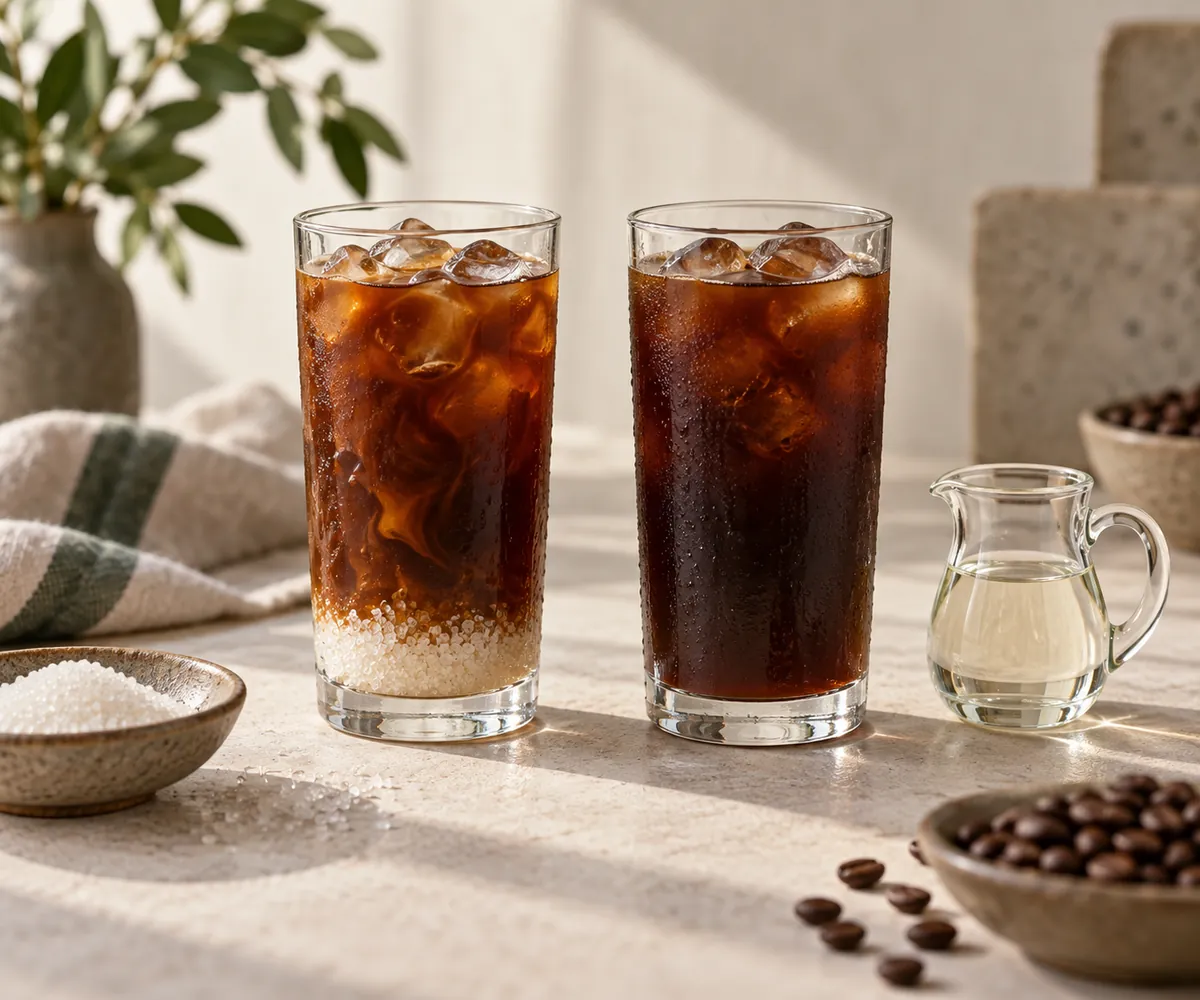
Simple syrup solves it completely, because the sugar is already in solution before it reaches the glass.
Simple syrup, once a month
- MeasureEqual weights of sugar and water.
- WarmHeat gently until the liquid runs clear.
- CoolLet it come to room temperature before bottling.
- KeepRefrigerated, and use it within a few weeks.
Milk is a second dilution and belongs in the arithmetic. Adding 100 ml of milk to a 300 ml glass has the same effect on strength as another 100 g of melted ice.
Cold also mutes sweetness. The same coffee needs noticeably more sugar cold than hot to taste equally sweet, which is worth knowing before you assume the syrup is weak.
Milk does one useful thing here. It softens acidity, so a bright flash-brewed coffee survives it better than a flat chilled one, which can end up tasting of very little at all.
Flash-brewed iced coffee
- Makes
- About 450 ml, two glasses
- Ratio
- 30 g coffee to 450 g total water, split 270 g hot and 180 g ice
- Water temp
- Brew water at 92 to 96 C onto ice
- Total time
- 5 min
What you need
- 30 g medium-ground coffee
- 270 g water at 92 to 96 C
- 180 g ice
Equipment
- Pour-over cone and filter
- Glass carafe
- Scale
- Kettle
- Tall glasses
Method
- WeighPut 180 g of ice into the carafe and zero the scale.
- RinseSeat the cone, rinse the filter, and discard the rinse water.
- BloomAdd about 60 g of hot water and wait 30 seconds.
- PourAdd the remaining hot water in stages, finishing around three minutes.
- SwirlStir the melt through the carafe before serving.
- ServePour over fresh ice in a pre-chilled glass.
Common questions
Can you make iced coffee with instant?
Yes, and the same arithmetic applies. Use roughly twice the powder you would for a hot mug, dissolve it in a little hot water first, then pour over ice.
Does the grind change for iced coffee?
No. Use the same grind you would for that brewer hot. The concentration comes from the water split rather than from grinding finer.
How long does iced coffee keep in the fridge?
A covered jug holds up for about a day. After that it flattens noticeably, and uncovered it will pick up other smells well before then.
Why is my iced coffee cloudy?
Rapid chilling can make a hot brew go hazy as oils and solids come out of solution. It affects appearance rather than taste and is normal in flash brewing.