How to Make a Latte, With or Without a Machine
A latte puts a concentrated coffee base under roughly three times as much steamed milk, so coffee at ordinary strength vanishes into it without trace.

Build a latte from about 60 ml of espresso under roughly 180 ml of steamed milk, finished with a thin centimetre of foam.
Three quarters of the glass is milk, so the coffee underneath has to be concentrated. That concentration, rather than the frothing tool, decides whether no-machine versions succeed or fail.
What are the proportions of a latte?
The proportions are one part coffee to three parts milk, which in a glass means a double shot of around 60 ml with about 180 ml of steamed milk over it and a foam layer of roughly a centimetre on top.
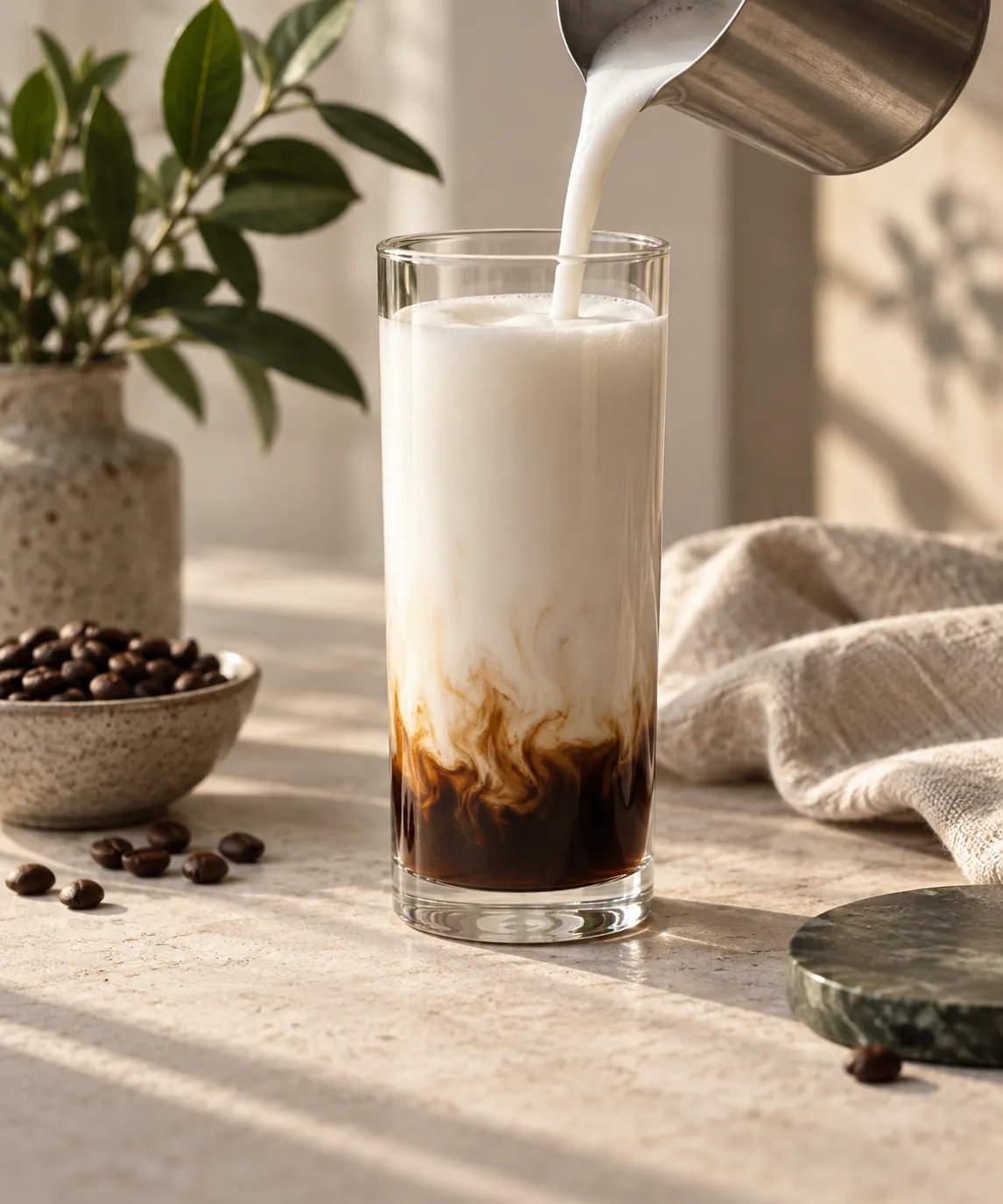
Measure your own glass before deciding on the shot. A 350 ml glass with a single espresso in it will taste of warm milk with a suggestion of coffee behind it.
A large latte carries more coffee than a standard one because the ratio has to travel with the volume, which is the arithmetic behind cafe sizes.
Foam depth keeps this from being a different drink, since a centimetre is a cap you can pour through rather than one that sits on the surface and has to be spooned aside.
Build the coffee base before heating milk
Milk softens bitterness and acidity, but it cannot replace sweetness that the shot never developed, so taste a teaspoon of the coffee base first. It should be concentrated and balanced enough to remain recognizable after its volume triples.
For espresso, begin with the basket recipe that already suits your machine rather than forcing every setup to produce exactly 60 ml. Two short shots or one double yielding roughly 36 to 45 g can carry a 240 ml latte, while a much larger glass needs either more coffee or less milk.
| Coffee alone | Likely result under milk | Useful next move |
|---|---|---|
| Sweet and concentrated | Clear coffee flavor with a rounded finish | Keep the shot and set milk volume by the cup |
| Sharp and fast-running | Thin latte with a sour edge | Grind finer or improve puck distribution |
| Dry and slow-running | Bitter latte even when the milk is sweet | Grind coarser or stop the shot earlier |
| Balanced but faint | Pleasant milk with little coffee identity | Use a second shot or choose a smaller cup |
A freshly dialled espresso is the most direct base, because pressure produces concentration without a long drink volume. Crema is visually useful, but the liquid beneath it carries the balance, and a thick surface does not prove that the shot will stand up to milk.
Beyond the shot itself, roast choice changes the margin. A medium or moderately dark roast usually keeps caramel, nut, and cocoa notes audible in milk, while a light coffee can work when its acidity is sweet and the shot is extracted evenly.
Have the glass ready before the shot finishes, because espresso aroma changes quickly after brewing and a shot left on the counter while you search for a jug loses its freshest aroma before the milk arrives.
Taste the base first when a latte seems wrong. That ten-second check separates a coffee problem from the milk and pouring problems that follow.
How do you steam milk for a latte?
A latte takes a second or two more air than a shorter drink does, and everything else is the same as any milk texturing: aerate while the milk is cool, then submerge the wand and let it roll until the bubbles are small enough to pour.
Steaming for a latte, in order
- PurgeClear condensed water from the wand before it reaches the milk.
- AerateTip just below the surface, two or three seconds of hiss.
- RollSink the tip and spin the milk until the jug is too hot to hold comfortably.
- StopBetween 60 and 65 C, a range at which milk tastes sweet.
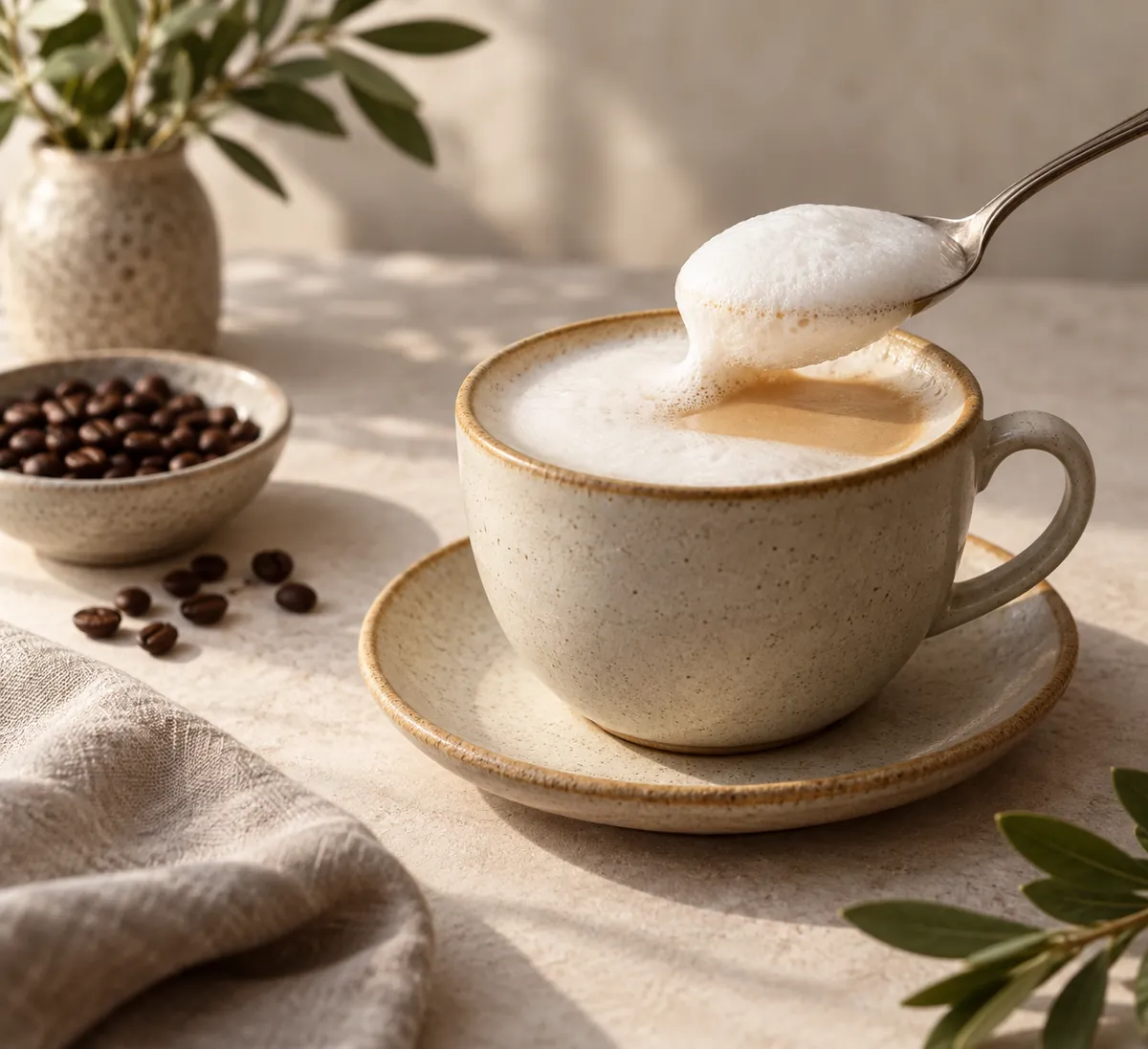
The air has to go in while the milk is still cool, because past about 38 C the bubbles that form are large and separated and rolling will not fold them down afterwards.
Temperature is the other limit, and although milk proteins help stabilize the air-liquid films around bubbles, heat, fat state, and processing change how that foam behaves, so pushing the pitcher well beyond the pleasant drinking range makes the result less sweet and less stable rather than creating better texture.
La Marzocco's guide for its Linea Mini says to heat milk to no more than 60 C for well-structured foam, and that foam dissipates more quickly above 65 C.
Wand power differs between machines, so treat the count as something you calibrate rather than a number to copy. A domestic single-hole wand takes longer than a commercial one to move the same volume.
How do you pour a latte that stays integrated?
The pitcher should look like wet paint before it reaches the cup: glossy, mobile, and free of a stiff cap. Swirl until the surface and liquid move together, because foam that has floated apart will land as a white raft while plain hot milk runs underneath it.
From finished milk to an integrated cup
- Swirl the espressoA brief turn combines crema and liquid into an even base
- Polish the milkSwirl the pitcher until no dry foam sits at the edge
- Start higherA narrow stream sinks below the surface and mixes milk with coffee
- Move closerLower the spout as the cup fills and the drink has enough depth
- Finish at the surfaceA wider stream lays the remaining microfoam across the top
Pouring high for the whole glass buries every bubble and leaves almost no cap. Starting low does the opposite, spreading the foam immediately, blocking later milk from integrating, and producing a pale top over a dark base.
A centered pour is easier to read than a decorative one, and what you are looking for is an even warm-brown body and a thin, continuous surface rather than a perfect leaf pattern.
Pause only long enough to swirl. Milk drains out of foam as it stands, so the pitcher becomes two ingredients again within a minute and no wrist movement can fully recombine a dry top with the liquid below.
When the last foam sticks in the jug, the milk was aerated too much or allowed to wait. Use less early air on the next attempt and begin pouring as soon as both the shot and milk are ready.
Can you make a latte without an espresso machine?
Yes, provided the coffee goes in at concentrate strength.
Any of the usual home brewers will make coffee, but ordinary drinking strength disappears completely under 180 ml of milk.
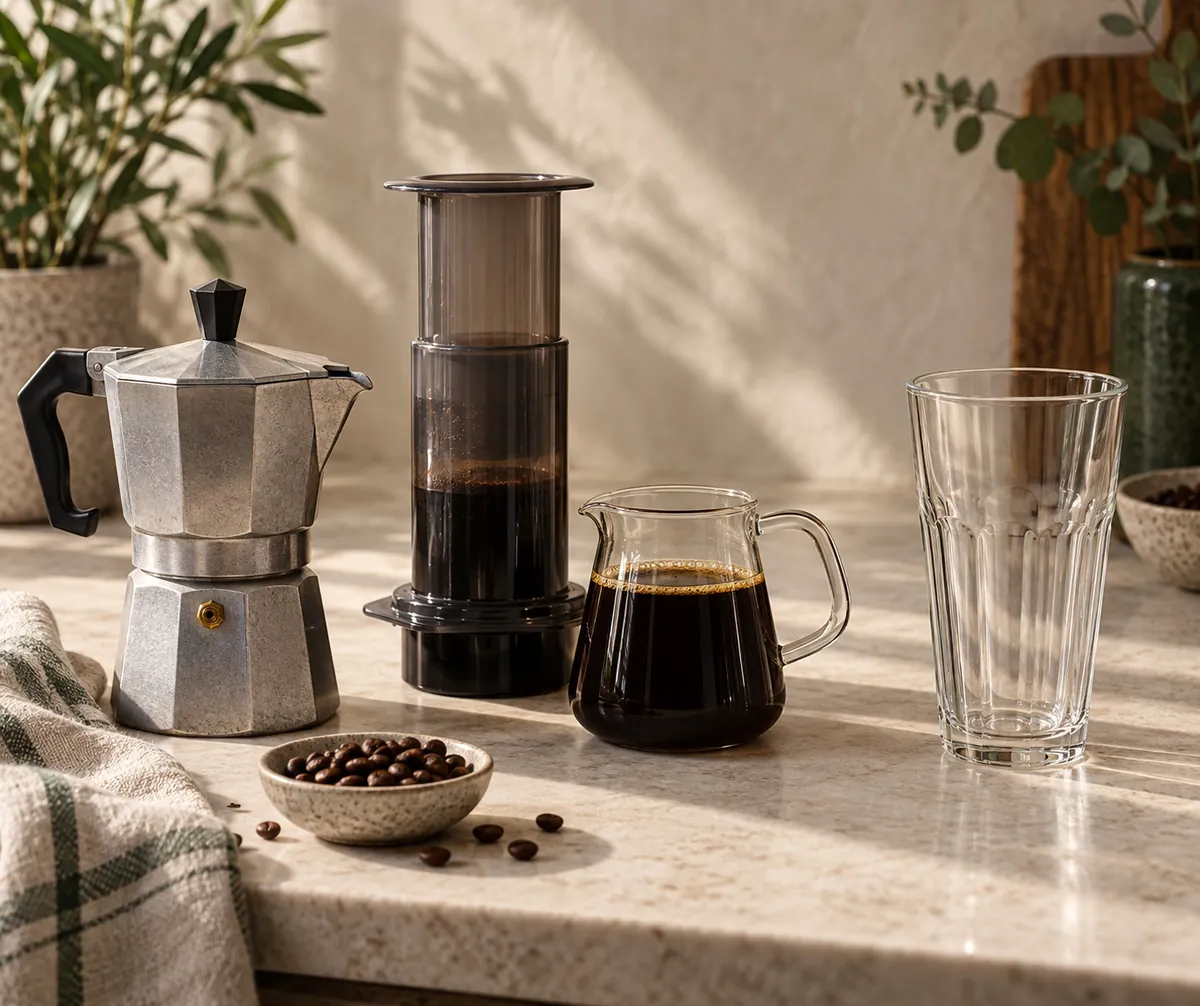
Moka pot
Already a concentrate. Use it as it comes, about 60 ml.
AeroPress
Press short and strong, roughly 1:5 rather than 1:15.
Strong filter
Brew at double strength, then use 60 ml of it.
A stovetop brewer needs no adjustment at all, since it produces something close to the right concentration by design, which makes it the easiest substitute of the three.
An AeroPress works if you cut the water rather than adding coffee. A short press at around 1:5 gives roughly 60 ml of something strong enough to survive the milk.
None of these carry crema, so the surface will look different from a cafe drink. Under a centimetre of foam that difference is largely invisible anyway.
How do you froth milk without a steam wand?
Four ordinary kitchen routes all work, though only one of them heats the milk at the same time, so the other three need a separate warming step, and for the jar that step comes after the shaking.
| Method | Effort | Heats the milk | Foam quality |
|---|---|---|---|
| Sealed jar | Shake hard for 30 to 60 seconds | No | Good, slightly dry |
| French press | Plunge 20 to 30 times | No | Finest of the four |
| Handheld frother | 20 seconds | No | Good, quick |
| Saucepan and whisk | Whisk while warming | Yes | Coarser, but one step |
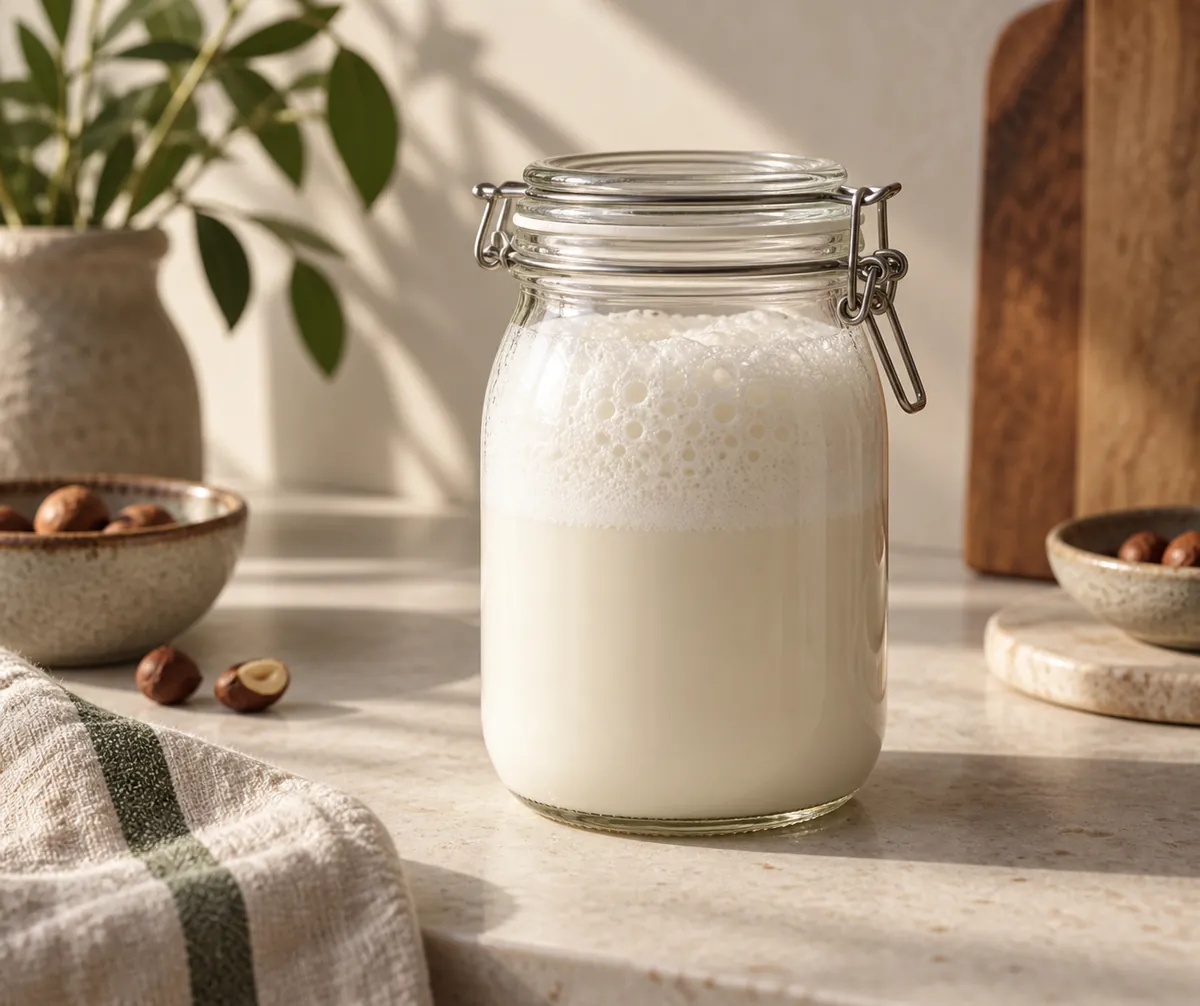
Half fill a jar with cold milk, close the lid and shake hard for half a minute, and the foam fills about the top third of the jar. Take the lid off before you warm the milk, because a closed jar of hot milk builds pressure.
A French press gives the finest foam of the four. Plunging repeatedly through warm milk works the air in more gradually than shaking does, which produces smaller bubbles.
Foam made without steam is drier and collapses faster than steamed microfoam, so it wants pouring straight away rather than standing.
How do you make an iced latte?
Build an iced latte with milk first, then ice, then the shot, which is the reverse of the hot build and what gives the drink its layered look before anyone stirs it.
Use roughly 180 ml of cold milk, and stir before drinking, because the layers are there to be looked at.

You skip the frothing step entirely. An iced latte has no foam, which makes it the easier of the two drinks rather than a harder variation on the hot one.
Fill the glass properly with ice cubes. A hot shot poured over a thin scatter of cubes melts most of them at once and the drink arrives diluted.
Do not reduce the shot to compensate for that melt. Cold also mutes coffee more than heat does, so if anything the base can go stronger than it would hot.
Which milk makes the best latte?
In a drink that is three quarters milk, this is not a minor choice.
Whole milk foams reliably, because the protein helps build the bubble walls.
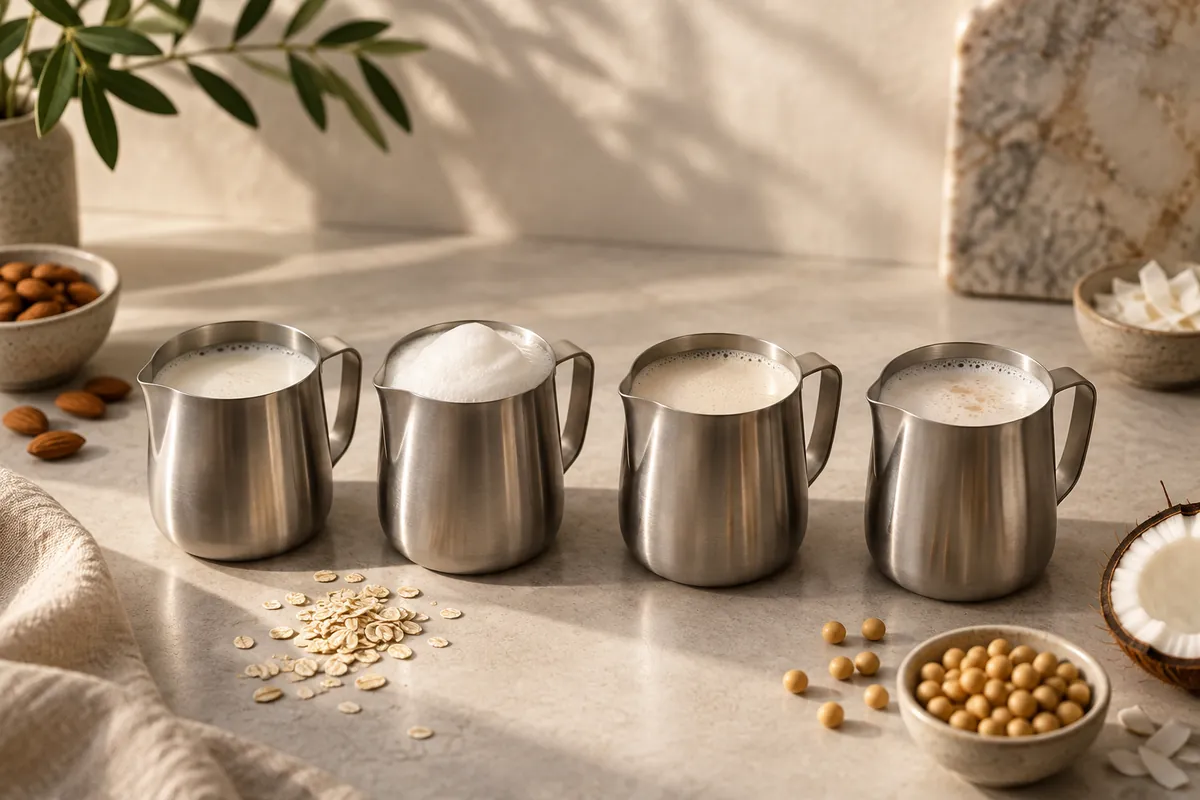
Whole
Reliable foam and a sweet taste, and the usual default.
Semi-skimmed
More volume of foam than whole, though how it holds depends on heat and processing.
Oat
The best plant option, and sweet enough to carry the drink.
Semi-skimmed whips up to more volume than whole milk, though how long that foam holds depends on heat, fat state, and processing.
Oat is the plant option that works. Barista formulations add protein and stabilisers specifically so the foam holds, and the difference against a standard carton is not subtle.
Start with cold milk whatever the type. Cold milk gives you more time to introduce air and build a vortex before the drink reaches serving temperature.
A barista label is a formulation clue, not a guarantee, because protein, oil, acidity regulators, and stabilizers vary between cartons. Compare how the drink pours and holds rather than assuming every oat or soy product will behave alike.
Plant milk curdling is a separate failure from weak foam. Fine flecks or a watery edge after the pour point to a heat-and-acid interaction, and lowering the milk temperature is a better first test than adding more air.
Rinse the pitcher and wipe and purge the steam wand immediately after pouring. Dried milk narrows the steam holes, changes the jet pattern, and makes the next pitcher harder to roll even when the technique is unchanged.
Why is my latte weak or watery?
Four causes, and the first two look identical in the glass.
The commonest is simply arithmetic: a single 30 ml shot under 180 ml of milk is half the coffee the ratio calls for.

The second cause belongs to readers without a machine. A perfectly good filter coffee at normal strength simply vanishes under this much milk, and the fix is to brew it stronger rather than to use more of it.
The third is milk rather than coffee. Over-aerated milk fills the glass with foam, so there is less liquid in each mouthful and the drink reads thin even though the shot was right.
Scalded milk is the one that misdirects, because milk taken past 70 C can lose its sweetness and taste flat, and flat reads as weak rather than burnt so you reach for another shot instead of a thermometer.
Syrup is not the answer to any of these. Sweetness masks a weak latte without correcting it, and the glass still holds the same small amount of coffee.
Latte method
- Makes
- 1 glass, about 250 ml
- Ratio
- About 60 ml espresso to about 180 ml steamed milk
- Water temp
- Milk stopped at 60 to 65 C
- Total time
- 5 min
What you need
- 60 ml espresso or equivalent concentrate
- About 180 ml milk or a barista plant drink
Equipment
- Espresso machine, moka pot or AeroPress
- Steam wand, jar, French press or frother
- Latte glass of 240 to 350 ml
Method
- BrewMake 60 ml of espresso, or a concentrate at roughly 1:5 from another brewer.
- WarmHeat the milk to 60 to 65 C.
- AerateTwo or three seconds of air at the surface, aiming at a centimetre of foam.
- RollFold the bubbles small, by wand, plunger or whisk.
- PourStart high into the centre, then drop the spout as the glass fills.
Common questions
Can you use instant coffee for a latte?
Yes, made about twice as strong as you would drink it, so it survives the milk. Dissolve it in a splash of hot water first rather than straight into the milk.
How much milk is in a large latte?
Enough that the shot has to scale with it. A 350 ml glass wants about 90 ml of espresso to hold the same ratio, against the 60 ml a 240 ml glass takes.
Does a latte need a glass rather than a mug?
No. The glass is conventional because the layers look good in one, and a mug of the same volume makes exactly the same drink.
Why does my foam vanish before I finish pouring?
Foam made without steam is drier and less stable. Pour it straight away, and swirl the jug hard first so the foam and the milk move together.