Why a Burr Grinder Beats a Blade, and Flat vs Conical
A burr grinder crushes coffee between two surfaces set a fixed distance apart, so every particle comes out roughly the same size. That uniformity is the single biggest equipment factor in how coffee tastes.
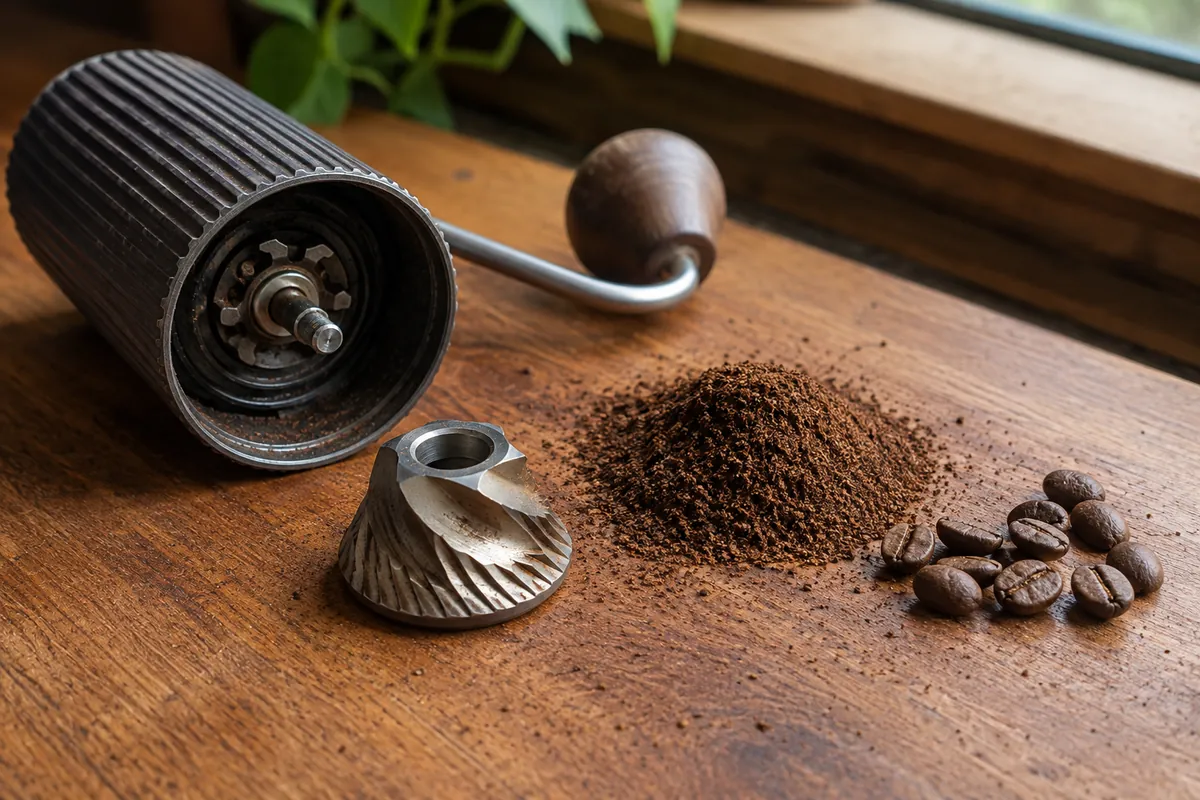
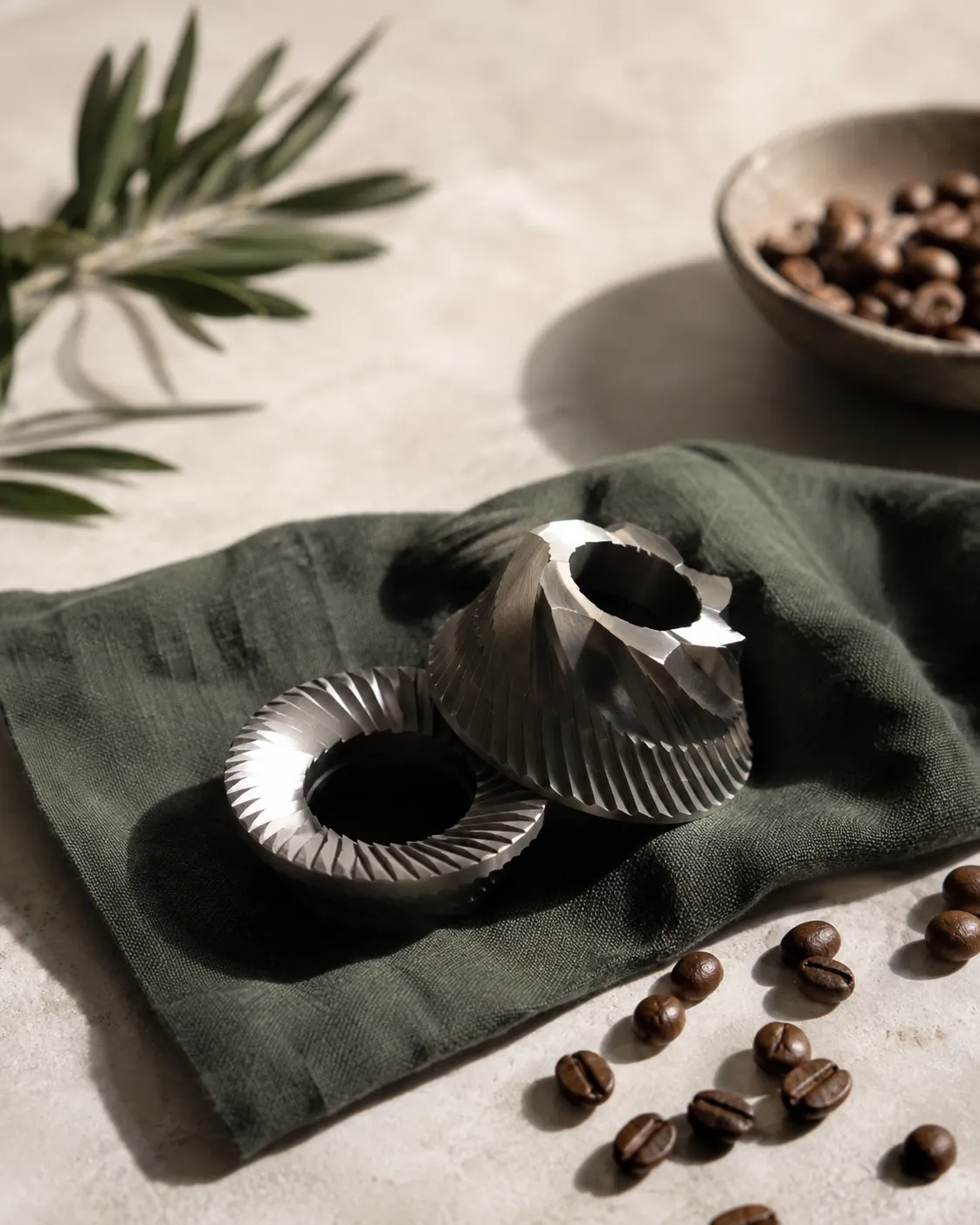
A burr grinder works by crushing coffee between two hard surfaces, called burrs, held a set distance apart. Beans are broken down until they are small enough to fall through the gap.
Because the gap sets the size, every particle leaves at roughly the same size. That is the whole point of the design, and it is the one thing a spinning blade cannot do at any speed or for any length of time.
The burr grinder at a glance
- How it works
- Crushes beans between two burrs held a set distance apart
- What it buys you
- Uniform particle size, so the whole dose extracts at one rate
- Burr shapes
- Conical and flat. Burr quality outranks burr shape
- Adjustment
- Stepped is fine for filter; espresso wants stepless or very fine steps
- Retention
- Grounds held inside come out stale in the next brew
- Burr life
- Hundreds of kilograms of coffee, which is years at home
- Hand or electric
- A hand grinder out-grinds an electric one at the same entry price
Why one particle size decides the cup
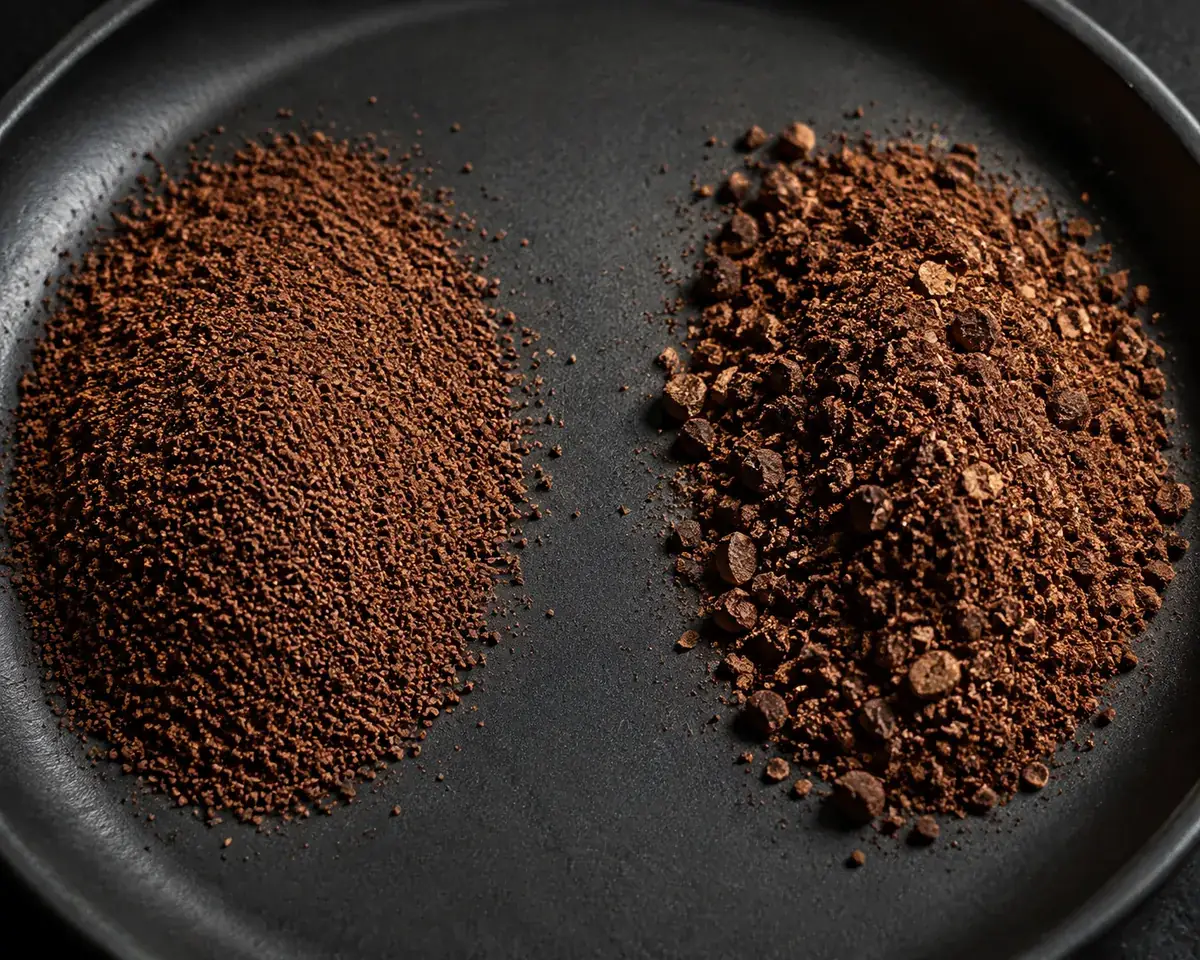
Extraction depends on particle size, and a grinder that produces several sizes at once puts them all into the same brew at the same moment. The fast ones and the slow ones then arrive in the cup together, which is a specific and recognisable fault rather than a general vagueness.
What happens with mixed particle sizes
- Fines
- Very small particles extract fast and over-extract, adding bitterness
- Boulders
- Large pieces extract slowly and under-extract, adding sourness
- Together
- The same cup is simultaneously over and under-extracted
- Result
- Muddled flavour that no adjustment to time or temperature can fix
- Uniform grind
- Everything extracts at a similar rate, so the brew has one character
A cup can be sour and bitter at the same time, and that combination almost always means grind. It is the clearest diagnostic in coffee, and no brewing adjustment resolves it: brewing for longer deepens the bitterness coming from the fines without rescuing the boulders, and brewing shorter does the reverse.
Every other variable, water and temperature and ratio and time, is applied to whatever the grinder has already produced. Grind consistency therefore sits at the top of the priority list rather than somewhere in the middle of it, and one bag of coffee through two different grinders can read as two different coffees.
Crushing at a set gap, chopping at random
Because a burr grinder breaks beans between two hard surfaces held a fixed distance apart, nothing leaves the mechanism until it is small enough to pass through that gap, which is why the setting rather than the timing decides what comes out.
| Burr | Blade | |
|---|---|---|
| Mechanism | Crushes between two surfaces at a set gap | Chops with a spinning blade |
| Particle size | Uniform, set by the gap | Random, set by how long you run it |
| Adjustment | A calibrated setting | Timing, which controls nothing precisely |
| Fines | Present but controlled | Substantial and unavoidable |
| Heat | Low | Higher, from friction and longer running |
| Repeatability | High | Very low |
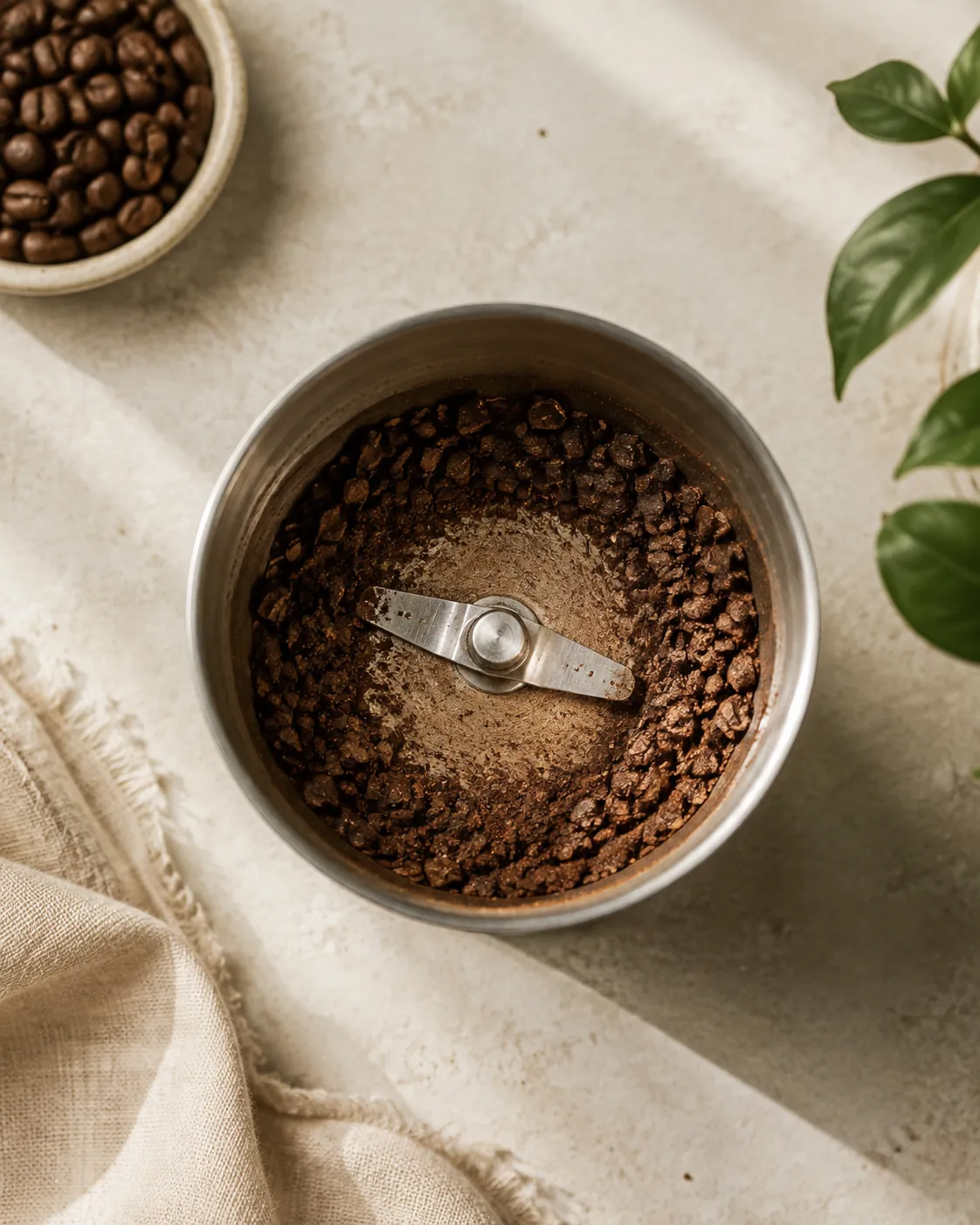
A blade grinder is a spice mill wearing a coffee label. It makes a mixture of dust and chunks, and running it for longer makes more dust without removing the chunks, because a blade has no way of knowing what it has already hit.
For a French press or an AeroPress that is survivable, since long immersion is forgiving about a wide particle spread. For a pour-over cone it is a real handicap, and for an espresso shot it is unusable behind any machine at all.
The second comparison, between the two burr shapes, is genuine and much smaller than the marketing around it.
Conical
A cone inside a ring. Cheaper to make, quieter, lower retention, slightly wider particle spread.
Flat
Two parallel rings. Narrower particle spread, often described as more clarity, more expensive and noisier.
In practice
Both produce far better results than any blade grinder, and burr quality matters more than burr shape.
Cheap flat burrs
Frequently worse than good conical burrs, so shape alone is not a quality signal.
Conical burrs dominate the domestic end and flat burrs the commercial one, which is a fact about manufacturing cost rather than a ranking. Deciding between two grinders at the same price on burr shape alone gets you nowhere, because burr quality outranks burr shape at every point on the scale.
Grind size by method, from powder to sea salt
Grinders rarely label their settings usefully.
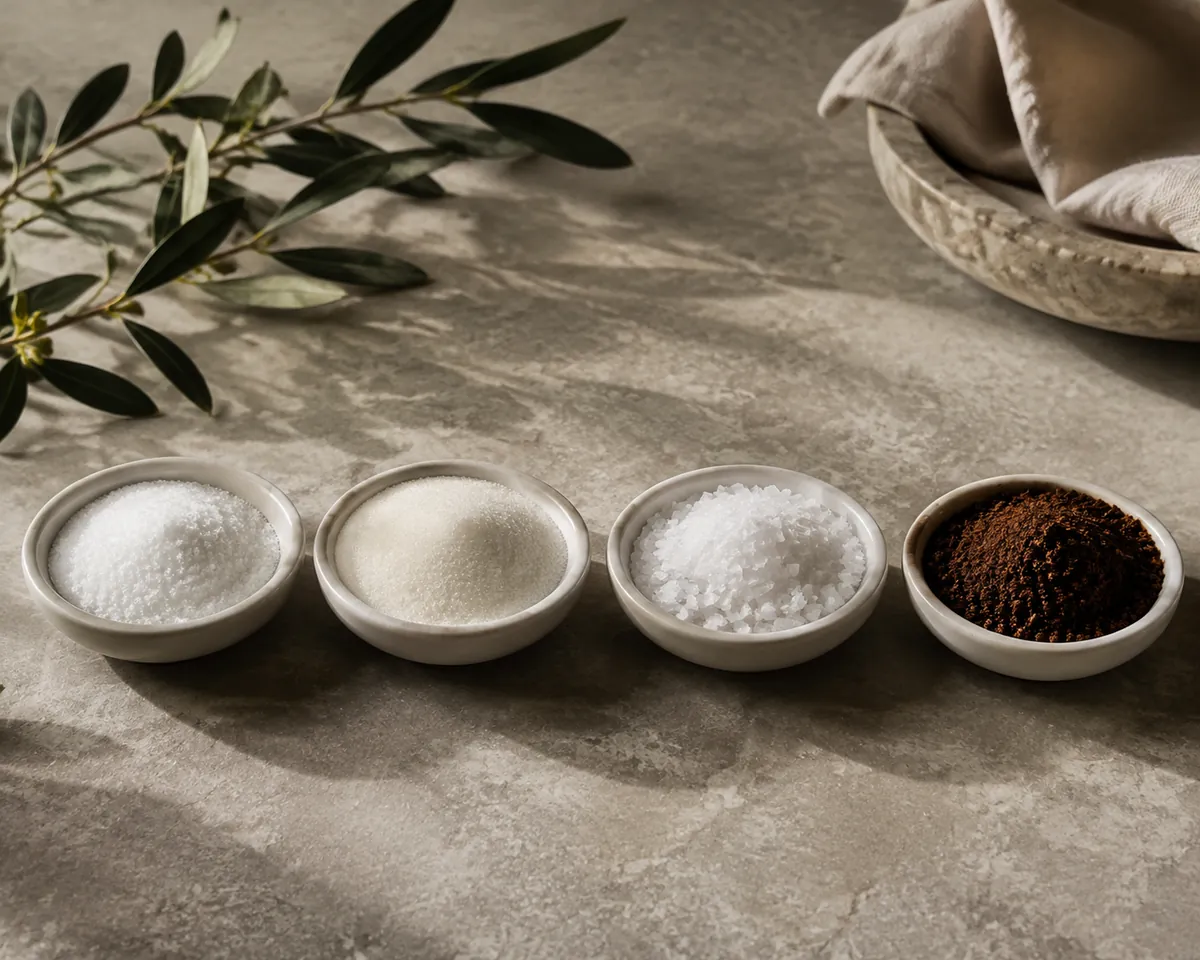
A number on a dial is a position on that particular mechanism rather than a measurement of anything, so the reference points below are worth carrying as textures instead of as digits.
Grind size by method
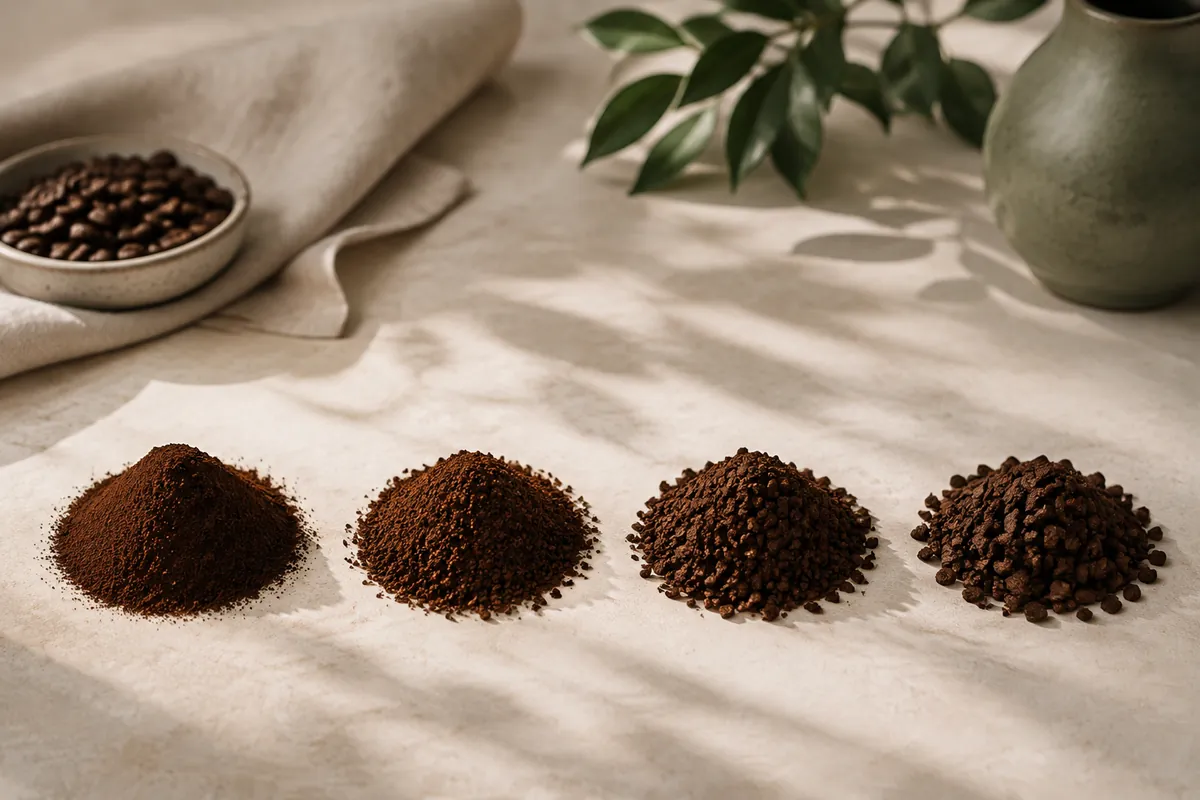
- TurkishPowder, finer than espresso
- EspressoFine, roughly table salt
- Moka potSlightly coarser than espresso
- AeroPressMedium-fine, and tolerant of a wide range
- Pour-overMedium, like caster sugar
- French press and cold brewCoarse, like sea salt
Two grinders set to the same number produce different grinds, which is why every dial-in starts from taste rather than from a setting someone else published. The width of the useful band matters as much as its midpoint: cold brew and a press tolerate a wide spread because the water sits on the grounds for hours, while Turkish coffee at the other end wants a powder that most domestic burr sets cannot comfortably reach.
Record the setting that works for each coffee and each method. It stops you rediscovering the same answer every fortnight, and it makes moving between a press and a drip machine in the same week painless rather than a fresh negotiation.
Clicks, and why espresso needs finer ones than filter
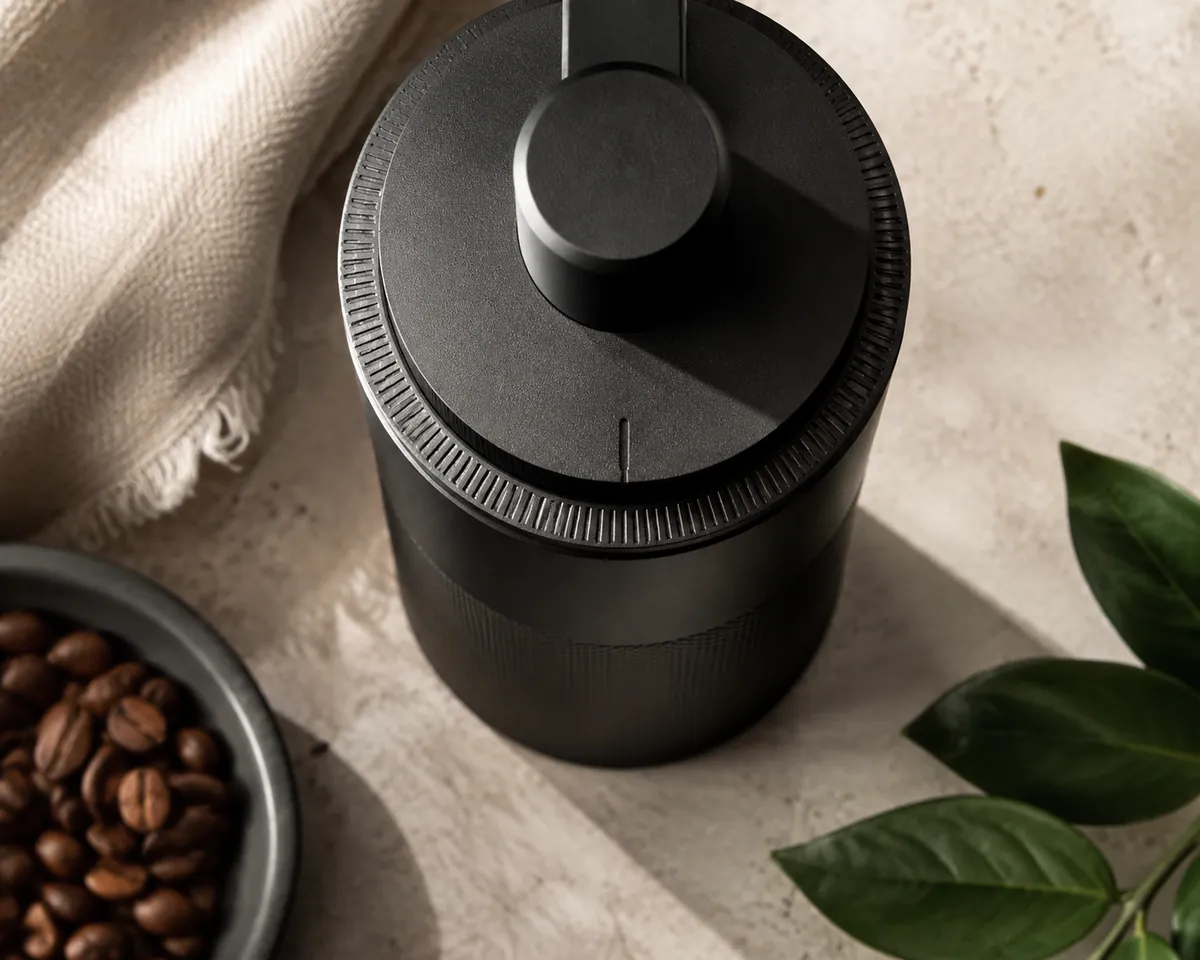
How a grinder adjusts matters far more at one end of the range than the other. Stepped grinders click between fixed positions, which is easy to return to and perfectly adequate wherever the useful band is wide.
Stepped
Clicks between fixed positions. Easy to find again, and a single step may be larger than a shot can tolerate.
Stepless
Adjusts continuously. Necessary where the useful change is smaller than one click, and harder to retrace.
Filter brewing
A wide useful band, so stepped adjustment costs nothing worth having.
Espresso
A narrow band, where a fraction of a step moves the shot time visibly.
The demands are different enough that some grinders do one job well and the other badly. Espresso needs very fine adjustment across a narrow band, and it needs to deliver a fine grind without clumping it; filter needs a much wider range at much coarser settings, and holding consistency at coarse settings is a different engineering problem from holding it at fine ones.
A grinder built for filter often cannot reach fine enough, or evenly enough, for pulling a shot at any position on its dial.
Anyone brewing only filter can treat stepped adjustment as a convenience rather than a compromise. Anyone who might move to an espresso machine later is buying the fineness of adjustment now, since it is the part of a grinder that cannot be retrofitted afterwards.
Retention, and yesterday's coffee in today's cup
Retention is the coffee left inside the grinder after it has finished, sitting in the chute and around the burrs until the next time you switch it on, and it does more damage than a specification line about a few grams suggests.
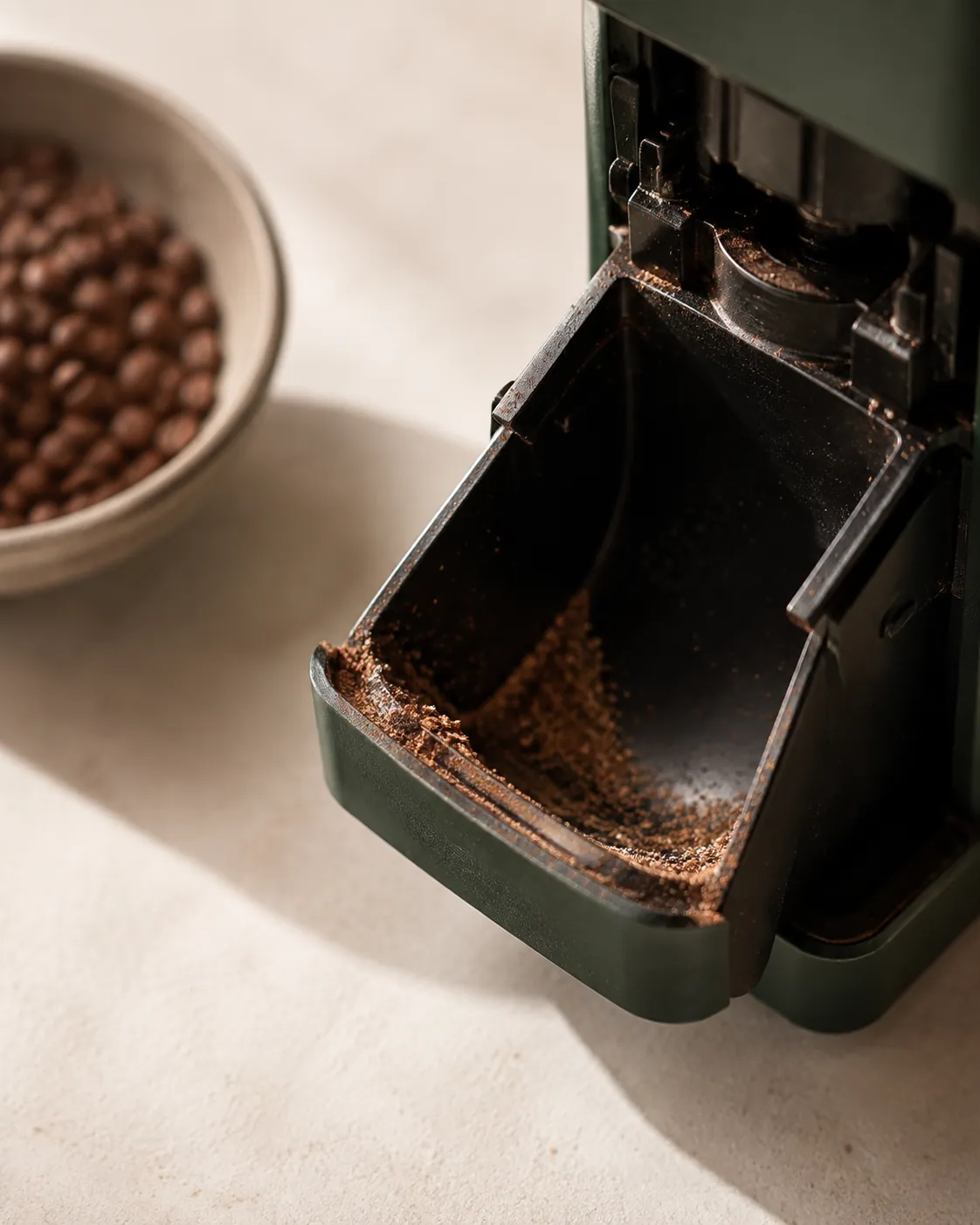
Coffee held inside is stale by the next use and comes out mixed with the fresh grind, so a high-retention grinder puts a little of the last brew into every one that follows. Ground coffee stales within minutes, not days, because grinding exposes an enormous surface area to air at once.
That is also why storing coffee beans concentrates on whole beans and treats grounds as something you make and use immediately.
- Grind only what you need, immediately before brewing.
- Purge a gram or two if the grinder has known high retention and you changed coffee.
- Tap or brush the chute out periodically; oils and fines build up invisibly.
- Do not store beans in the hopper, where they sit exposed to light and air.
- Weigh beans in rather than grinding by time, which varies with bean density.
How the beans get into the grinder has become the practical expression of the same problem.
| Hopper | Single-dose | |
|---|---|---|
| Loading | Fill once, dispense repeatedly | Weigh each brew in |
| Retention | Higher, so old grounds mix with new | Very low |
| Switching coffees | Requires emptying the hopper | Trivial |
| Bean storage | Beans sit exposed to light and air | Beans stay in the bag |
| Best for | One coffee, drunk daily | Small bags and several methods |
Hopper grinders suit one coffee drunk repeatedly and handle switching badly, since the hopper has to be emptied first. Single-dose grinders take exactly what you weigh in, at the cost of a few seconds of weighing and, on some designs, a tap or a puff of air to clear the last grounds.
For a household buying 250 g bags and changing coffee every fortnight, single-dosing is the better fit, which is why it has spread down from enthusiast machines into mid-range ones.
Where the money goes first
Grinder priority is the most repeated advice in coffee and the most ignored. A cheap cone behind a good grinder makes better coffee than an expensive brewer fed by a blade grinder, and the reverse never holds at any price.
That ordering holds across every method and holds most strongly at the fine end, where an uneven grind makes an even puck impossible.
Where money makes the most difference
- GrinderSets particle uniformity, which everything else depends on
- Fresh coffeeA recent roast date, which costs nothing extra
- WaterFiltered or suitable mineral content
- BrewerMatters, but far less than the three above
- Kettle and scalesUseful refinements once the rest is sound
The two decisions at the top of that list account for more of the distance between a good cup and a bad one than every other purchase combined, and neither of them is a brewer. It applies equally to a press and to a cone, which is what the comparison between the two keeps running into: the argument about method is much smaller than the argument about grind.
Spending in that order also means the grinder is the piece you keep. Brewers are cheap enough to accumulate and easy to change your mind about; a good grinder outlasts several of them and improves all of them at once.
Turning a handle or plugging it in
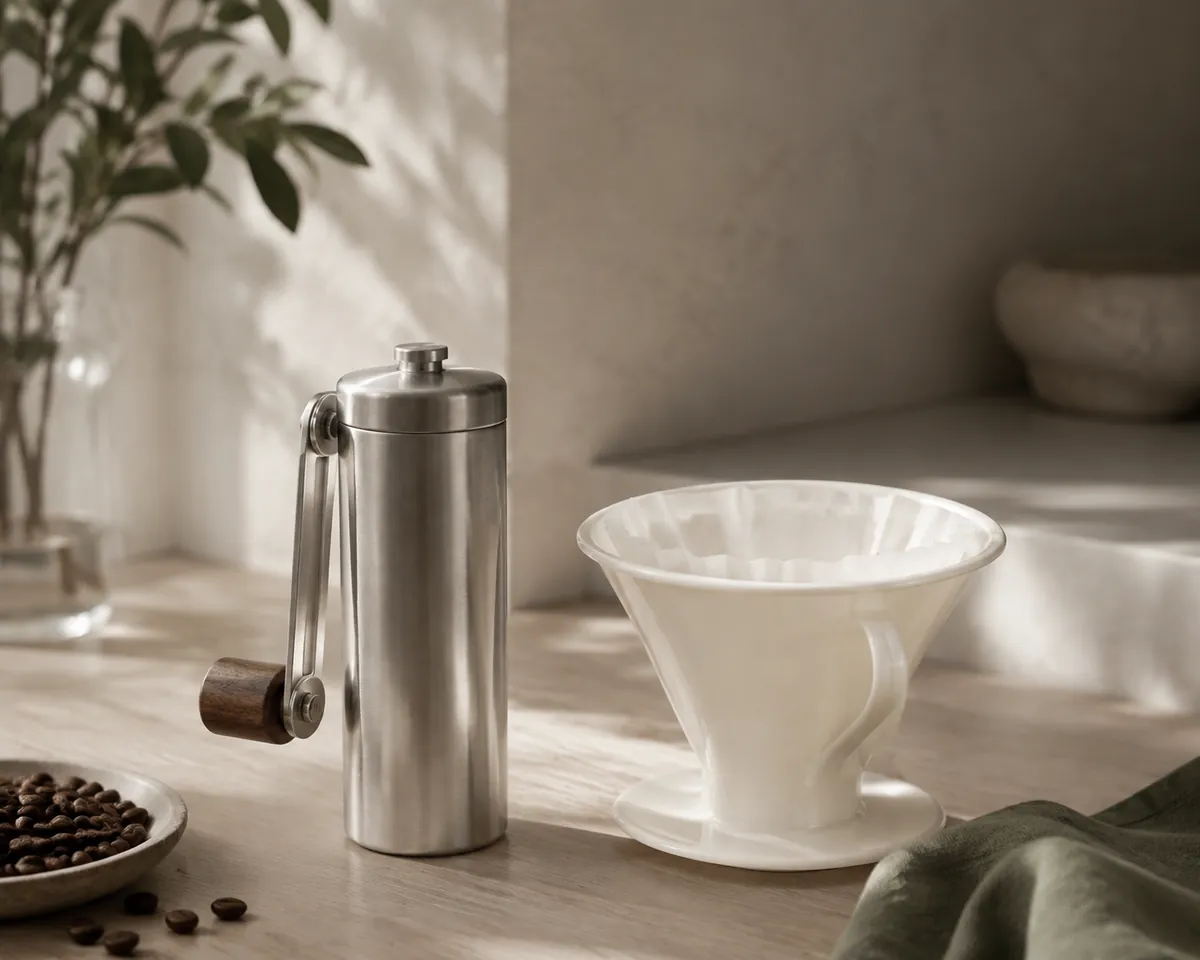
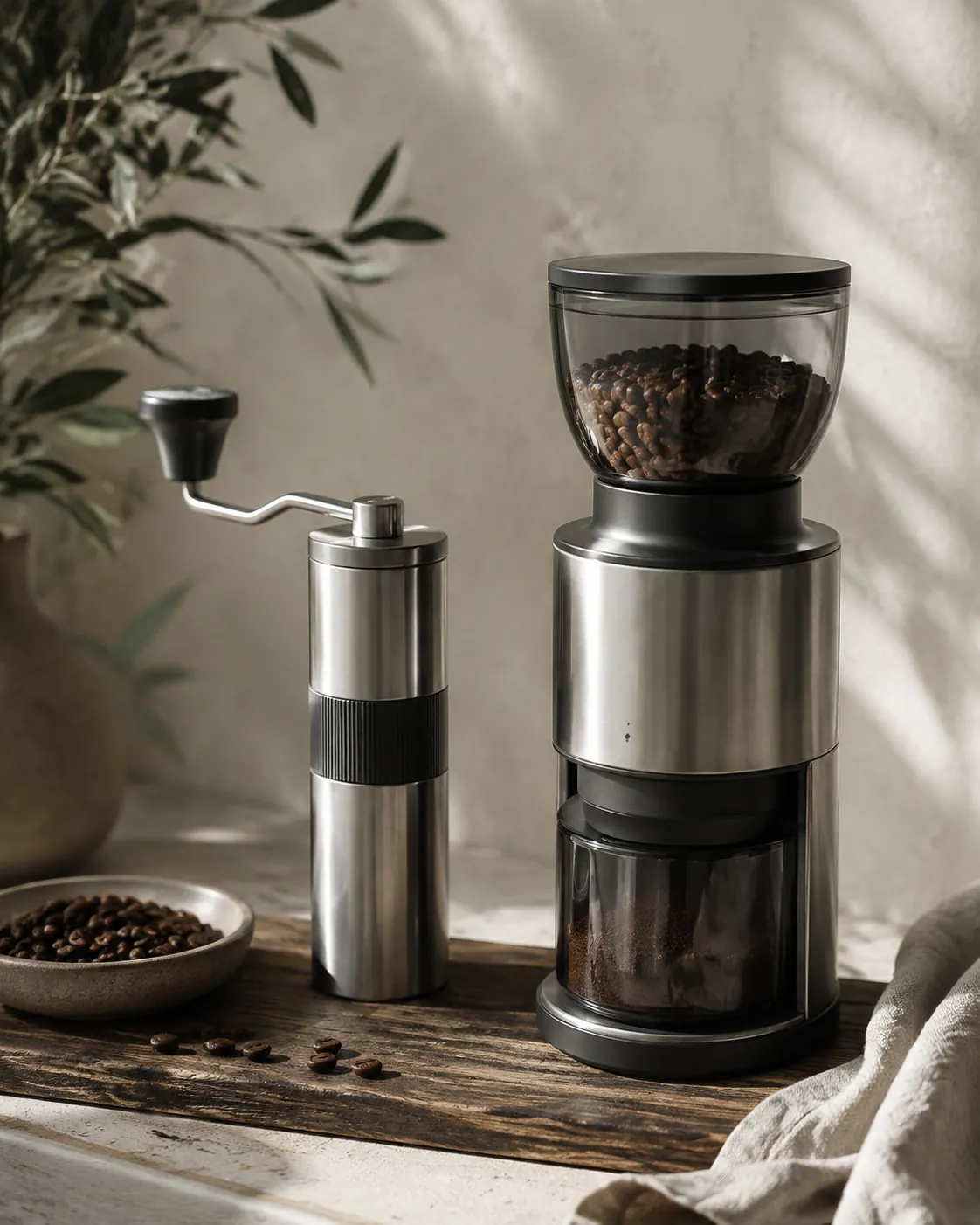
A hand grinder is a serious option rather than a compromise.
At the entry level it will out-grind an electric one at the same price comfortably, because none of the money has gone on a motor, a housing or electronics. The cost comes back as effort and time: roughly thirty to sixty seconds a cup for filter, and considerably more for espresso or a moka pot, where the grind is finer and the handle is noticeably harder to turn.
Three practical things separate electric grinders from each other and rarely appear in a review. Flat burr grinders are generally louder than conical ones, and high-speed grinders louder than low-speed, which stops being trivial in a shared house at six in the morning.
Speed matters daily for espresso and hardly at all for filter, where a few extra seconds is nothing. Heat is largely a non-issue at domestic volumes, since a single dose does not sit against the burrs long enough to warm, whatever the marketing around low-speed grinding claims.
- Decide whether you need espresso capability, which roughly doubles the entry price.
- For filter only, a good hand grinder at modest cost beats most cheap electric ones.
- Check the adjustment mechanism, and prefer fine steps or stepless for espresso.
- Look for replaceable burrs, which extend the life of a good grinder considerably.
- Ignore claims about low-speed grinding and heat, which are marginal at domestic volumes.
Buy for the finest grind you will actually use.
A grinder that handles espresso handles everything coarser as a matter of course, while one built for filter often cannot get fine enough, or even enough, at any setting on its range.
What the price of a grinder actually covers
A grinder is the largest single upgrade available to most home coffee, and also the one people most readily talk themselves out of. What the money buys is worth setting out plainly rather than leaving as a general recommendation.
Works well for
- Uniform particle size, which is the single largest lever on how a coffee extracts
- A repeatable setting, so a cup that worked can be made again tomorrow
- Grinds to order, which no pre-ground coffee can offer at any price
- One device covers every method from espresso fineness to a coarse immersion grind
- Good burrs last for hundreds of kilograms before they need replacing
Struggles with
- Several times the price of a blade grinder, and the gap widens at espresso quality
- Retention, so some of yesterday's coffee comes out with today's
- Hand grinding at espresso fineness is real effort, around a minute of it per shot
- Electric models are loud, and the cheap ones throw static and chaff
- Bench space and a plug, neither of which a hand grinder needs
Retention is the specification buyers notice last and live with longest. A grinder holding five grams internally mixes a little of every previous coffee into the current one, which matters far more to someone switching beans often than to someone working steadily through one bag a month.
The real comparison for most households is not between two grinders at all. It is between grinding at home and buying coffee pre-ground or as instant, and that gap is wider than the gap between any two burr grinders, which is the argument for a modest one now rather than an ideal one later.
Brushing the burrs, and spotting them dulling
Because burrs wear slowly and grinders clog gradually, neither fault arrives at a moment you could point to, and the grind widens by degrees while the coffee quietly gets worse.
Domestic steel burrs last for hundreds of kilos of coffee, which is years in most households, and they do dull. A dulling set shows first at the fine end where the tolerance is smallest, so shots that will not settle at any setting are worth reading as a grinder symptom before a machine one, as espresso problems sets out.
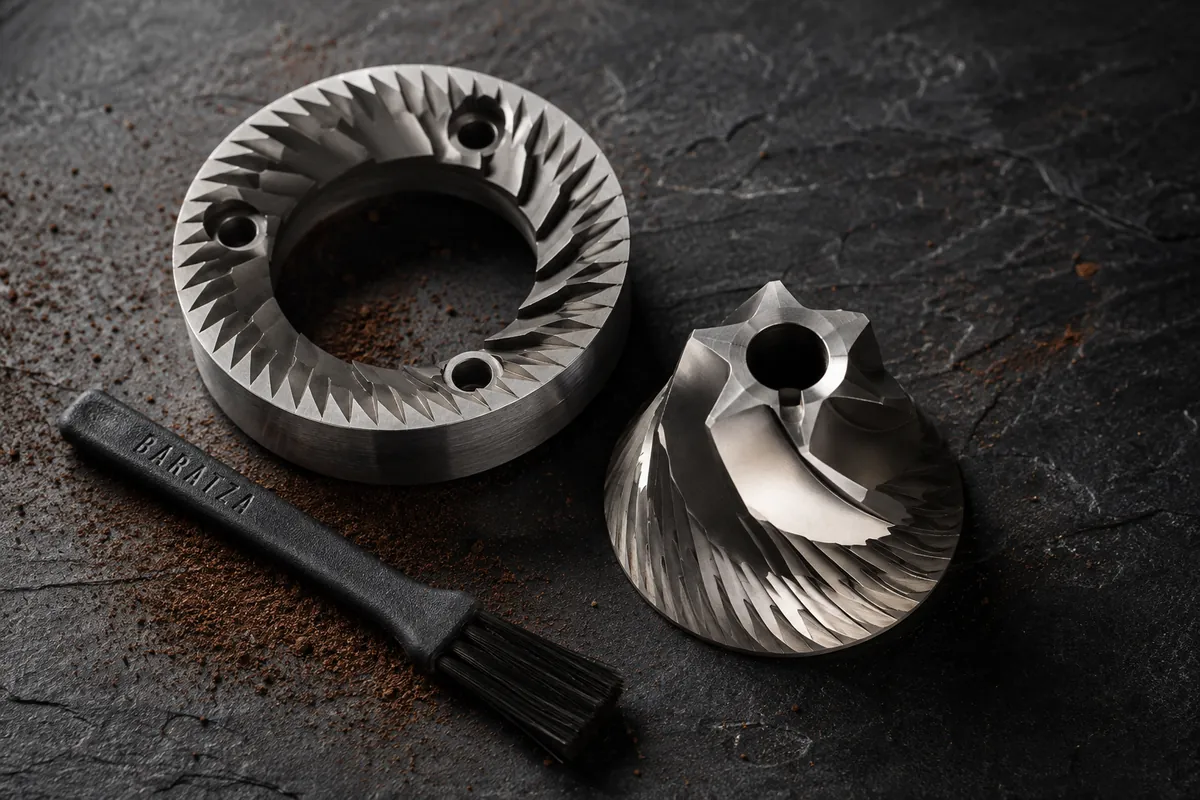
Oils build up on the burrs and in the chute, and stale oil taints fresh coffee as a slow drift rather than as an off note you catch on a particular morning. Brushing the burrs out every few weeks, with a deeper clean occasionally, keeps that in check.
- Brush the burrs out every few weeks, more often if you grind oily dark roasts.
- Use grinder cleaning tablets for machines that are hard to open.
- Do not run rice through it; rice is harder than coffee and can damage burrs.
- Watch for the grind widening over time, which is how dulling burrs present.
- Keep beans out of the hopper, where they stale and shed oil onto the mechanism.
None of that is frequent work. A brush every few weeks and a proper clean twice a year keeps a domestic grinder performing as it did new, and cleaning tablets are the sensible answer for a machine that is awkward to take apart.
The faults a grinder will not rescue
Grinders get treated as a solution to everything, which sets up the disappointment of buying one and finding the coffee only slightly better than it was. The limits are worth naming.
A grinder cannot make stale coffee taste fresh: it sets particle size, and where the aromatics have already gone, uniform particles deliver a consistently stale cup. It cannot compensate for unsuitable water either, since extraction happens in whatever came out of the kettle, and brewing water sets the ceiling on what any grind can reach.
What a grinder does and does not decide
- Decides
- Particle uniformity, and therefore how evenly the coffee extracts
- Decides
- Whether espresso is possible at all, through fineness of adjustment
- Does not fix
- Stale coffee, which grinds consistently and still tastes stale
- Does not fix
- Unsuitable water, which sets the ceiling on extraction
- Does not fix
- A method being used badly, such as a channelling pour
Nor can it rescue a method used carelessly. A perfect grind poured badly still channels, and a channelled bed under-extracts everywhere the water avoided while over-extracting the route it took instead.
What a grinder does is remove the largest single source of inconsistency, which is the reason it comes first and not the reason it is sufficient.
Dialling in a fresh bag
Recording what works is only useful once you have found it, and finding it on a new bag takes three brews rather than a morning, provided you move one thing at a time and taste between moves.
Dialling in
- Fix everything elseSame dose, same water volume, same temperature, same brewer. Only the grind moves.
- Start from the last beanWhatever setting worked for the previous bag is the starting point, not the middle of the range.
- Brew and time itNote the total time from first water to last drip, and taste it while hot.
- Read the resultSour, thin and fast means too coarse. Bitter, drying and slow means too fine.
- Move one stepOne click, not three. A grinder's range is narrower than it looks and large jumps overshoot in both directions.
- Brew again and compareSide by side if you can, since memory of a cup an hour old is unreliable.
- Write it downBean, roast date, method, setting. This is the record that makes the next bag take one brew instead of three.
A fresh bag needs re-dialling even from the same roaster, because roast level, bean density and days since roasting all change how a coffee breaks up under the burrs. Denser beans resist more, which is part of why a lightly roasted arabica and a dark-roasted one at the same setting are not the same grind at all.
Coffee also grinds finer as it ages and dries, so a setting drifts across a bag's life rather than holding. A cup that was right on day four and tastes bitter on day eighteen has usually not changed brewer, water or technique; the same click is simply delivering a finer grind than it was.
Common questions
Is a burr grinder really better than a blade grinder?
Yes, and the difference is large. A burr grinder produces uniform particles set by a fixed gap; a blade grinder chops randomly, producing dust and chunks together. Mixed sizes extract at different rates, giving a cup that is sour and bitter at once.
Flat or conical burrs?
Burr quality matters more than shape. Flat burrs give a slightly narrower particle spread and are usually more expensive; conical burrs are quieter and cheaper. A good conical grinder beats cheap flat burrs comfortably.
Are hand grinders good enough?
At lower budgets they are usually better than electric, because there is no motor or electronics to pay for. The trade-off is effort: thirty to sixty seconds per cup for filter, and considerably more for espresso.