The Siphon Brewer, and How Vapour Pressure Moves Water
A siphon moves water uphill with vapour pressure and pulls it back down with a partial vacuum. The point of all that machinery is an immersion held at a steady temperature from the first second to the last.
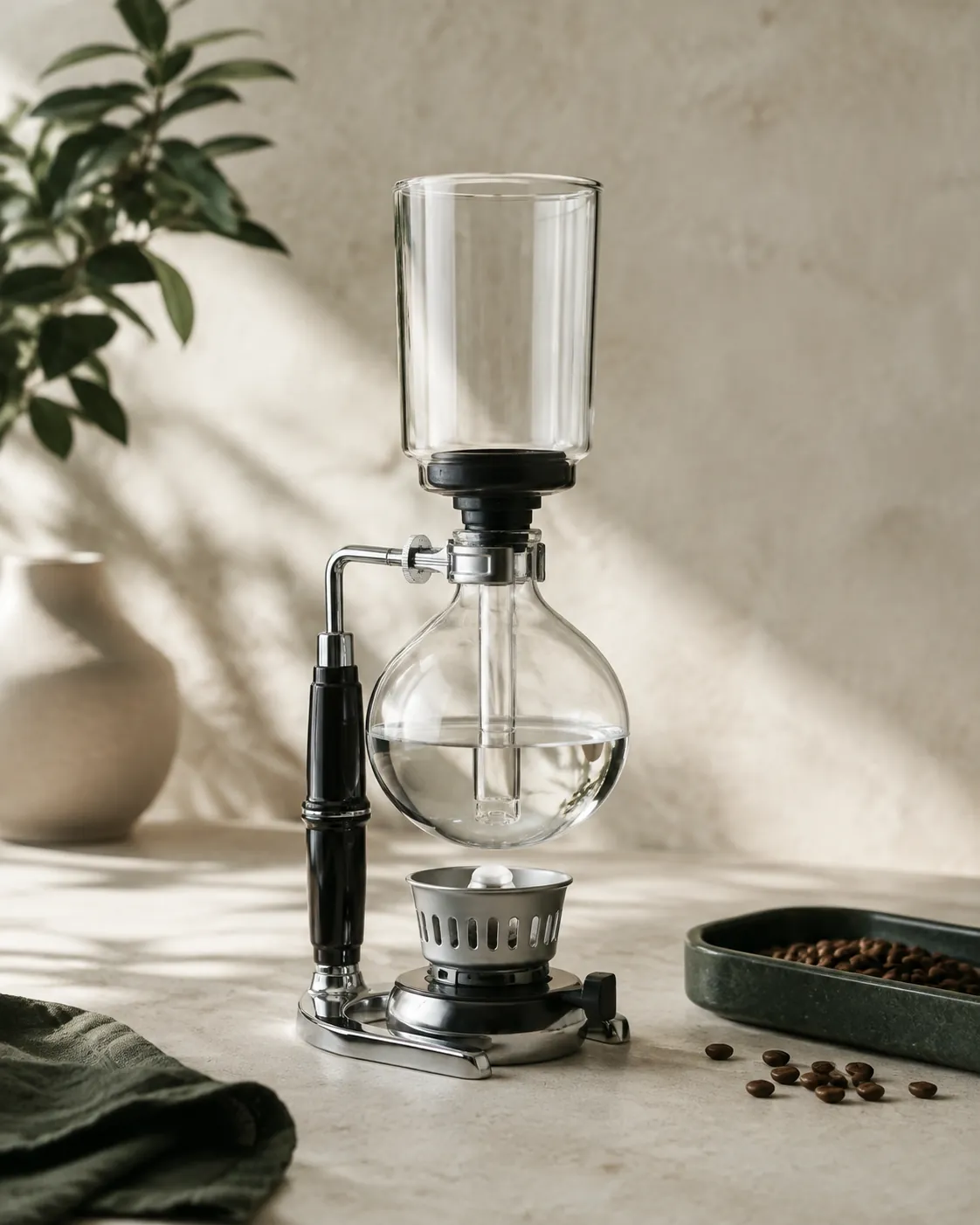
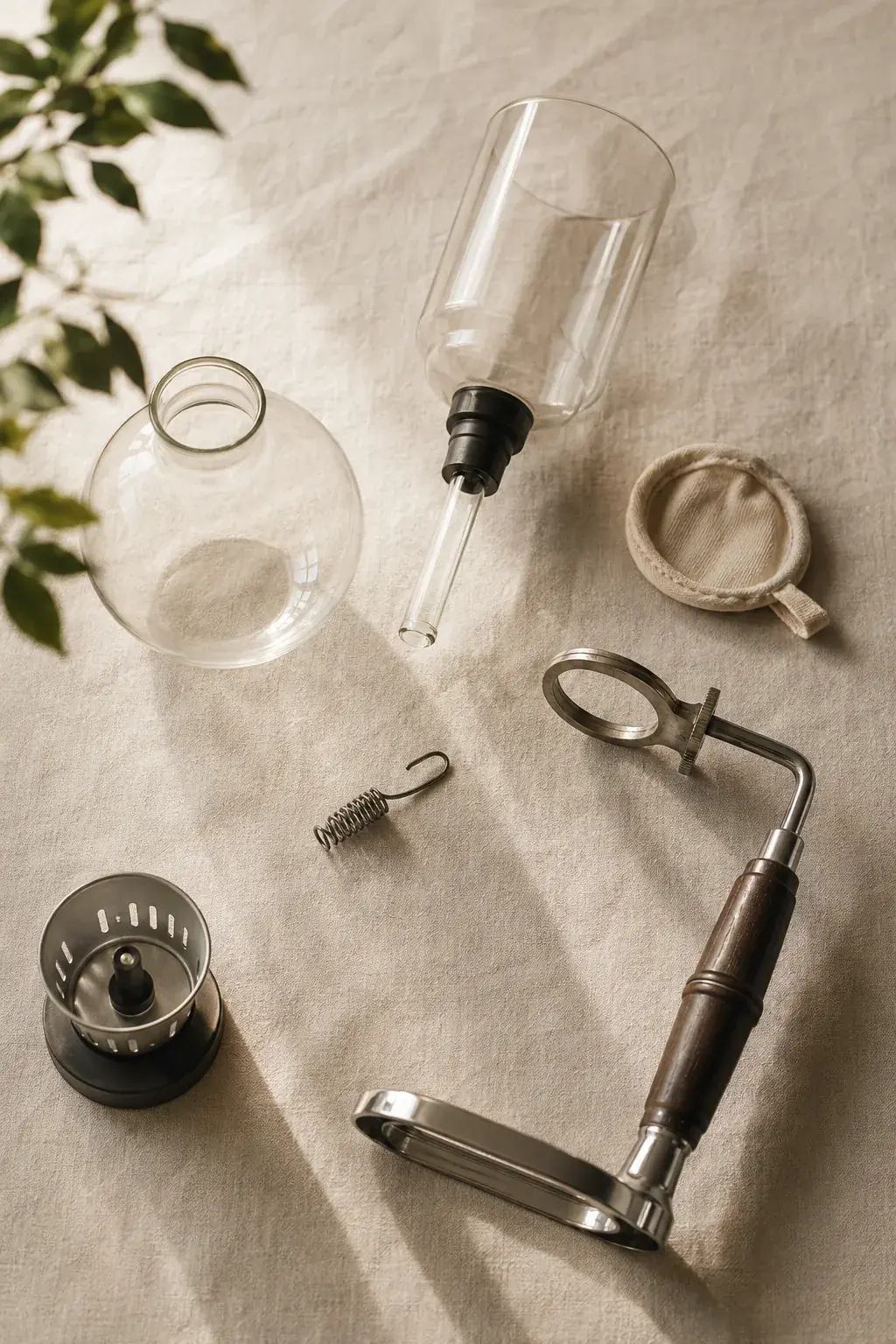
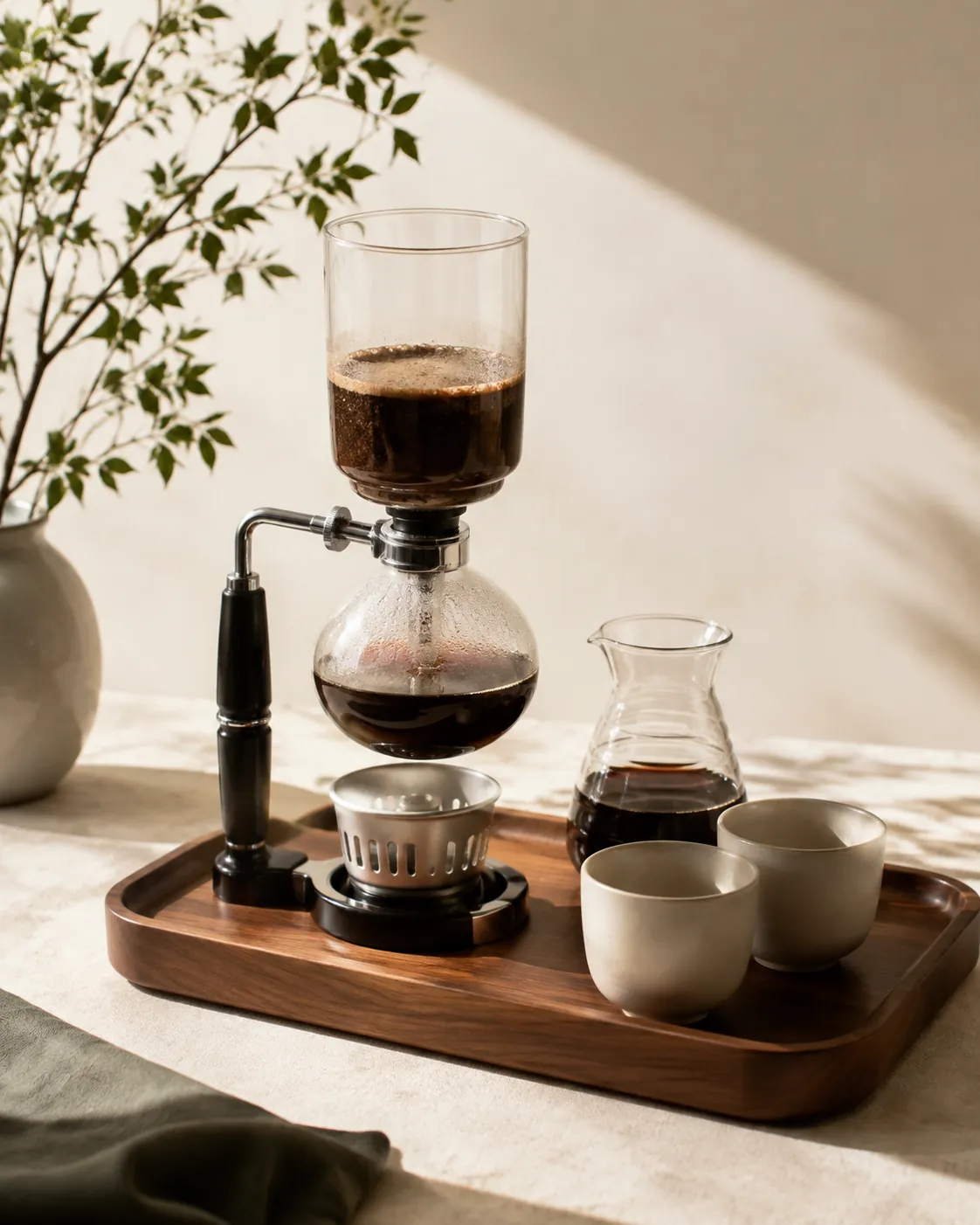
A siphon brewer is two glass chambers stacked one above the other, with a tube running from the upper chamber down into the lower one. Water goes in the bottom, ground coffee goes in the top, and heat does all the moving.
Nothing is pumped, nothing is plunged, and nothing is poured over anything. The water climbs because vapour pressure pushes it up, and the finished coffee returns because the lower chamber cools and the surrounding air presses the brew back down through a filter.
That round trip is the whole apparatus, and it produces an extraction no other brewer quite reproduces.
The siphon brewer at a glance
- What it is
- Two stacked chambers, a connecting tube, and a filter seated between them
- How the water rises
- Vapour pressure in the sealed lower chamber forces it up the tube
- How the coffee returns
- The lower chamber cools, pressure falls, and the atmosphere presses it down
- Extraction style
- Full immersion, held near 90 to 94 C for the entire brew
- Filter options
- Cloth, paper, fine metal, or a ground glass rod
- Time in the upper chamber
- Roughly 60 to 90 seconds, plus the draw
- Also called
- A vacuum pot, or a vac pot
- The real cost
- Fragility and washing up rather than the purchase
How the water gets into the top chamber
Fill the lower globe, seat the upper chamber on it, and apply heat. What follows is the only genuinely unusual event in coffee brewing.
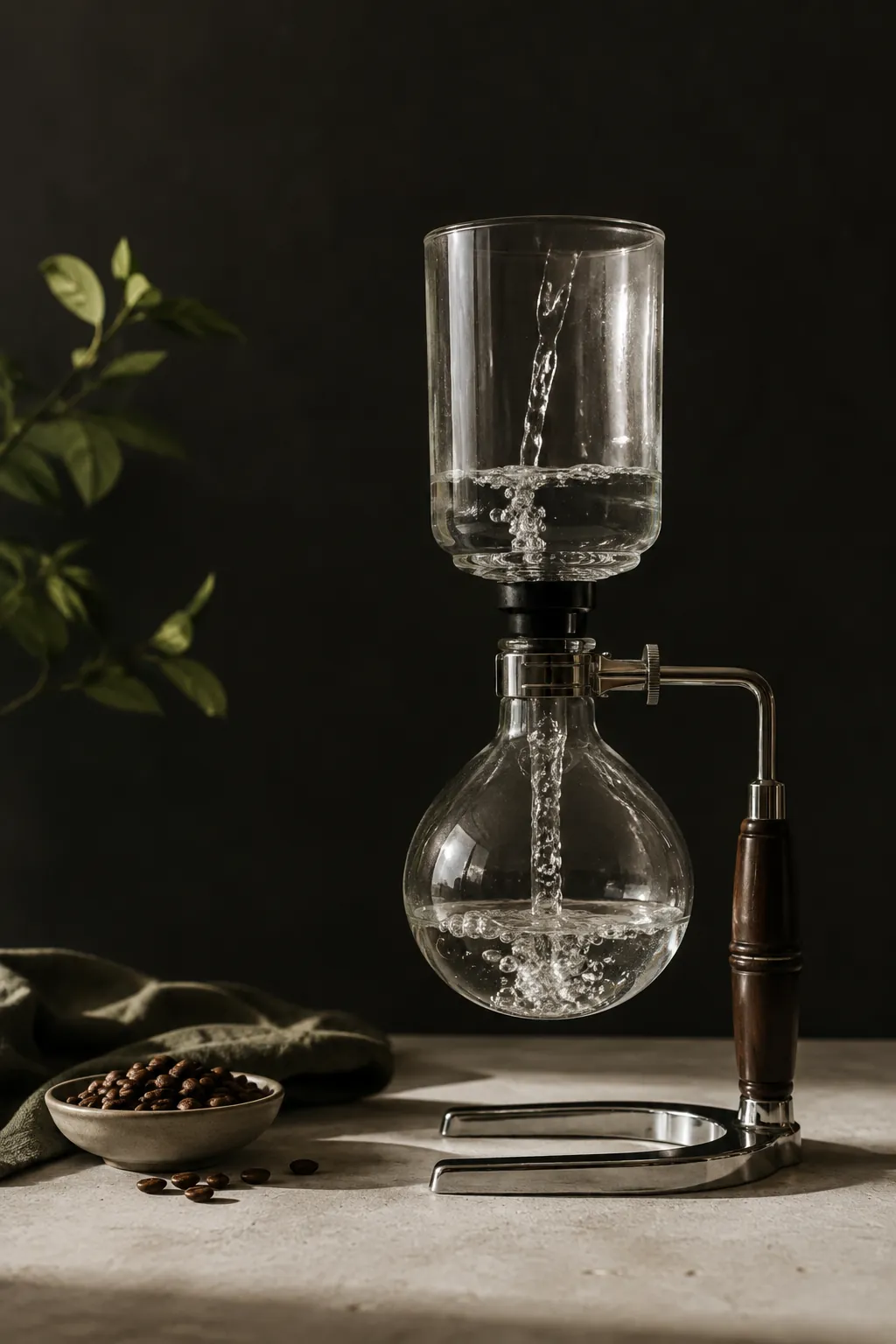
The upper chamber's tube carries a gasket that seals against the neck of the globe, so once the water starts to steam, the vapour above it has nowhere to escape. Pressure in that closed headspace climbs slightly above atmospheric, and the single available exit is down the tube and out through the water itself.
Vapour therefore pushes the liquid ahead of it. Water rises up the tube, spills into the upper chamber, and stays there, held in place by the pressure still being generated underneath.
A shallow pool is deliberately left behind in the globe, bubbling away, and that residual bubbling is what keeps the pressure steady for the length of the brew.
One full cycle
- HeatThe water in the lower globe warms and begins to give off vapour.
- SealThe gasket closes the globe, so pressure has only one way out.
- RiseVapour drives the water up the tube and into the upper chamber.
- BrewGrounds and water sit together, held high by continuing pressure.
- CoolThe heat comes off and the vapour in the globe condenses.
- DrawAir pressure outside pushes the brew down through the filter.
Understood this way, the machine is a pressure vessel that vents on purpose. It is not building the several bars a moka pot needs, and it is nowhere near the nine bars of an espresso machine.
A fraction of an atmosphere is enough to lift water thirty centimetres.
Why the coffee comes back down
Take the heat away and the sequence runs backwards, though not for the reason most people assume. The brew is not draining under its own weight.
Once the flame or element is removed, the vapour trapped in the lower globe condenses back into liquid. Vapour occupies vastly more volume than the water it came from, so the instant it condenses the pressure in the globe falls below the pressure of the room.
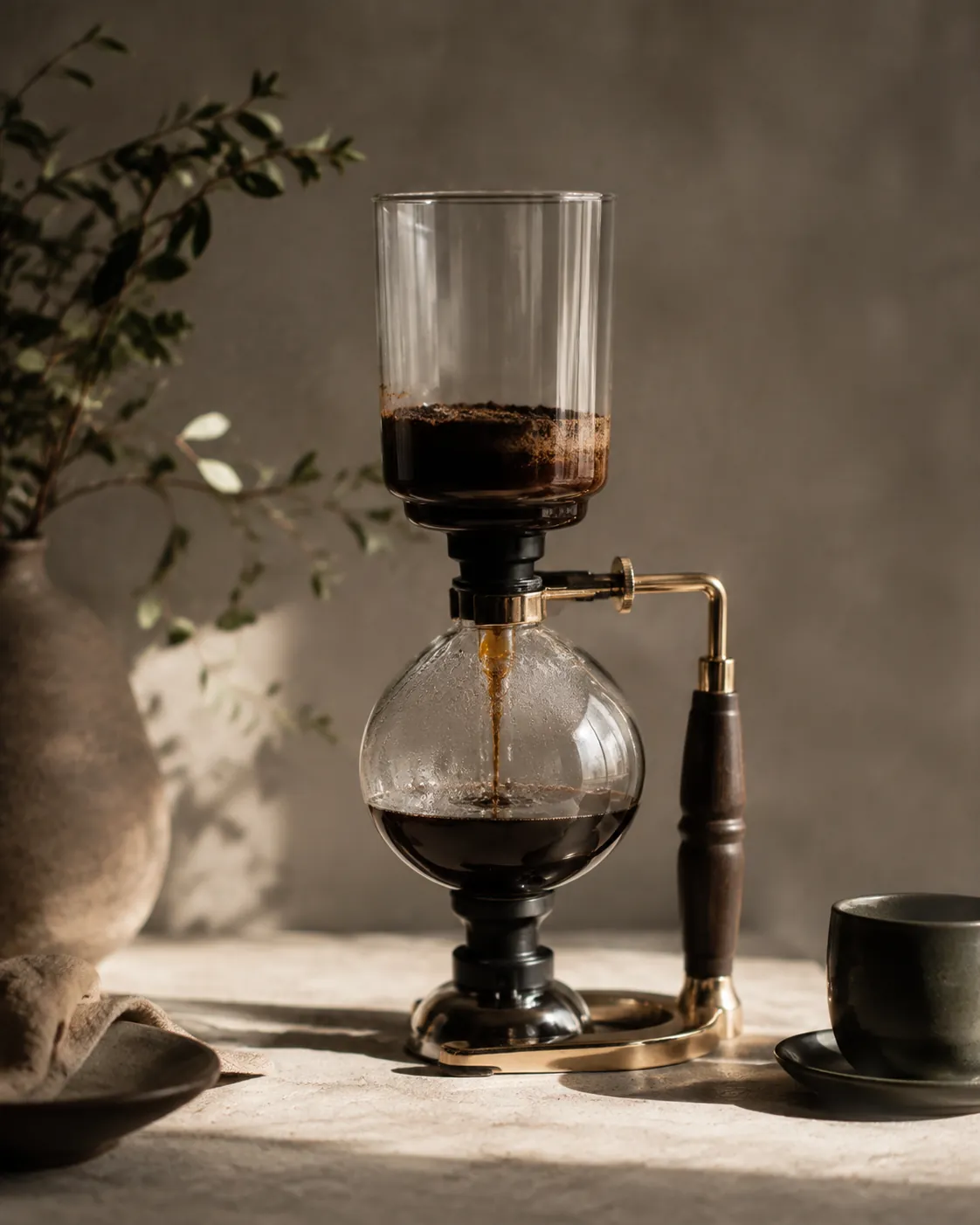
The atmosphere then does the work. Air pressing on the open top of the upper chamber pushes the brew through the filter and back into the globe, which is why the drawdown accelerates rather than trickling to a halt. A partial vacuum below and ordinary air above amount to a difference of a few tenths of a bar, and a few tenths of a bar moves half a litre of liquid in well under a minute.
Watch the last of it and the mechanism confirms itself. The coffee goes down fast, the level in the upper chamber falls to nothing, and then a rush of air bubbles up through the tube as the pressure equalises, with a noise like a drain clearing.
What full immersion at a fixed temperature does to the cup
Immersion brewing is not rare. Holding an immersion at a constant high temperature for its whole duration very much is, and that combination is the reason siphon coffee tastes the way it does.
In a French press, water arrives at its hottest and cools from the first second onwards, so the last minute of the steep extracts less than the first. In a pour over, the water cools in the air on the way down and cools again against the cone.
Both methods extract on a falling curve.
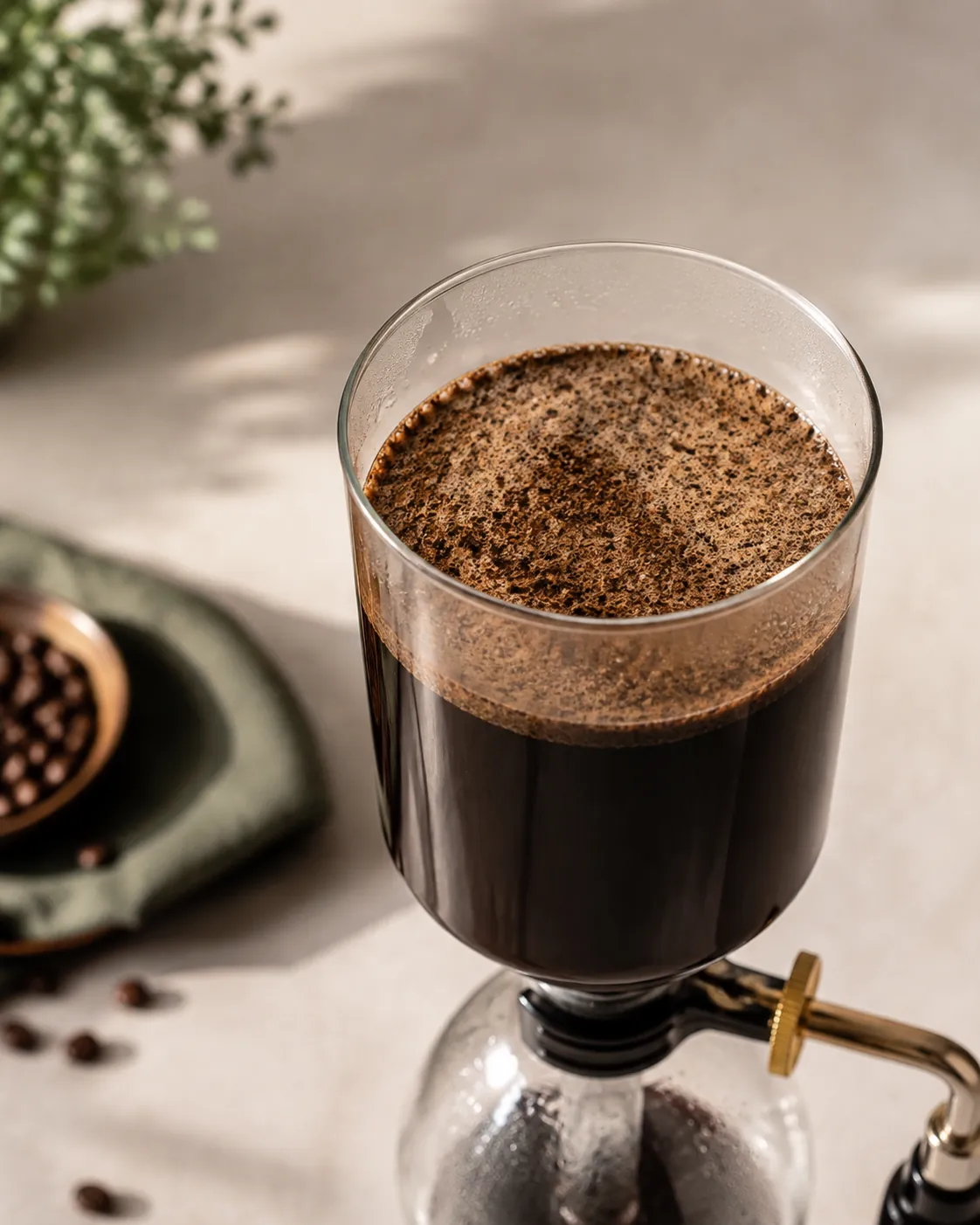
A siphon does not. The pool of water still bubbling in the globe feeds hot vapour up the tube for as long as the heat is on, so the slurry above sits within a couple of degrees of where it started.
| Method | Water at the start | Water at the end | Effect on extraction |
|---|---|---|---|
| Siphon | About 90 to 94 C | Effectively unchanged | Even from first second to last |
| French press | Near boiling | Several degrees down | Front-loaded, then tapering |
| Pour over | Near boiling at the kettle | Lower at the bed | Falls across the pour |
| Automatic drip | Varies by machine | Usually falls | Depends on the heater |
Two consequences follow. The extraction runs further for the same contact time, because nothing slows down halfway, and aromatics that a cooling brew would leave locked in the grounds are carried into the liquid instead.
That is the origin of the usual description of siphon coffee as clean and bright at once.
Clarity comes from the filter and brightness comes from the temperature, and few brewers supply both from separate mechanisms.
Which filter to fit, and what each one costs you
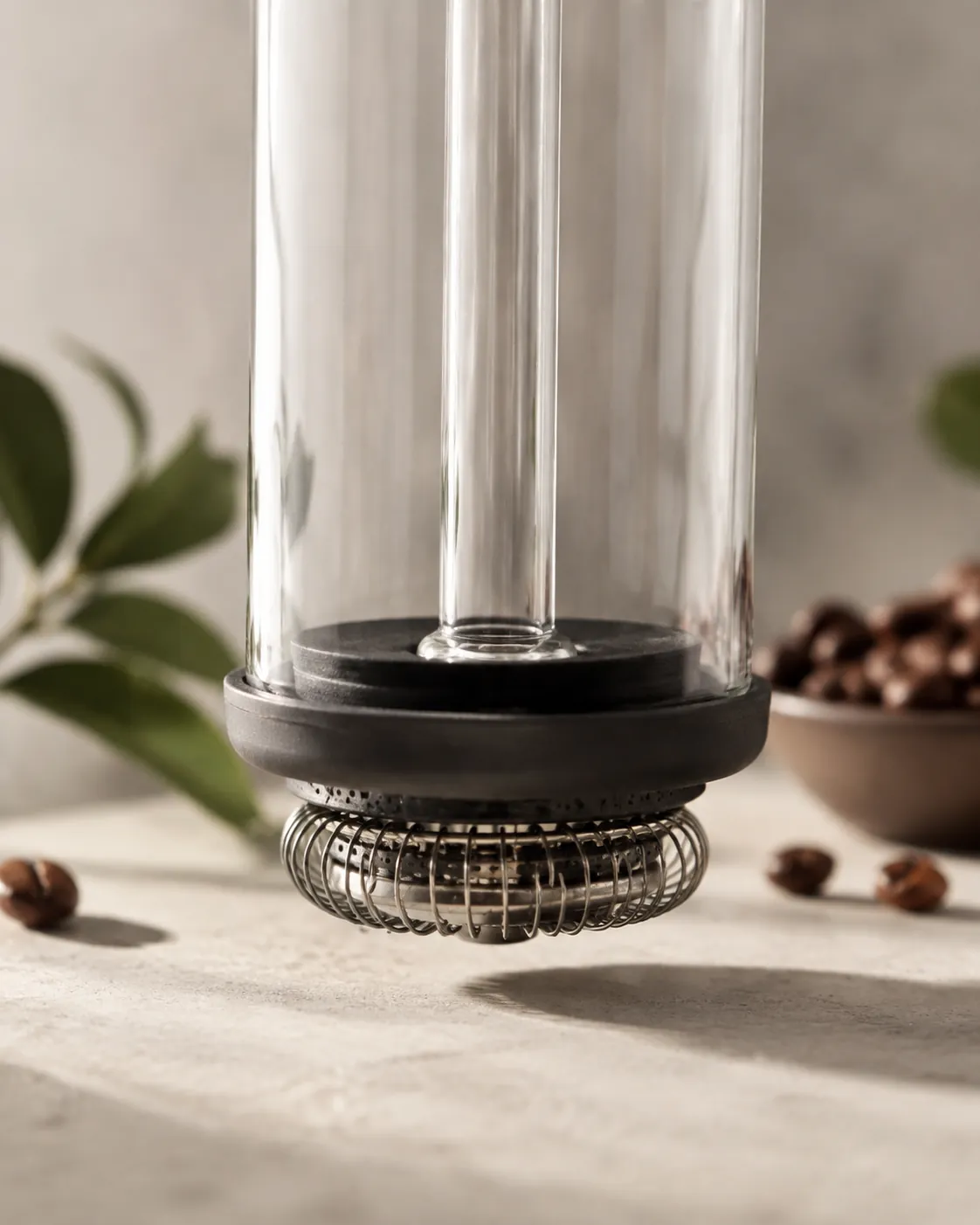
The filter sits in the base of the upper chamber, held by a hooked spring that clips over the bottom of the tube. It is the one component you choose, and it changes the cup more than any other decision here.
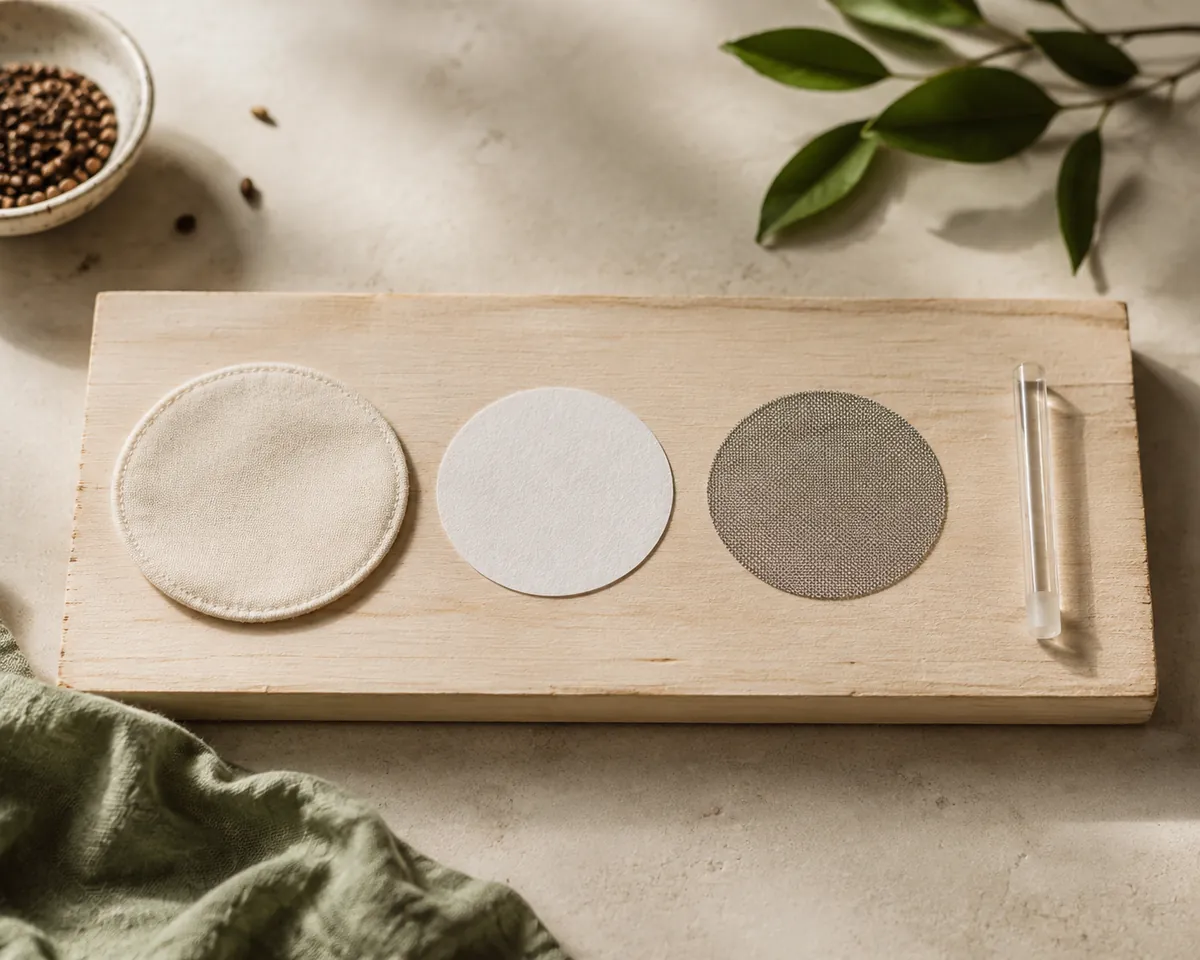
| Filter | What reaches the cup | The catch |
|---|---|---|
| Cloth | Almost no fines, a rounded body, some oil held back | Must be stored wet and replaced every few months |
| Paper | The cleanest cup, and the thinnest body | Discs are fiddly to seat and slow the draw |
| Metal | Oils and a scatter of fines, the fullest body | Cloudier, with sediment in the last inch |
| Glass rod | Coarse particles only, closest to a plunger | Requires a coarse grind and gives a heavy cup |
Cloth is the traditional answer and still the most common. It removes fines well enough to give the clarity siphon coffee is known for, while letting through enough oil that the body does not thin out to nothing.
Paper takes that a step further and gives the cleanest cup available from this device. It is also the fussiest, because the disc has to sit flat against the plate or the brew finds a route around the edge.
The glass rod deserves a note, because it confuses people who meet it for the first time. It is a solid stopper ground to a precise fit, filtering by leaving a narrow gap rather than by having pores, which means it strains coarse grounds and passes everything finer.
It puts a siphon closer to an immersion pot than to a filter brewer.
Whatever passes the filter settles, so the last centimetre of a rod-filtered cup carries a fine silt not far off what Turkish coffee leaves behind. Some people pour that inch away and some do not, and it is the clearest illustration of what a filter choice actually buys.
How to brew a pot without fighting it
The order of operations matters more here than in most brewers, because heat is doing the transport and heat takes time to build.
A working sequence
- Preheat the waterPour already hot water into the globe. Heating from cold takes minutes and cooks the gasket.
- Seat the filterWet it, clip the spring over the tube, and centre it on the plate.
- Fit the upper chamberPush it home until the gasket grips, then leave it tilted or seated depending on the model.
- Let the water riseWait until all but a shallow pool has climbed. Coffee goes in after this, not before.
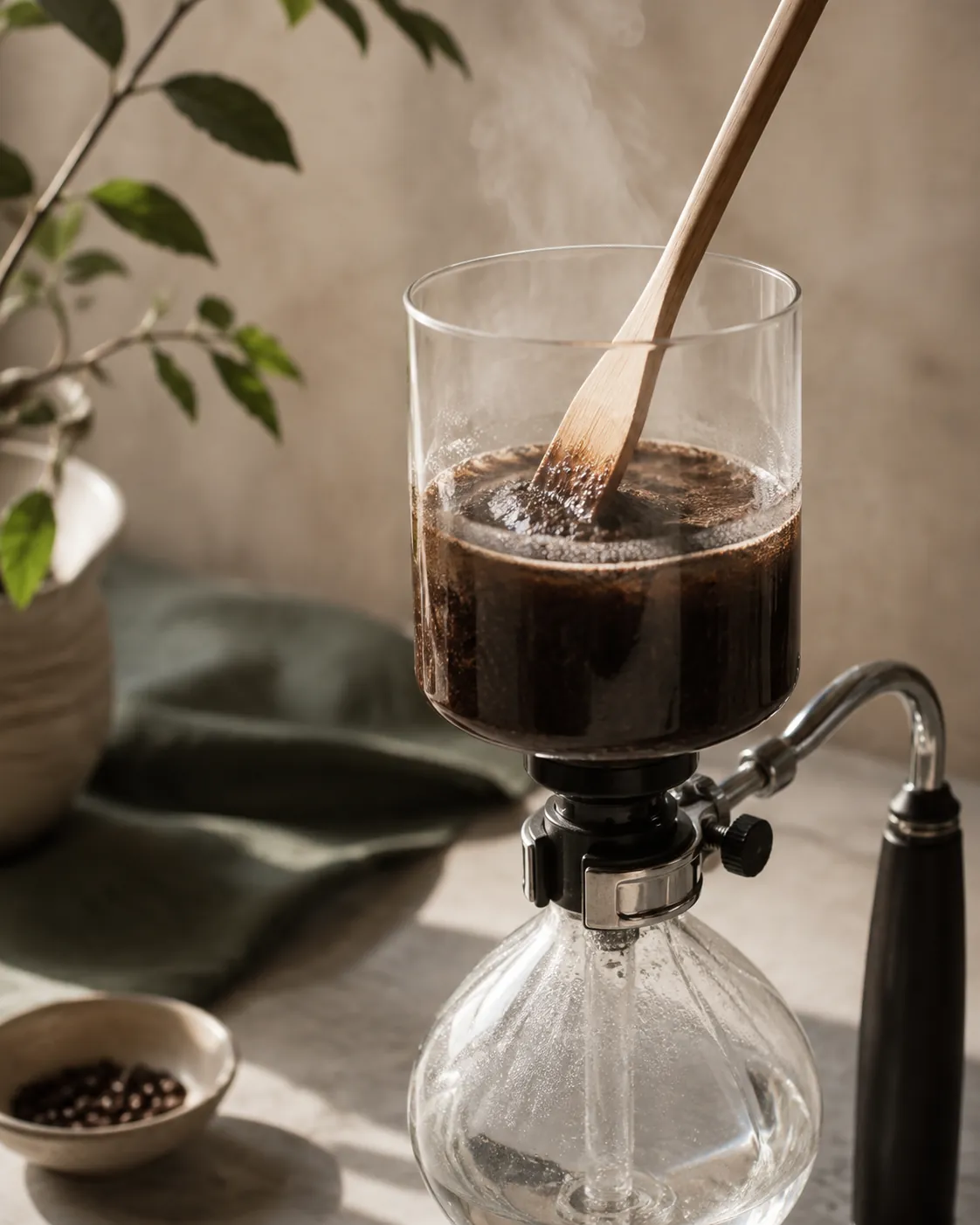
- Add the groundsTip them onto the surface and stir gently to wet everything.
- Time itAround 60 to 90 seconds from that first stir.
- Stir againOne short stir at the end breaks the crust and starts the draw evenly.
- Kill the heatRemove the burner entirely rather than turning it down.
The two stirs are the part people skip, and then wonder why the result is uneven. Dry grounds floating on the surface are not brewing at all, and a crust left intact at the end drags the drawdown out while the bottom of the bed over-extracts.
Starting with hot water is worth insisting on. A variable kettle is not needed for the pour, since there is no pour, but filling the globe with water already near temperature cuts several minutes off the wait and spares the gasket a long slow bake.
Grind matters as much as it does anywhere, and a burr grinder is what makes it repeatable. For a siphon the short version is that a medium grind suits cloth and paper, while a glass rod filter demands something noticeably coarser.
The instruction that matters most is to remove the heat rather than lower it.
A reduced flame keeps generating just enough vapour to hold the brew up, so the pot sits there refusing to draw while the coffee carries on extracting.
What heat source suits it
The brewer has no heater of its own, so the heat source is genuinely part of the design rather than an accessory to it. What you use decides how controllable the brew turns out to be.
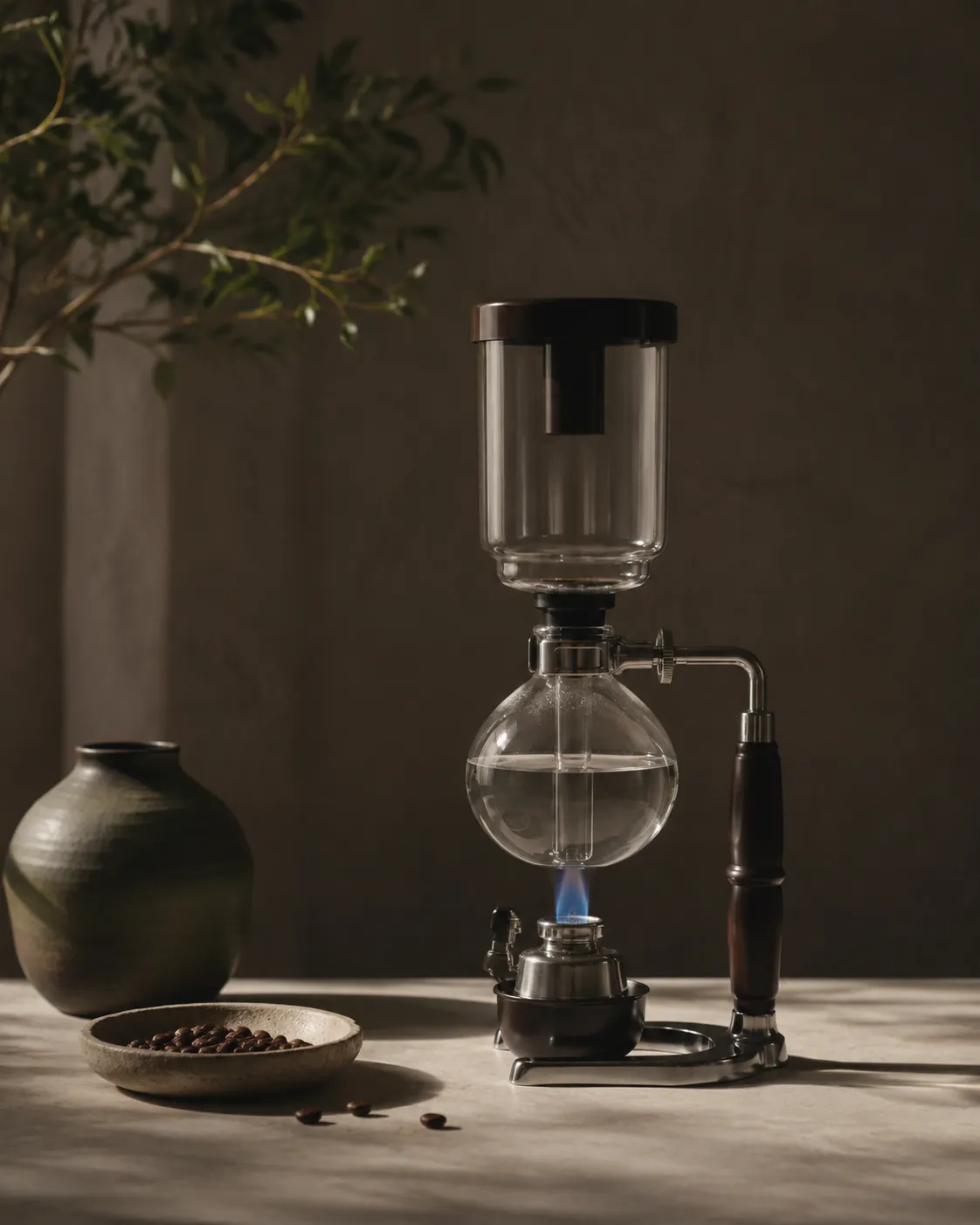
Butane burner
The common choice. Adjustable, hot enough, and easy to pull away cleanly.
Halogen lamp
Fastest and most theatrical. Heats by light rather than flame, and stops the moment it is switched off.
Spirit lamp
Supplied with many pots. Slow, and hard to regulate once lit.
Gas hob
Works with a heat diffuser, though most glass globes are wider than the flame ring.
Induction
Only with a compatible metal-based model, since glass is invisible to an induction plate.
Speed of removal is the property that matters most, which is why halogen has become popular despite costing the most. The brew stops when the heat stops, and a lamp that switches off is more decisive than a burner that has to be slid out of the way.
Anything with a wide, unfocused flame is the wrong tool here. Heat spread across the glass rather than under the centre of the globe raises the risk of uneven expansion, and thin borosilicate breaks along exactly that kind of stress.
Why it stalls, draws slowly, or never rises
Every failure that looks mysterious traces back to the gasket, and it is worth understanding before anything else on the pot is blamed.
That rubber or silicone ring turns the lower globe into a closed vessel. Without a proper seal, vapour escapes around the join instead of pushing water up the tube, and the brewer sits there heating water like an ordinary pan.
- Check the gasket is seated square before every brew, not pinched at one side.
- Replace it when it hardens, cracks, or stops gripping the neck of the globe.
- Never dry a gasket on a hot surface, which stiffens it far faster than use does.
- Wet the gasket lightly if the upper chamber is difficult to push home.
- Keep a spare, since it is the one part that will fail and the only one that is cheap.
A hardened gasket produces a specific and confusing symptom: water rises partway and stalls, or rises fully and starts sinking back before the brew is finished. Both are pressure escaping, not a fault with the heat.
The other seal is between the filter and its plate. A filter clipped off-centre lets grounds slip around the rim during the draw, and the cup arrives with a silt at the bottom that no grind adjustment will fix.
A slow draw is the most common complaint about siphon brewing and it is usually diagnostic rather than mysterious. The rate at which the brew returns is a direct readout of how tightly the coffee bed is packed against the filter.
| What you see | Likely cause | What to change |
|---|---|---|
| Draw takes over 90 seconds | Grind too fine, bed compacted | Coarsen a step |
| Draw stalls halfway | Heat reduced rather than removed | Take the burner away entirely |
| Water never fully rises | Gasket failing, or heat too low | Reseat or replace the gasket |
| Coffee sinks back mid-brew | Pressure leaking at the seal | The same fix, made before the next brew |
| Fast draw and a thin cup | Grind too coarse, or a torn filter | Tighten the grind, inspect the cloth |
| Grit in the cup | Filter sitting off-centre | Recentre it and re-clip the spring |
The spent bed is the other reading, and it is free.
After a clean draw the grounds sit as an even, slightly domed mound on the filter, which means the bed drained uniformly.
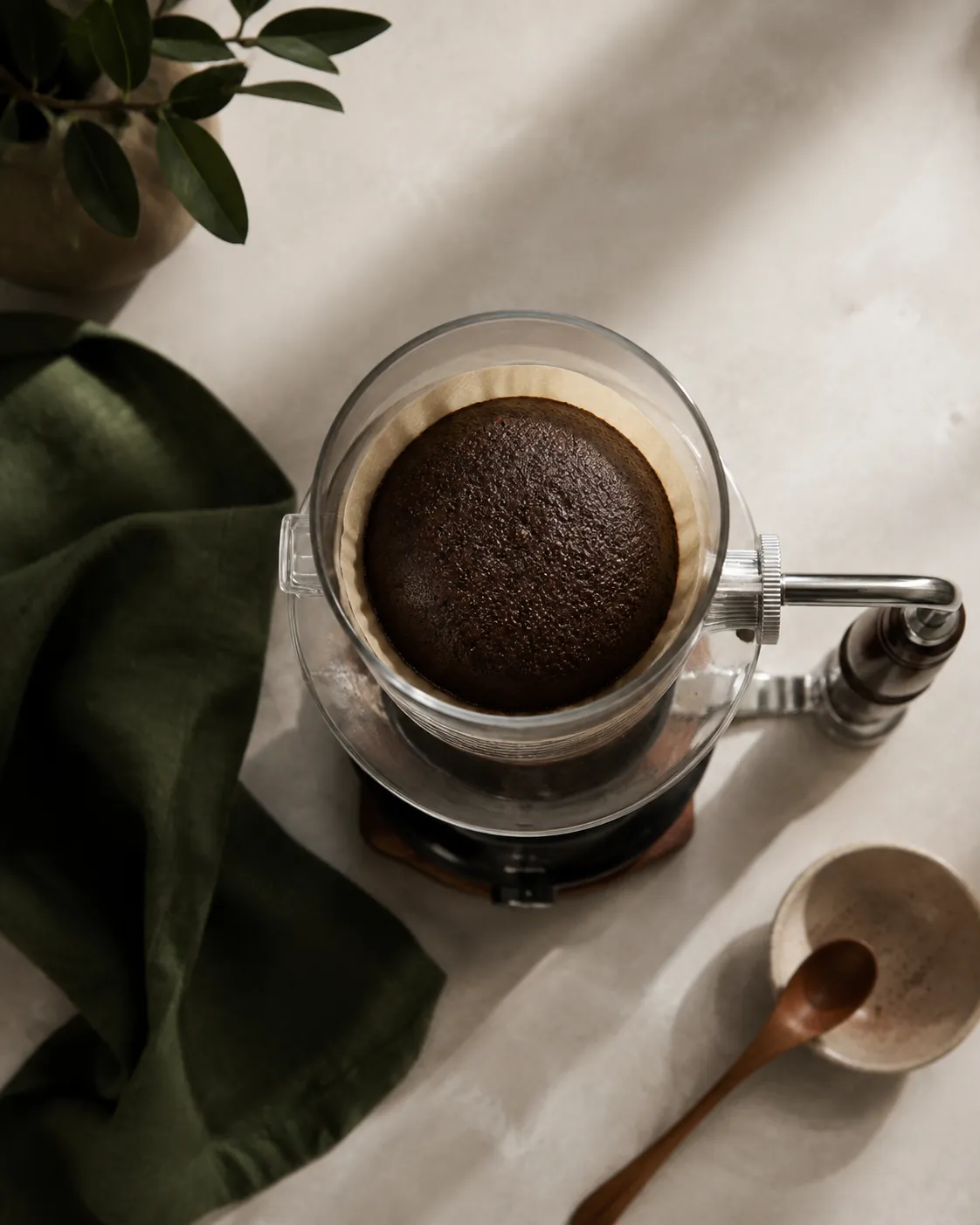
A bed that comes out flat and cratered, or heaped up one side, says the final stir was uneven or the pot was not level. The shape of the grounds is a record of how the liquid left, and reading it costs nothing.
None of this needs a scale or a thermometer to interpret. The draw is visible through the glass, which is the practical compensation for owning something this breakable.
Cleaning it, and the cloth filter problem
Glass is the easy part. Both chambers rinse clean with hot water, and coffee oil never gets the chance to bake on, because nothing in the pot stays hot for long once the brew is over.
The cloth filter is the reason people give up on siphons, and it deserves stating plainly rather than glossing over.
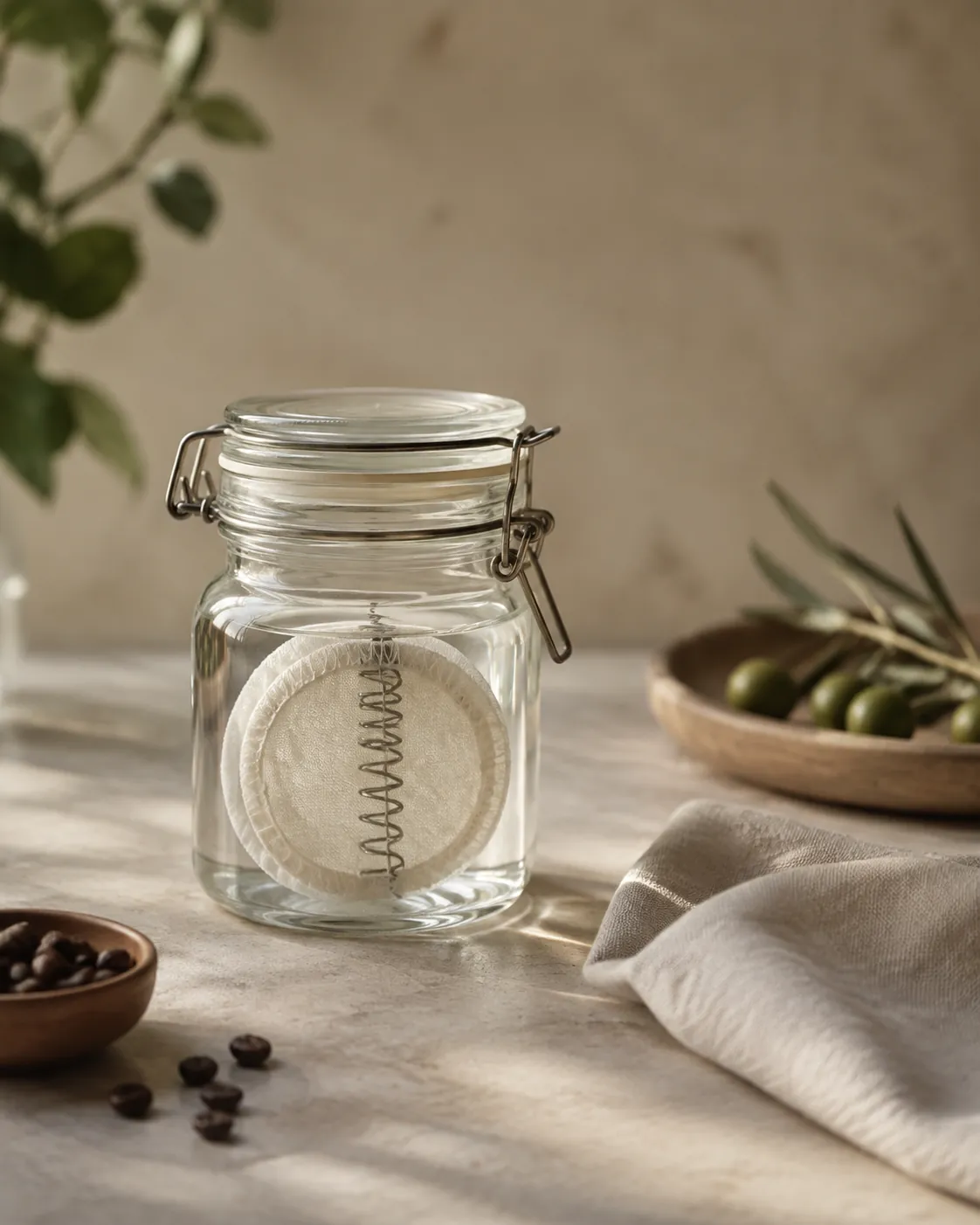
- Rinse the cloth thoroughly in hot water immediately, with no detergent at all.
- Store it submerged in water in a sealed jar in the fridge, never dry.
- Change that water every day or two, since it is what stops the cloth going stale.
- Boil the cloth in plain water occasionally to lift the oil a rinse leaves behind.
- Replace it when it stays brown after boiling, or when the weave starts to open.
A cloth allowed to dry out is finished. The coffee oil in it oxidises as it dries, and the next brew carries a rancid note that no washing removes.
Paper sidesteps the whole problem and is the honest recommendation for anyone brewing a few times a week rather than daily. The cup comes out slightly thinner and the discs cost a little each time, and neither is much of a price for never keeping a wet cloth in a jar.
The glass itself asks only for care with temperature. Cold water into a hot globe is how most of these break, and the crack usually appears at the base, where the heat was concentrated.
Where a siphon wins and where it loses
Set against every other way of making coffee, this one buys a specific result with a specific set of inconveniences, and both halves of that trade are unusually large.
Works well for
- Even extraction, because the brew temperature does not fall during the steep
- Clarity and body together, which most brewers make you choose between
- Every stage is visible, so faults can be diagnosed while they happen
- Genuinely repeatable once the grind and the timing are settled
- Handles delicate light roasts better than most immersion methods
- Works for leaf tea as well, with a coarse leaf and a shorter contact time
Struggles with
- Thin borosilicate glass, and both chambers are breakable
- Many parts to wash, and a cloth filter to keep wet between brews
- Needs a dedicated heat source that will not fit on most hobs
- Slow to set up, so it is a weekend pot rather than a weekday one
- Awkward to scale beyond about half a litre
- Unforgiving of a worn gasket, which stops it working entirely
The second list is longer, which is fair rather than a criticism. This is a laboratory apparatus repurposed for a kitchen, and it keeps the manners of one.
What redeems it is that the advantages are not easily found elsewhere. An AeroPress gives immersion and a paper filter but no temperature stability, and a percolator gives constant heat while spoiling the coffee by recirculating it, so the combination stays particular to this pot.
For a single cup before work, almost anything else is better. For an unfamiliar bag of washed arabica that you want to hear clearly, few things beat it.
The tea claim in that first list is not a novelty either. Rolled oolong brewed in the upper chamber for forty seconds behaves much as it does in a gongfu vessel, though the pot is far more trouble than a lidded bowl and gives up the ability to run steep after steep.
The design is older than it looks
Vacuum brewing is a nineteenth-century European idea, developed in the 1830s and 1840s once glassblowing was good enough to make a sealed vessel that survived direct heat.
Elaborate balancing versions, with two chambers side by side on a beam, were parlour objects of the period.
It faded almost everywhere as electric filter machines arrived, since a machine that makes filter coffee while you do something else beats a pot that has to be watched. The siphon kept a foothold in Japanese coffee houses, where a visible process suited counter service built around one cup at a time, and the modern revival came back out of that tradition rather than from Europe.
The theatre here is not incidental. A device that shows the liquid moving teaches better than one that hides everything, and the mechanism that makes it entertaining is the same mechanism that keeps the temperature flat.
There is one practical legacy in that history. Because siphons predate the modern insistence on very hot water, they were built to brew a little below boiling, which is roughly where current thinking has landed anyway, and it is one reason the water going in shows up so clearly in the cup.
Who it actually suits
Interest in the process is the real qualification, and it is worth being blunt about that before anyone buys one.
Worth it if
You enjoy watching a brew happen and will use it on unhurried mornings.
Worth it if
You buy light roasts and want a method that extracts them fully without harshness.
Worth it if
You already own a good grinder, since this method exposes a bad one.
Skip it if
You want coffee within four minutes of waking.
Skip it if
You regularly make more than about two cups at a time.
Skip it if
Keeping a cloth filter wet in the fridge sounds like an imposition.
Anyone in the second group is better served by a cone or a plunger, and choosing between those two is the more useful argument to settle first. That is not a criticism of the siphon so much as an accurate description of what it asks for.
Where it genuinely earns a place is as a second brewer beside a fast one. Something quick handles the weekday, this handles the bag you are curious about, and neither has to pretend to be the other.
The grinder is the purchase that should come first, though. A siphon will faithfully reproduce whatever the grind gives it, including a wide spread of particle sizes, and how the beans were kept matters more than the glass does.
If either the grinder or the coffee is the weak link, this pot will show it plainly, in the same way that brew method changes what ends up in the cup more than most people expect.
Common questions
How does water get from the bottom chamber to the top of a siphon brewer?
The gasket on the upper chamber's tube seals the lower globe, so as the water heats, the vapour above it cannot escape. Pressure in that closed headspace rises slightly above atmospheric and the only exit is down the tube, so the vapour pushes the liquid ahead of it and up into the upper chamber. A shallow pool is left bubbling in the globe, and that continuing bubbling is what holds the water up.
Why does siphon coffee taste cleaner than other immersion methods?
Two separate mechanisms are at work. The filter, usually cloth or paper, removes the fines that make an immersion cup muddy, and the water is held near 90 to 94 C for the whole brew because the globe keeps feeding hot vapour upwards. A French press or a pour over extracts on a falling temperature curve, so a siphon runs its extraction evenly instead of front-loading it.
Why is my siphon brewer drawing down so slowly?
A slow draw usually means the coffee bed is packed too tightly against the filter, so coarsen the grind a step. If it stalls halfway instead, the heat was turned down rather than removed, and the vapour still being produced in the globe is holding the brew up. Take the burner away entirely.