How to Use a Gaiwan, and Why It Beats a Teapot
A gaiwan is a lidded bowl with no spout, no filter and no moving parts. It is the most versatile brewing vessel in tea, and the only real obstacle is learning to hold it.
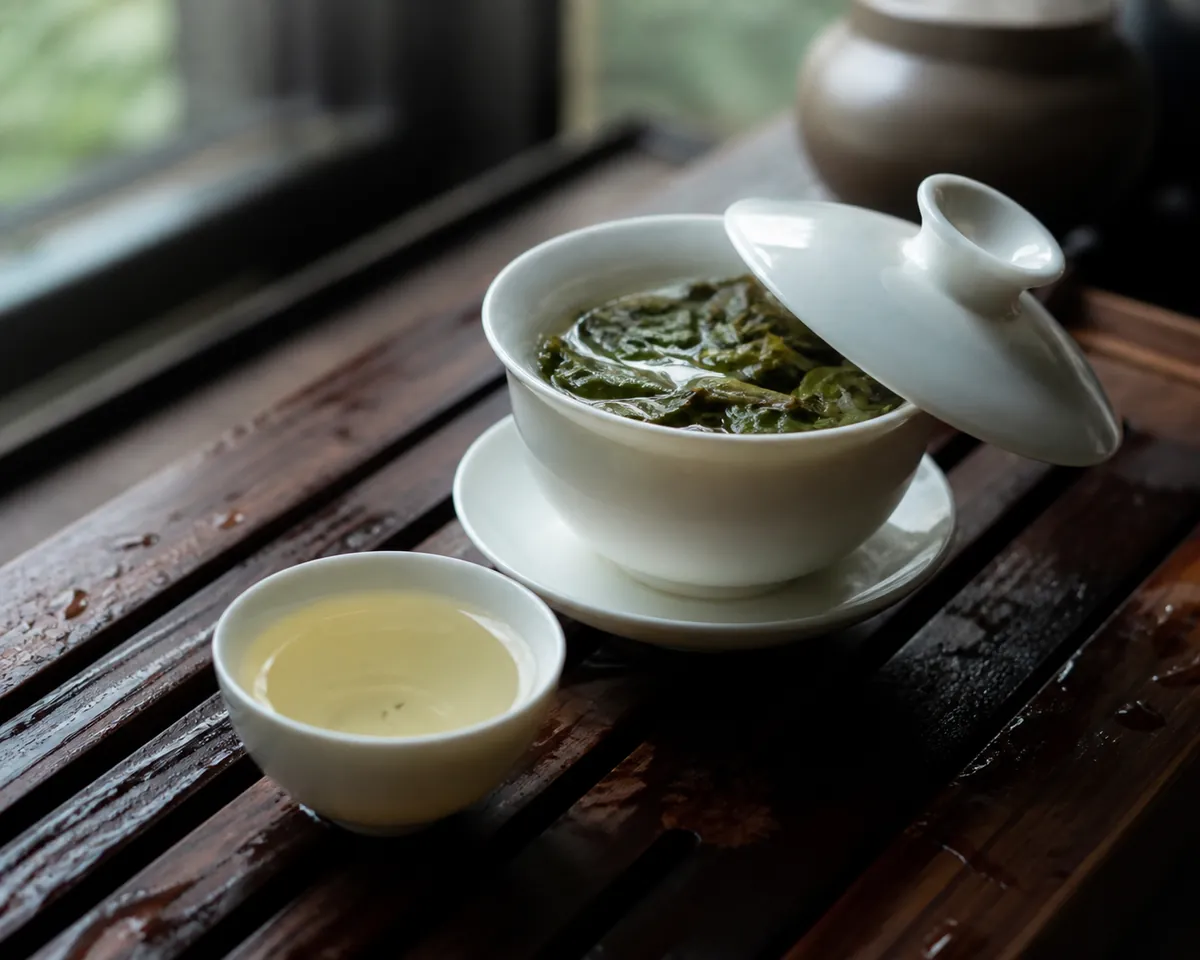
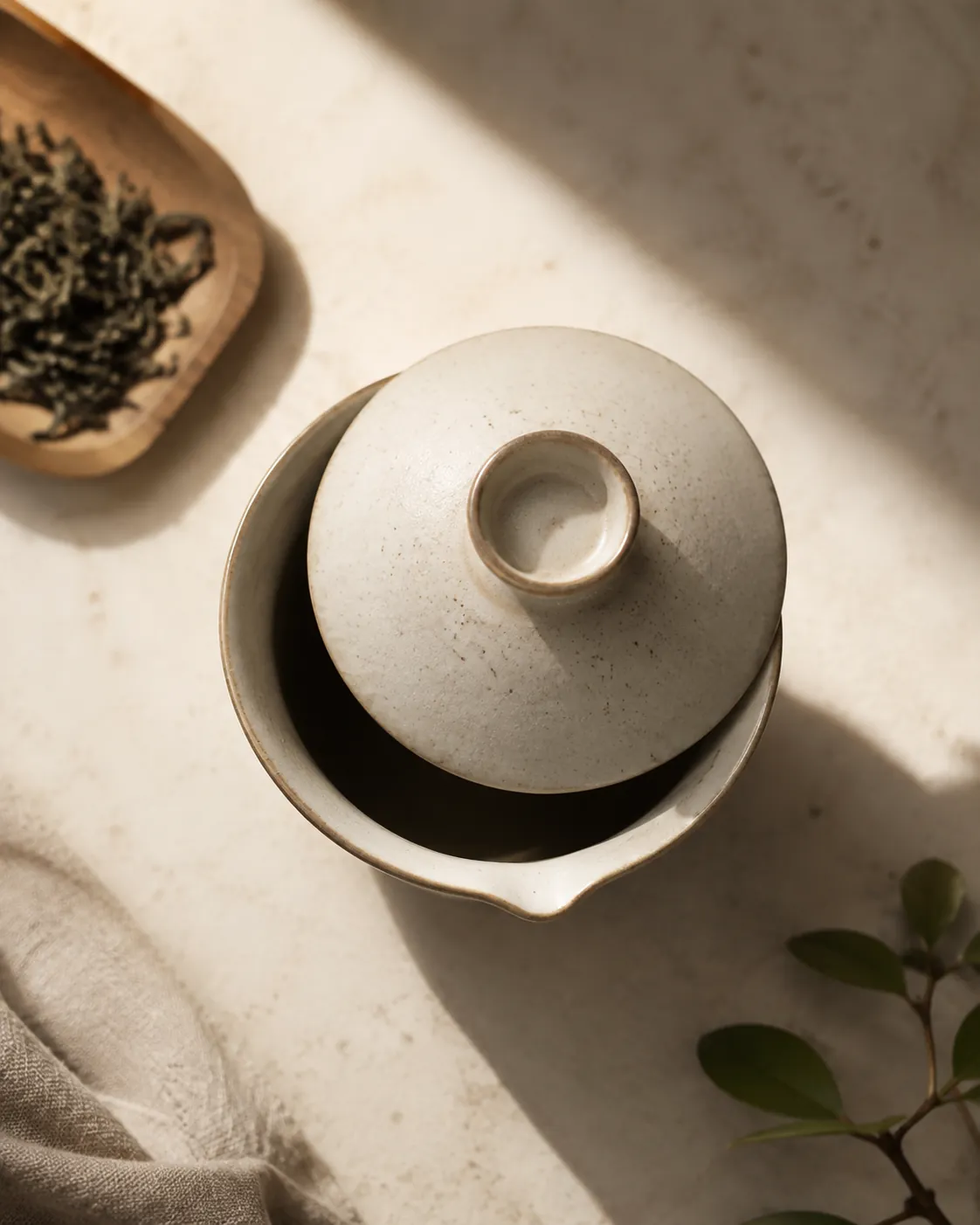
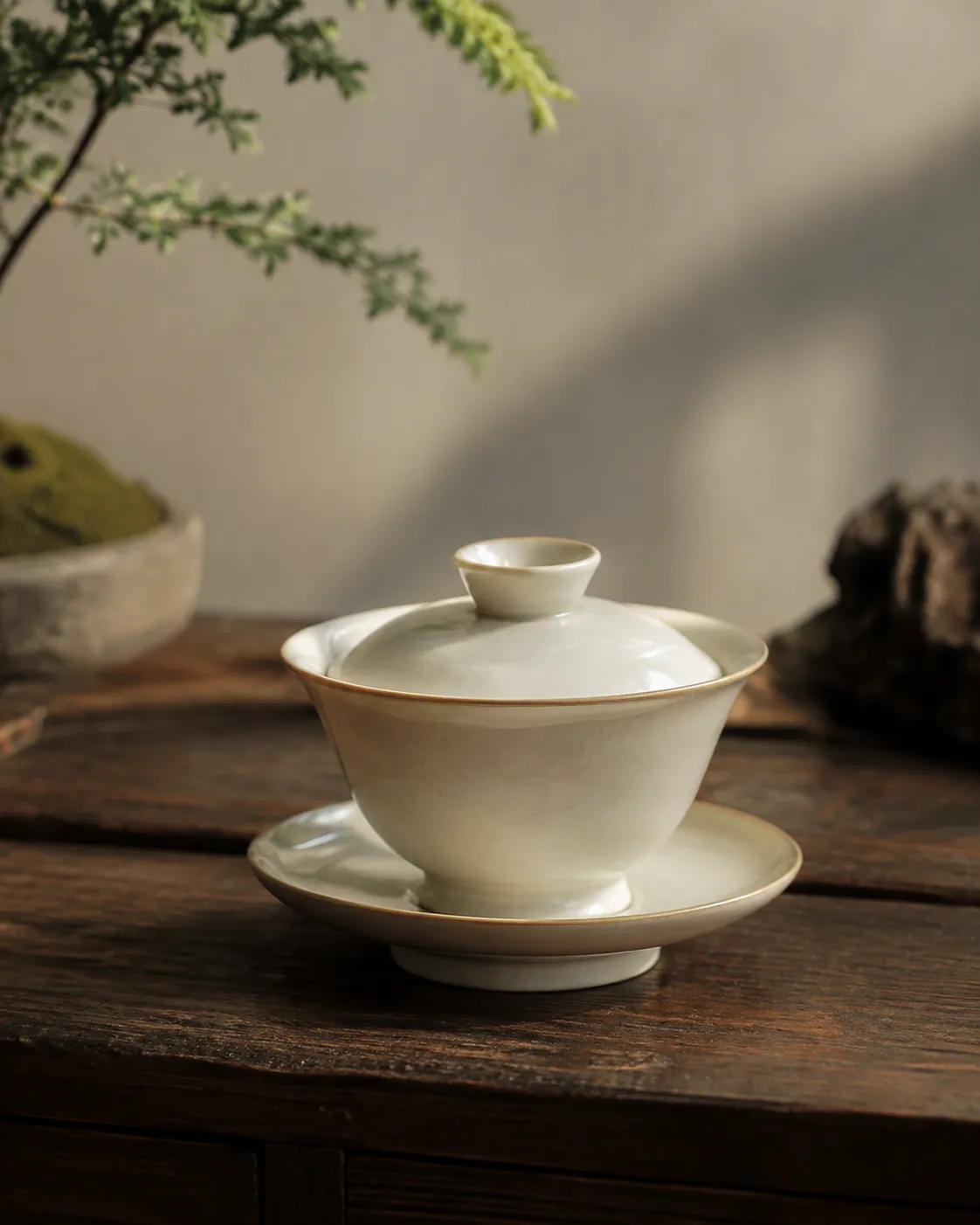
A gaiwan is a bowl, a lid and usually a saucer. Tea leaves go in the bowl, water goes over them, and the lid is tilted to hold the leaf back while the liquid is poured out.
That is the entire mechanism. There is no infuser, no filter and no spout.
The gaiwan at a glance
- What it is
- A lidded porcelain bowl with no spout, filter or moving parts
- Size to buy
- 110 to 150 ml, which suits one or two drinkers
- Leaf ratio
- About 5 g per 100 ml, roughly double western brewing
- Steeps
- Five to ten, starting at 10 to 20 seconds each
- Brews
- Every category of tea, because glazed porcelain absorbs nothing
- The one difficulty
- The grip, which takes five minutes with cold water to learn
How a gaiwan works, and why it suits tea
The absence of features is the advantage.
No absorption
Glazed porcelain takes on nothing, so one gaiwan brews every tea.
Full expansion
Leaf moves freely, unlike in a cramped infuser basket.
Fast decanting
The whole vessel empties in seconds, so steeps stop when you want.
Visible leaf
You can watch the leaf open and judge the next steep.
Aroma
The warm lid is smelled between steeps, which is part of the practice.
Anything that holds the leaf in a small basket under-extracts it. A gaiwan lets the leaf occupy the whole vessel, which is why the same tea tastes fuller from one than from a mug infuser.
A clay teapot absorbs flavour and becomes dedicated to one tea, which is the whole argument for and against a yixing pot. Porcelain does not, which makes a gaiwan the more flexible first purchase and the reason most people who own both reach for the gaiwan when the tea is unfamiliar.
The lack of a spout matters more than it sounds. A spout has to be cleared of leaf, and it fixes the pour rate; the open rim of a gaiwan empties as fast as the tilt allows, which is what makes a two-second decant possible at all.
How to hold a gaiwan without burning yourself
Only one part of this is hard.
The grip is thumb and middle finger on the rim of the bowl, index finger on the lid knob. The rim stays cool because the water level sits below it, while the sides of the bowl do not, which is why gripping it like a mug scalds.
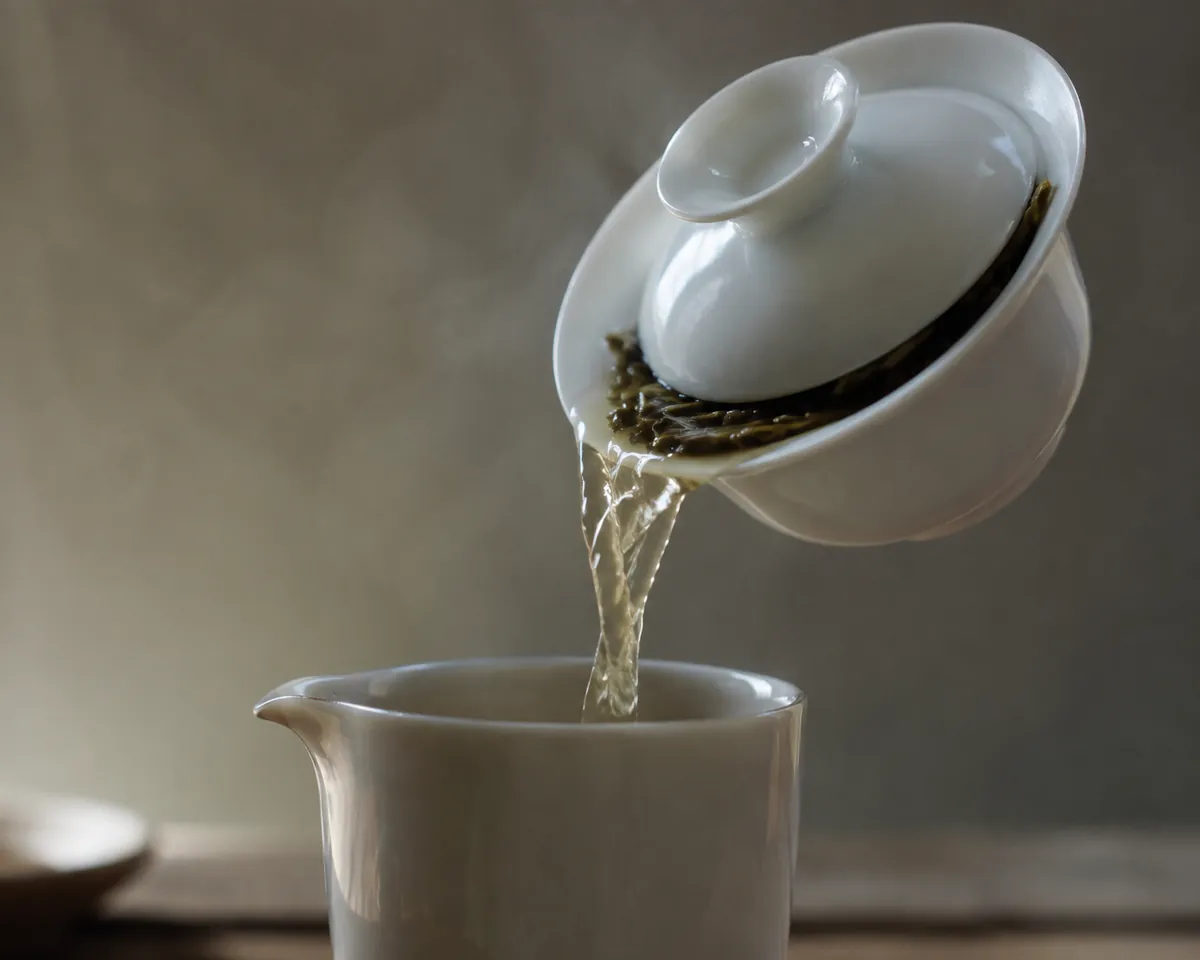
The pour
- FillWater to about a centimetre below the rim, never to the top.
- Seat the lidSlide it slightly off-centre so a narrow gap opens at one edge.
- GripThumb and middle finger on the rim, index on the lid.
- TiltPour in one decisive motion through the gap.
- EmptyCompletely. Leaf left sitting in water keeps extracting.
Hesitation is what makes it go wrong. A slow, tentative tilt lets tea run down the outside of the bowl and over your fingers, while one committed motion sends it all through the gap.
Filling to a centimetre below the rim is the other half of it. A gaiwan filled to the top has hot water against the part you are about to hold, and no grip survives that.
What size gaiwan to buy, and what to look for
Capacity is the decision people get wrong most often.
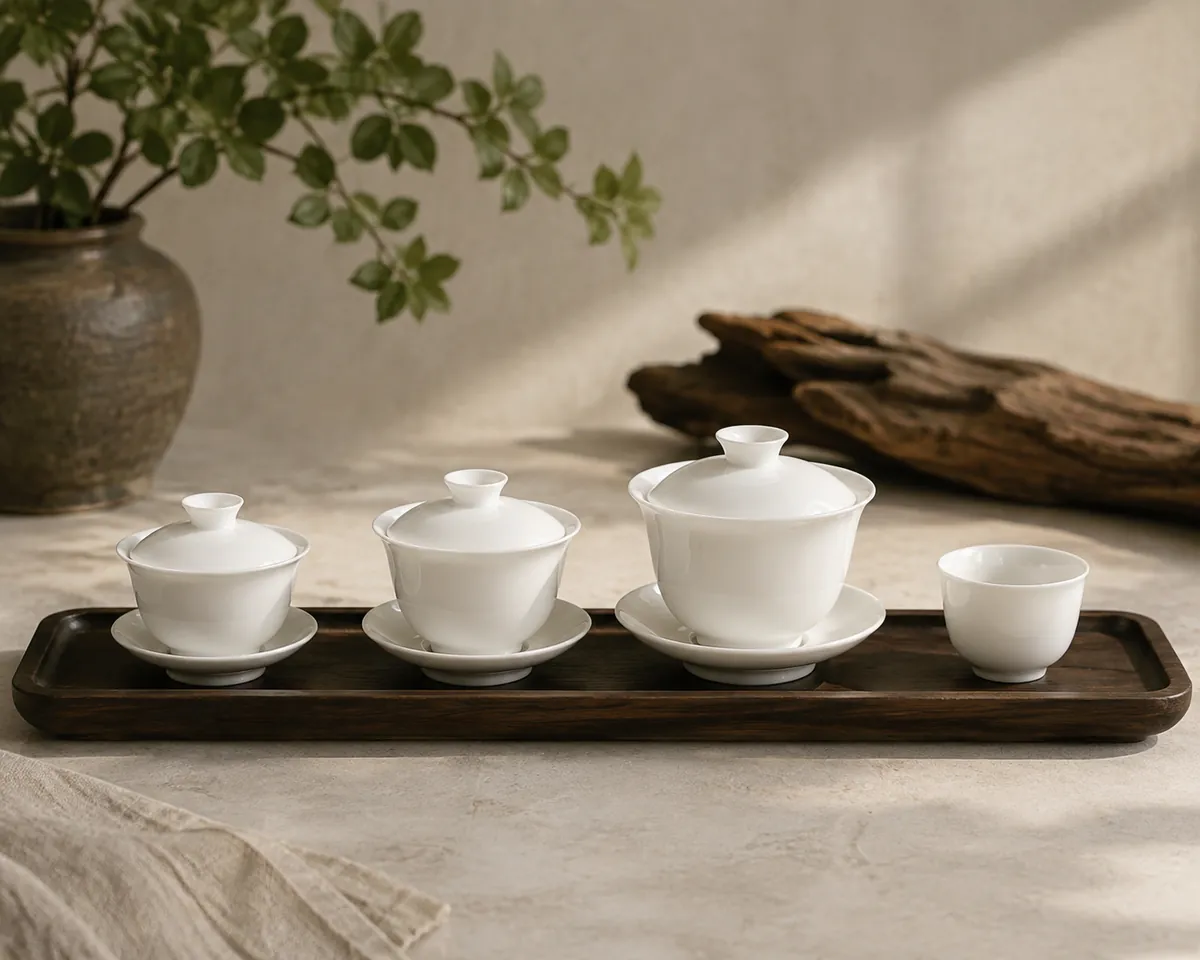
| Capacity | Suits | Note |
|---|---|---|
| 80 to 100 ml | One drinker, gongfu style | Cools fast, which suits green tea |
| 110 to 150 ml | The standard. One or two drinkers | The most versatile choice |
| 150 to 200 ml | Two or three drinkers | Heavier and harder to pour one-handed |
| Over 200 ml | Western-style single long steeps | Loses the point of the vessel |
Buy small. A gaiwan is for short repeated steeps, and a large one holds so much water that the leaf-to-water ratio drops and the method stops working as intended.
- Prefer porcelain over glass for heat comfort, and over clay for versatility.
- Check the rim: a flared, wide rim stays cooler and is far easier to hold.
- Look for a lid that sits slightly loose, so it can be offset to pour.
- Buy around 110 to 150 ml unless you know you want otherwise.
- Avoid anything with an unglazed interior, which will absorb flavour.
A flared rim is the single feature worth paying attention to. A straight-sided gaiwan transmits heat to your fingers and makes the grip genuinely uncomfortable, and no amount of technique compensates for it.
Price is close to irrelevant here. Good porcelain gaiwans cost less than a mediocre teapot, and the expensive ones buy decoration rather than a better pour.
How to brew tea in a gaiwan
The gaiwan is built for gongfu brewing, which means a high ratio of leaf to water and a great many infusions each lasting only a few seconds rather than one long steep.
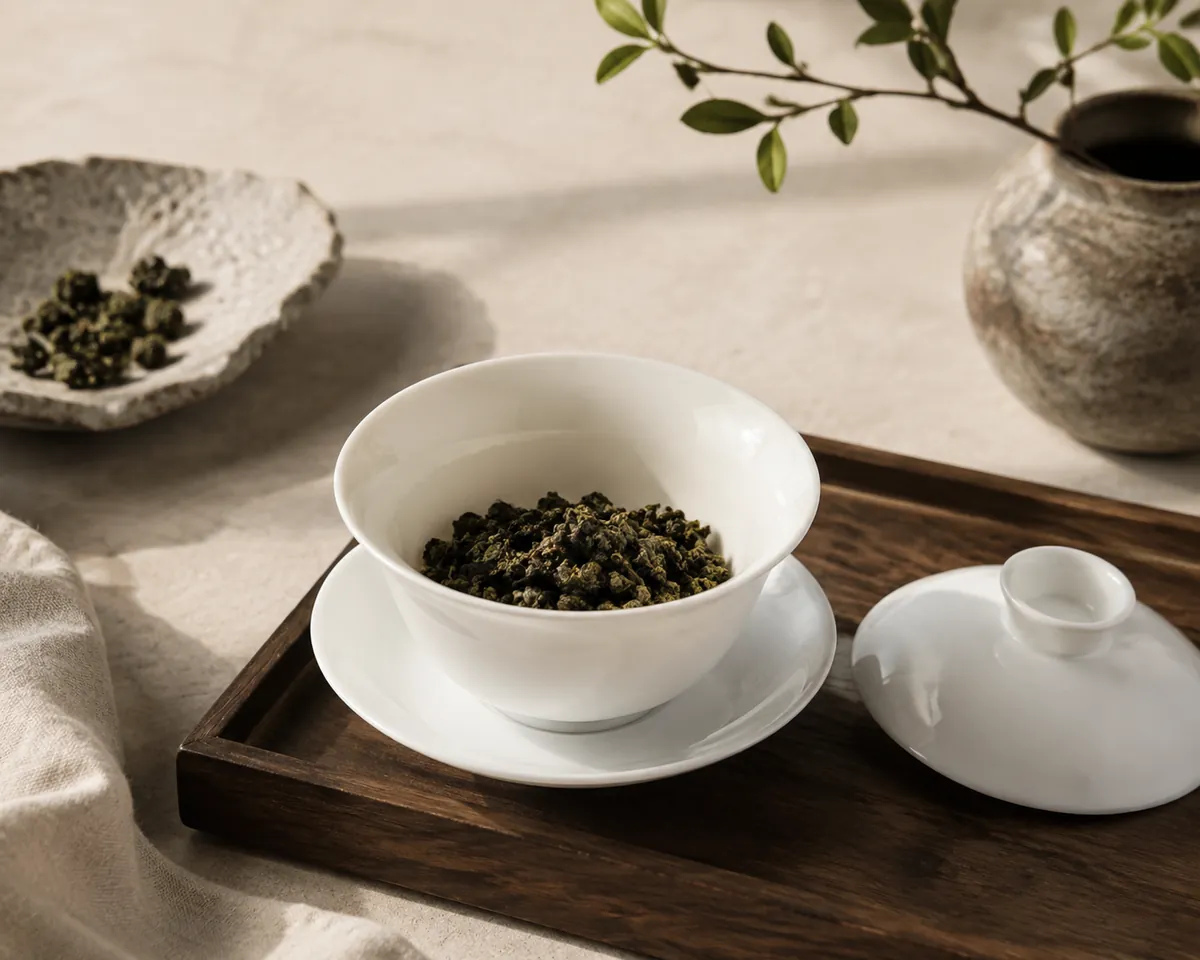
A general starting point
- Leaf
- 5 g per 100 ml, far more than western brewing
- Rinse
- One quick pour, discarded, for compressed or rolled teas
- First steep
- 10 to 20 seconds
- Later steeps
- Add 5 to 10 seconds each time
- Infusions
- Five to ten, depending on the tea
Those leaf weights are roughly double what western brewing uses, and the steeps are a small fraction as long. That inversion is the whole method: strength comes from the ratio, and control comes from stopping early.
This is where rolled oolong and compressed pu-erh show what they can do, because both release in stages across many steeps rather than all at once.
| Tea | Water | Leaf | First steep |
|---|---|---|---|
| Green tea | 75 to 80 C | 4 g | 15 seconds |
| White tea | 85 C | 4 g | 20 seconds |
| Oolong, rolled | Boiling | 6 g | 20 seconds, after a rinse |
| Black tea | 95 C | 5 g | 10 seconds |
| Pu-erh, compressed | Boiling | 6 g | 10 seconds, after one or two rinses |
It also works for sencha and delicate green teas, with cooler water and even shorter steeps, since the vessel empties fast enough to stop extraction precisely, though a kyusu is the vessel those teas were actually designed around. Roasted leaf such as hojicha is the forgiving end of the same range, since there is very little left in it to over-extract.
Where a tea is unfamiliar, steeping temperature is the variable to settle first, because getting it wrong makes every other adjustment unreadable. The water itself is the variable underneath that one, and at this leaf ratio a hard water shows up in the cup far more plainly than it does in a mug.
What the lid and the spent leaf tell you
Two readings a closed teapot cannot give.
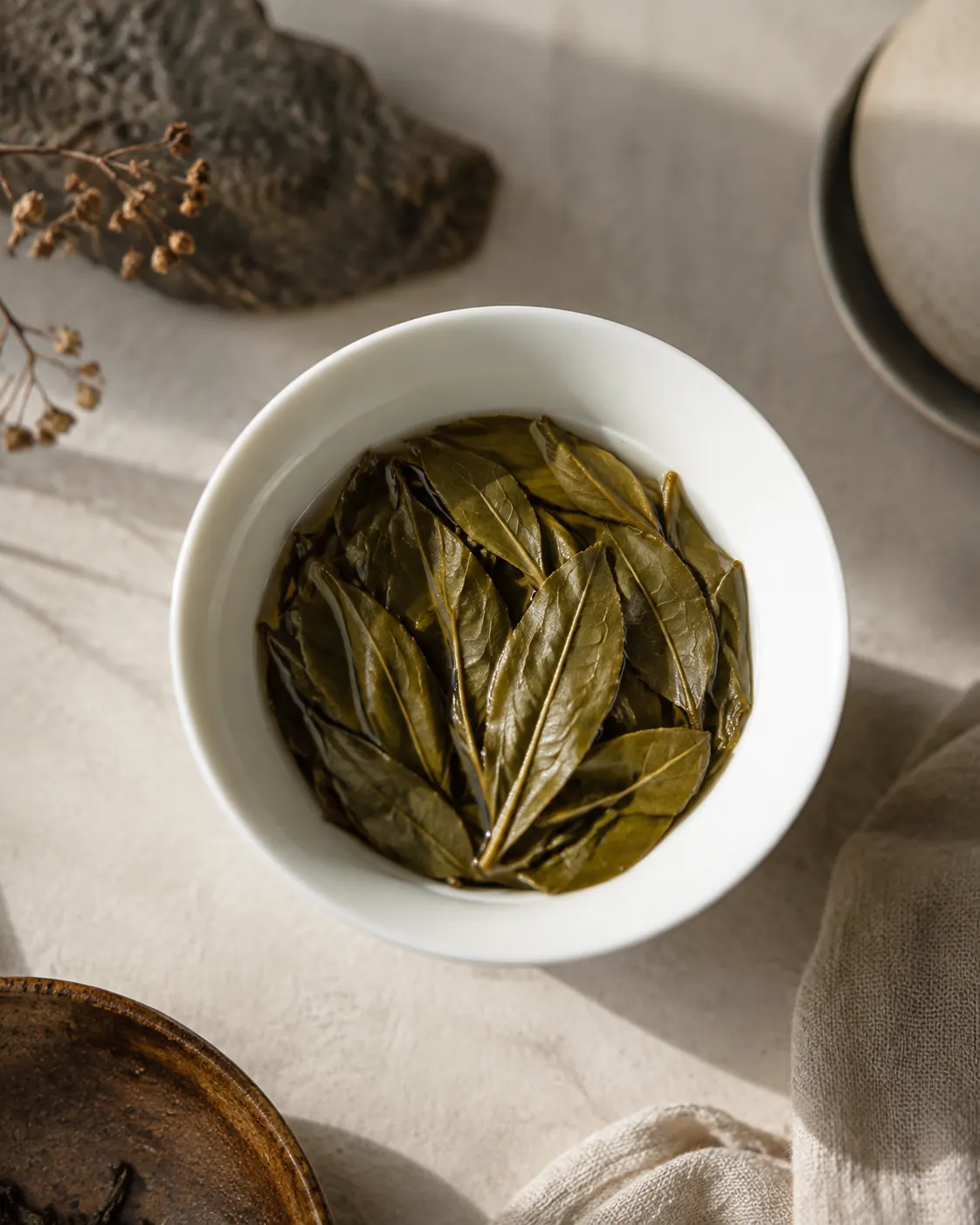
The underside of the warm lid concentrates aroma, and it changes across a session. A tea that smells sweet and floral on the lid at the third steep and flat by the sixth is telling you the session is ending.
The open leaf tells the other half of the story. Whole unbroken leaves that unfurl into recognisable shapes indicate careful plucking and processing, while a bowl of fragments explains a cup that came out fast and harsh.
Both readings are only available because the vessel opens. It is the practical reason experienced drinkers keep a gaiwan even when they own better-insulating pots.
What a gaiwan does well, and where it is the wrong tool
Every advantage this vessel has is paid for somewhere, and the drinker carries most of that cost in attention rather than in money, so the trade deserves stating plainly rather than defending.
Works well for
- Brews every category of tea, because glazed porcelain absorbs nothing
- Empties in about two seconds, so a steep stops exactly when you decide
- The leaf expands fully, unlike anything held in a basket
- Cheap, with good ones costing less than a mediocre teapot
- Nothing to break, block, or replace, since there are no moving parts
Struggles with
- The grip has to be learned, and the first few attempts are uncomfortable
- Small, so serving more than two or three people means repeated rounds
- No filter, so fine leaf and broken grades escape into the cup
- Poor heat retention next to clay, which matters for the heaviest oolongs
- Thin porcelain chips, and a chipped rim makes the pour unreliable
Every entry in the second list except the grip is a consequence of the design working as intended. A vessel that held heat like clay would also hold flavour like clay, and one with a filter would stop the leaf moving.
Being honest about where it loses matters more than defending it. For a pot to leave on a table through a long meal, a western teapot or a jug of rooibos is simply better suited, because the gaiwan makes a small volume repeatedly and cools too fast to sit.
For teabags it does nothing at all, since the bag already restricts the leaf and there is no lid work to do. And for a desk at work it is impractical: brewing this way takes a table, a tray and attention, which is exactly the point of it and exactly why it does not travel.
What else you need on the table
The gaiwan rarely works alone, and the pieces around it each do one job.
Fairness pitcher
A small jug the gaiwan empties into. The first and last of a pour differ in strength, and this evens them out before serving.
Small cups
30 to 50 ml. Short steeps make concentrated tea, and a mug-sized serving of it is unpleasant.
Tea tray
Catches the rinse water and the overflow, which the method produces plenty of.
Strainer
Sits over the pitcher and catches the fine leaf the lid lets past.
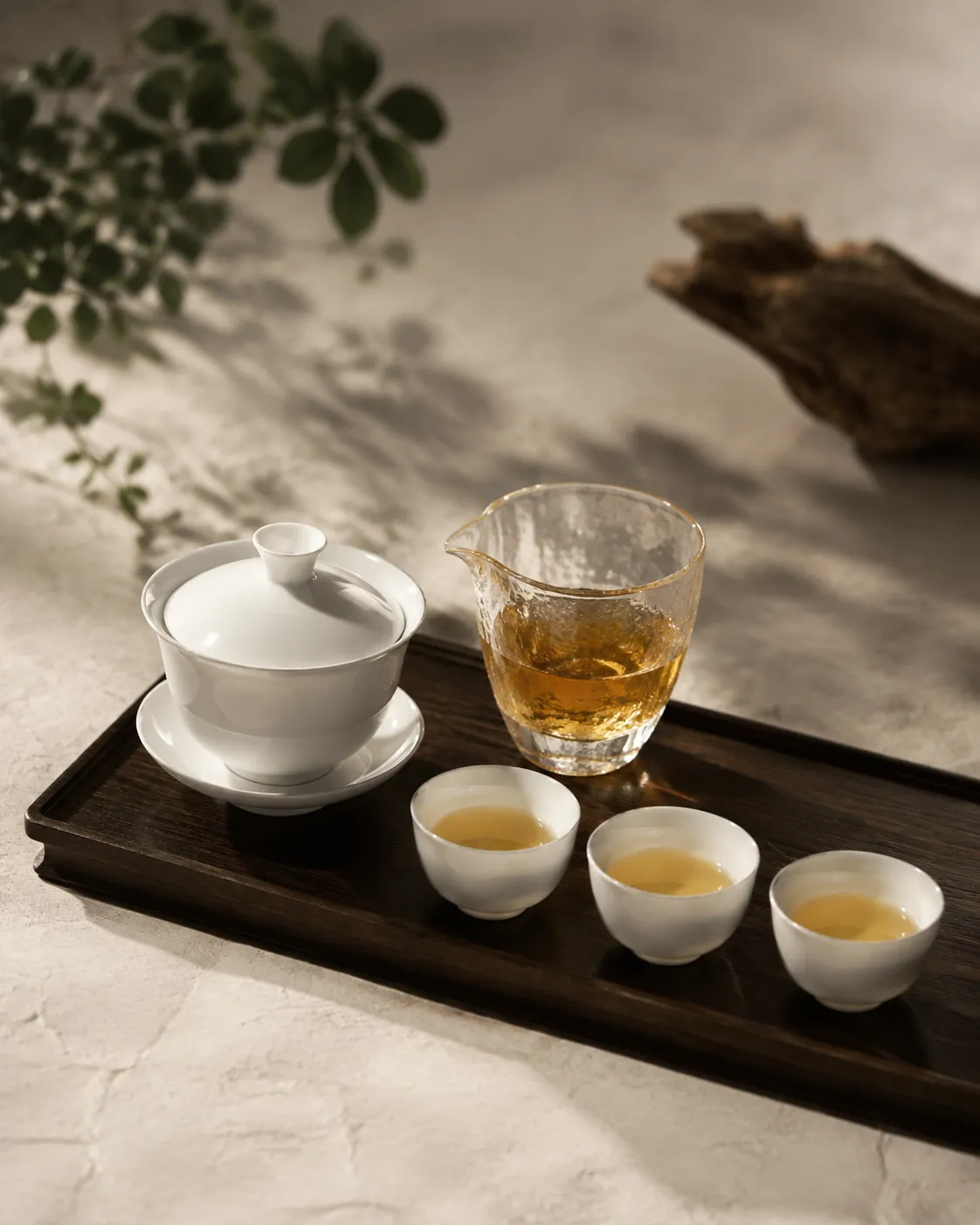
None of it is required to make tea. A gaiwan, a mug and a kettle work perfectly well, and the pitcher is the one addition that changes the result rather than the ceremony.
The strainer is the second most useful. Broken grades and the dust at the bottom of a bag will get past the lid however narrow the gap, and catching them before the cup is easier than pouring carefully.
The tray is the one people skip and then buy anyway. Gongfu brewing discards a rinse, overfills on purpose and drips on every decant, and a kitchen worktop absorbs all of that badly.
Small cups are less optional than they look. Tea brewed at this ratio is concentrated enough that a mugful tastes punishing, and the 30 to 50 ml cup exists to make a strong infusion pleasant rather than to look delicate.
What goes wrong, and how to look after one
Nearly every bad experience with a gaiwan comes down to one of five faults, four of which are fixable in about a minute once you know which one you are looking at.
| Symptom | Cause | Fix |
|---|---|---|
| Burnt fingers | Gripping the sides, or filling to the rim | Hold the rim only; fill a centimetre short |
| Leaf in the cup | The lid gap opened too wide | Narrow the gap; add a strainer over the pitcher |
| Tea runs down the outside | Pouring slowly or hesitantly | Pour in one decisive motion |
| Bitter after the third steep | Not emptied completely each time | Tip it fully; a few drops left keeps extracting |
| A crack on first use | Boiling water into a cold bowl | Warm the gaiwan with a rinse first |
The thermal shock one catches people out with cheap porcelain in particular. A rinse of hot water before the tea goes in warms the vessel, preheats it for the brew, and costs a few seconds.
The bitter-after-three-steeps fault is worth separating from an ordinary bad cup, because the mechanism is different. It is not the leaf and not the temperature but a few millilitres left sitting in the bowl, which go on extracting at full strength and then join the next steep, and it produces exactly the sharpness described in why green tea tastes bitter from a tea that had no reason to be sharp.
Porcelain is forgiving beyond that, which is most of the appeal, and two habits keep one usable for decades.
- Rinse with hot water and no detergent. Glazed porcelain holds nothing, so there is nothing to scrub off.
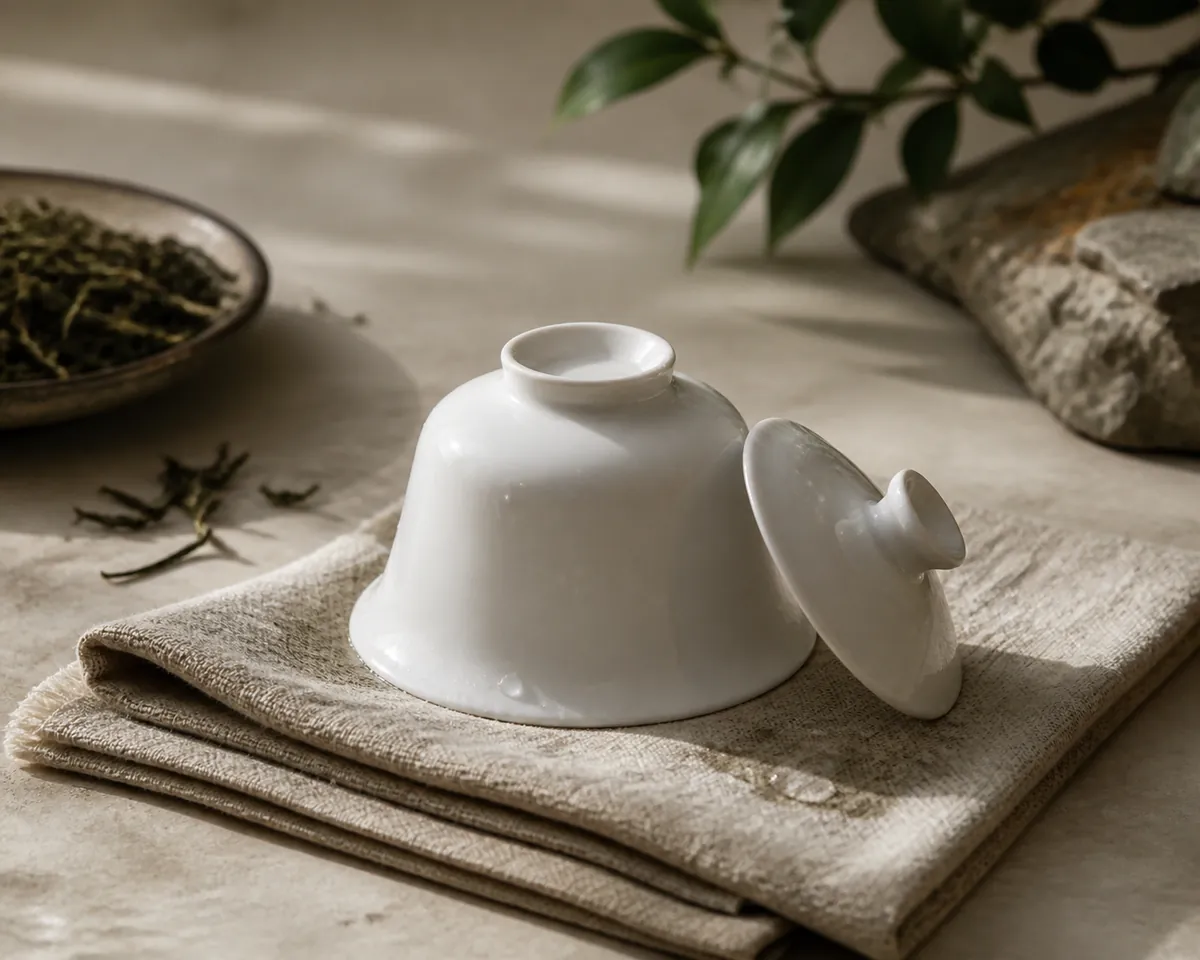
- Dry it upside down with the lid off, since a lid left on traps moisture.
- Never take it from a hot pour straight into cold water.
- Check the rim for chips before buying secondhand; a chipped rim leaks down the side.
- Store the lid beside the bowl rather than on it, which stops the two grinding.
Tea stains inside the bowl are cosmetic on glazed porcelain and will not affect flavour. Bicarbonate of soda lifts them if they bother you, and there is no reason beyond appearance to bother.
The vessel outlasts the leaf by decades, which shifts the real maintenance question onto the tea. A gaiwan will brew a stale tea faithfully and reveal exactly how stale it is, so storing loose leaf does more for a session than any amount of care given to the porcelain.
Where the gaiwan came from
The gaiwan is younger than tea drinking by a long way, and the reason it exists explains the shape.
Powdered tea whisked in a bowl was the Chinese method for centuries, and it survives in Japan as matcha, still made with a bowl and a whisk rather than a strainer. Loose leaf steeped in water replaced it in China during the Ming dynasty, and that change created a problem the old bowl could not solve, since leaf floats and gets in the way of drinking.
The lid answered it. A bowl with a lid can hold the leaf back while the liquid leaves, and the saucer underneath keeps a hot bowl off the table and off the fingers.
Two quite different uses grew out of the same object. As a brewing vessel it is decanted into a pitcher and shared, which is the gongfu method described above.
As a drinking cup it is used directly, and this is still the everyday form in Sichuan teahouses. Leaf and water go in, the lid is held slightly ajar, and the drinker sips from the gap while the leaf stays behind, topping the bowl up with hot water through a long afternoon.
That second use is worth trying once. It is a completely different drink from a gongfu session, weaker and slower and continuously changing, and it explains why a gaiwan is sometimes sold with a saucer that looks too formal for a brewing vessel.
Common questions
How do you hold a gaiwan without burning your fingers?
Thumb and middle finger on the rim, index finger on the lid knob. The rim stays cool because the water sits below it. Gripping the sides like a mug is what scalds. Fill to about a centimetre below the rim and practise with cold water first.
Is a gaiwan better than a teapot?
More versatile. Glazed porcelain absorbs nothing, so one gaiwan brews every tea, whereas a clay pot seasons and becomes dedicated to one. A gaiwan also empties in seconds, which matters for the short repeated steeps it is designed for.
What size gaiwan should I buy?
110 to 150 ml for most people. Gaiwans are for short repeated steeps at a high leaf ratio, so a large one dilutes the method. Anything over 200 ml is really a small teapot without a spout.