What Is Oolong Tea? The Whole Band Between Green and Black
Oolong is the widest category in tea. It covers everything between green and black, so two teas both correctly called oolong can have almost nothing in common.
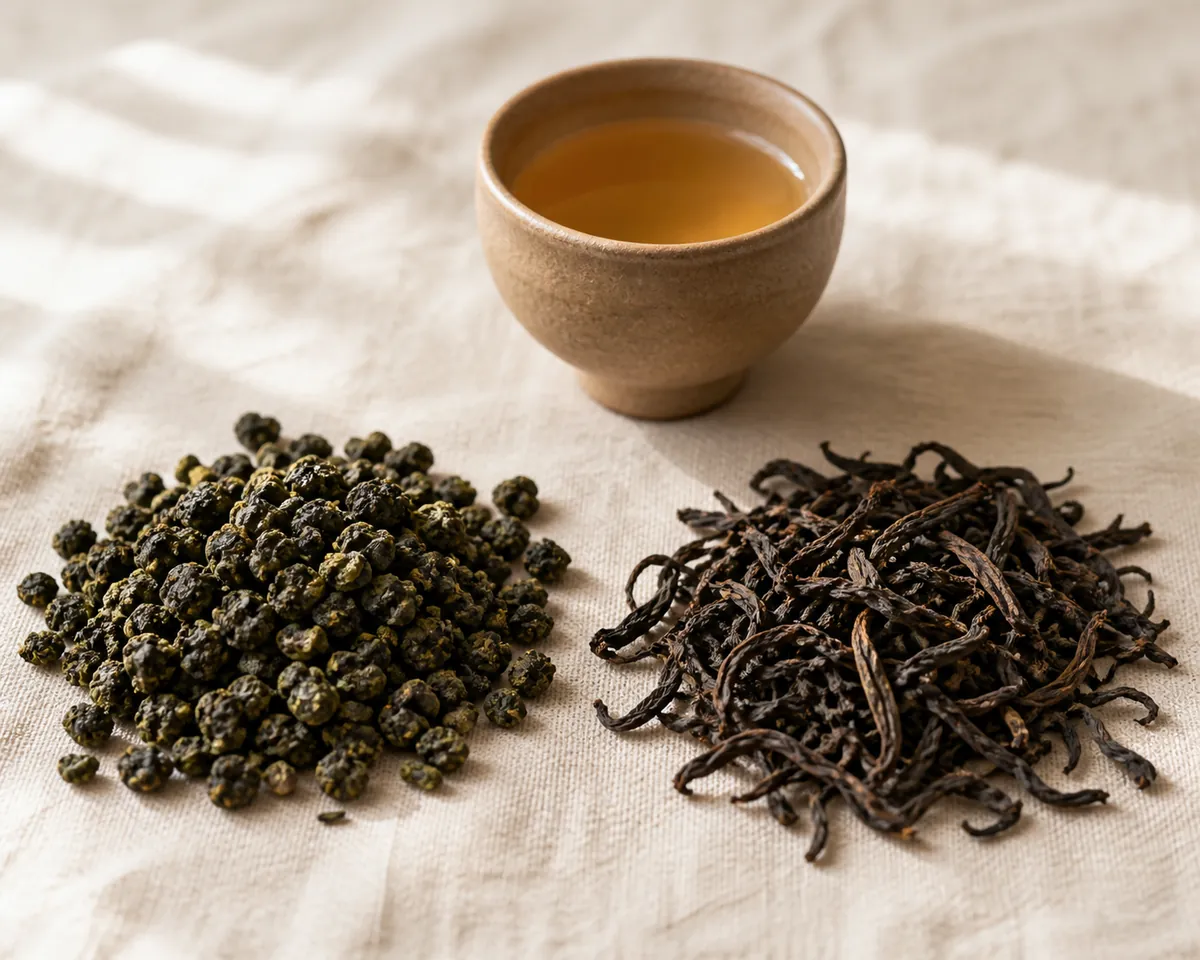
Oolong is Camellia sinensis leaf that has been partly oxidised. The reaction is started deliberately, watched, and then stopped part way, which places the category between green tea and black tea, where the full oxidation spectrum is set out.
That description is accurate and almost useless on its own, because the band it covers is enormous and nothing about the word tells you where inside it a given tea sits.
Oolong at a glance
- What it is
- Leaf oxidised part way, from roughly 10 to 80 per cent
- Second variable
- Roast, applied after oxidation stops and independent of it
- Leaf form
- Rolled into tight pellets or long twists, which controls how it brews
- Water
- 85 to 90 C for light styles, 90 to 95 C for roasted ones
- Leaf
- 3 g per 200 ml western, 5 g per 100 ml gongfu
- Infusions
- Two western, five or more gongfu
- Keeps
- Months for green styles, a year or more for roasted ones
Why one name covers teas with almost nothing in common
The gap between the two ends of this category is wider than the gap between a green tea and a black one, which is the fact every piece of general oolong advice quietly ignores. A lightly oxidised Taiwanese leaf behaves like a green tea in the pot, and a heavily roasted Wuyi behaves like a black one.
The oolong band inside the wider scale
A light oolong and a dark oolong have less in common with each other than either has with its neighbour. Advice that does not say which end it means is wrong for half the category.
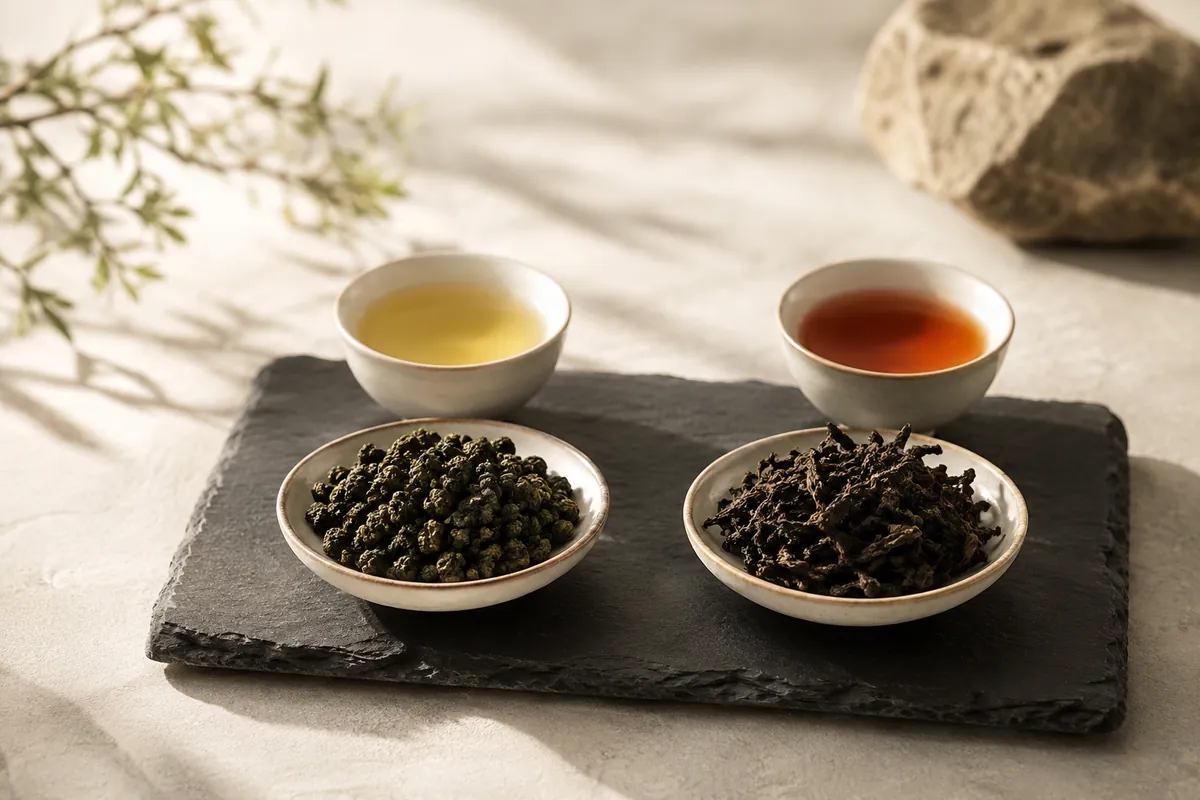
Four names cover most of what you will actually find on sale outside China and Taiwan, and each one sits in a different part of the band.
Tieguanyin
From Fujian, and sold in both a modern green style and a traditional roasted one, which is why the name alone tells you little.
Wuyi rock tea
Also Fujian, grown among cliffs. Heavily oxidised and roasted, with a mineral character called yan yun.
Dan Cong
From Guangdong, and famous for tasting of specific flowers and fruits, often from single-bush harvests.
High-mountain Taiwanese
Grown above roughly 1000 m. Lightly oxidised, creamy and floral, sold as Alishan or Lishan.
Milk oolong needs naming separately because it confuses people. It contains no milk. The name describes a creamy texture, and a good deal of what is sold under it has been artificially flavoured rather than grown that way.
The bruise-and-rest cycle, and the red rim it leaves
Oolong takes more hands-on judgement than any other style of tea, and the reason is that the maker has to stop a moving reaction at a point nobody can measure directly.
The oolong process
- WitherPlucked leaf is spread in the sun and then indoors to lose moisture.
- BruiseThe leaf is tossed or rolled repeatedly, damaging the edges rather than the whole leaf.
- OxidiseBetween each bruising the leaf rests, and oxidation advances from the damaged edges inward.
- FixHeat is applied to halt the reaction at the chosen point.
- RollThe leaf is shaped, into tight pellets or long twists.
- RoastMany oolongs are then roasted, sometimes over hours and sometimes repeatedly across years.
Damage is applied to the rim of the leaf on purpose. Oxidation runs from the edge inward, so a partly oxidised oolong leaf ends up red at its border and green at its centre.
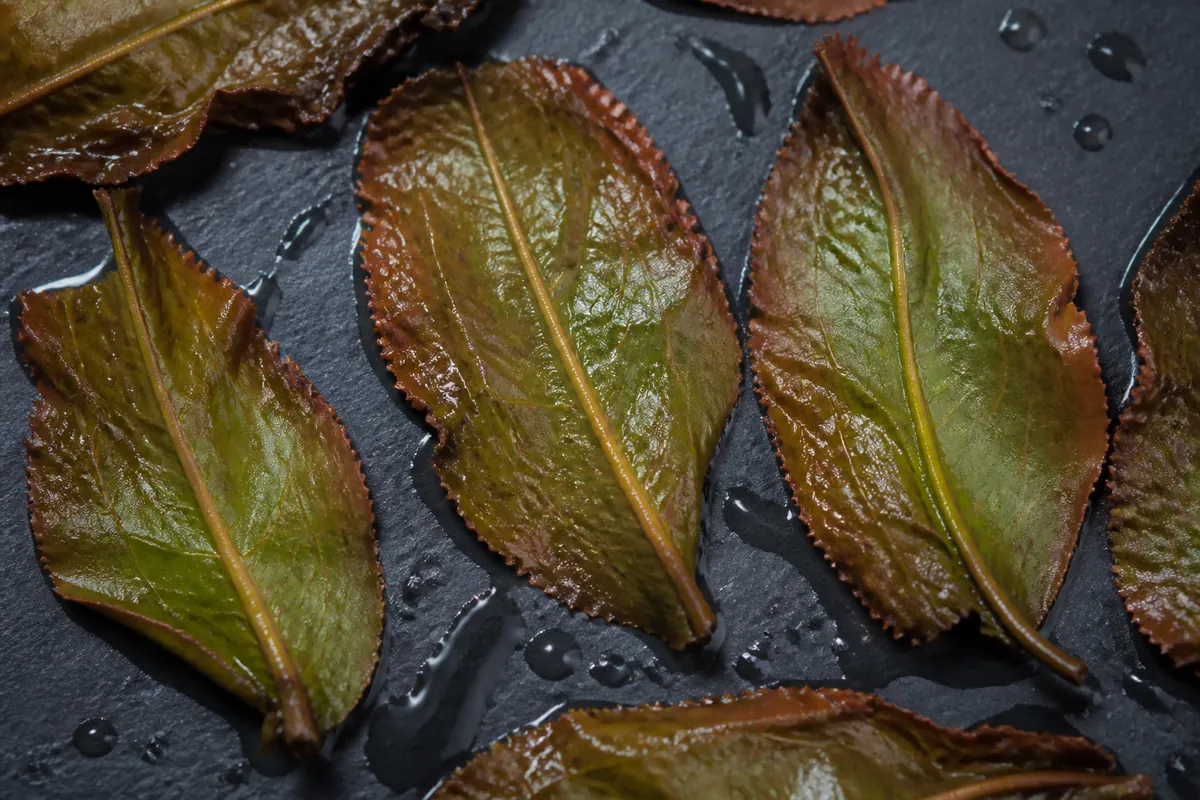
Spent leaf is the most honest record of what a maker decided. Open a used pellet out flat after brewing and the width of that red rim tells you roughly how far the reaction was allowed to run, which no label will state as plainly.
The cycle repeats through the night and the timing changes with the weather, the leaf and the batch.
Stopping early leaves a rough green tea. Stopping late leaves a mediocre black one, and the window between the two moves.
Roasting adds a second chance to ruin the batch, since a heavy roast runs for hours and an over-roasted tea cannot be brought back. That is why good oolong costs more than good green tea from the same hillside, and why making oolong is largely a description of decisions rather than of steps.
Roast is the second axis, and the one that misleads
Treating oxidation as the only variable is the commonest mistake in reading an oolong listing.
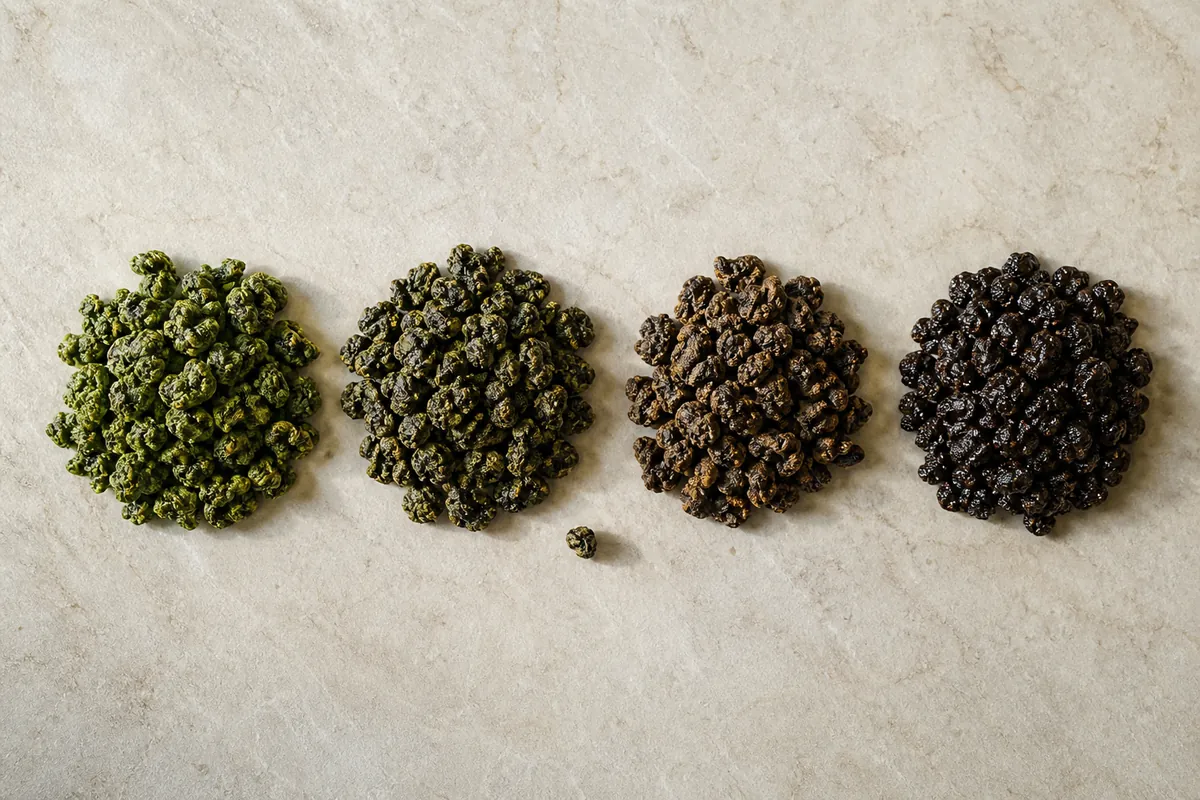
Roasting happens after the leaf is fixed, so it is applied to a tea whose oxidation is already settled. A tea can be lightly oxidised and heavily roasted, or heavily oxidised and barely roasted at all, and those two combinations taste nothing alike.
| Light roast | Heavy roast | |
|---|---|---|
| Light oxidation | Floral, green, creamy. Most Taiwanese high-mountain oolong | Uncommon, and reads as toasted florals |
| Heavy oxidation | Fruity, honeyed, brisk. Many Dan Cong styles | Dark, mineral, roasted. Wuyi rock teas and traditional Tieguanyin |
Two tins both labelled Tieguanyin can therefore be completely different teas. The modern green style is lightly oxidised and barely roasted, and the traditional style is more oxidised and roasted hard, and only the second one will taste of anything after a year in a cupboard.
Roast also changes what the tea reminds you of. A heavy roast brings out grain, caramel and woodsmoke, which is the same family of aromas that roasting produces in hojicha, arrived at from a completely different starting leaf.
The practical reading is that roast level belongs on the label beside oxidation. A seller who gives one and not the other has told you half of what decides the cup.
What rolling the leaf into a pellet actually does
Those tight balls are the other thing that makes oolong behave unlike the teas either side of it.
Rolling protects the leaf while it sits in a packet. A tightly rolled pellet exposes very little of its surface to air, which is a large part of why an oolong keeps better than an open-leaf green tea of the same age.
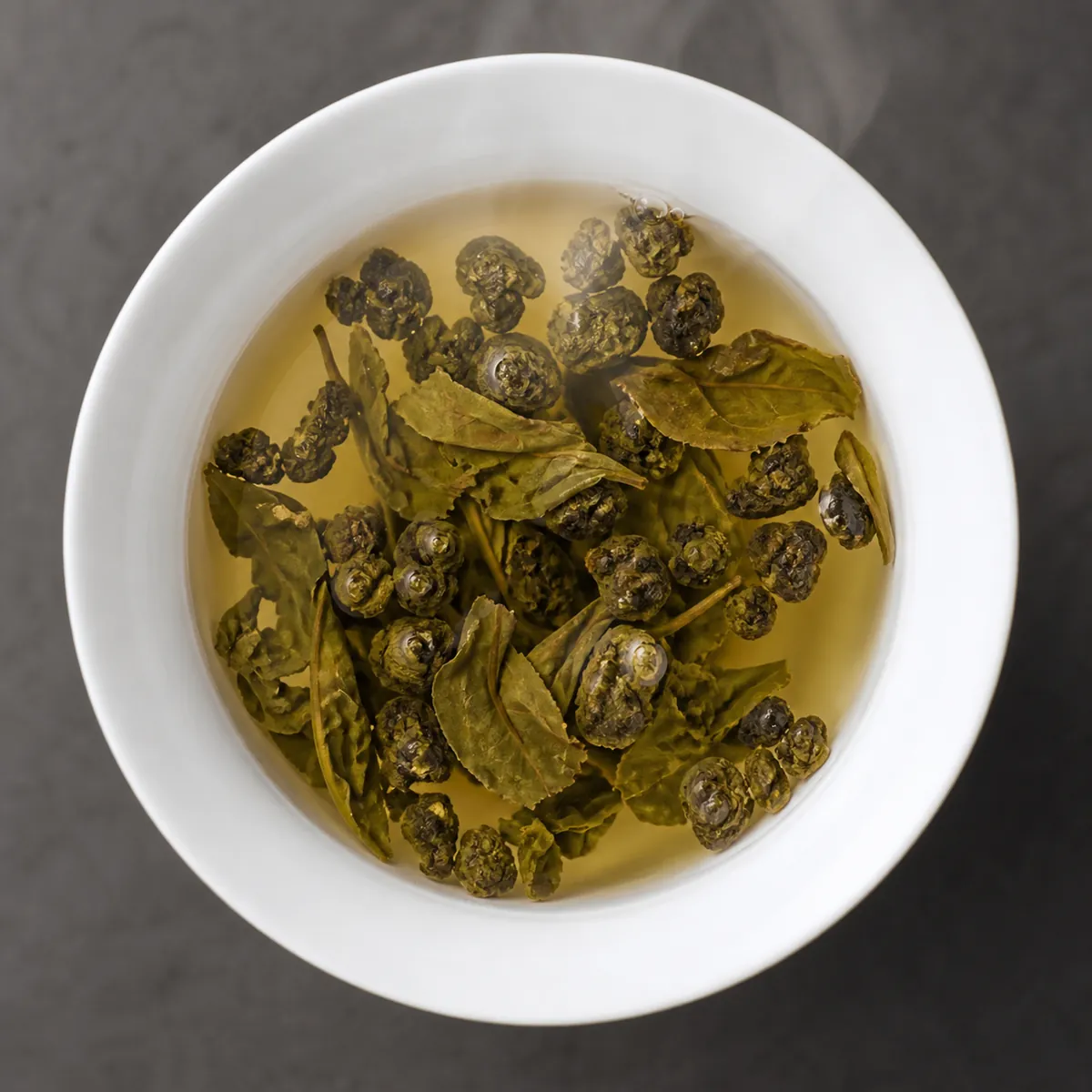
It also meters the extraction. The pellet opens gradually across successive infusions and releases its flavour in stages rather than all at once, which is exactly what makes a run of short steeps worth the trouble.
That staging is why the third infusion is often the best one. The leaf has only just finished opening by then, and a single long steep collapses the whole sequence into one flat cup.
Leaf form is worth reading as a processing decision rather than a look. Long twisted leaf, as most Dan Cong and Wuyi teas are shaped, gives up more of itself immediately and rewards a shorter first steep than a pellet does.
Two sets of numbers, and which one an instruction assumes
Because the band is so wide, no single set of numbers serves the whole category, and an instruction that does not say which approach it assumes has left out the important half.
Two starting points
- Light oolong, water
- 85 to 90 C
- Light oolong, steep
- 2 to 3 minutes
- Dark oolong, water
- 90 to 95 C
- Dark oolong, steep
- 2 to 4 minutes
- Leaf
- 3 g per 200 ml, more than green or black tea
Use the cooler end for anything floral and green, and the hotter end for anything roasted. Soft water suits the light styles and hard water flattens them, which brewing water sets out in full.
Those figures assume western brewing, meaning one pot, one or two infusions and a single balanced cup. The other approach produces a genuinely different drink from the same leaf.
| Western | Gongfu | |
|---|---|---|
| Leaf to water | About 3 g per 200 ml | About 5 g per 100 ml |
| Steep length | 2 to 4 minutes | 20 to 60 seconds |
| Infusions | One or two | Five or more |
| What you get | One balanced cup | A sequence that changes each round |
| Vessel | Teapot or mug | Small gaiwan or clay pot |
Gongfu is a different goal rather than a more correct method. Western brewing aims at one representative cup, and gongfu aims at watching the tea change across a session.
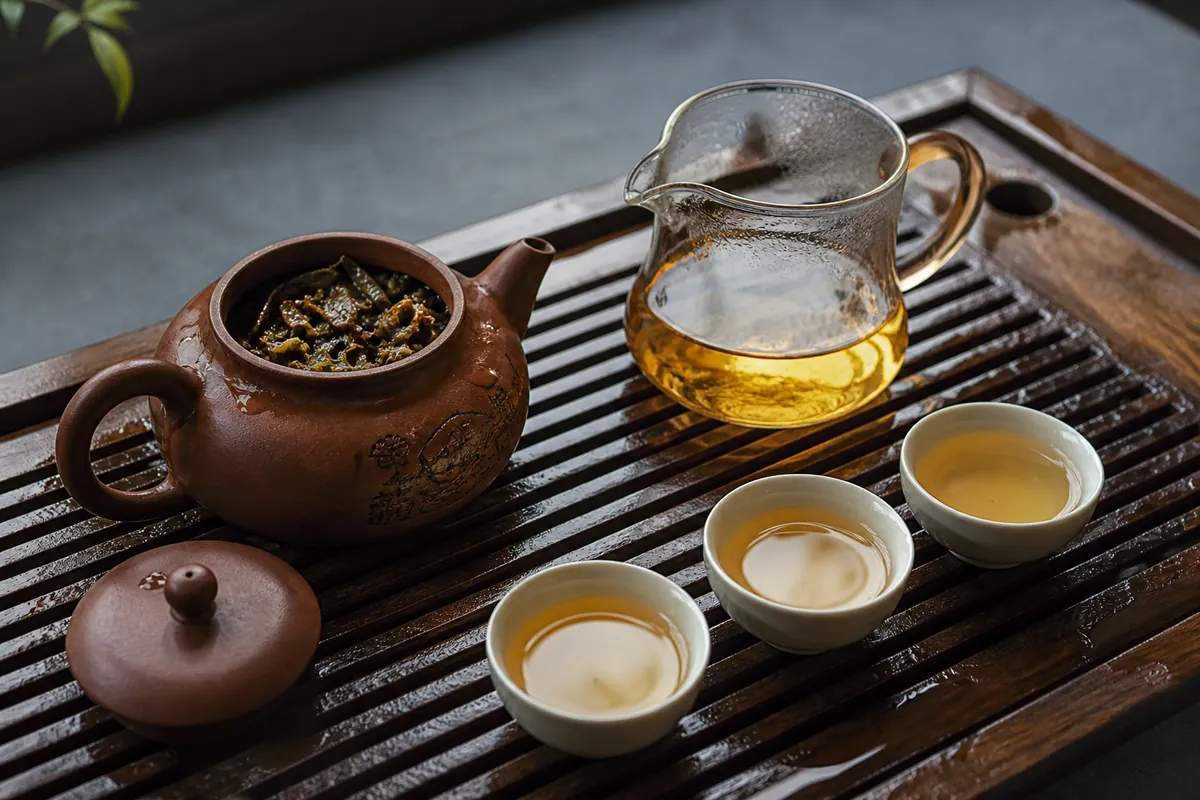
The small controlled pours that a session depends on are the one tea case where a gooseneck kettle earns its place. If an expensive oolong has underwhelmed you, the brewing style is the first thing to change and steeping temperature is the second.
How much caffeine is in oolong tea
Oolong lands between green and black tea, and the spread inside it is wide enough that the category name predicts very little.
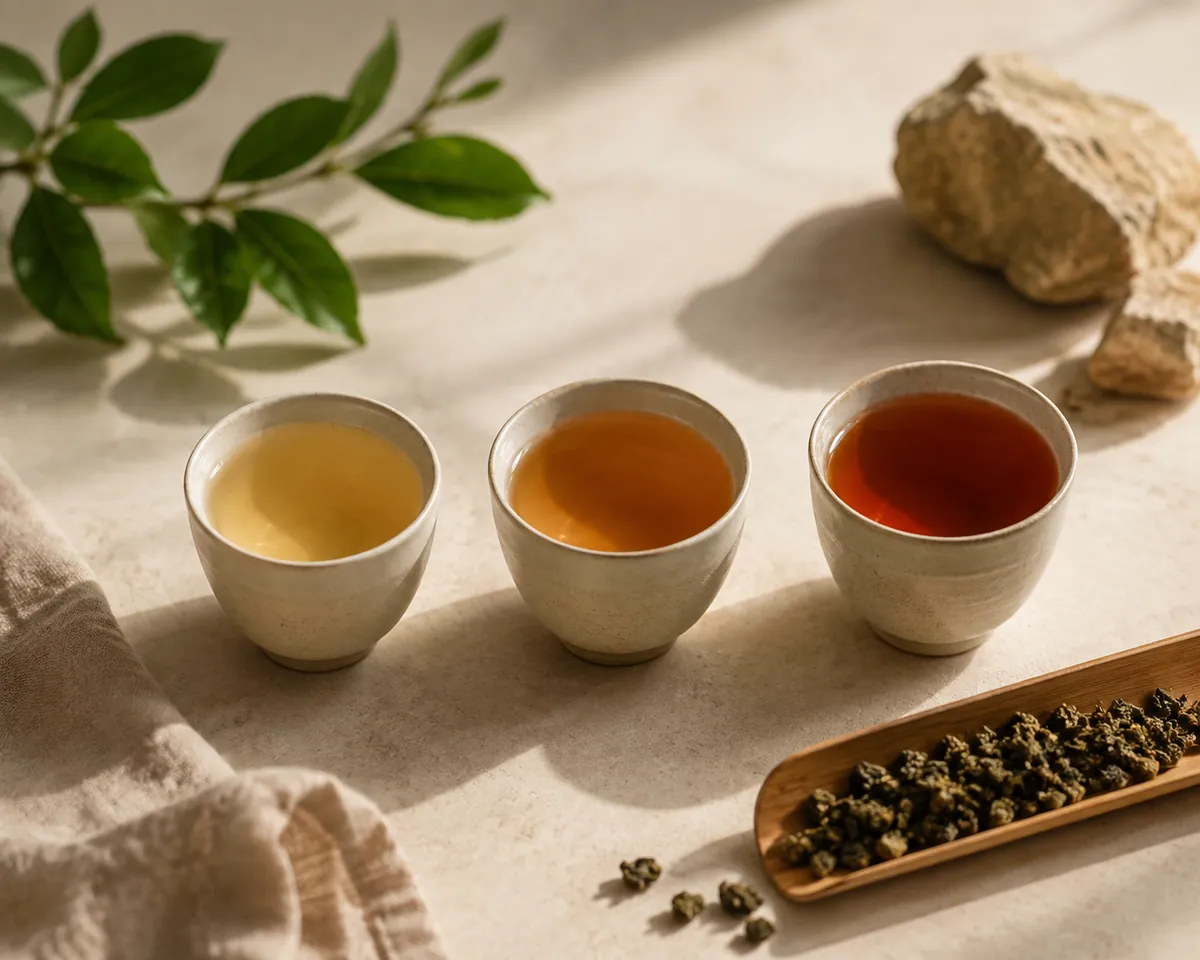
Most oolong sits between the first two figures, and oolong caffeine carries the fuller range. Neither oxidation nor roast moves it much, because caffeine survives both, and a heavily roasted tea is not the low-caffeine option a dark colour suggests.
Dose does far more than category. Brewing 3 g rather than 2 g shifts the number further than any processing decision does, and the same relationship between dose and serving size drives caffeine by brewing method on the coffee side.
Gongfu brewing complicates the arithmetic in a way that is worth knowing. Each individual cup is small and briefly steeped, so it carries much less than the table suggests, while a full session through eight infusions of 5 g of leaf totals a good deal more.
Keeping it, and the teas that are stored on purpose
Storage splits along exactly the same line the category does, which is one of the few places where the enormous internal range simplifies rather than complicates a decision.
Green, lightly oxidised
Fades within months. Airtight, opaque, and the floral top notes go first.
Medium roast
Keeps most of a year. Stable enough to buy in useful quantities.
Heavy roast
A year or more, and often better after a few months of rest.
Deliberately aged
Stored for years and re-roasted periodically, which is maintenance rather than storage.
Rolled leaf protects itself, which is why a tightly balled oolong holds up better than an open-leaf one kept beside it in the same tin. The general container rules in storing loose-leaf tea still apply, and storing oolong covers what changes between the two ends.
A freshly roasted oolong is the one tea here that is worth putting away rather than drinking. Straight from a heavy roast it tastes harsh and one-dimensional, and several months of rest lets the roast settle back into the leaf.
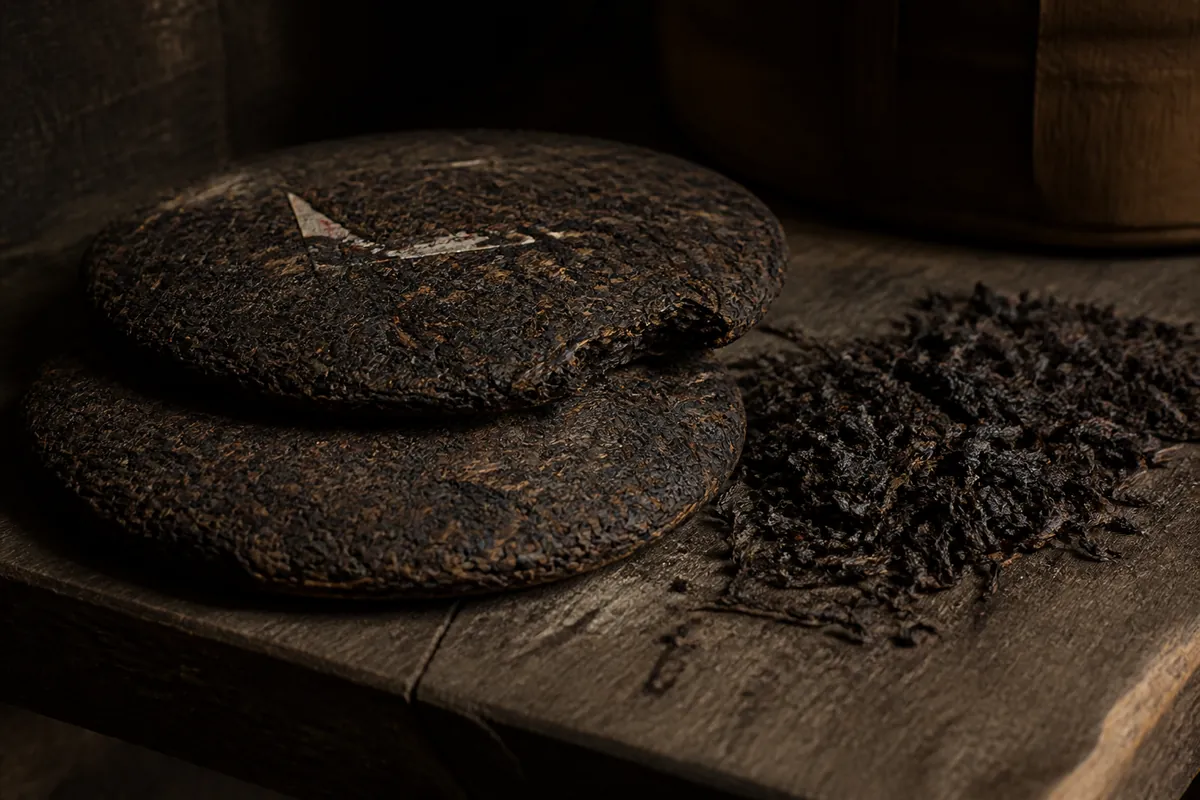
Deliberate ageing takes that idea much further. Heavily roasted leaf is kept for years and re-roasted every so often, losing its sharper edges and developing a depth often described as plummy or medicinal.
This is not the same thing as ageing pu-erh. No microbe is involved, the change is a slow chemical settling, and the periodic re-roast does most of the work.
An aged oolong that was simply forgotten in a cupboard tastes stale and sour, and there is no established market to tell you which one you are being sold.
Where to start, and what a listing should tell you
Sampler sets do this category a particular disservice.
Five oolongs from across the band give five unrelated experiences and no sense of the shape of the thing. Picking one end and learning it properly works far better, because it gives you a reference point everything else can be measured against.
Start with a medium-roast Tieguanyin if you already like black tea, or a high-mountain Taiwanese oolong if you prefer green. Then change one variable at a time, taking the same style at a heavier roast, or the same roast at a different oxidation, and the two axes stop being abstract.
- Look for the oxidation level, stated as a percentage or as light, medium or heavy.
- Look for the roast level separately. A tea can be light in one and heavy in the other.
- Check the leaf form. Tight pellets and long twisted leaf brew quite differently.
- Treat milk oolong with caution unless the flavouring is disclosed.
- Prefer a seller who names the region and the year over one who names only the style.
A vendor who states oxidation and roast has told you what the tea will taste like before you open it. One who prints only the words oolong tea has told you that it sits somewhere in the middle of the scale, which was already obvious.
Buying a small quantity first matters more here than for a single-origin black tea. Nothing about a name, a price or a photograph reliably predicts which corner of the grid a tea occupies, and oolong problems mostly begin with a tea bought blind.
Wulong, and how a name for two teas came to cover fifty
Written in Chinese as wulong, meaning black dragon or dark dragon, the name is older than any of the classification now built on top of it and describes an appearance rather than a process.
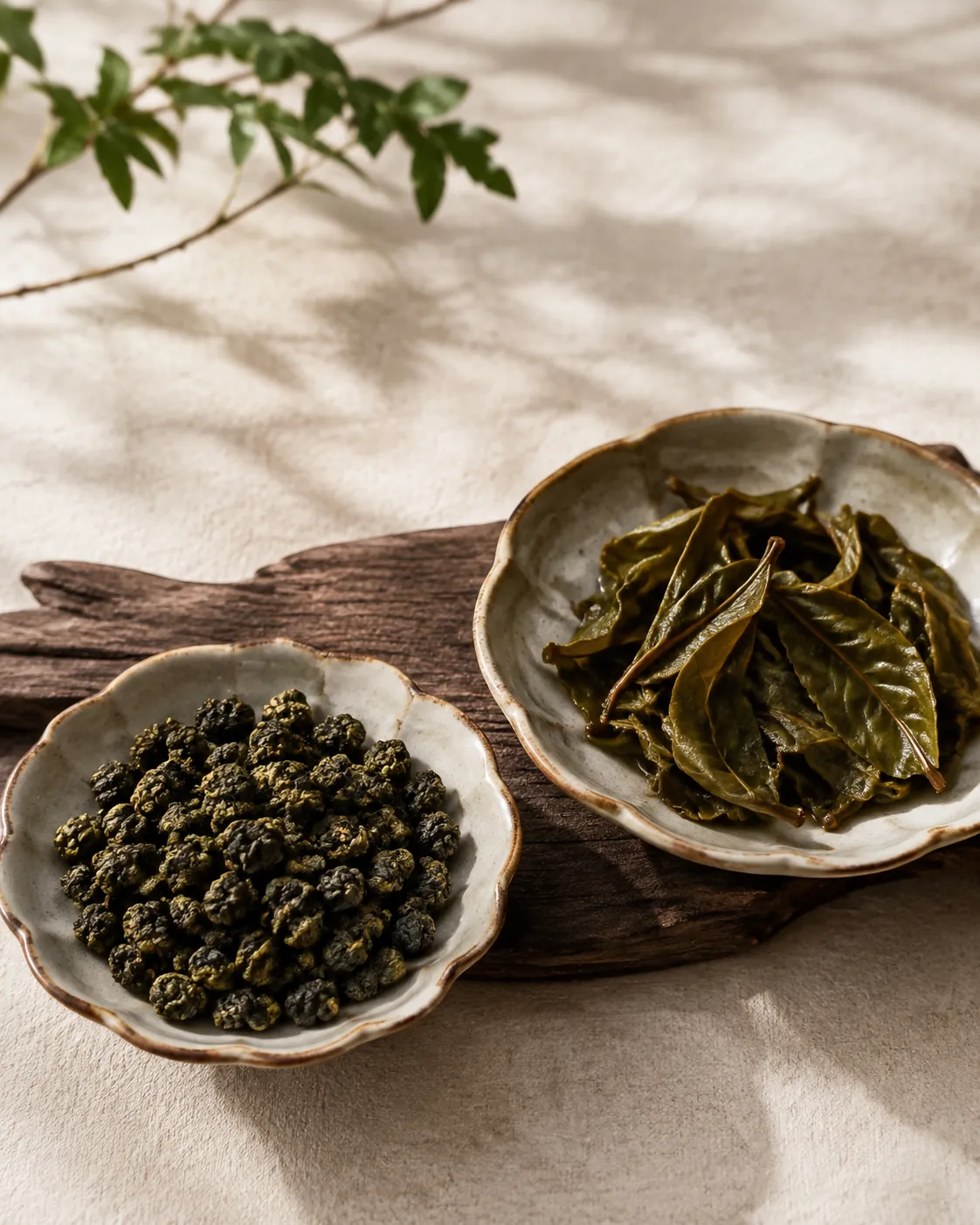
The dark twisted leaf of the original teas looked like a small dragon, and the word was later stretched to cover everything partly oxidised.
That is the whole reason the category is so broad. It was never designed as a middle band between green and black.
Several origin stories compete and none of them is settled. The most repeated involves a tea maker distracted by a deer, whose leaf oxidised while he was away and turned out better for it, which reads as folk tale rather than history.
A partly oxidised Darjeeling sold as black tea shows how loosely these labels have always sat.
What survives the story is a useful warning about names in this category. A traditional name describes what a tea looked like to somebody centuries ago, and it will not tell you the oxidation, the roast or the leaf form, which are the three things that decide the cup.
Scented oolongs sit slightly outside all of this. Taiwan makes small quantities of jasmine-scented oolong, and the aroma there is applied after processing in the way jasmine tea describes, rather than developed by the maker.
Oolong at the table
Of the true teas this is the one that works alongside the widest range of food, and the range is exactly why.
Light, floral oolong
Works with delicate food. Steamed fish, fresh cheese, light vegetable dishes.
Medium roast
The most flexible. Handles roast chicken, mushrooms and most everyday cooking.
Heavy roast
Stands up to rich and fatty food, and is the traditional partner for dim sum.
Aged oolong
Deep and mellow, and suits dark chocolate or anything with dried fruit.
A roasted oolong cuts through fat in a way a green tea cannot, which is why it appears alongside rich food across southern China rather than being served separately afterwards.
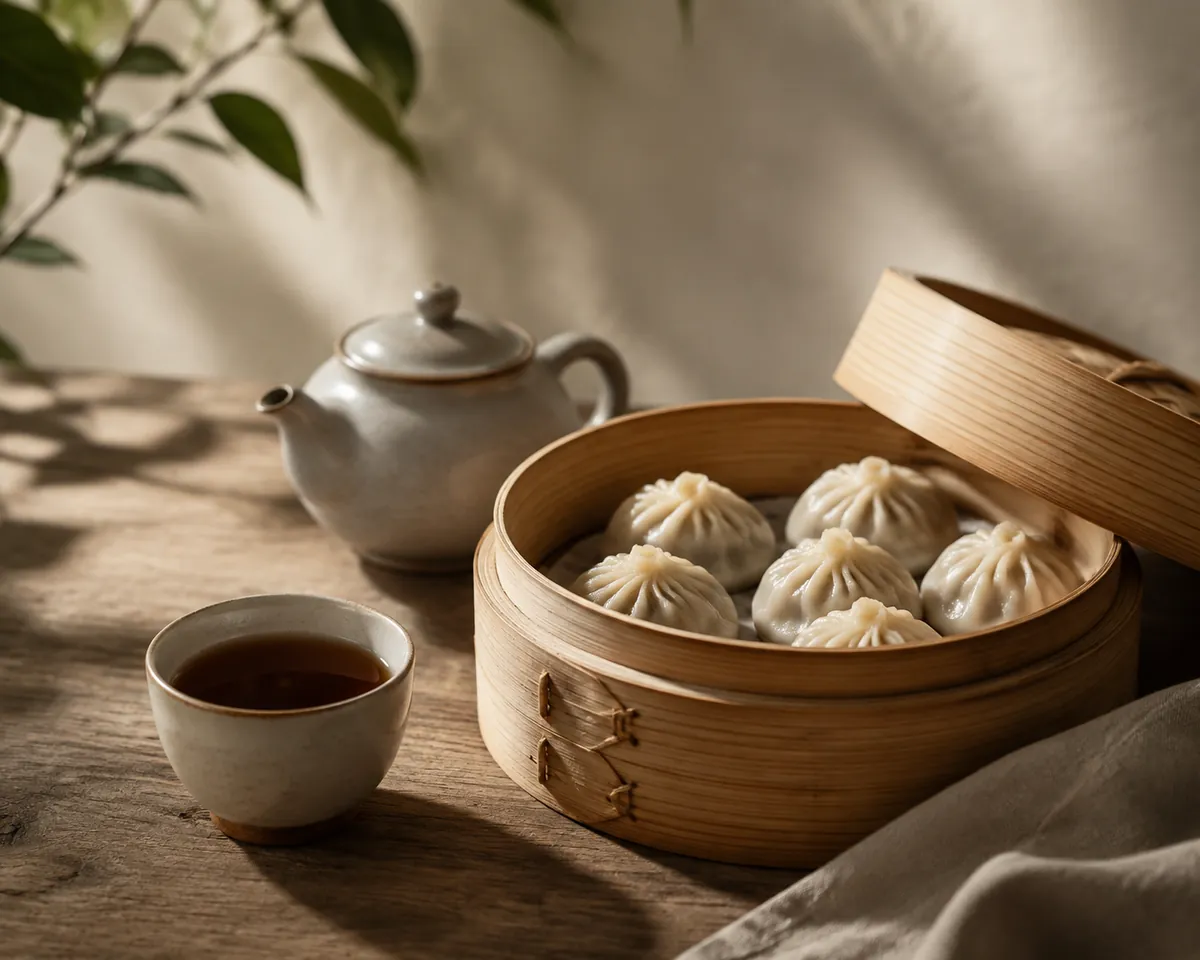
The matching logic is closer to wine than to the rest of tea. Match the weight of the tea to the weight of the dish, and let the roast level rather than the origin do most of that work.
What oolong does not want is milk or sugar. A light one has no tannin structure for milk to bind to, and a roasted one has a caramel sweetness of its own that sugar simply doubles up on, flattening the very thing how oolong tastes is describing.
Temperature at the table matters more than for a black tea. A floral oolong loses most of its aroma once it drops below drinking heat, so a small pot poured out quickly serves it far better than a large one left to stand.
Common questions
Is oolong closer to green tea or black tea?
It depends entirely on the oolong. A lightly oxidised Taiwanese high-mountain tea behaves much like a green tea, and a heavily roasted Wuyi rock tea behaves much like a black one. The category spans both.
Does milk oolong contain milk?
No. The name describes a creamy texture and mouthfeel. A good deal of what is sold as milk oolong has been artificially flavoured to exaggerate it, but the traditional tea contains nothing but leaf.
How many times can you re-steep oolong?
Rolled oolong commonly gives three to six infusions, and often improves by the third as the pellet fully opens. Add roughly fifteen to thirty seconds to each successive steep.