Espresso machine vs Moka pot
Espresso Machine vs Moka Pot: Nine Bars Against a Stovetop
One device pumps water through a tamped puck at about nine bars under held temperature, and the other is a sealed base on a hob pushing water up at one and a half. Axis by axis that explains the grind, the milk, the upkeep and the cost, and on several axes the stovetop pot wins outright.
An espresso machine holds water at 92 to 96 C and pumps it through a compressed bed at around nine bars for 25 to 30 seconds, which is what makes crema, microfoam and a genuine shot possible, and what makes a capable grinder mandatory rather than optional. A moka pot builds roughly 1 to 1.5 bars of steam pressure in a sealed base and pushes water up through a basket that must never be tamped, ready in two minutes from cold with no power and one gasket a year. The machine wins on control, temperature and milk, and the pot wins on cost, speed from cold, portability and upkeep.
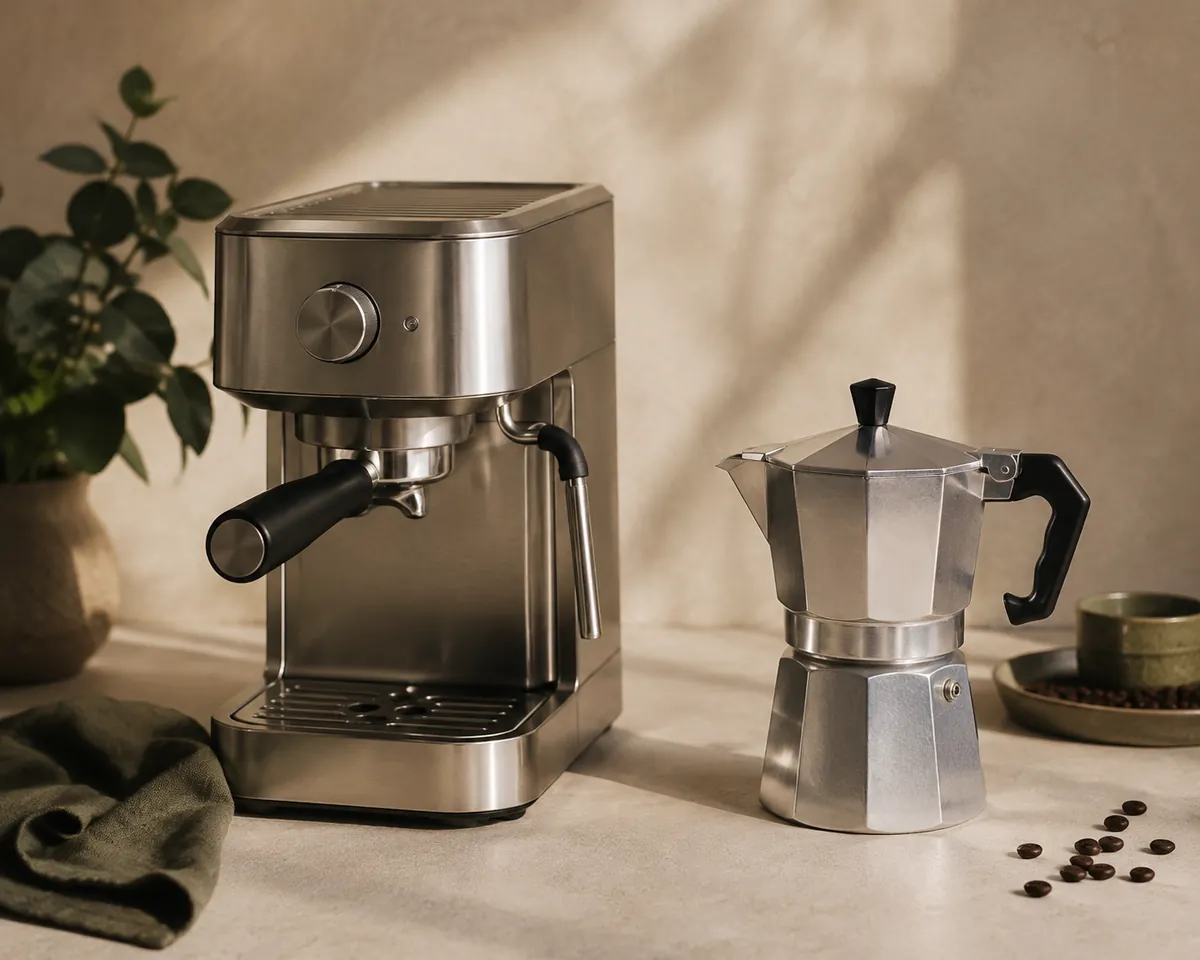
Side by side
| Attribute | Espresso machine | Moka pot |
|---|---|---|
| How the water is moved | A pump, at about 9 bars held steady | Steam pressure in a sealed base, 1 to 1.5 bars |
| Temperature control | Held at 92 to 96 C, often by a PID | None. Whatever the hob is giving it |
| The coffee bed | Fine grind, tamped flat and square | Medium-fine, filled level and never tamped |
| Ready from cold | Fifteen to thirty minutes on a boiler machine | Two minutes on the hob with pre-boiled water |
| Milk | A steam wand, and real microfoam | No steam to spare, so milk is a separate job |
| Grinder | Mandatory, and bought before the machine | The one accessory that reliably improves it |
| Running costs | Descaler, filters, tablets, gaskets, electricity | A rubber gasket about once a year |
| What ends it | Limescale in the boiler, often unseen | Almost nothing, and a hardened gasket is cheap |
Two ways to move water through coffee
Both devices push hot water through a packed bed of grounds and both make a small, strong, dark drink, which is why they end up in the same shopping decision. The mechanisms behind that push have almost nothing in common.
An espresso machine uses a pump. It heats water, holds it at 92 to 96 C, and drives it through a compressed bed at around nine bars while replacing the heat the shot is drawing out in real time.
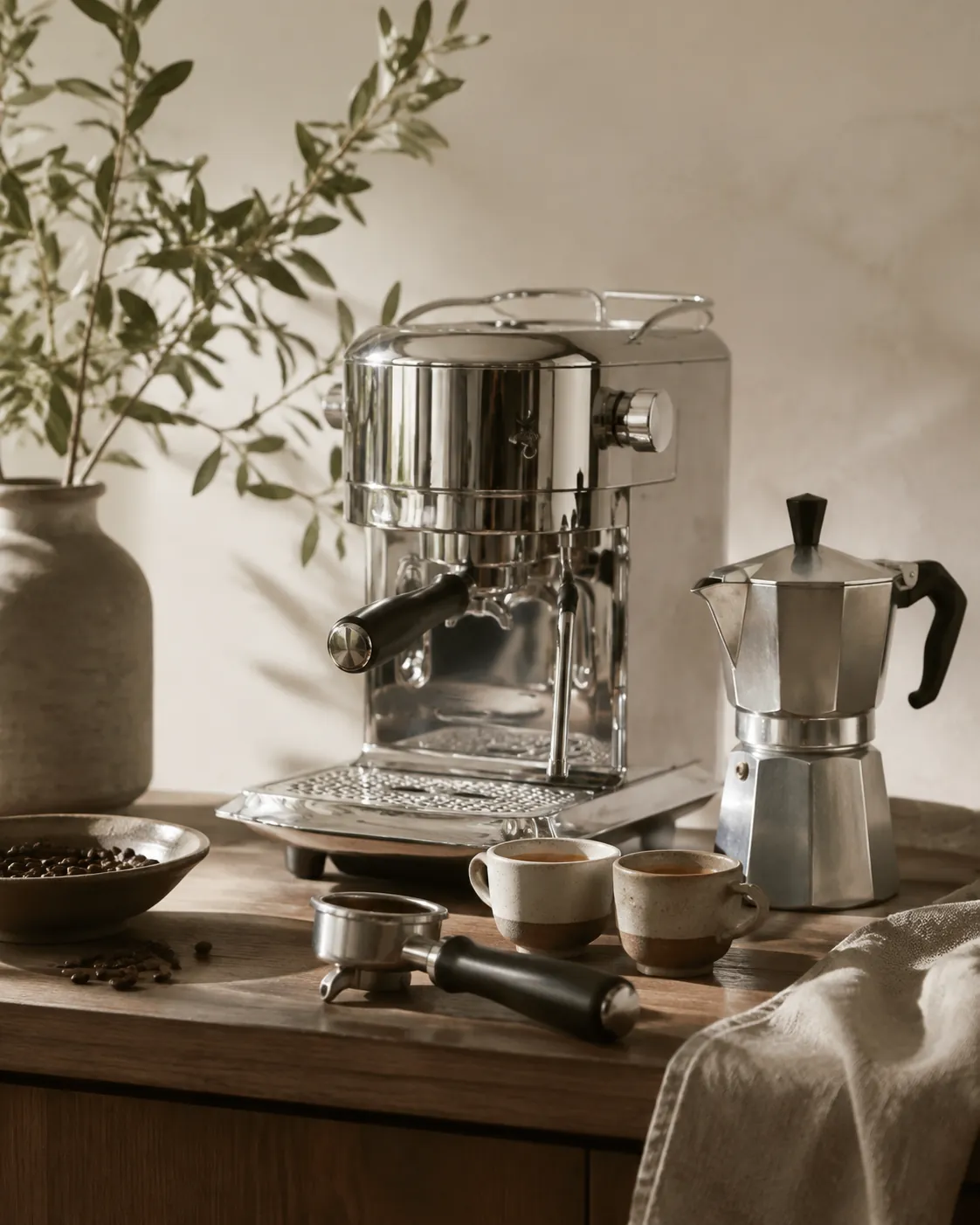
A moka pot uses steam. Heating the sealed base builds pressure above the water, that pressure forces liquid up a funnel and through a fixed bed, and the whole apparatus is three pieces of metal, a rubber gasket and a perforated plate.
One is a controlled system with a boiler, a pump and a set of decisions, and the other is a pressure vessel on a hob.
Everything below follows from that, including the several axes where the cheap one wins.
Why nine bars and one and a half are not two settings of the same thing
The pressure figures look like a scale. They are not.
A moka pot generates roughly 1 to 1.5 bars, which is enough to push water upward through a loosely filled basket and no more. An espresso machine works at about nine, which is enough to force water through a bed that has been deliberately compressed until it resists.
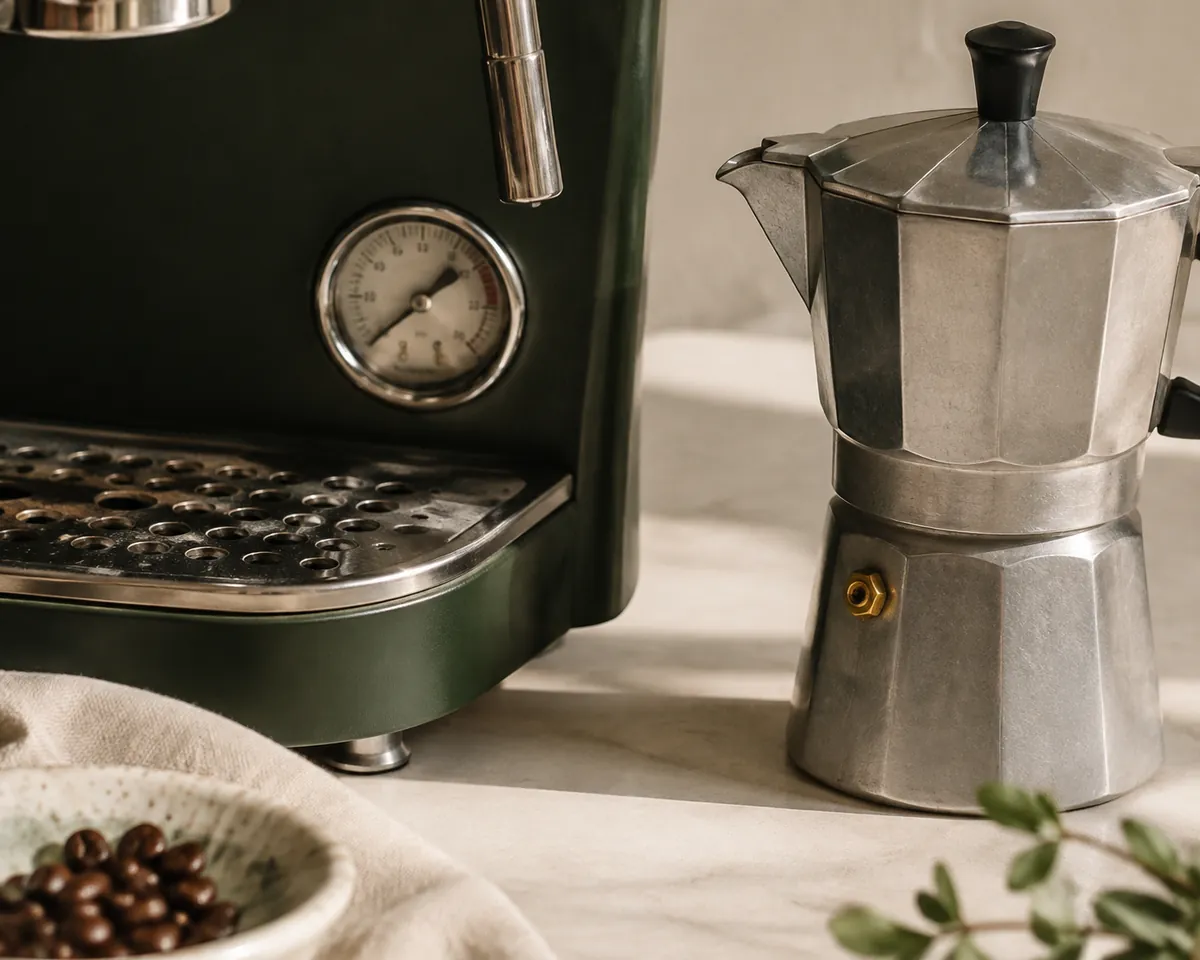
That difference of roughly six times changes what the bed can be. Under nine bars a fine grind tamped flat becomes a puck that the water has to work through, extracting hard in 25 to 30 seconds, and the oils emulsify into the liquid as crema.
At one and a half bars the same puck is simply a wall, and the pot either trips its safety valve or forces a slow scorched trickle around one side.
| Espresso machine | Moka pot | |
|---|---|---|
| Pressure | About 9 bars, held steady | Roughly 1 to 1.5 bars, whatever the heat gives |
| Grind | Fine, roughly table salt | Medium-fine, coarser than a shot |
| The bed | Compressed by a tamp | Filled level and never tamped |
| Brew time | 25 to 30 seconds | Two minutes on the hob with pre-boiled water |
| Crema | Thick and persistent | Little, and it collapses quickly |
| Adjustable | Dose, yield, temperature, time | The grind, and nothing else |
Tamping is the clearest illustration of the gap. It is the central skill on one device and an active mistake on the other, since the pot has no mechanism for handling a compressed bed and will channel or block instead.
Which one controls its own temperature
Temperature control is the machine's whole reason for existing, and the pot has none at all.
Water has to arrive at 92 to 96 C and stay there while the shot draws heat out of it, which is genuinely difficult and is what most of a machine's price buys. Steaming milk wants nearer 130 C, so one boiler cannot easily do both in the same minute, and the four architectures on sale are four answers to that single conflict.
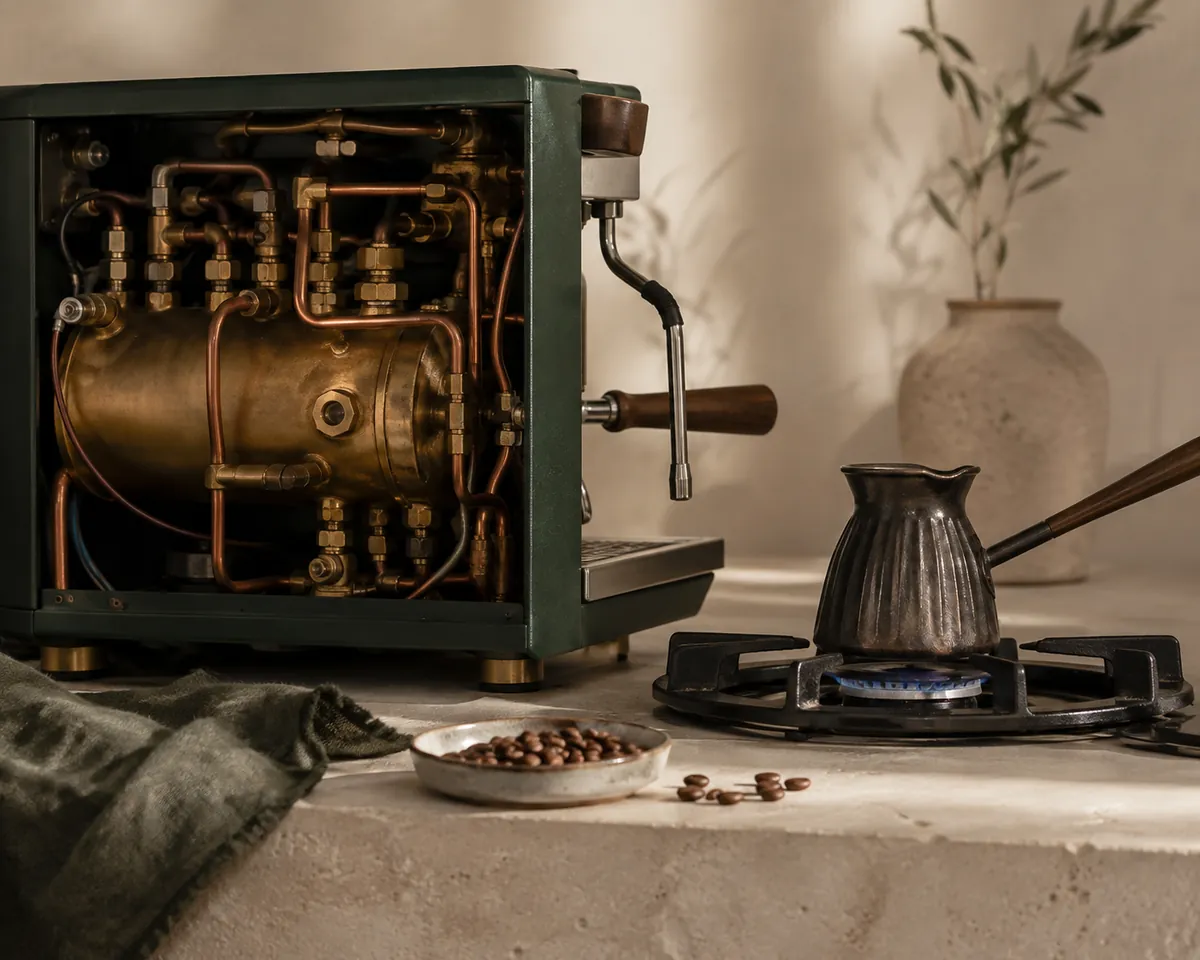
A moka pot has whatever the hob is giving it. There is no thermostat, no controller and no setting, so the temperature is a consequence of the burner, the metal and how long the pot has been sitting there, and the coffee in the basket is being heated from below the whole time.
What decides the brew temperature on each
- Dual boiler with a PIDA chosen temperature, held through the shot and through the steaming
- Single boiler with a PIDA chosen temperature, with a wait between brewing and steaming
- Thermoblock machineNominally set, and the cold group head pulls the first shot down
- Moka pot on medium heatRising throughout, and the coffee is baking before the water arrives
- Moka pot on high heatRising fast, scorched, and through in a hurry
The pot's one available correction is to start with pre-boiled water from a kettle, and it improves the cup more than anything else that can be done to one. Cold water means several minutes on the heat while the dry grounds above are slowly roasted a second time, which puts a burnt note in before a drop of water has reached them, and no adjustment later removes it.
Making moka pot coffee sets out the rest of the sequence.
What each one leaves the operator to do
Neither device is automatic, and the two skill sets barely overlap.
An espresso machine asks for a great deal and punishes each of it inside thirty seconds. Grind to a micron, dose to a tenth of a gram, a level distribution, a square tamp, and a shot stopped on weight rather than on time, since a shot pulled to thirty seconds can be any strength at all.
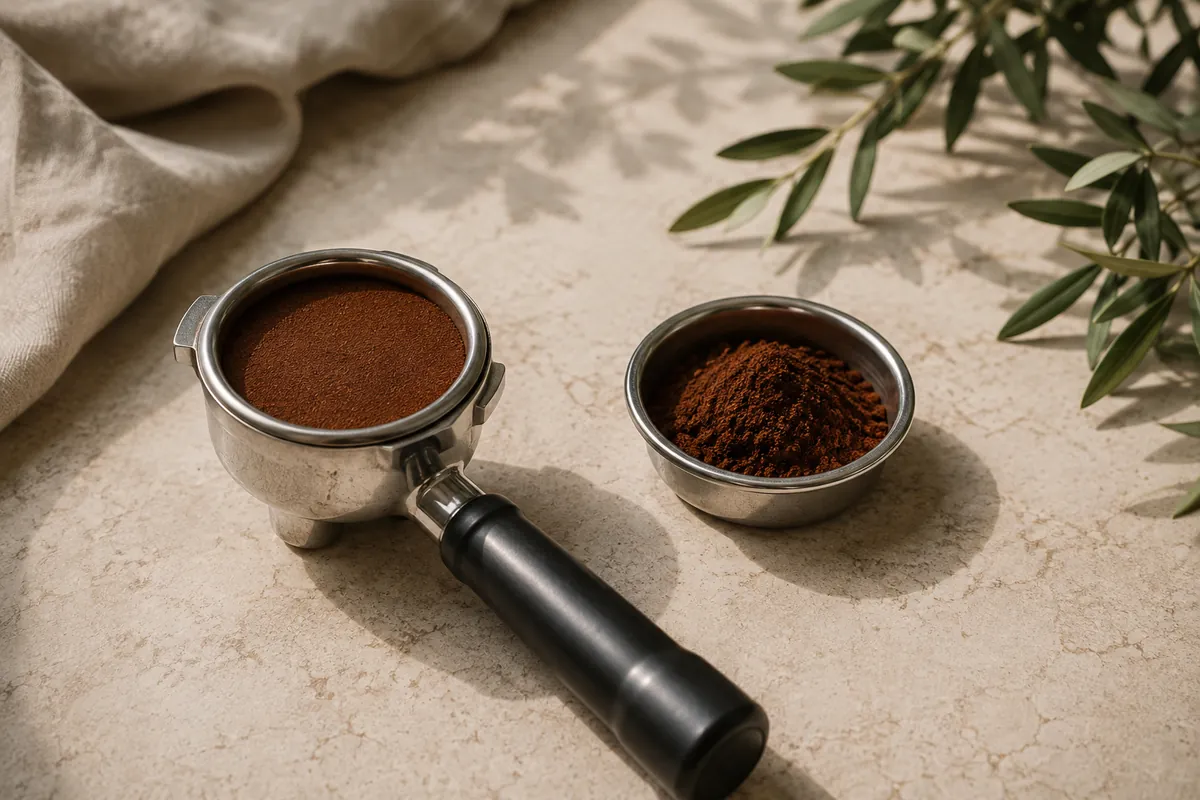
A moka pot asks for one thing and asks for it at a specific moment. Stand there, watch the stream, and lift the pot the instant it turns from dark and steady to pale and foamy, because after that the water has run out and steam is passing through a spent bed and carrying the harshest compounds into coffee that was fine a moment earlier.
- Warm a machine for fifteen to thirty minutes with the portafilter locked in, so the group head is at temperature and not just the boiler.
- Purge the group for two seconds before dosing, and start the shot the moment the basket is locked in.
- Watch for the first drops at around eight to twelve seconds, which reads the grind before the shot has finished.
- Fill a stovetop base with pre-boiled water to just below the safety valve, and use a cloth, since the pot is hot immediately.
- Fill the basket level and strike it flat. Never tamp it.
- Take the pot off the heat the moment the flow pales, and stand the base under a cold tap for a few seconds to stop it.
So the pot has almost no adjustments and one moment of attention, while the machine has adjustments everywhere and a genuine learning curve behind them. The pot cannot be dialled in, which is a limitation and, on a bad morning, a mercy.
How long each takes to be ready
Cold start belongs to the pot, and the margin is not close.
A boiler machine takes fifteen to thirty minutes to reach equilibrium, because the whole mass of brass and steel has to come up to temperature rather than just the water inside it. A thermoblock is nominally ready in under a minute and lands its first shot cool anyway, because the group head and portafilter are still cold.
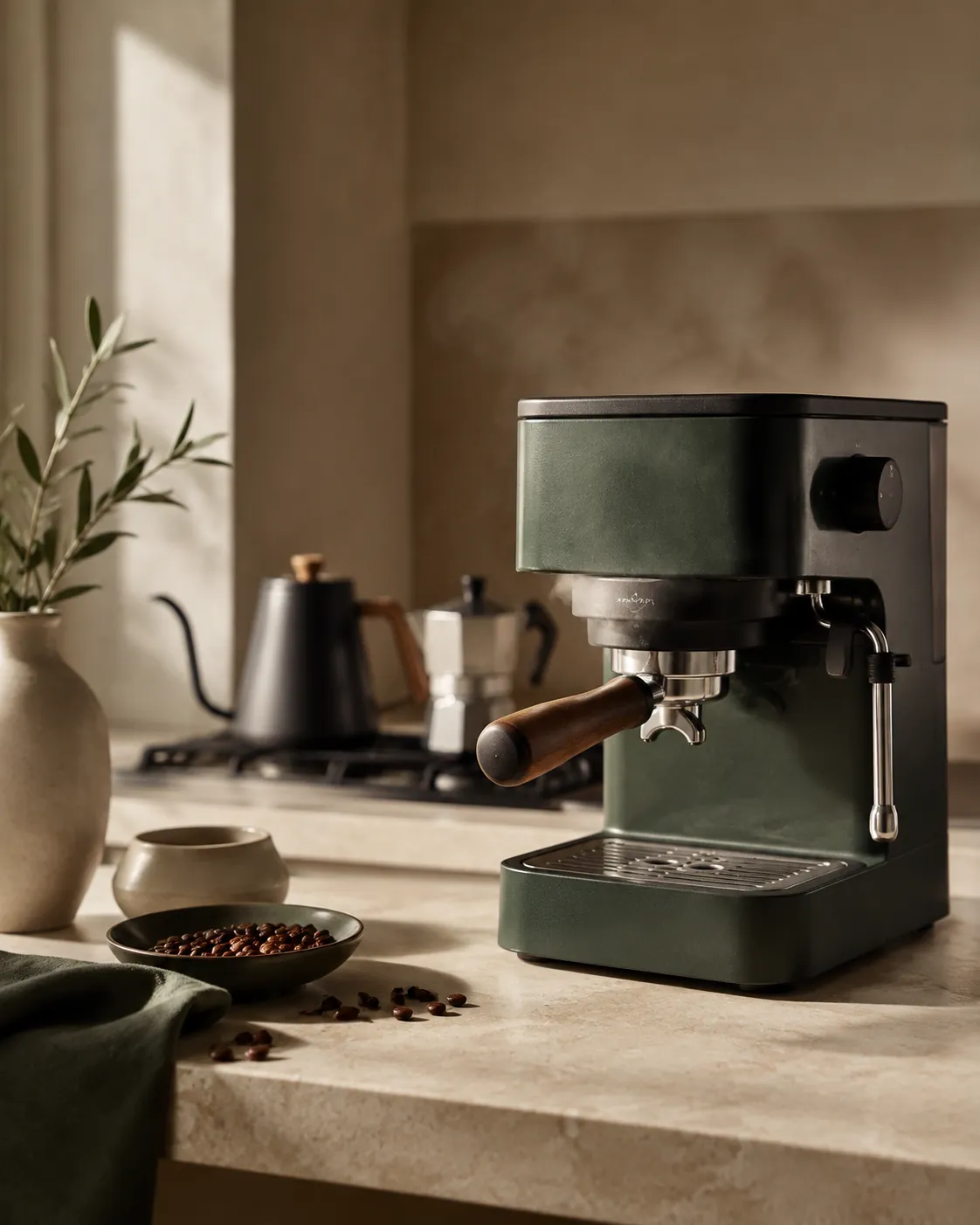
A moka pot is two minutes on the hob once the kettle has boiled, from a cold kitchen, with no warm-up and nothing left switched on.
The ranking reverses once more than one drink is wanted. A warm machine turns out a shot in about thirty seconds and keeps doing it.
A pot has to be emptied, rinsed, refilled and reheated for every round, and it makes exactly its own rated volume each time. Half-filling a six-cup does not produce three cups, it produces a badly extracted six, because the geometry between water, bed and valve height is fixed at the factory.
What the grinder does for each
Grind consistency matters to both. It is a precondition on one side and an improvement on the other.
An espresso machine cannot produce a good shot behind an inadequate grinder at any price. An uneven bed channels under nine bars, water carves a route and races out, and no boiler, gauge or profiling curve corrects it, which is why the standing advice is to split a budget and buy the grinder first.
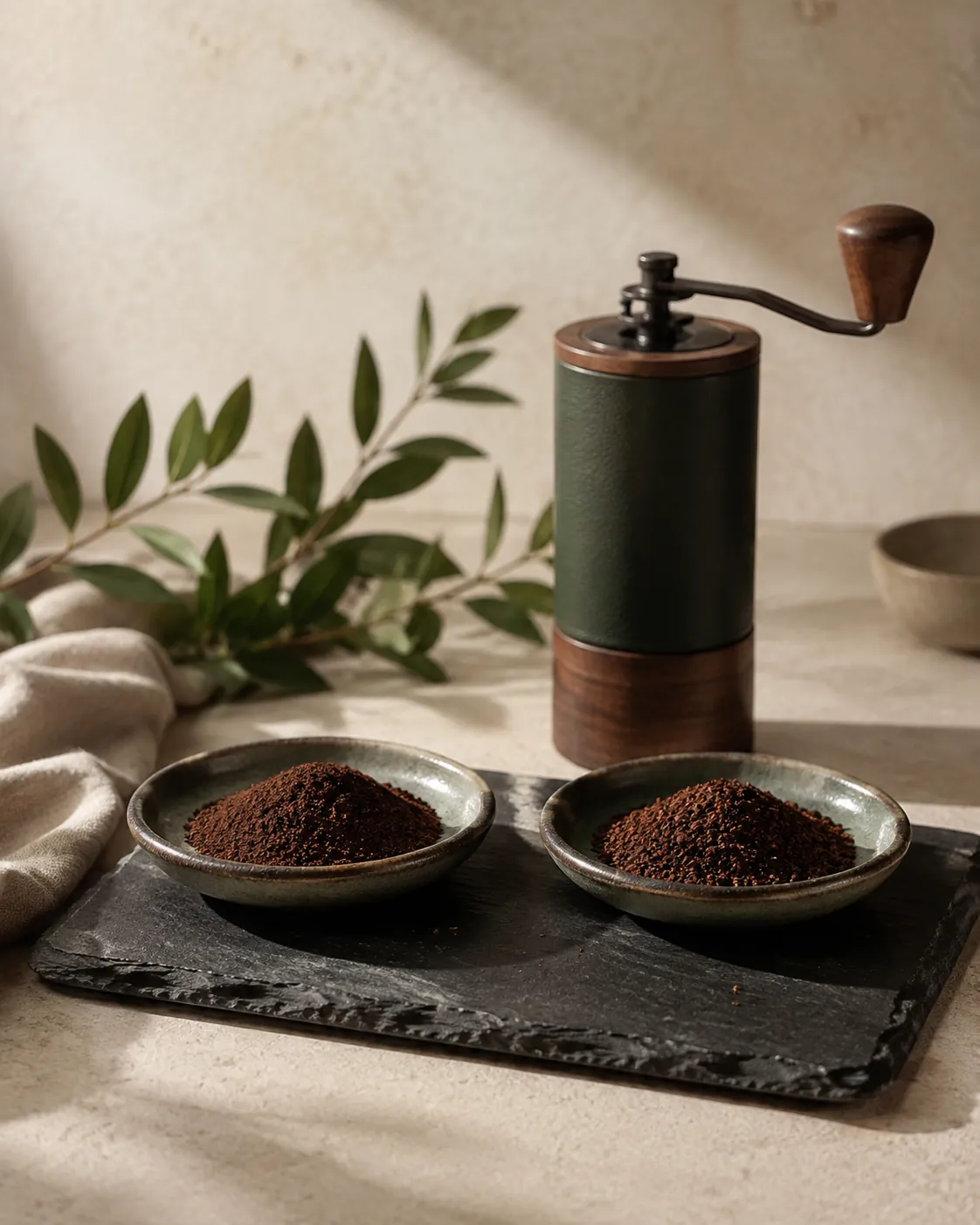
A moka pot is more forgiving and still rewards the same purchase. Uneven grounds give the water an easy channel and it will take it, so a burr grinder is the one accessory that reliably improves a stovetop brew, and it is optional rather than mandatory.
Machine, poor grinder
No usable shot, and the fault looks like every other fault
Machine, good grinder
A modest machine behind one beats an expensive machine without
Pot, poor grinder
A duller cup, and a channel through one side of the basket
Pot, good grinder
Cleaner and sweeter, and the difference is real but not decisive
Machine, pre-ground coffee
Only through a pressurised basket, which fakes the crema
Pot, pre-ground coffee
Workable, provided it is medium-fine rather than espresso-fine
The pressurised basket deserves a word, because it is the trap on the machine side. It creates artificial back-pressure through a single small hole and produces something resembling crema whatever the grind was, which makes it impossible to learn on, since bad technique looks exactly like good technique in the cup.
Milk, and the one thing the pot cannot do
Steam is the axis where the machine wins outright, and the irony is that a moka pot is powered by steam and cannot spare any of it.
All the steam a stovetop pot produces is doing the pushing. There is no wand, no spare pressure and no way to texture milk with it, so anyone making a milky drink from one is heating milk separately in a pan, a jug or a standalone frother.
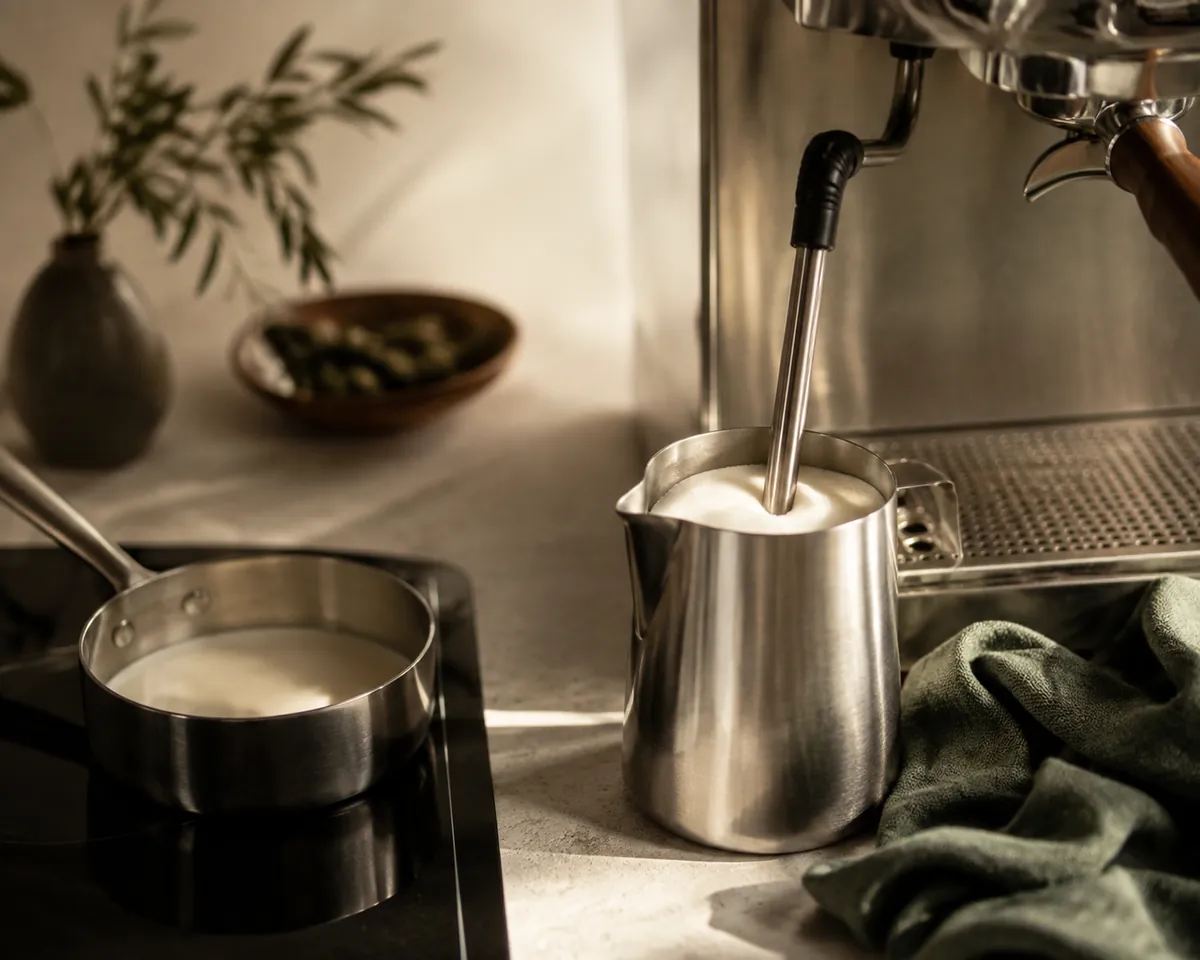
A machine with a working wand makes microfoam, and microfoam is the whole difference between a cafe drink and hot milk with coffee in it. Steam power decides how fast milk can be textured, and a weak wand produces bubbly milk through timing rather than through technique, which is why a cappuccino forgives a modest machine and a flat white does not.
| Drink | Espresso machine | Moka pot |
|---|---|---|
| Latte | The standard build, on a real shot | Close, since the pot holds up under milk |
| Flat white | Needs fine glossy microfoam | Not reachable without a separate frother |
| Cortado | Built on a shot, and revealing of the roast | An approximation at best |
| Americano | Shot plus hot water | Genuinely good, and a fair filter stand-in |
| Iced, over a full glass | Works | Survives dilution unusually well |
| What limits it | The wand, and the boiler behind it | No steam to spare, so the milk is a separate job |
The honest half of that table is the first column of the pot. Its heavy body and low acidity hold up under hot milk far better than a filter brew does, so a home latte built on a stovetop pot is closer to the cafe version than the same attempt from a drip machine, and the gap that remains is entirely about the foam.
What each costs to buy and to keep running
Money is the pot's largest win, and the gap is wider after the purchase than at it.
A machine is a system rather than an appliance. The grinder belongs inside the up-front figure rather than beside it, and the running costs are descaler a few times a year, a water filter, cleaning tablets, a group gasket every year or two, and the electricity of a device left warm for hours.
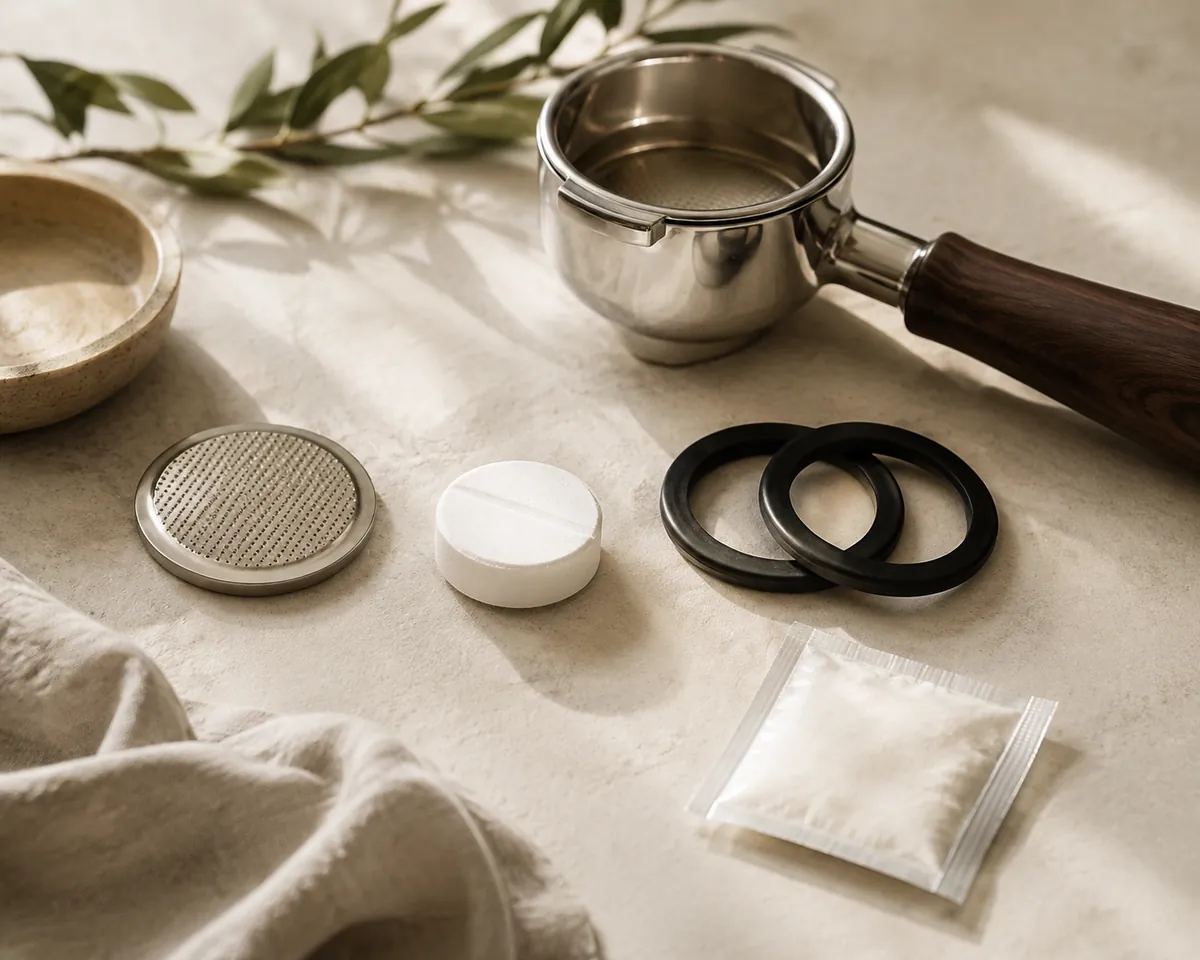
A stovetop pot has no paper, no power of its own and one consumable. A rubber gasket about once a year is the entire running cost, and the filter plate wants a brush through its holes now and then.
Up front
A machine plus a capable grinder, against a pot and whatever heat you already have
Consumables
Descaler, filters, tablets and gaskets, against one gasket a year
Power
A boiler left warm for hours, against a hob ring for two minutes
The failure that ends it
Limescale in a boiler, against a hardened gasket costing very little
Repairability
Gaskets, seals and pumps on a boiler machine. Thermoblocks rarely
Counter space
Permanent, heavy and hot, against a cupboard shelf
Water composition sets the pace on both sides, and it is the ongoing cost people notice last. Scale is the failure that ends machines, which is why manuals specify water at all, and brewing water sets out what those figures mean at a domestic tap.
A pot scales too, and the part that matters is the safety valve, which must never be obstructed.
Which one survives twenty years
Longevity favours the pot, though not by as much as its price suggests.
Boiler machines are largely mechanical and repairable, so a well-kept one from a decade ago can be entirely serviceable, with gaskets, seals, pumps and even boilers available as parts. The risk is a scaled boiler on a machine run hard water without descaling, which is expensive or impossible to put right and invisible from the outside.
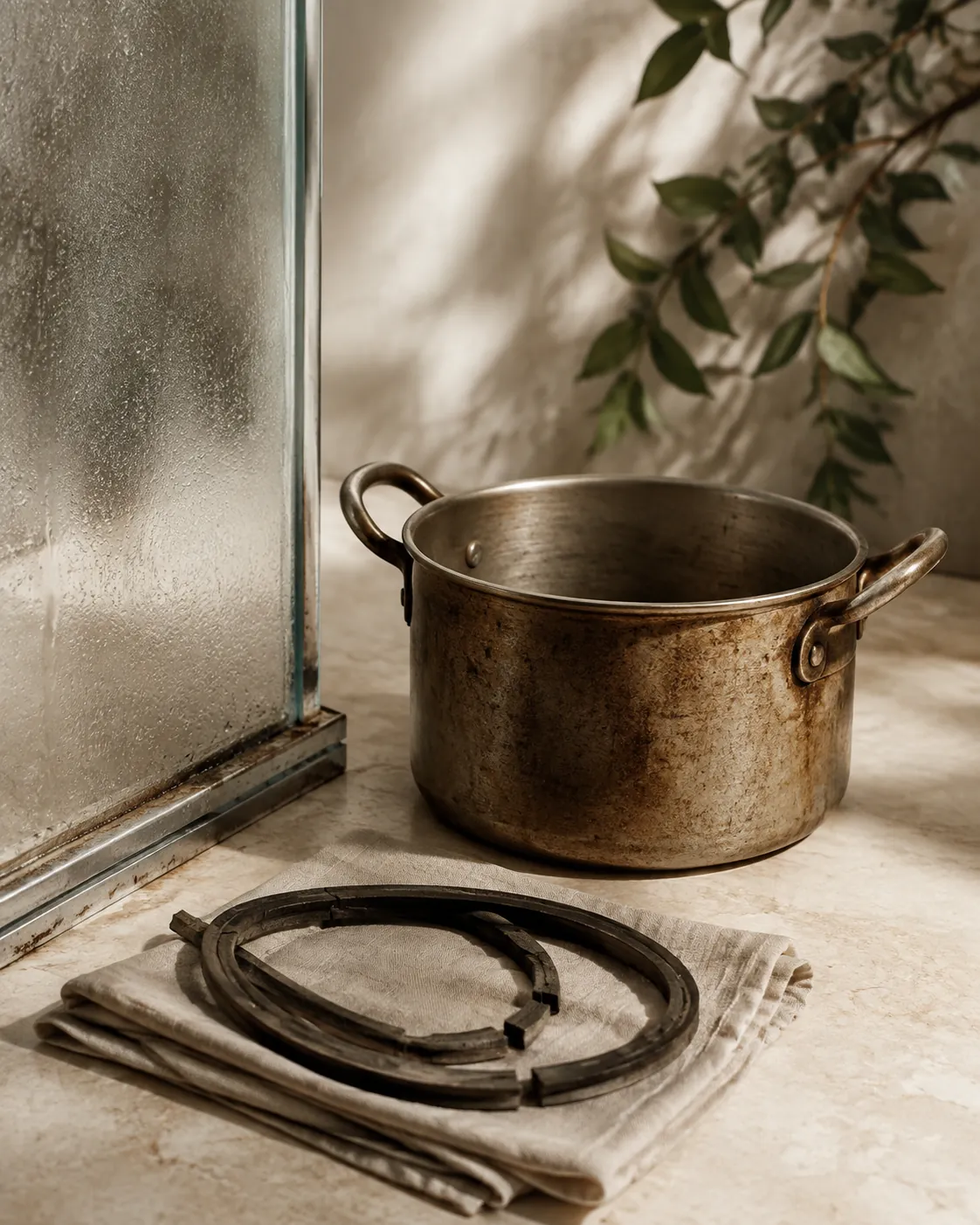
A stovetop pot in steel is effectively indestructible and one in aluminium is repairable indefinitely, since gaskets are sold everywhere and nothing else in it wears. Never put an aluminium pot in a dishwasher, though, since detergent strips the patina and oxidises the surface, and the metallic taste that follows takes several brews to clear.
- Ask a used machine's seller what water was used and how often it was descaled, since a vague answer is a warning.
- Prefer well-supported machines where spare parts are still sold, and budget for a service.
- Treat a thermoblock machine as unrepairable, and rarely worth buying second-hand at any discount.
- Buy spare stovetop gaskets with the pot, since they are cheap and easy to forget.
- Store a stovetop pot in pieces, so the gasket is not compressed and no moisture is trapped.
- Rinse a pot with hot water after every use, because oils left in warm metal go rancid.
Portability belongs in the same paragraph. A pot works on any heat source, which is why it travels and why it suits a camp stove, and a machine works where there is a socket, a counter and room for a grinder beside it.
What neither of them will do for you
Several of the comparisons made between these two do not actually separate them, and listing those keeps the rest of the verdicts honest.
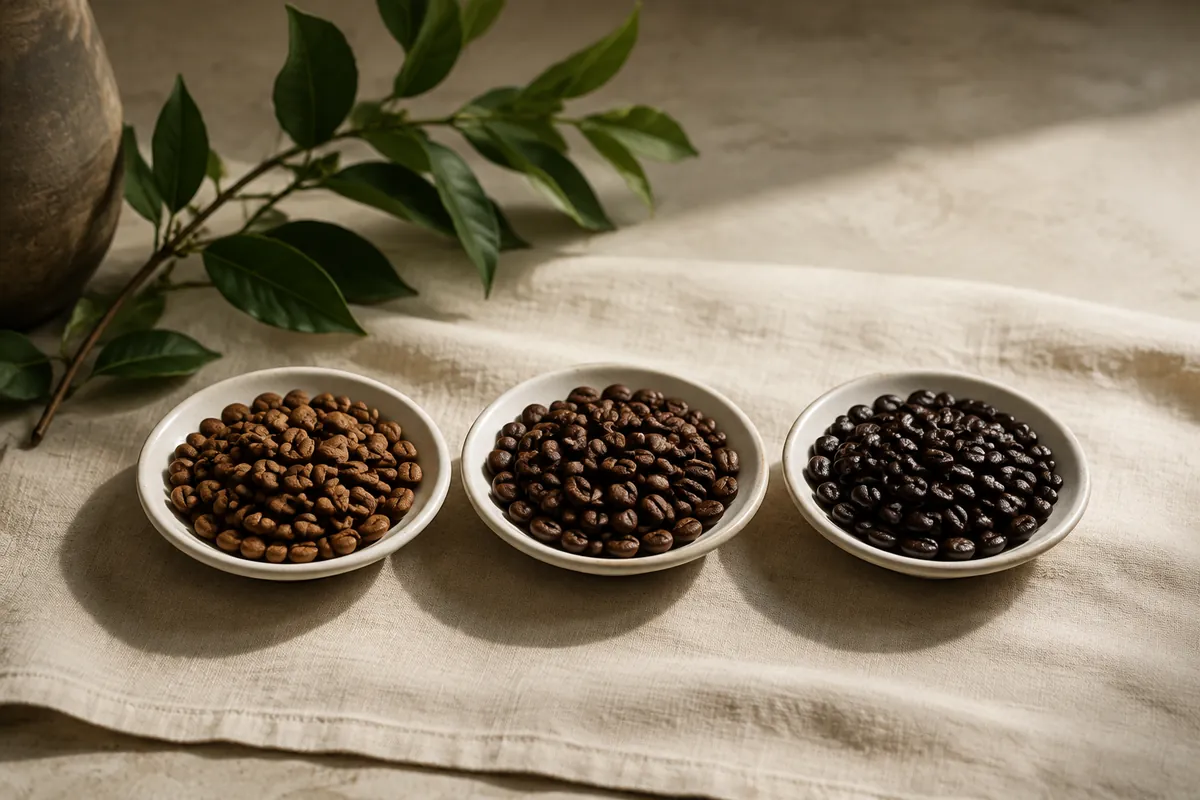
Bean choice is the first. Both concentrate roast character over origin character, so a delicate light arabica is largely thrown away in a stovetop pot for the same reason it is in cold brew, and a modern light-roast shot is the narrowest thing on a machine to dial in.
Roast character
Dominant in both, and origin character is the casualty either way
Freshness
Matters to both, and more to the shot than to the pot
Water
Decisive for both, and the first thing to check when either tastes wrong
Caffeine per cup
Set by the dose, and neither device changes what came out of the bag
Bitterness
Fixable on both sides, by grind on one and by lifting the pot on the other
Which is better coffee
Two different drinks, and a preference rather than a measurement
Both also hold the same relationship to a robusta blend, which brings body and generous foam to a shot and behaves itself in a stovetop pot where it would be brutal through paper. And both drift with the bag, so a coffee that suited one setting on day four wants another on day eighteen, which is why storing beans matters at these grind sizes more than anywhere else.
Caffeine deserves its own line only because the question is asked so often. Dose and serving size do the work in both, exactly as they do everywhere in coffee, and caffeine by brew method places the two alongside the larger drinks they get compared with.
Choosing between them on the drink you actually make
The purchase decision turns on one question, and it is not which device makes better coffee.
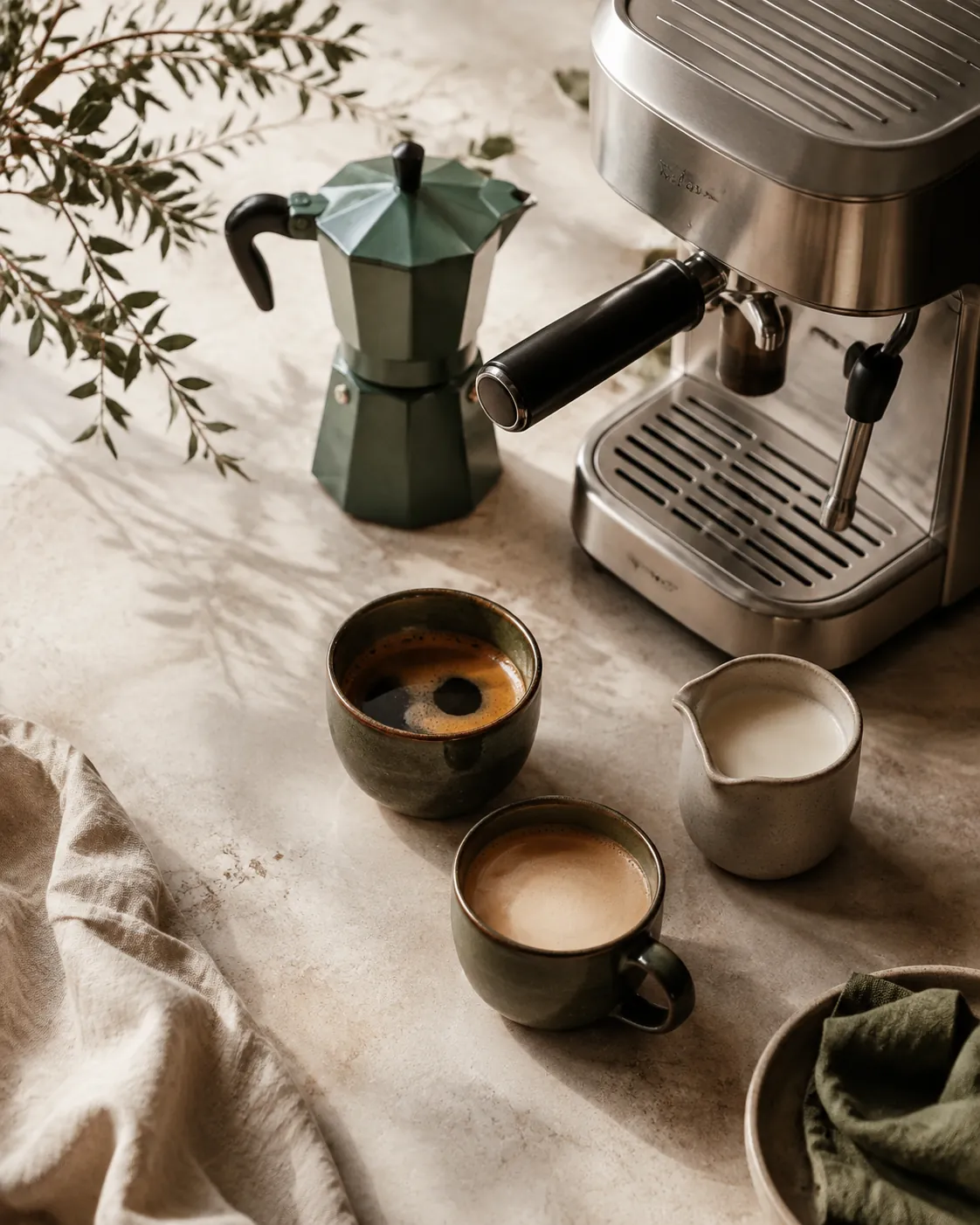
Ask what the drink has to be. If it has to be a genuine shot, with real crema and real microfoam over it, only the machine reaches that and nothing substitutes.
If it has to be strong dark coffee, often with milk, made cheaply on a hob that was already lit, the pot has been answering that question for a century.
| Question | Espresso machine | Moka pot |
|---|---|---|
| Makes genuine espresso | Yes | No |
| Textures milk itself | Yes | No |
| Ready from cold in two minutes | No | Yes |
| Works with no electricity | No | Yes |
| Needs a capable grinder | Yes | Helpful, not required |
| Fits in a cupboard | No | Yes |
Two other routes sit between them and are worth naming rather than ignoring. An AeroPress presses at well under a bar and gives one clean cup quickly, and a pour-over cone or a French press will produce excellent black coffee for a fraction of the cost of either device here.
The last thing to settle is the name on the box. A stovetop pot sold as a stovetop espresso maker is a legitimate brewer producing a legitimate drink, and calling it espresso sets an expectation the cup was never built to meet, which is a labelling problem rather than a fault in the coffee.
What it actually tastes like belongs with moka pot coffee, and what a real shot tastes like belongs with espresso flavour.
Common questions
Does a moka pot make real espresso?
No, and the difference is not one of degree. A moka pot generates roughly 1 to 1.5 bars of steam pressure while espresso needs about nine, which is the gap between pushing water through a loosely filled basket and forcing it through a deliberately compressed bed. It is a legitimate brewer making a legitimate drink, and only the borrowed name on the box is a problem.
Can you froth milk with a moka pot?
Not with the pot itself. All the steam it produces is doing the pushing, so there is no wand and no spare pressure, and milk has to be heated separately in a pan or a standalone frother. The coffee it makes is heavy-bodied and low in acidity, which holds up under hot milk unusually well, so what is missing is the microfoam rather than the strength.
Do I need a burr grinder for a moka pot?
It helps, and it is not mandatory the way it is for a machine. An uneven grind gives the water an easy channel through the basket and it will take it, so a good grinder makes a cleaner sweeter cup. On an espresso machine an uneven bed channels under nine bars and no boiler, gauge or profiling curve corrects it, which is why the grinder is bought first.