How to Make Espresso, and What to Change When It Tastes Wrong
One control corrects both a sour shot and a bitter one, and the stopwatch is only there to tell you which way to move it.
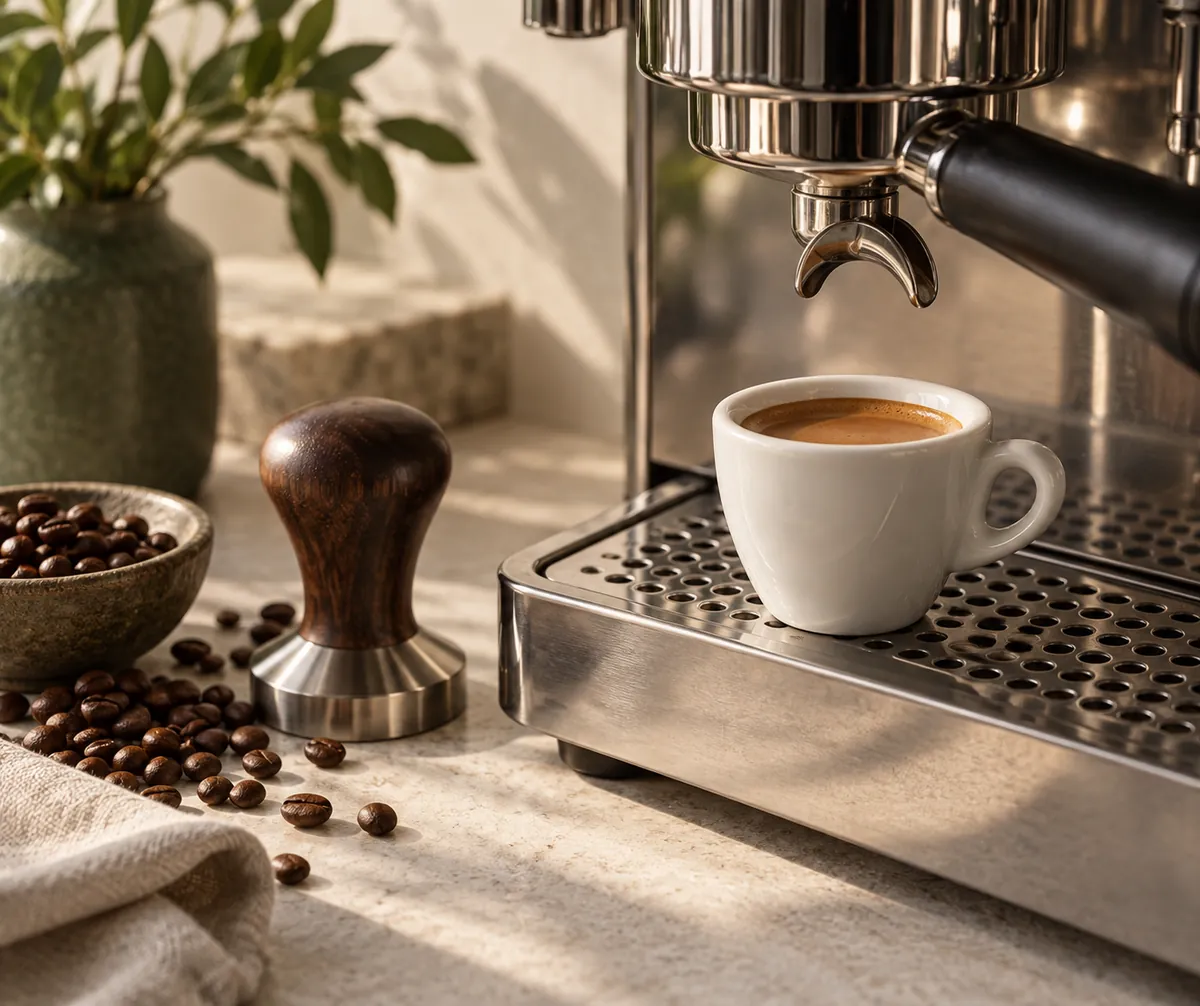
To make espresso, grind 18 g of fresh coffee fine into a clean basket, tamp it level, and pull about 36 g of liquid in 25 to 30 seconds.
The machine supplies the pressure and the heat. Your side of the work is the coffee itself: how fine it is ground, how evenly it sits in the basket, and when you stop the shot.
Most of what goes wrong at home happens before the pump ever starts.
What do you need before you pull a shot?
Espresso sets one hard entry requirement.
The coffee has to be ground fine enough to resist roughly nine bar of pressure for half a minute without collapsing, which is more than filter coffee ever asks of it.
Most grinders sold for filter brewing cannot get there. Their finest setting still empties the basket in under ten seconds, and no amount of tamping compensates for particles that are simply too large.
- A burr grinder that reaches espresso fineness, adjustable in small steps
- Beans roasted 7 to 21 days ago, ground immediately before the shot
- A machine held at brew temperature for its full warm-up
- A scale reading to 0.1 g, for the dose and for the shot
Warm-up is the step people skip.
A thermoblock machine is ready in 30 to 60 seconds, a single boiler wants 5 to 10 minutes, and an E61 group head needs 20 to 30 before the metal stops pulling heat out of the water.
Leave the portafilter locked into the group while that happens. A cold portafilter drops the brew temperature at the exact moment water meets coffee, and the shot reads sour for a reason that has nothing to do with grind.
Bean age has a window rather than a deadline. Coffee needs a few days to release the carbon dioxide left by roasting, and it loses aroma steadily after about three weeks.
That puts most espresso roasts at their best between seven and twenty-one days.
An opaque, airtight container at room temperature slows the decline, and how you store the bag matters more than the roast date printed on it.
One warning about entry-level machines. Many ship with a pressurised basket, which restricts flow through a single small hole rather than through the coffee.
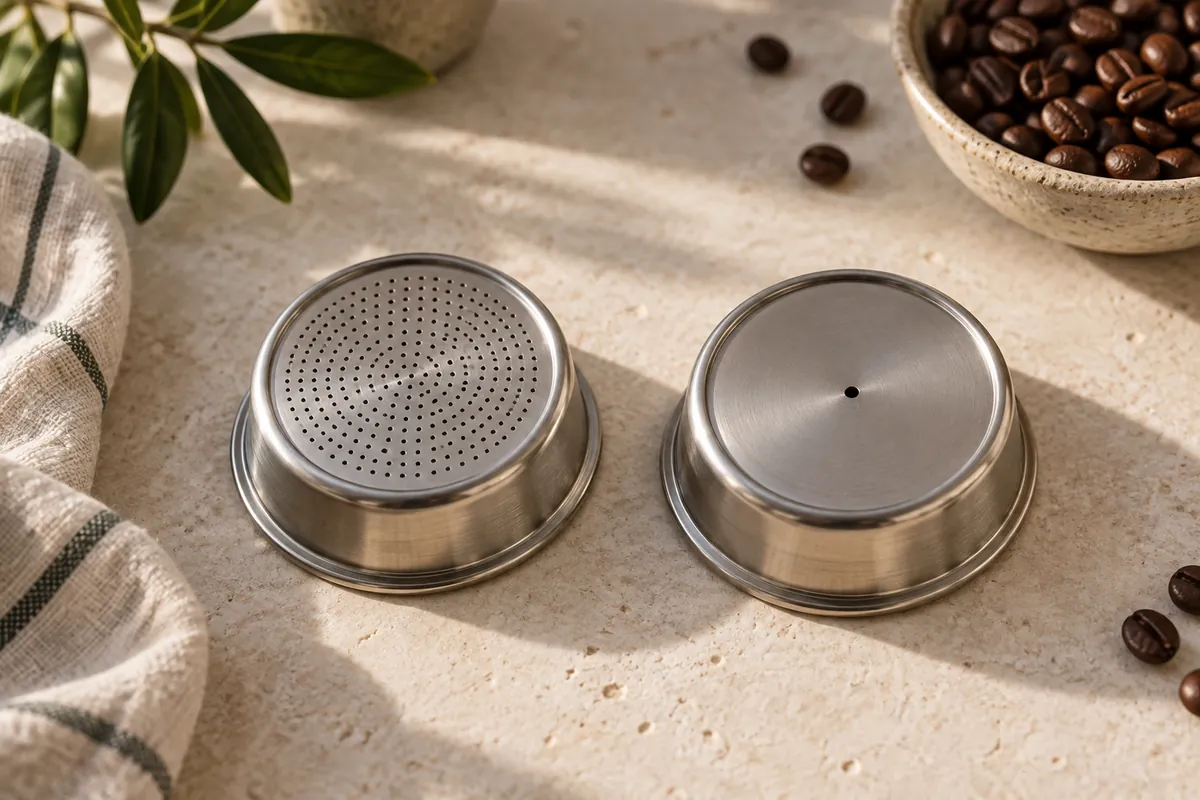
Turn your basket over to tell them apart. Until a pressurised one is swapped for a normal basket, every adjustment you make downstream is being hidden from you.
How much coffee goes in, and how much comes out?
A double shot starts at 18 g of dry coffee producing about 36 g of liquid espresso. That is a 1:2 ratio by weight, and it is the frame to hold steady while everything else moves.
Double espresso baseline
- Dose
- 18 g in a double basket
- Yield
- About 36 g of liquid
- Ratio
- 1:2 by weight
- Time
- 25 to 30 seconds from the first drop
- Water
- 90 to 96 C, or 195 to 205 F
- Pressure
- About 9 bar at the group
Weigh the liquid rather than filling to a line on the cup. Crema exaggerates volume, so two cups of espresso that look identical can differ by several grams of actual liquid.
The last two numbers are the machine's, not yours.
Water temperature and pump pressure are set by the design, and on a machine without a gauge the nine bar figure is a target the manufacturer aimed at rather than something you can read.
What is in the water is still your decision. Brew water heavy in minerals scales a boiler and dulls the cup, and very soft water strips the acidity out of a shot that was extracted correctly.
Time belongs on that card as a reading, not as a setting. You do not stop at 27 seconds because the clock says so.
You note what the clock said when 36 g arrived, and that number tells you whether the grind needs to move for the next shot.
How do you prepare the puck so water cannot find a shortcut?
Ground espresso clumps. Static, coffee oils and the sheer fineness of the particles pull grounds into small dense lumps that settle beside looser pockets in the basket.
Water under pressure takes the easier route through that bed.
Part of the puck then over-extracts while another part is barely touched, and the same shot arrives sour and harsh at once.
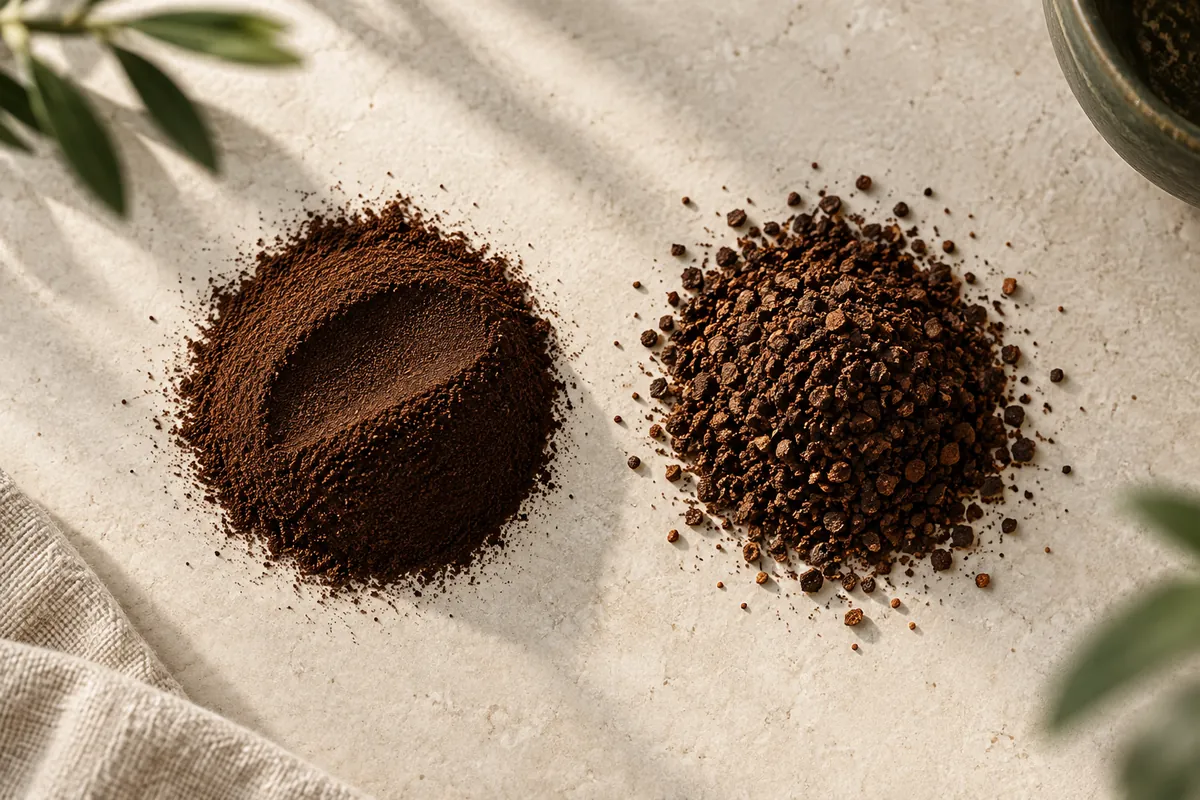
Fineness is easier to feel than to read about. Espresso grind holds its shape for a moment when pressed with a fingertip, where a filter grind falls apart as soon as the pressure comes off.
Puck preparation, in order
- GrindGrind straight into the basket, because fine grounds clump and stale quickly.
- DeclumpStir the bed with fine needles to break the lumps sitting below the surface.
- LevelEven out the surface so the tamper meets one flat plane.
- TampPress flat rather than hard, keeping the tamper parallel to the rim.
- WipeClear the rim of loose grounds and lock the portafilter in.
A distribution tool levels the surface and stops there. It cannot reach a clump sitting in the middle of the bed, which is why a set of fine needles stirred through the grounds still does something a flat spinner does not.
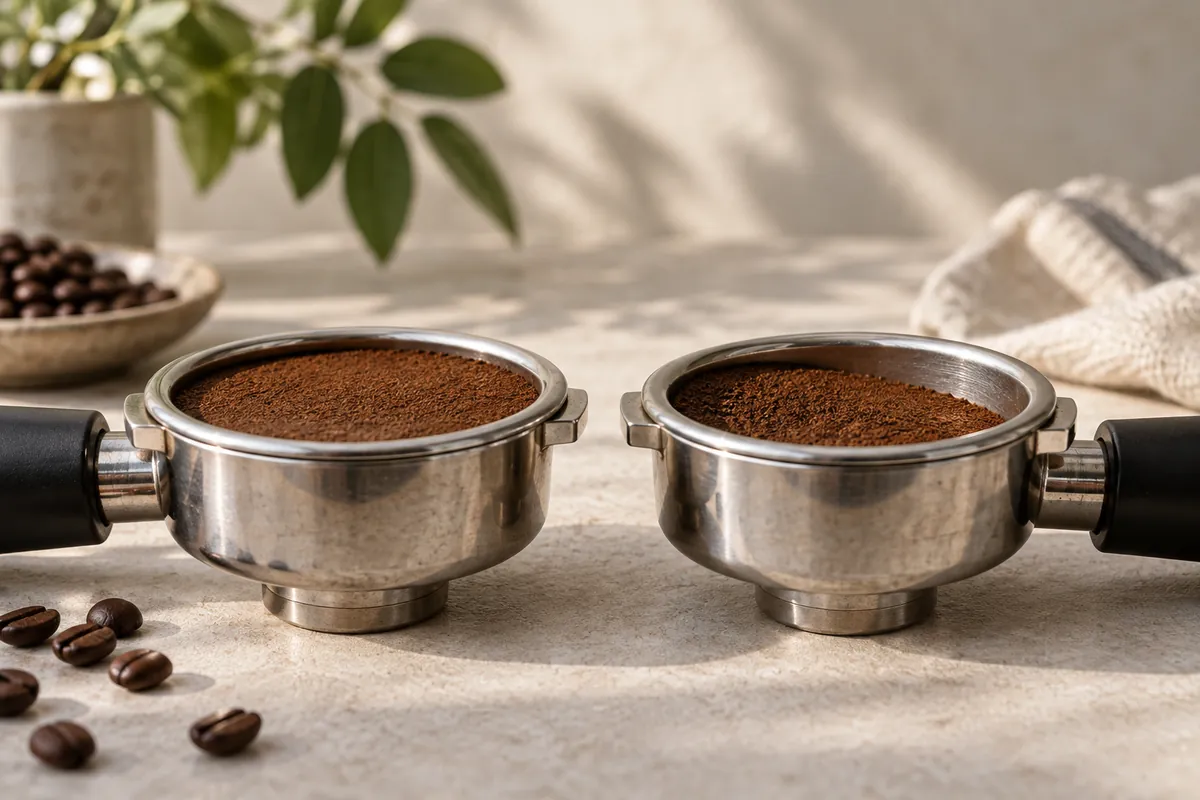
Tamping force matters far less than most people expect.
Around 15 to 20 kg fully compacts the puck, and past that point extra effort changes nothing at all.
What ruins the shot is a tilted tamp. It leaves one side of the puck thinner than the other, and water starts flowing through the thin side first.
Match the tamper to the basket while you are at it.
A tamper narrower than the basket leaves an untamped ring at the edge, and that ring behaves exactly like a channel.
How do you read the shot while it is pouring?
Start the clock when you start the pump, and watch the spouts rather than the timer for the first ten seconds.
On a dialled-in double the first drop appears somewhere around 5 to 10 seconds in, once the bed has soaked through.
What follows should look like slow dark honey. A healthy flow leaves the spouts as one thread rather than as several separate streams.
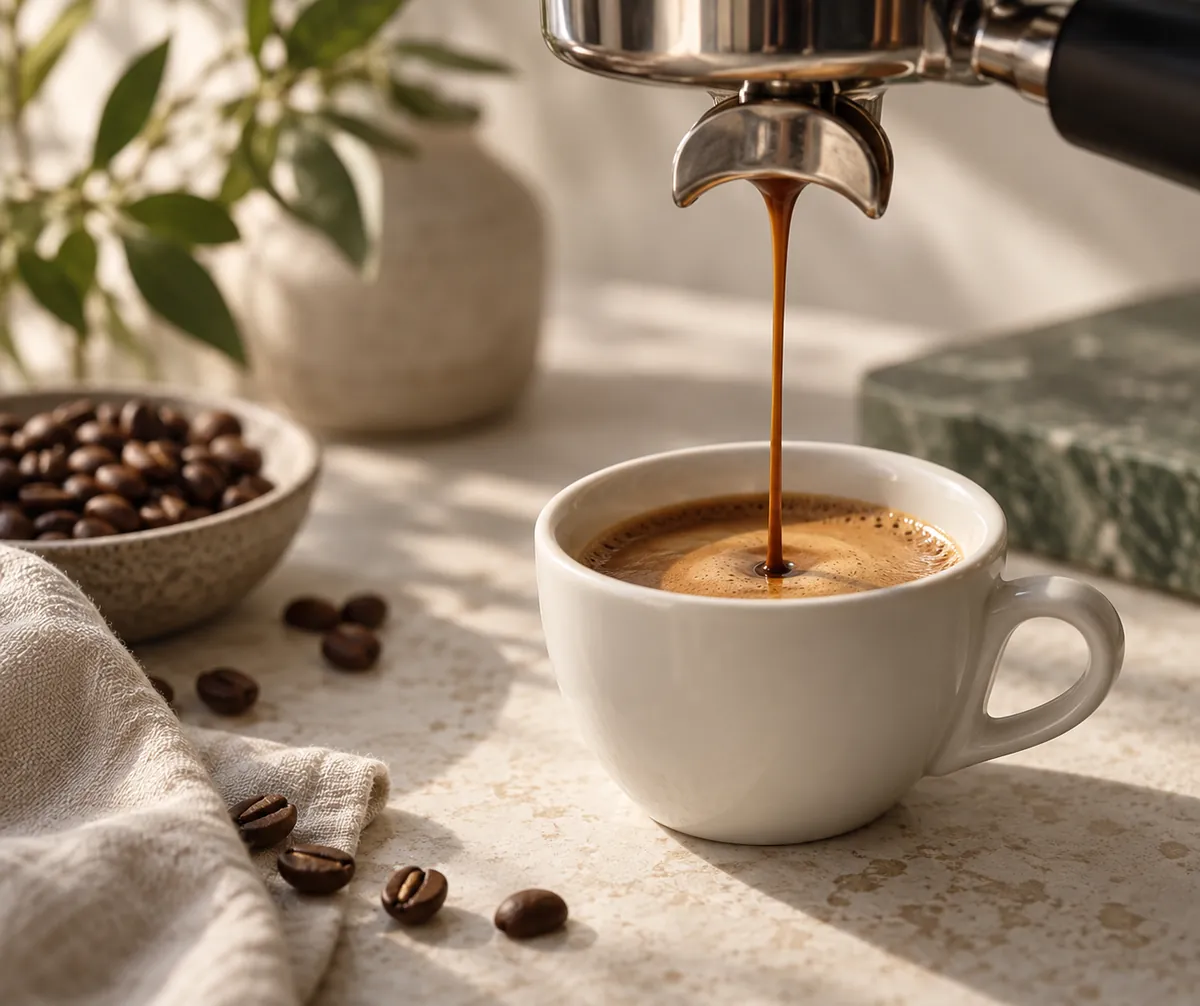
Two failures are visible before you taste anything. Fast pale streams spraying from separate holes mean the water found a channel, and a stalled drip that never becomes a stream means the grind is finer than the machine can push through.
Either one is worth abandoning.
A channelled shot is already lost, and drinking it only confirms what the spouts said ten seconds earlier.
Stop on the scale at 36 g rather than on the timer. Crema settles over the following minute, so the cup looks fuller when you cut the shot than it does when you drink it.
Crema is a poor witness for extraction.
It reports dissolved carbon dioxide and bean freshness, which is why very fresh beans build a thick head on a shot that was badly extracted underneath it.
Robusta in a blend thickens crema further, which is one reason a cheap supermarket blend can out-foam a carefully roasted single origin.
Why does espresso taste sour or bitter?
Sour means the shot ran out of the puck before the coffee had given up its sweetness, and harsh, drying bitterness means the water stayed with the same grounds long enough to start pulling at the parts you did not want.
Grind is the control for both. The timer is the reading you take afterwards, and moving it directly does nothing to the coffee.
| What you get | What it means | What to change |
|---|---|---|
| Sharp and thin, under 20 seconds | Under-extracted, water passed too easily | Grind one step finer |
| Harsh and drying, over 35 seconds | Over-extracted, water worked too long | Grind one step coarser |
| Sour and bitter in the same cup | Channelling, not grind | Redo the puck before touching the grinder |
| Flat and papery at any time | Coffee past about four weeks off roast | Replace the beans |
| Faster today than yesterday | The bag is drying and degassing with age | Grind finer as the coffee ages |
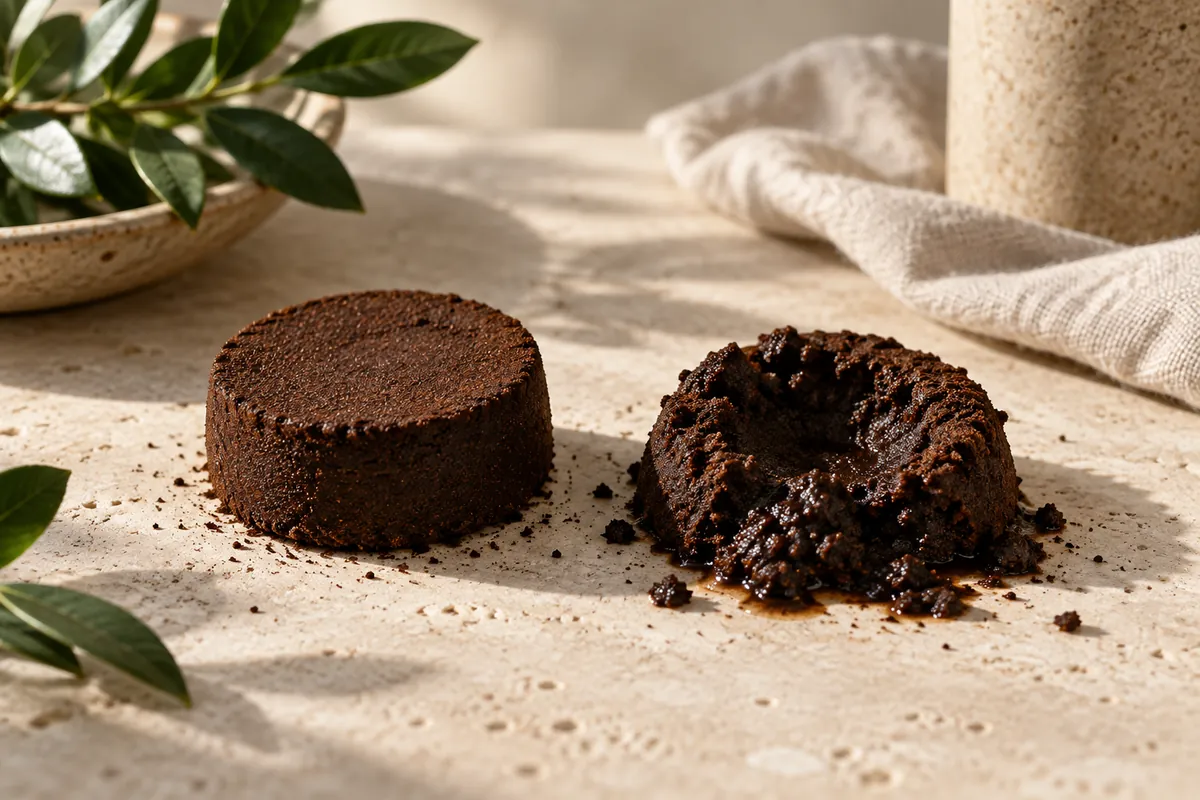
The spent puck carries its own evidence, and knocking it out takes a second.
Change one thing per shot.
Two adjustments at once make the next result unreadable, and the grinder ends up travelling back and forth around a setting that already worked.
Keep the dose and the yield fixed while you do it. Eighteen grams in and thirty-six out is what gives the timer any meaning, because a shot that changed weight as well as grind has told you nothing.
Taste has the final say over the stopwatch.
A shot that lands at 22 seconds and tastes balanced is a good shot, and the window exists to get you close rather than to overrule your own mouth.
Does the roast level change the ratio?
It does.
Roast level decides how quickly the coffee gives up what is soluble in it, which is why the same 18 g dose wants a different yield from a light bag than from a dark one.
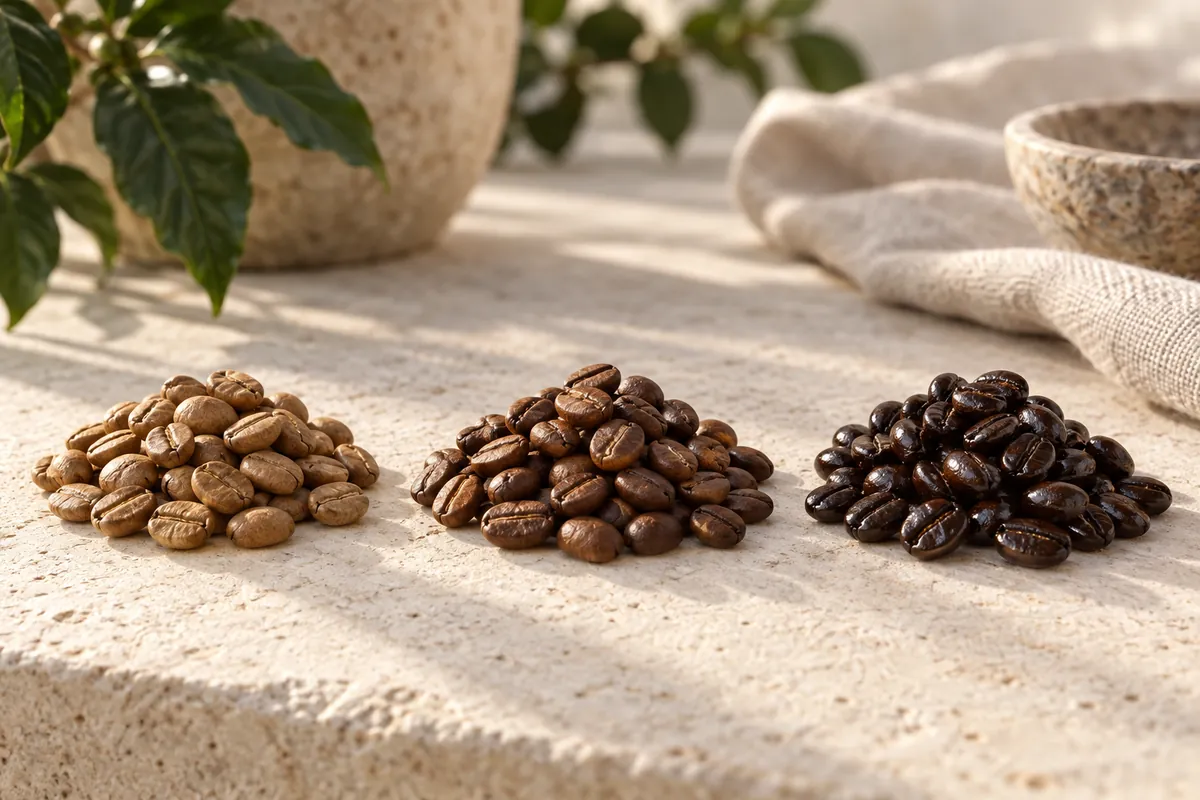
Roast level and useful brew ratio
- Light roast1:2.5 to 1:3, about 45 to 54 g from an 18 g dose
- Medium roast1:2, about 36 g from an 18 g dose
- Dark roast1:1.5 to 1:1.8, about 27 to 32 g from an 18 g dose
Light roasts are dense and slow to release their sugars. Stretching to 1:2.5 or 1:3 gives the water more chances at that sweetness without grinding so fine that the machine chokes.
Dark roasts run the other way.
Their solubles come out early, so cutting the shot short stops it before the ashy end of the extraction arrives in the cup.
Medium roasts sit at 1:2 and forgive the widest error, which is why they are the sensible thing to learn on.
Roast level is not the same axis as species. Most espresso is arabica, and a dark roast of it is still arabica, so a bag marked dark tells you about time in the roaster rather than about what was grown.
The bands are starting points rather than instructions. Roast labels are not standardised between roasters, so the bag marked medium at one roaster may want the ratio of a light roast at another.
Can you make espresso without an espresso machine?
Not exactly.
The reason is pressure rather than technique, and the gap between the devices is wide enough to change what arrives in the cup.
Moka pot
About 1 to 2 bar from steam, enough for a strong concentrate.
AeroPress
Well under 1 bar from hand pressure, closer to a pressed filter.
A stovetop moka pot builds pressure from steam in its lower chamber and reaches roughly one to two bar. That makes a strong, syrupy concentrate with real body, and no crema, because there is not enough pressure to emulsify the oils.
An AeroPress presses at well under one bar. Its output is cleaner and less concentrated, and it sits closer to a strong filter coffee than to a shot.
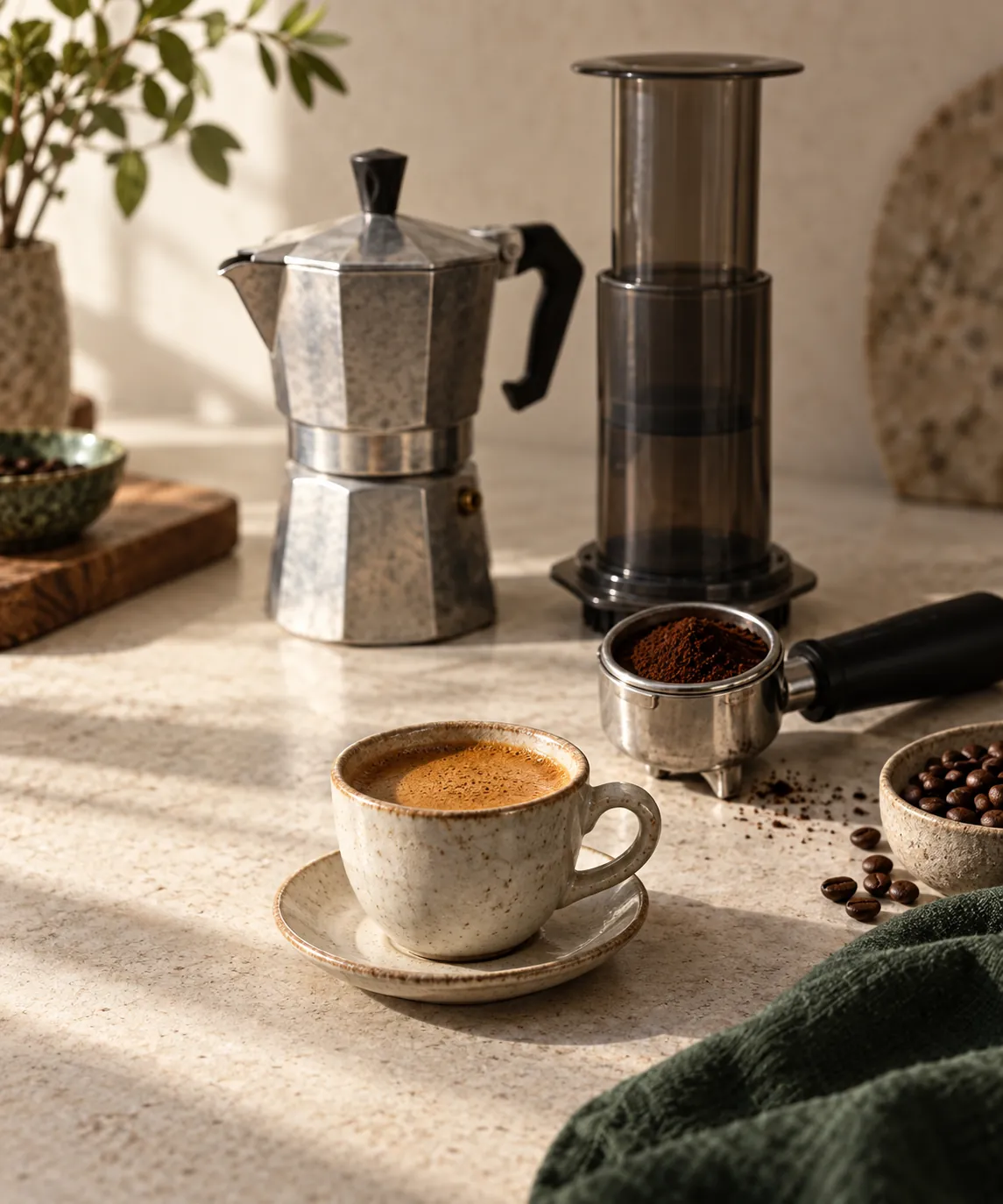
Manual lever devices are the honest exception. They reach espresso pressure through a spring or your own arm, and they do produce a genuine shot.
Both of the common substitutes still carry the drink most people were building.
If the plan was a flat white or a long black, either concentrate will do the job, and only the texture of espresso itself needs the full nine bar.
Double espresso method
- Makes
- 1 double shot, about 36 g
- Ratio
- 18 g of coffee to about 36 g of liquid, 1:2 by weight
- Water temp
- 90 to 96 C / 195 to 205 F at the group
- Total time
- 3 min
What you need
- 18 g fresh espresso-roast coffee, 7 to 21 days off roast
- Fresh filtered brew water
Equipment
- Espresso machine
- Burr grinder that reaches espresso fineness
- Double basket and portafilter
- Tamper matched to the basket
- Scale reading to 0.1 g
Method
- HeatBring the machine to temperature with the portafilter locked into the group.
- GrindGrind 18 g straight into a dry double basket.
- DistributeBreak the clumps with fine needles, then level the surface.
- TampPress flat and parallel to the rim, then wipe the rim clean.
- PullLock in, start the pump and the clock together, and watch the flow.
- CutStop at about 36 g on the scale and read the time it took.
- AdjustMove the grind one step for the next shot, and change nothing else.
Common questions
Can you use pre-ground coffee for espresso?
Rarely with good results. Pre-ground coffee is cut for filter brewing and is too coarse to hold back nine bar, and grounds this fine also stale within minutes rather than days.
Why does my espresso have no crema?
Most often the beans are well past a month off roast, since crema is built from dissolved carbon dioxide. A grind too coarse for the basket also lets the shot run before any pressure builds.
Do you have to weigh the shot?
It is the difference between a recipe and a guess. Crema hides several grams of liquid, so two cups filled to the same line can hold noticeably different shots.
What are ristretto and lungo?
They are the same shot cut at a different ratio. A ristretto stops nearer 1:1.5 and a lungo runs on past 1:3, along the same axis the roast bands move on.