How to Whisk Matcha Without Lumps: Sift, Cool Water, W Shape
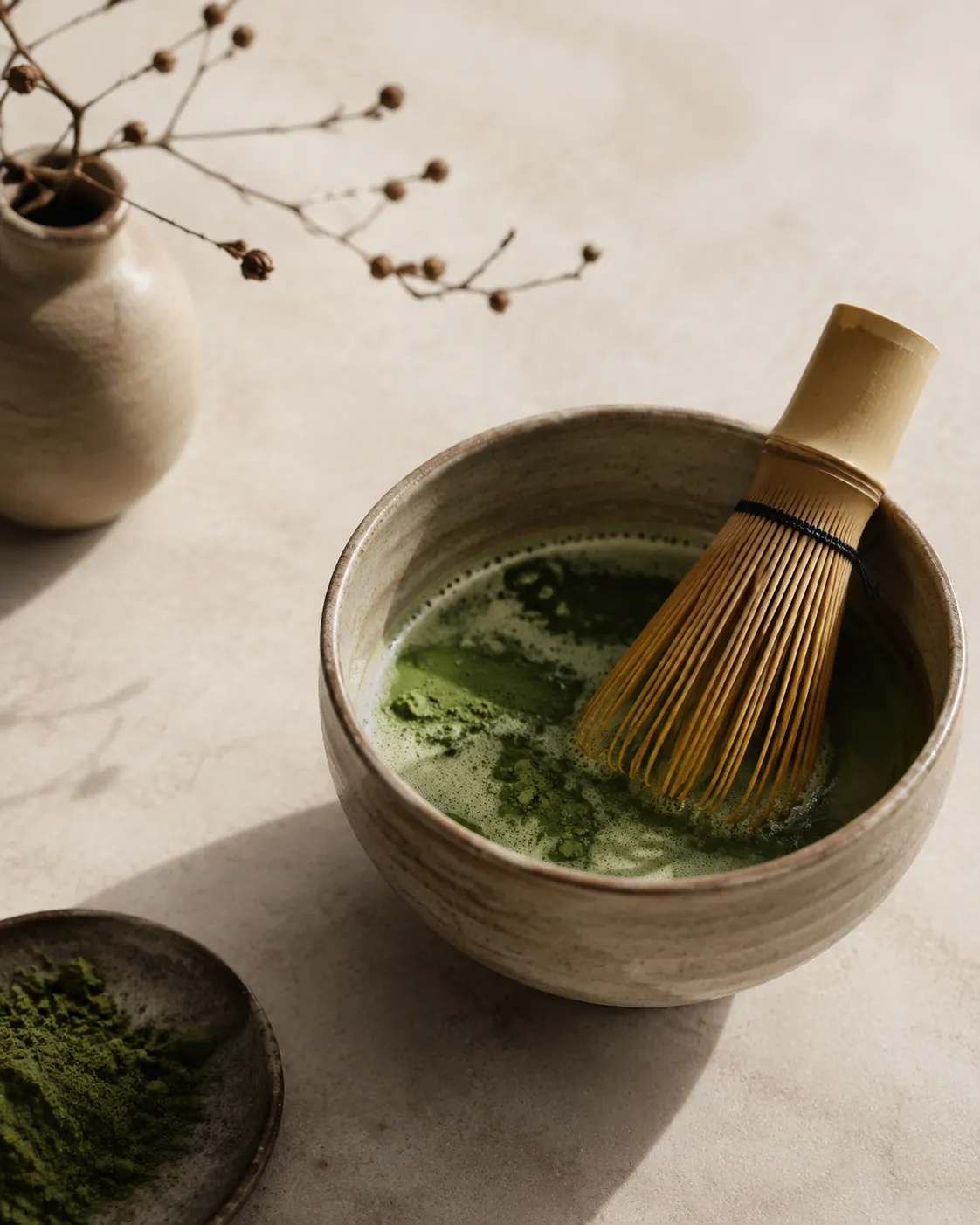
Sift the powder, use water at 75 to 80 C rather than boiling, and whisk briskly in a W shape rather than stirring in circles. Those three things account for almost every lumpy or bitter bowl.
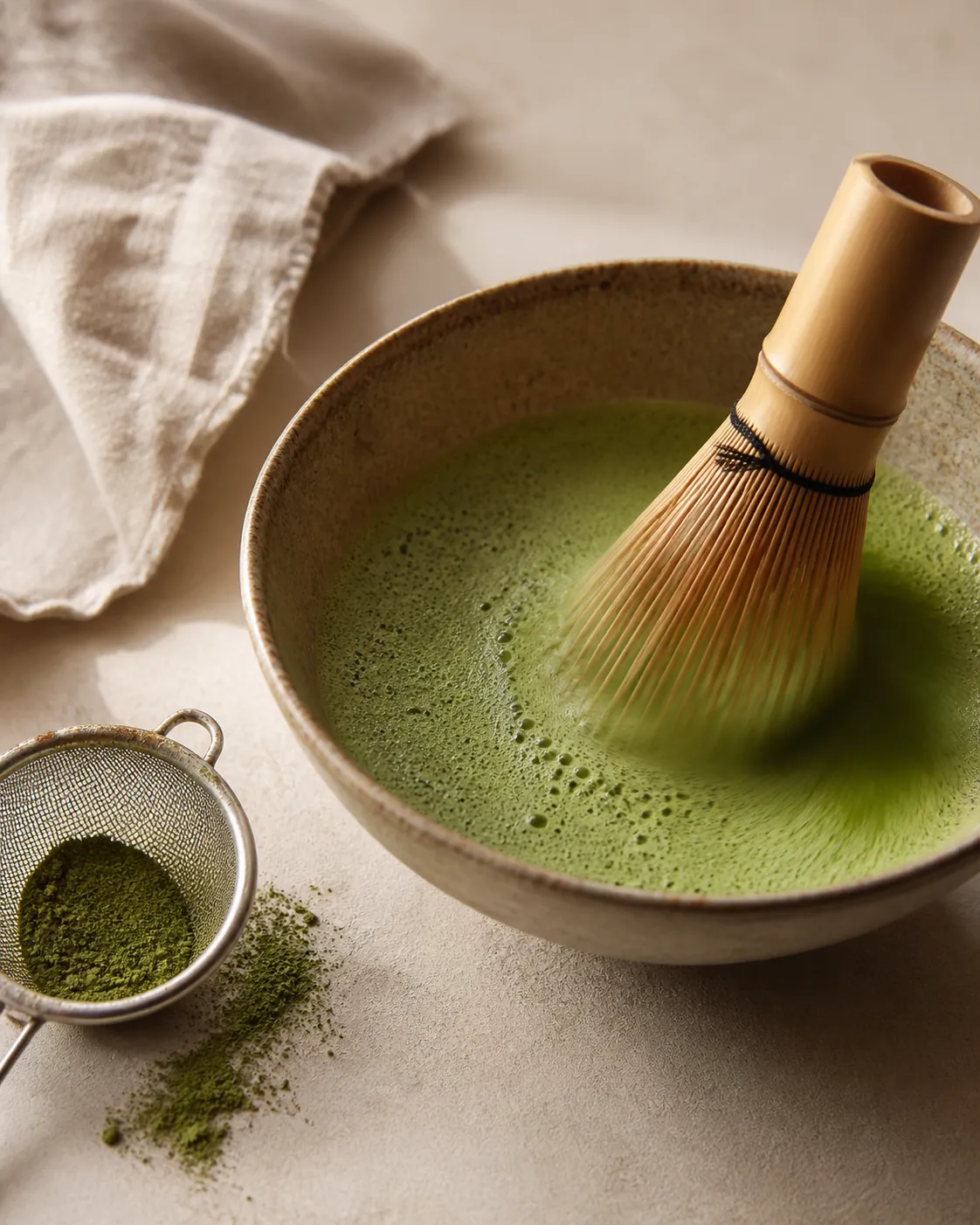
Whisking matcha is not stirring. The goal is to suspend a very fine powder evenly through water and to force air into it, and the technique is genuinely different from mixing a drink.
Nothing dissolves at any point. Matcha is a suspension, so the whisk is doing mechanical work on solid particles rather than helping something melt into the water around them.
The sequence for one bowl
Nothing in the bowl dissolves, which is why the whisk is doing mechanical work rather than helping something melt, and why a circular stir produces a visibly different drink from the same powder.
The numbers
- Powder
- 2 g, about one heaped teaspoon
- Water
- 60 to 70 ml
- Temperature
- 75 to 80 C
- Whisking
- 15 to 20 seconds, briskly
Those figures make one bowl of the thin everyday preparation, which is the form usucha describes and the one almost everybody means by the word matcha. The sequence below is what they look like at a counter.
Step by step
- Soak the whiskStand the chasen in warm water for thirty seconds. Dry bamboo tines snap.
- Warm the bowlRinse with hot water and dry it. Matcha cools fast in a cold bowl.
- Sift the powderPush 2 g through a fine sieve into the bowl. This is the step that prevents lumps.
- Make a pasteAdd about a tablespoon of the water and work it smooth against the base of the bowl.
- Add the restPour in the remaining water down the side rather than straight onto the powder.
- Whisk in a WRapid back-and-forth from the wrist for 15 to 20 seconds, keeping the whisk just off the base.
- Finish at the surfaceSlow down and lift through the top layer to break any large bubbles.
Drink it promptly, because the powder starts settling within a couple of minutes and the texture is most of the point of making it this way.
Why the order cannot be changed
- SiftBreaks the clumps while the powder is still dry.
- PasteUses friction against the bowl to disperse what water alone cannot.
- Add waterDown the side, so the paste is not blasted apart.
- WhiskA rapid W forces air in and builds the foam that carries the texture.
Skip any one of those and the failure shows up two steps later, which is why lumps get blamed on the whisk when they were caused by the sieve, and why the order is part of the recipe rather than a suggestion.
Why sifting, the paste and the W each matter
Steps in this sequence are not ceremony, and each removes one specific way the bowl goes wrong.
Matcha is extremely fine and compacts into clumps as it sits in the tin. A clump that reaches the water does not disperse: it hydrates on the outside and stays dry in the middle, which is the whole of the grit at the bottom of a badly made bowl.
Every lump in a finished bowl started as a clump in the powder.
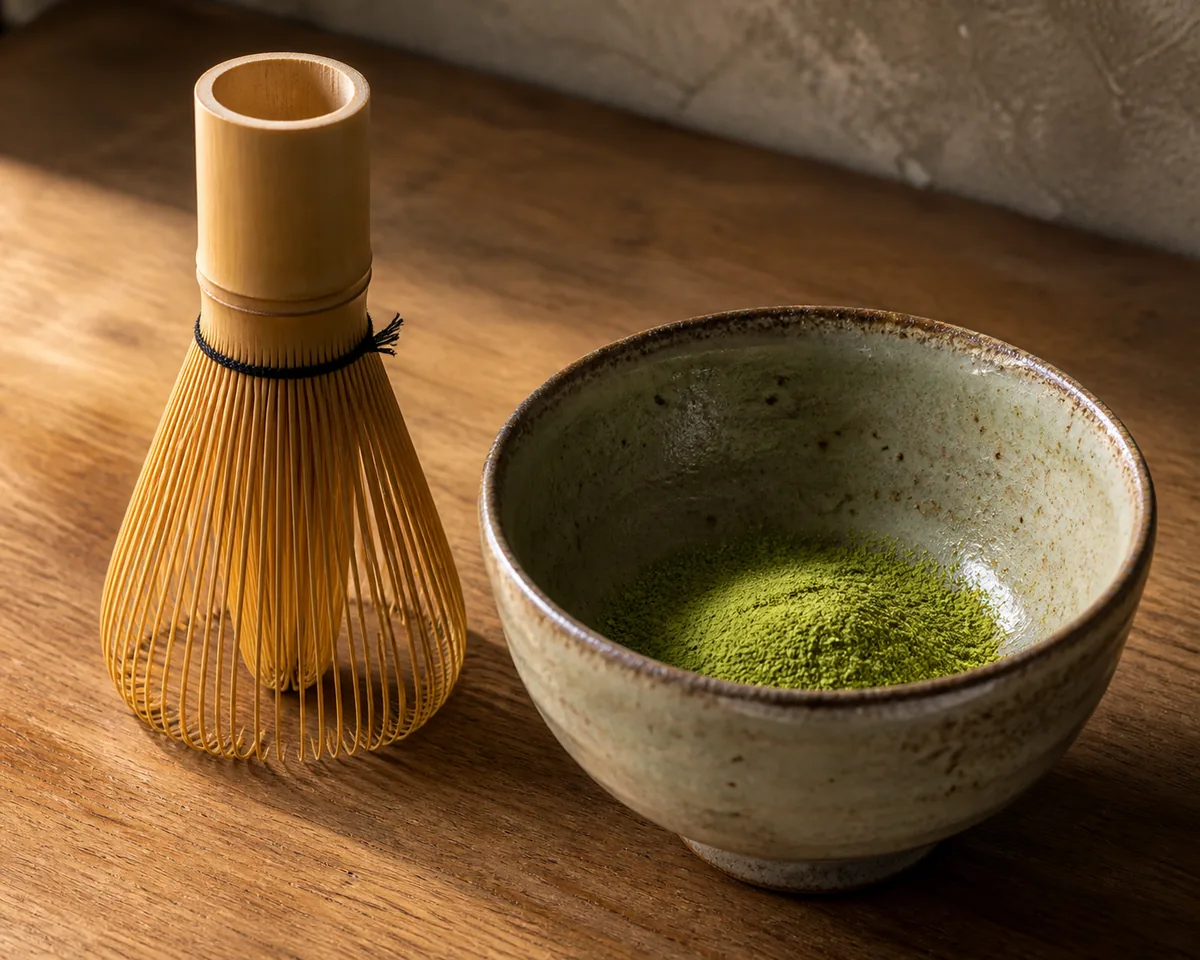
The paste step works for a related reason. Adding all the water at once asks the powder to disperse into a large volume immediately, which it will not do, whereas a tablespoon of water and the flat base of the bowl give you friction to break everything down against.
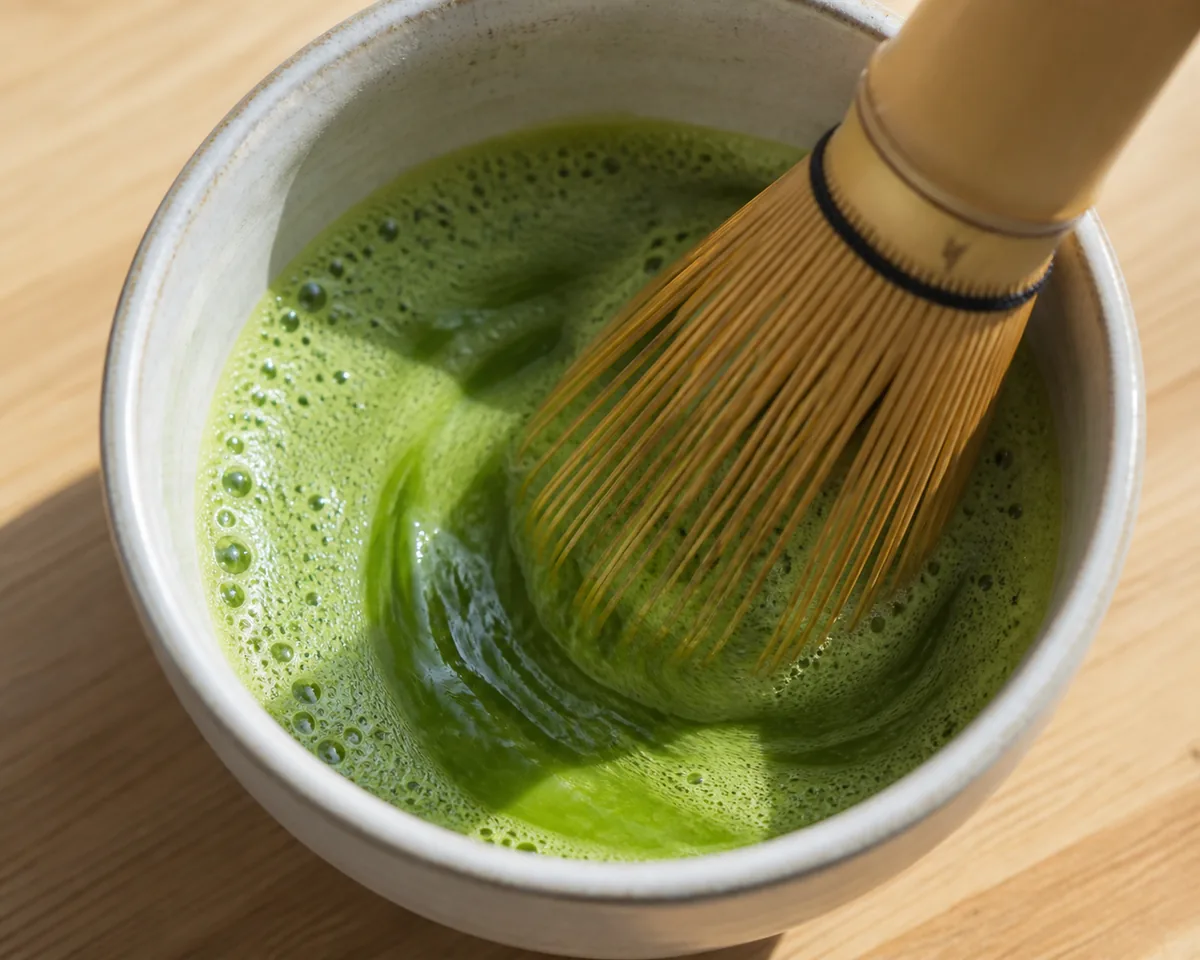
The W is about air rather than mixing. A circular stir spins the liquid as a body and introduces almost nothing, while a rapid back-and-forth from the wrist shears the surface repeatedly and builds the fine foam that gives matcha its body.
Water at 75 to 80 C is the last of the four. Boiling water pushes the astringent catechins forward and flattens the sweetness the shading built, which is the mechanism what matcha is explains in the leaf and why matcha tastes wrong traces in the cup.
Chasen, frother and jar are not interchangeable
A chasen is the traditional tool and it is not the only workable one.
What it does that nothing else quite matches is shear a shallow layer of liquid with a very large number of very fine points. Eighty to a hundred split bamboo tines pass through the water on every stroke, and the bubbles they leave behind are small enough to hold together.
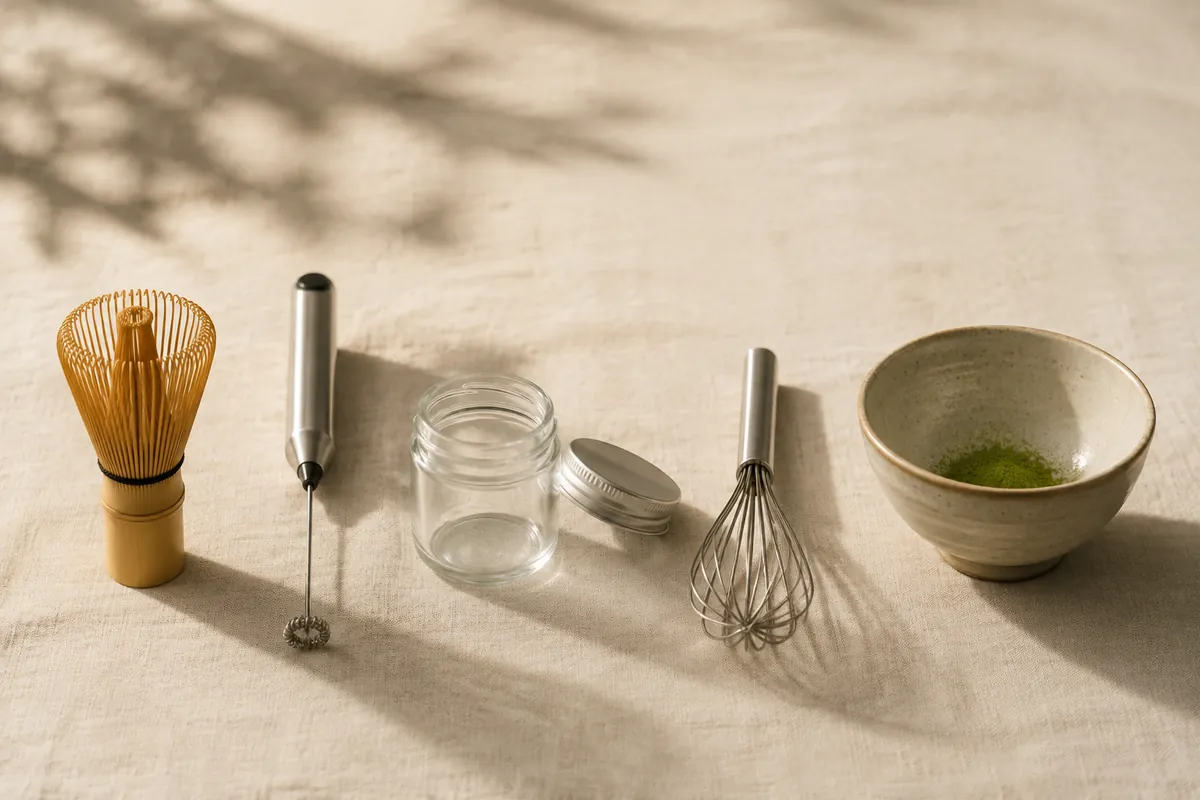
Bamboo chasen
The finest foam and the most control. A consumable that eventually loses tines.
Electric frother
Fast and effective in a narrow vessel. Coarser bubbles that collapse sooner.
Jar and lid
Disperses the powder perfectly well and builds almost no foam at all.
Balloon whisk
Works in a narrow jug, fails in a bowl. Too few wires, and each one too thick.
An electric milk frother is not equivalent, and the reason is geometry rather than power. Its single spinning head needs liquid depth to work against, so used in a wide chawan it spins the bowl without shearing it, and used in a tall jar it produces foam that comes close to a chasen's and collapses faster.
The jar is the honest budget answer and it deserves the same paste step as everything else. Sifted powder, a spoonful of water swirled smooth, then the rest and fifteen seconds of hard shaking gives a completely dispersed drink with no foam, which loses the texture and keeps the flavour.
None of the substitutes can make thick tea, and that is the one preparation where the bamboo whisk has no alternative at all.
Shape, depth and why a mug fails
Shape decides more than material.
A chawan has a flat interior base rather than a curved one, and that flat area is what the whisk works the paste against. A rounded cereal bowl still gives you enough of it, and a hemispherical one does not, because the tines skate around the curve instead of pressing into it.
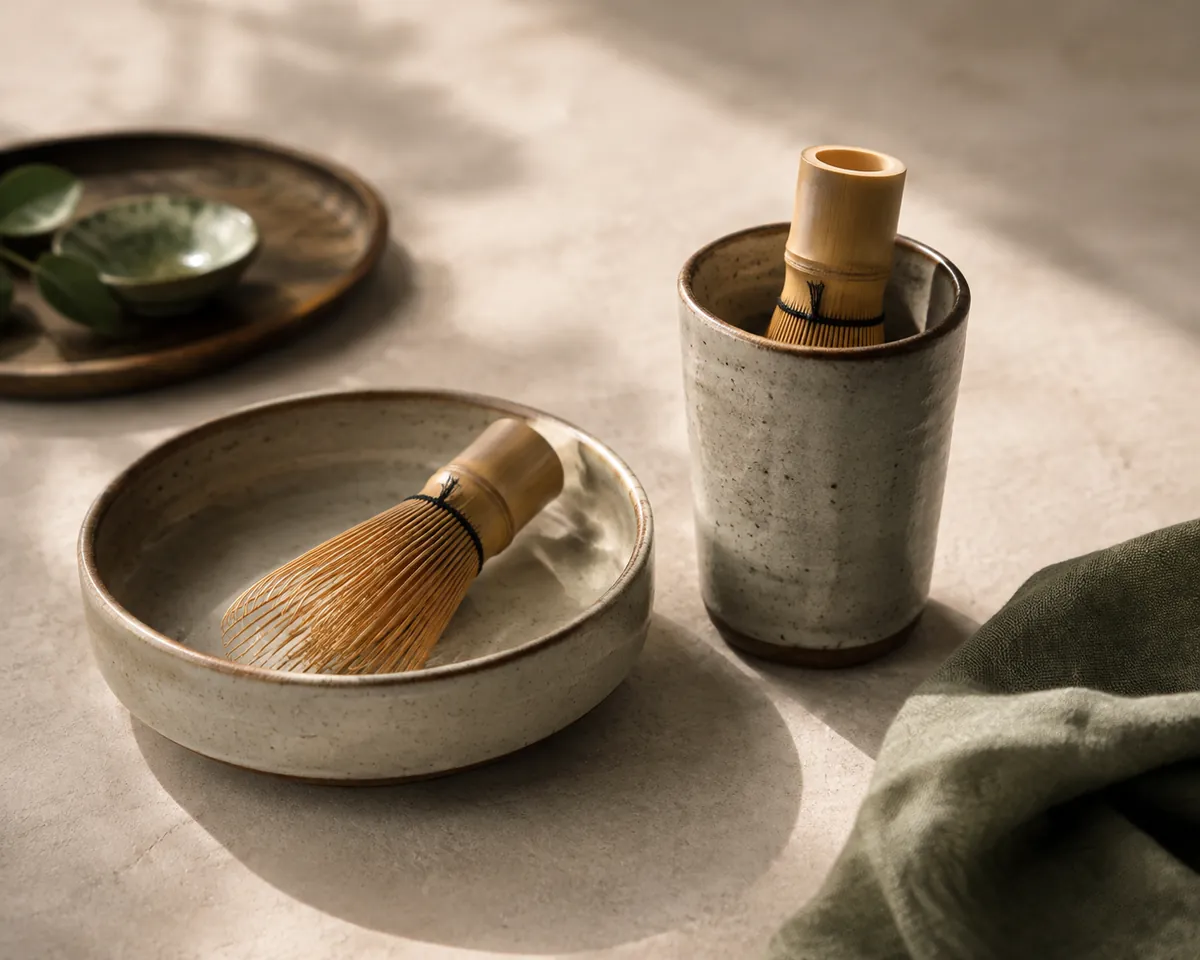
What the vessel needs to do
- Diameter
- Around 11 to 13 cm suits a single bowl of thin tea
- Base
- Flat, so the paste has something to be worked against
- Depth
- Shallow enough for the wrist to travel sideways
- Walls
- High enough that a brisk W does not throw water out
- Material
- Ceramic holds heat; thin glass loses it in under a minute
- Seasonal shape
- Wide and shallow cools faster, narrow and deep holds heat
Much wider than 13 cm and the liquid spreads too thin for the tines to reach; much narrower and there is nowhere for the wrist to travel, which is the whole reason a mug produces flat matcha no matter how much effort goes in.
The seasonal convention in Japan turns out to be a real effect rather than an aesthetic one. A wide shallow bowl in summer loses heat quickly because surface area governs cooling in a small volume, and pouring from a gooseneck kettle down the side of the bowl rather than onto the powder is the other half of controlling the same variable.
Reading the foam on the surface
Surface appearance is the thing beginners worry about most and the thing the schools disagree about, which is worth knowing before anyone tells you a bowl is wrong.
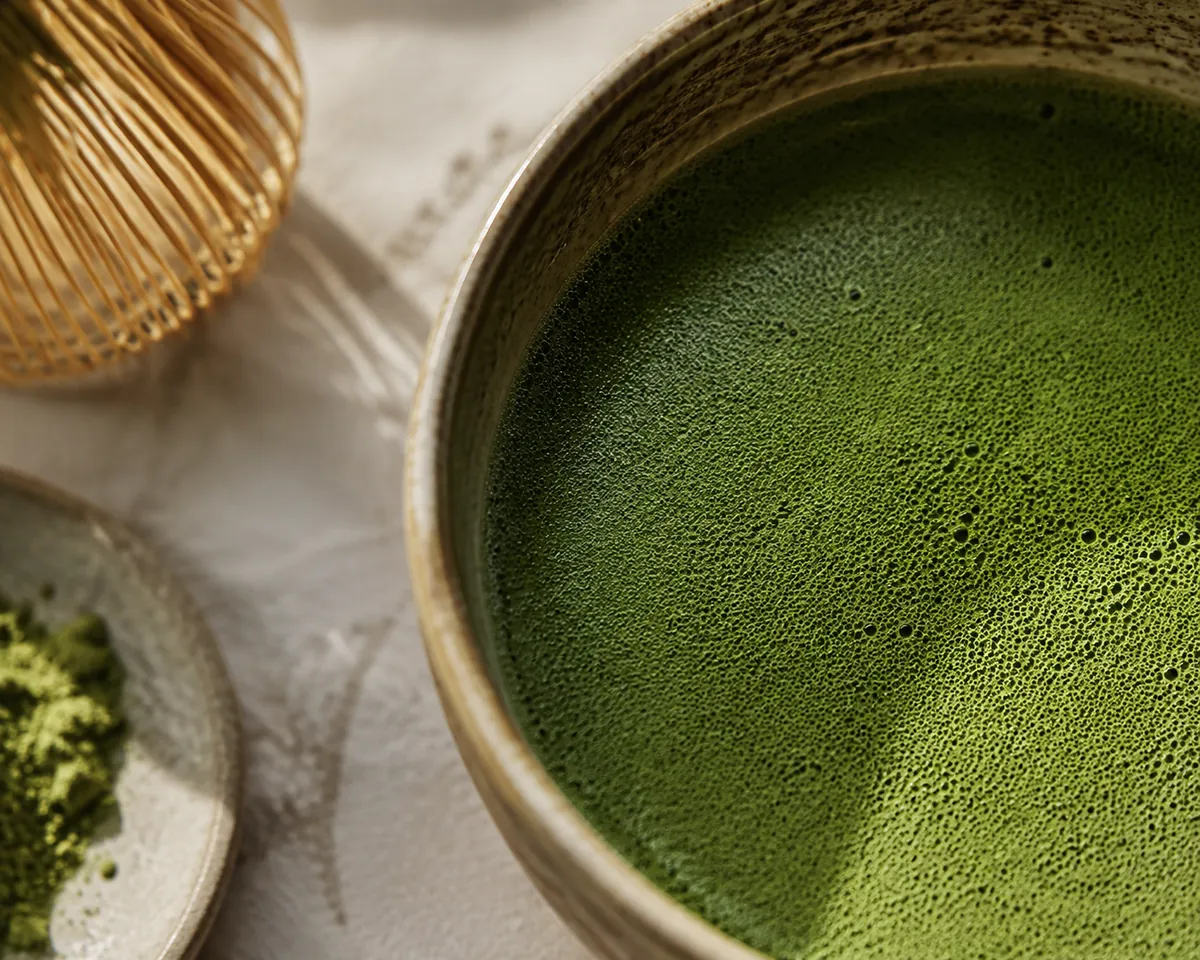
The Urasenke school finishes thin tea with a thick, even, fine foam across the whole surface. The Omotesenke school deliberately leaves a crescent of clear liquid at one edge, and neither of them is making a mistake.
What both are after is a fine, uniform bubble structure rather than a few large ones. Large bubbles collapse within seconds and leave the surface patchy, which is why a bowl that looked good when it was made can look neglected by the time it reaches the table.
The finishing move matters more than the whisking for this. Slowing right down at the end and lifting the whisk up through the top layer pops the large bubbles and leaves the small ones behind, and what remains is the texture that what matcha tastes like describes as creaminess.
Water temperature first, minerals second
Temperature gets all of the attention and the mineral content of the water matters more here than it does in any brewed tea.
Matcha is suspended rather than infused, so the water is a far larger proportion of what actually reaches the tongue. There is no spent leaf holding anything back and nothing to blame if the water is wrong.
What the water should be
- Temperature
- 75 to 80 C, or a kettle left two minutes off the boil
- Hardness
- Soft to medium. High calcium flattens the sweetness
- Chlorine
- Detectable against matcha. A jug filter removes it
- Distilled
- Avoid. Water with nothing in it makes a hollow bowl
- Volume
- 60 to 70 ml for thin tea, poured down the side of the bowl
Hard water sharpens the astringency and suppresses the umami, and very hard water leaves a chalky edge that gets blamed on the powder. Soft water is the traditional preference and the reason Kyoto's supply is talked about in this context, with a jug filter as the practical version at home.
A bottle is a lottery rather than an upgrade, since mineral water ranges from very soft to extremely hard and the label is the only way to tell. What brewing water sets out about minerals applies here with the volume doubled in importance, and steeping temperature covers why 75 C rather than boiling.
Kneading thick tea rather than whisking it
Everything above describes the thin preparation, and the other one uses the same powder with almost none of the same technique.
Thick tea is roughly four grams of matcha to thirty millilitres of water, which is double the powder in less than half the liquid. There is not enough water for a whisk to move through in any ordinary sense.
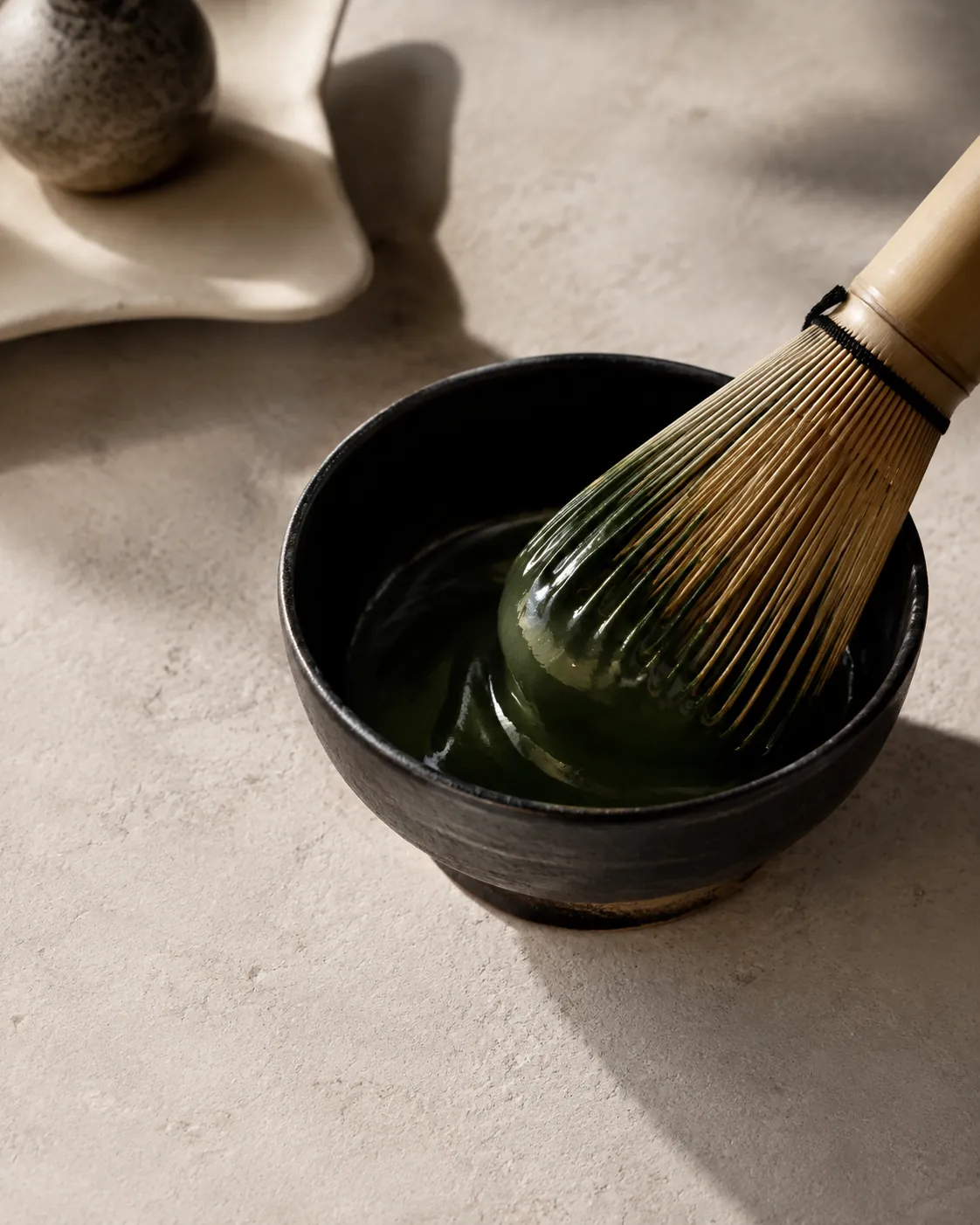
Koicha
- Powder
- 4 g, sifted, and it must be a high grade
- Water
- 30 ml at 75 C
- Technique
- Knead and fold with the chasen rather than whisking
- Time
- 30 to 45 seconds, slowly
- Result
- Thick, glossy, closer to paint than to tea. No foam at all
The motion is a slow fold, pressing the tines through the paste and turning the whisk rather than driving it back and forth. Whisking quickly at this ratio traps air and produces a lumpy, foamy mess instead of the smooth glaze koicha is supposed to be.
Grade stops being a matter of preference here. Everything in the leaf is concentrated at that ratio, so a lower tier is punishingly astringent rather than merely disappointing, and ceremonial grade is genuinely required rather than recommended.
Milk, ice and the drinks that are not a bowl
Milk resists the powder.
Whisking matcha straight into milk is much harder than whisking it into water, because milk is thicker and its proteins get in the way of dispersal, which is how most lumpy green drinks happen. The fix is always the same: whisk into water first, about 40 ml of it, exactly as above, and only then add the milk.

A matcha latte also wants a lower temperature than a coffee one. Milk much above 65 C dulls the tea underneath it, and a barista formulation of oat milk handles the acidity better than a thin nut drink does.
Cold preparation is a different technique rather than the hot one cooled down. Whisk into 40 ml of cool water, which takes longer and foams less, then pour over a full glass of ice and top with cold water or milk.
Shaking works better than whisking at low temperature, and a sealed jar with powder, cool water and ice shaken hard for twenty seconds disperses everything completely. What fails is whisking hot and pouring over ice, where the melt thins an already delicate drink, and that is the single most common fault in a home-made iced matcha.
Looking after a chasen, a sieve and a bowl
Bamboo is a consumable, and the sieve is the part that actually causes the trouble.
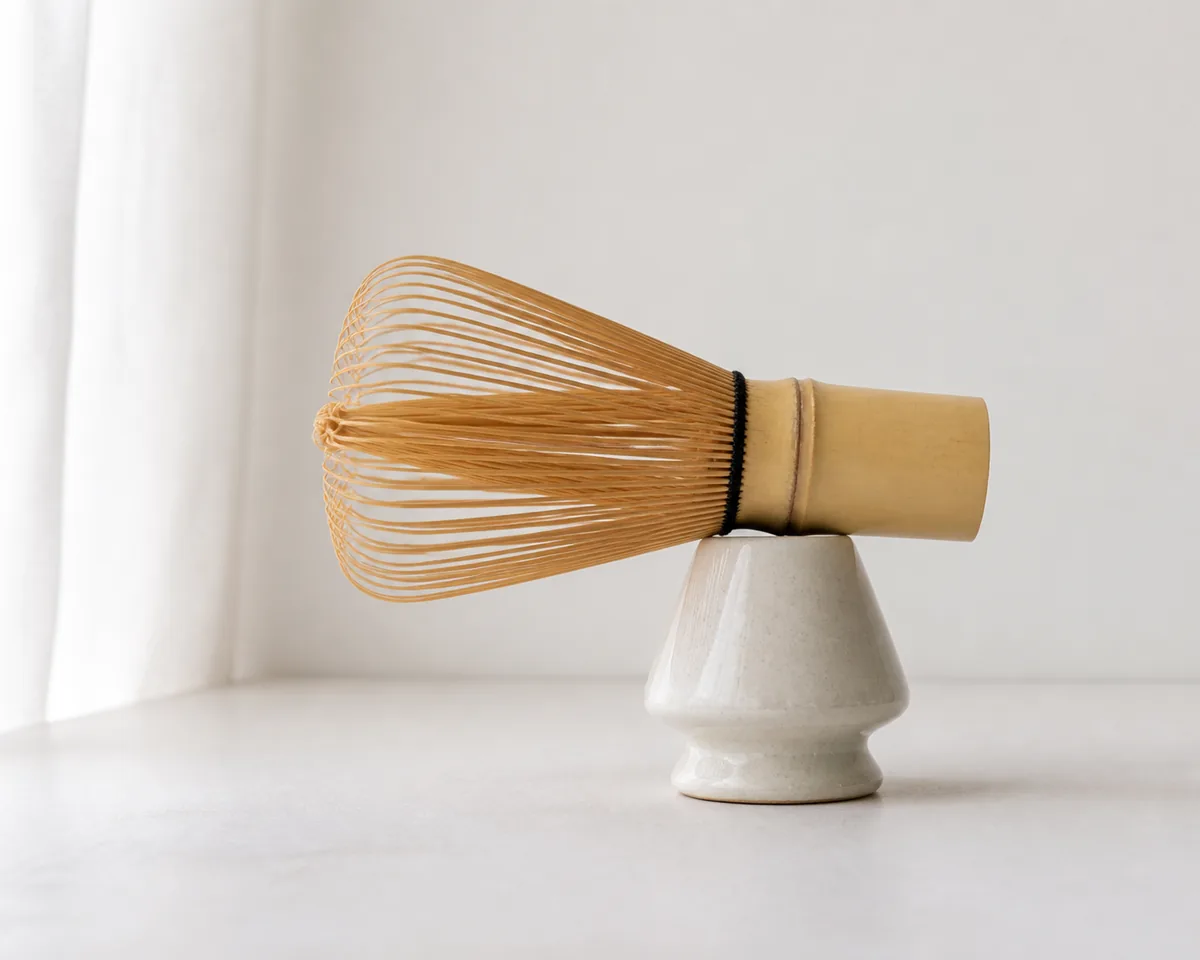
The holder is not decoration. It keeps the tines splayed in the shape they were carved into, and a whisk dried lying flat or standing in a mug dries bent, which is where the first breakages happen.
- Rinse it in warm water straight after use. No soap.
- Stand it on a whisk holder or upright to dry, so the tines keep their shape.
- Never put it in a dishwasher or leave it soaking.
- Brush the sieve dry immediately rather than rinsing it.
- Never wash a bamboo scoop at all; wipe it and let it dry.
Damp matcha left in a fine mesh dries into a film that blocks it, and the next bowl goes unsifted because the sieve has quietly stopped working. Brushing it out dry takes five seconds and rinsing it makes the problem worse, since water turns the residue into paste.
Ceramic stains slightly over time, particularly on an unglazed foot or a crazed glaze. The marking is cosmetic rather than a fault.
A paste of bicarbonate lifts it if it bothers you, and the tin the powder came from deserves more attention than the bowl does, which is what storing matcha is about.
When the powder is the limit rather than the method
Assume for a moment that the sequence was followed exactly and the bowl is still harsh, because that happens often enough to deserve its own answer.
| Problem | Cause | Fix |
|---|---|---|
| Lumps in the bowl | Powder not sifted, or all the water added at once | Sift, then make a paste with a little water first |
| No foam | Circular stirring, or whisking too slowly | Whisk briskly in a W from the wrist, not the arm |
| Harsh and drying | Water too hot, or powder past its best | Drop to 75 C; check the powder is a vivid green |
| Thin and watery | Too much water for the dose | Move towards 2 g powder to 60 ml water |
| Gritty at the bottom | Normal settling, or coarse powder | Drink it promptly; if it persists, the powder is coarsely ground |
| Broken bamboo tines | Whisk used dry | Soak the tines in warm water before whisking |
Work down that table before spending anything, because every fix on it is free. A bowl that is still drying and flat at 75 C with sifted powder and a correct dose has stopped being a technique problem.
Culinary grade is made from later-harvest leaf and built to be tasted through milk and sugar, so no amount of care at the bowl turns it into a drinking tea. That is the product working as designed, and it shares its sharp forward edge with the over-brewed leaf described in green tea bitterness.
Age is the other limit and it arrives faster than people expect. Matcha oxidises within weeks of opening and shifts towards hay and dullness, and once a powder smells of dry grass in the tin, nothing done in the bowl brings it back.
The method
- Makes
- 1 bowl, about 70 ml
- Ratio
- 2 g powder to 70 ml water
- Water temp
- 75 to 80 C / 167 to 176 F
- Total time
- 3 min
What you need
- 2 g matcha powder, about one heaped half-teaspoon
- 70 ml water at 75 to 80 C / 167 to 176 F
Equipment
- A bamboo whisk, or a small electric milk frother
- A wide bowl, wider than it is deep
- A fine sieve
- A kettle
Method
- Soften the whiskIf using a bamboo whisk, soak the tines in warm water for a minute so they flex instead of snapping.
- Sift the powderPush 2 g of matcha through a fine sieve into the bowl. Matcha clumps as it sits, and sifting is what stops lumps forming later.
- Add a little water firstPour in about 15 ml and work it into a smooth paste against the side of the bowl. This is the step most people skip, and it is the one that prevents lumps.
- Add the restPour in the remaining water, aiming for 75 to 80 C rather than boiling.
- Whisk in a WMove the whisk briskly back and forth in a W or M shape from the wrist, keeping the tines just off the bottom. Circular stirring does not aerate it.
- Finish the foamAfter about 20 to 30 seconds a fine, even foam should form. Lift the whisk through the centre in a slow spiral to break the largest bubbles.
- Drink it soonMatcha is a suspension, not a solution, and the powder settles within a few minutes.
Common questions
Do I need a bamboo whisk to make matcha?
No. A bamboo whisk gives the finest foam, but a small electric milk frother works well, and a jar with a tight lid shaken hard will produce a lump-free bowl.
Why is my matcha lumpy?
Almost always because the powder was not sifted, or because all the water was added at once. Sift the powder, then work a small amount of water into a smooth paste before adding the rest.
What temperature should the water be for matcha?
Around 75 to 80 C. Boiling water brings the astringency forward and flattens the sweetness, and it does not help the powder disperse, because matcha is suspended rather than dissolved.