Why Your Matcha Tastes Wrong: Four Faults With Four Causes
Matcha fails in four distinct ways, and each has a different cause. Telling them apart matters, because two are fixed by changing what you do and two mean the tin was already wrong.
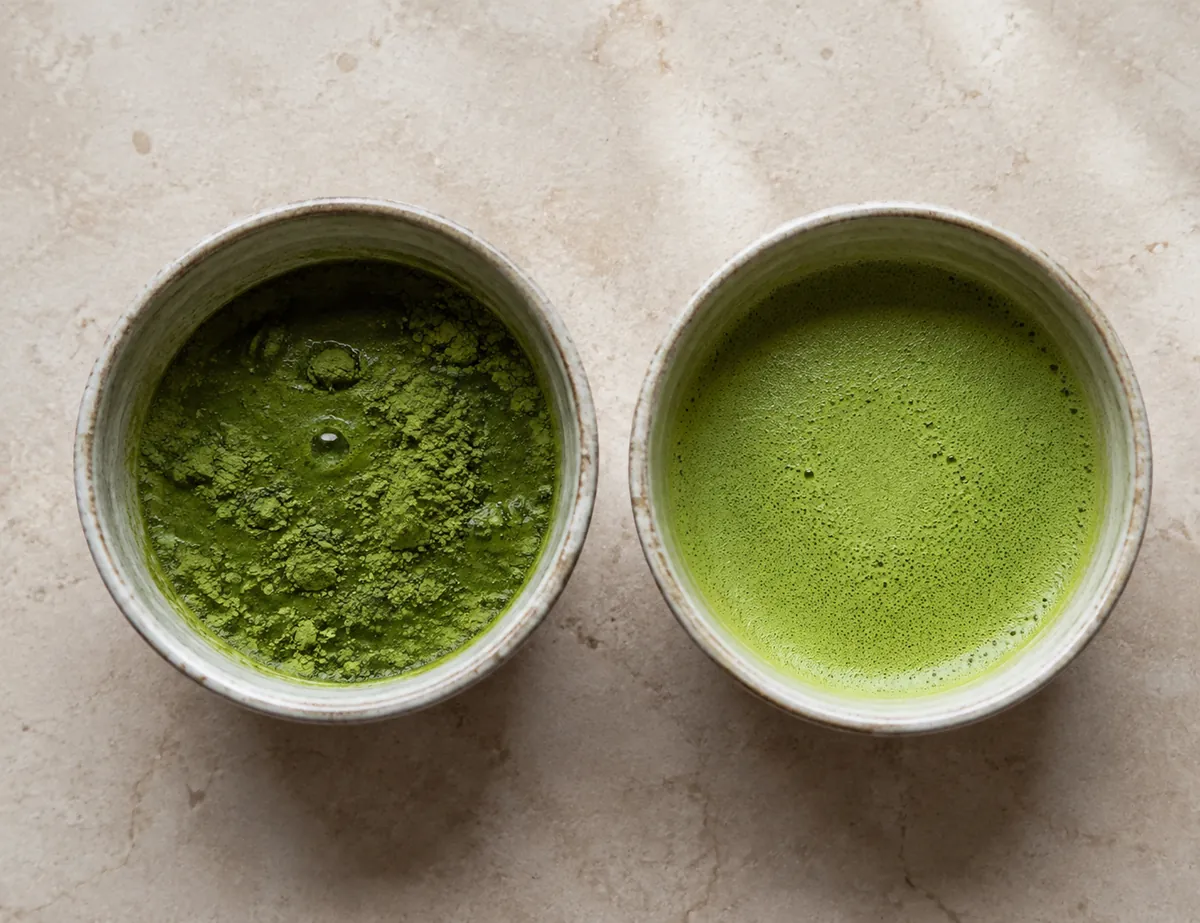
Matcha goes wrong in four ways that are easy to confuse with one another and that have entirely different causes. Three of them are free to fix and the fourth cannot be fixed at all.
Working out which one is in the bowl is most of the repair. The order below is the order worth checking, because each step costs less than the one after it.
Bitter, or actually astringent
Almost nobody who calls a bowl bitter means bitterness.
Bitterness is a taste registered at the back of the tongue. What a harsh bowl of matcha actually delivers is astringency: catechins binding to the proteins in saliva, so the whole mouth feels dry and gripped rather than sharp.
Causes, in order of likelihood
- Water too hot
- Boiling water scalds the powder. 70 to 80 C is the range
- Too much powder
- 2 g per 70 ml is the standard. A heaped teaspoon is nearly double
- Later-harvest leaf
- Powder made for baking is genuinely more astringent by design
- Old powder
- Oxidation shifts the balance and shortens the sweet finish
- Hard water
- Mineral content sharpens the grip and flattens the umami
Temperature accounts for most cases. A kettle taken off the boil and left standing two minutes produces a completely different bowl from exactly the same powder, and the arithmetic is the same one steeping temperature applies to leaf tea.
Water chemistry accounts for a run of the rest, and no amount of cooling the kettle touches it. Matcha is suspended rather than infused, so the water is a much larger share of what reaches the tongue than it is in a brewed cup, and there is no spent leaf to take the blame.
What water does to a bowl
- Soft water
- Sweeter, rounder, closest to how the powder is meant to taste
- Hard water
- Astringent and flat, with the savoury depth suppressed
- Bottled
- Depends entirely on the bottle; high-calcium waters are the worst offenders
- Distilled
- Flat and lifeless. Some mineral content is needed
- Chlorinated tap
- Detectable, and it clashes badly with matcha's marine note
Running the water through a jug filter first strips the chlorine and some of the hardness, and it costs almost nothing to try. What brewing water says about minerals applies here with the effect roughly doubled, a bottle of mineral water is a lottery rather than an upgrade, and the shading that built the sweetness in the first place is described in what matcha is.
Clumps, grit and the sieve you skipped
Grit starts in the tin.
Matcha compacts under its own weight as it sits, and those clumps do not break up under a whisk. Water wets the outside of a clump and seals it, the inside stays dry, and the whole thing survives into the bowl as a gritty pocket that never dispersed.
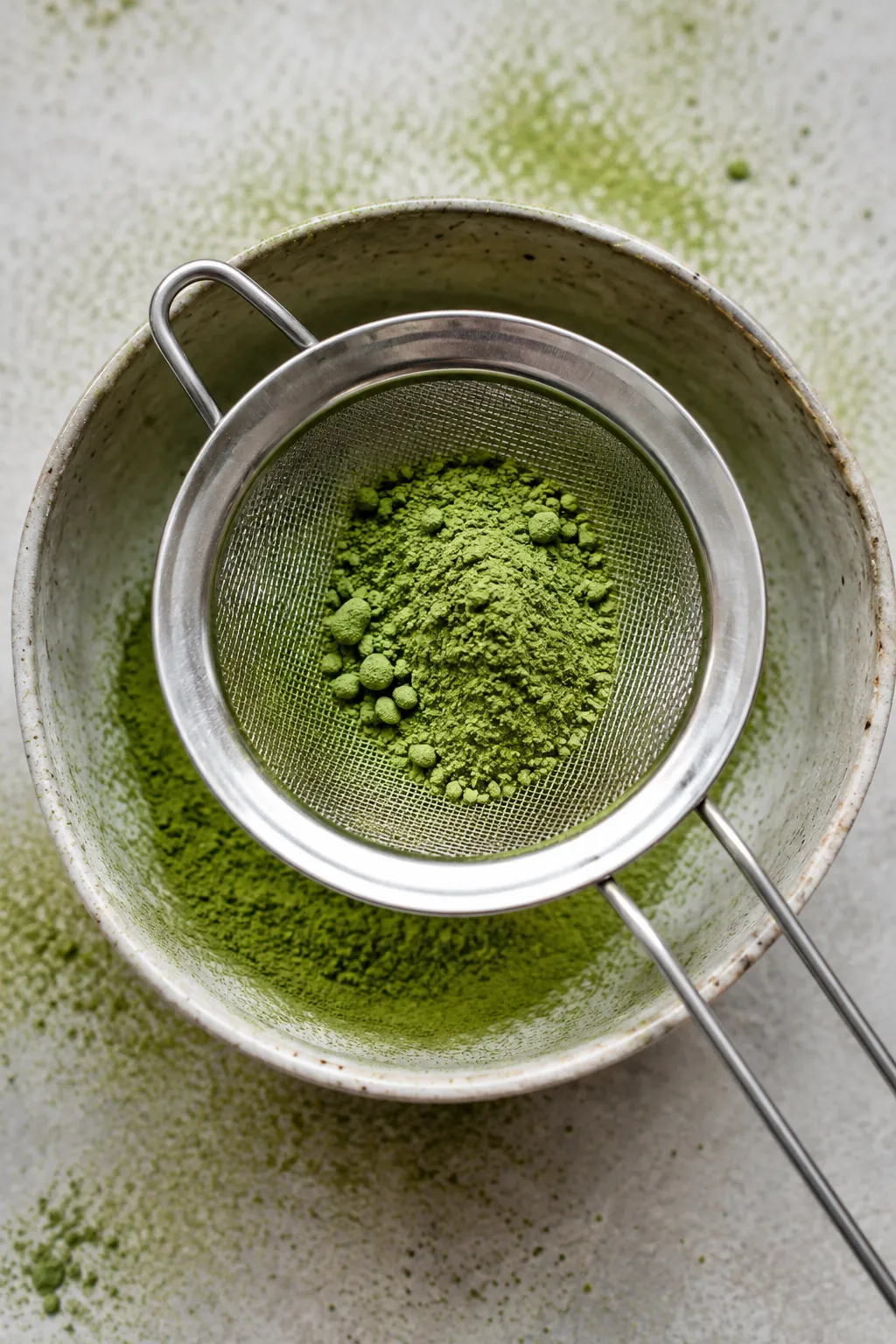
Why sifting is not optional
- SittingFine powder compacts under its own weight in the tin.
- WettingWater wets the outside of a clump and seals it.
- WhiskingThe whisk moves clumps around rather than breaking them.
- ResultGrit at the bottom of the bowl and a thin drink above it.
- FixA fine sieve, ten seconds, before any water goes near it.
Ten seconds with a sieve removes the entire fault, and skipping it cannot be compensated for further down the sequence, which is why how to whisk matcha puts sifting before every other instruction.
The tool is the other mechanical cause. A metal kitchen whisk has a handful of thick wires and a chasen has eighty to a hundred fine bamboo tines, and only the second one breaks clumps apart while it works.
Settling at the bottom of a finished bowl is a separate thing and entirely normal. If grit persists after sifting and prompt drinking, the powder was coarsely ground rather than badly handled.
Flat, with no foam on the surface
Flat matcha is a texture failure rather than a flavour one, and the vessel usually causes it.
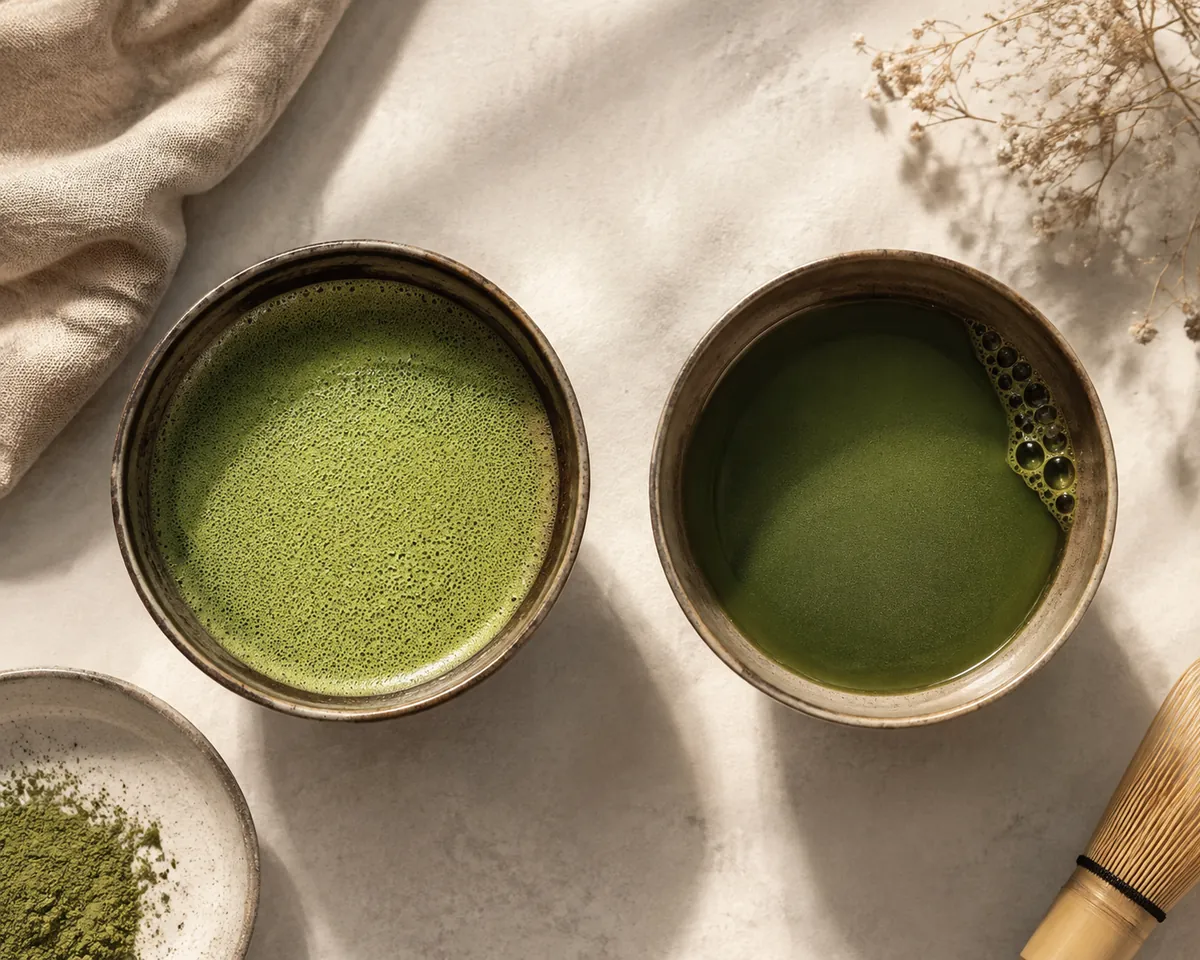
A mug is the most common single cause. Its narrow base gives the whisk nowhere to travel sideways, so the wrist ends up describing circles, and a circular stir spins the liquid as one body without shearing air into it.
- Use a wide bowl, not a mug. A chasen needs room to move.
- Whisk in a rapid W or M motion from the wrist, not a circular stir.
- Make a paste with a little water first, then add the rest.
- Whisk briskly for 15 to 20 seconds; most people stop far too early.
- Check the chasen: a new one needs soaking, and an old one loses tines.
Speed is the second cause and it is usually underestimated. Fifteen to twenty seconds of genuinely brisk work is what builds a fine, stable foam, and most people stop at five because the powder has already dispersed and the bowl looks finished.
An electric frother fails for the opposite reason to a mug, since its spinning head needs depth to work against and finds none in a shallow bowl. Powder from a later harvest also foams less, because it carries fewer of the amino acids that hold small bubbles together.
Dull, hay-like or faintly fishy
Some faults are the tin telling you it has finished, and no adjustment at the bowl argues with a powder that has already oxidised.
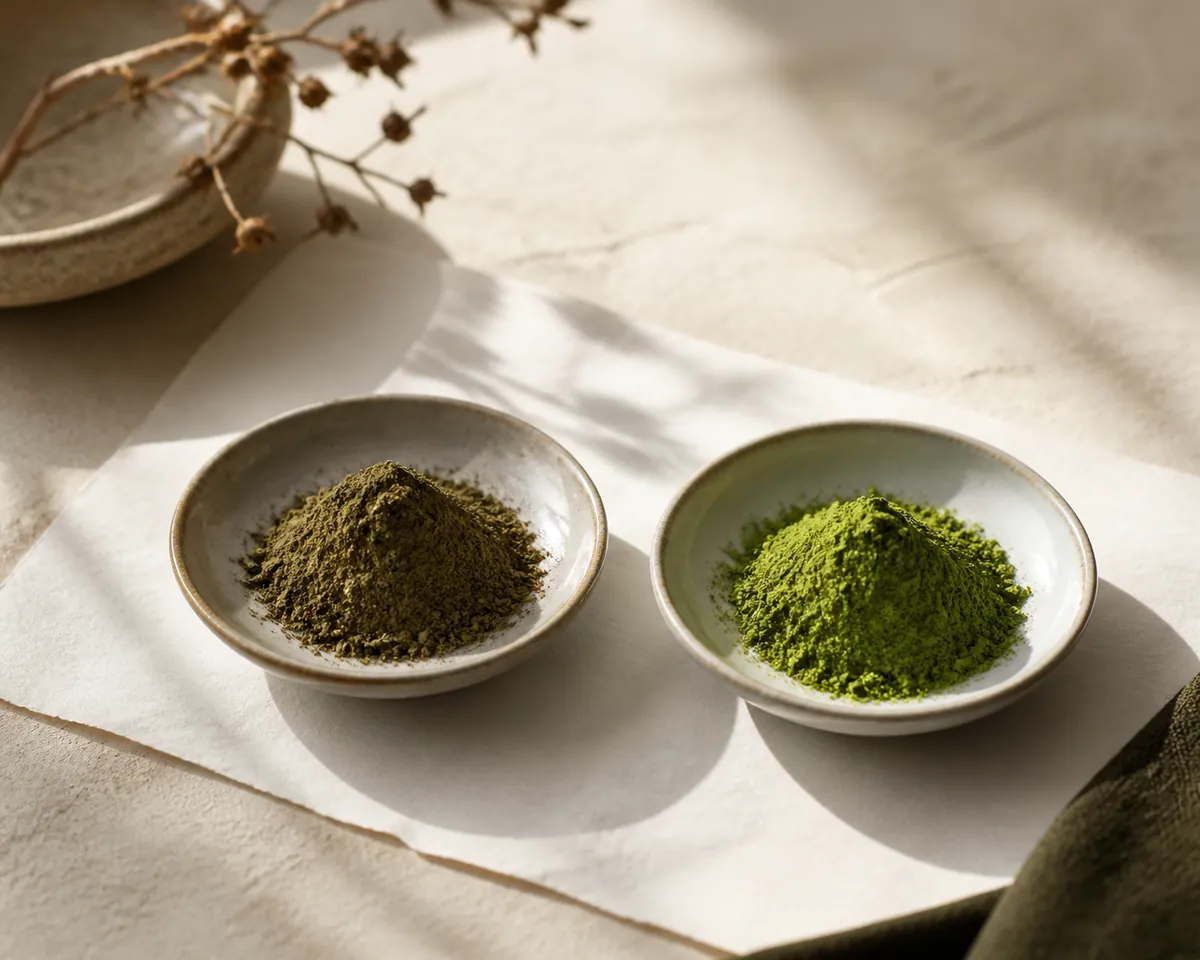
Hay, dust and a faintly fishy note are the flavours of oxidation. Air, light or warmth have had too long with the powder, and the sweetness and marine character that made it worth buying have gone rather than gone into hiding.
Reading the colour
- Vivid jadeFresh, well stored
- Bright greenGood. Normal a few weeks after opening
- Dull oliveFading. Usable for lattes and baking
- Yellow-greenWell past its best
- Brown-greenOxidised. It will taste of hay whatever you do
That scale is useful and it is routinely over-trusted in both directions. Vivid green tells you a powder has not badly oxidised and tells you nothing about whether the leaf was shaded, picked early or stone-milled, and some cheap powders are bright and taste of very little.
Smell decides it, and the test takes a second. Fresh matcha smells sweet, green and faintly of the sea; spent matcha smells of hay, dust or fish, which is the same signal what matcha tastes like treats as the fastest quality test there is.
A good powder a few weeks into its tin dulls slightly and still tastes excellent, so discarding one on colour alone wastes money. Keeping it from getting there is what storing matcha is for.
Symptom to cause, at a glance
Symptoms sort into four families.
| Symptom | Most likely cause | Fixable by technique |
|---|---|---|
| Bitter, harsh | Water too hot, or too much powder | Yes |
| Gritty, lumpy | Not sifted, or wrong whisk | Yes |
| Flat, no foam | Mug instead of a bowl, or under-whisking | Yes |
| Dull, hay-like, fishy | Oxidised powder | No |
| Sour against milk | Hard water, or an unstable plant drink | Partly |
The first three cost nothing to correct, which is the whole argument for working through them before replacing a tin. Only the fourth requires buying anything, and it is the only one where the answer is genuinely to stop and start again.
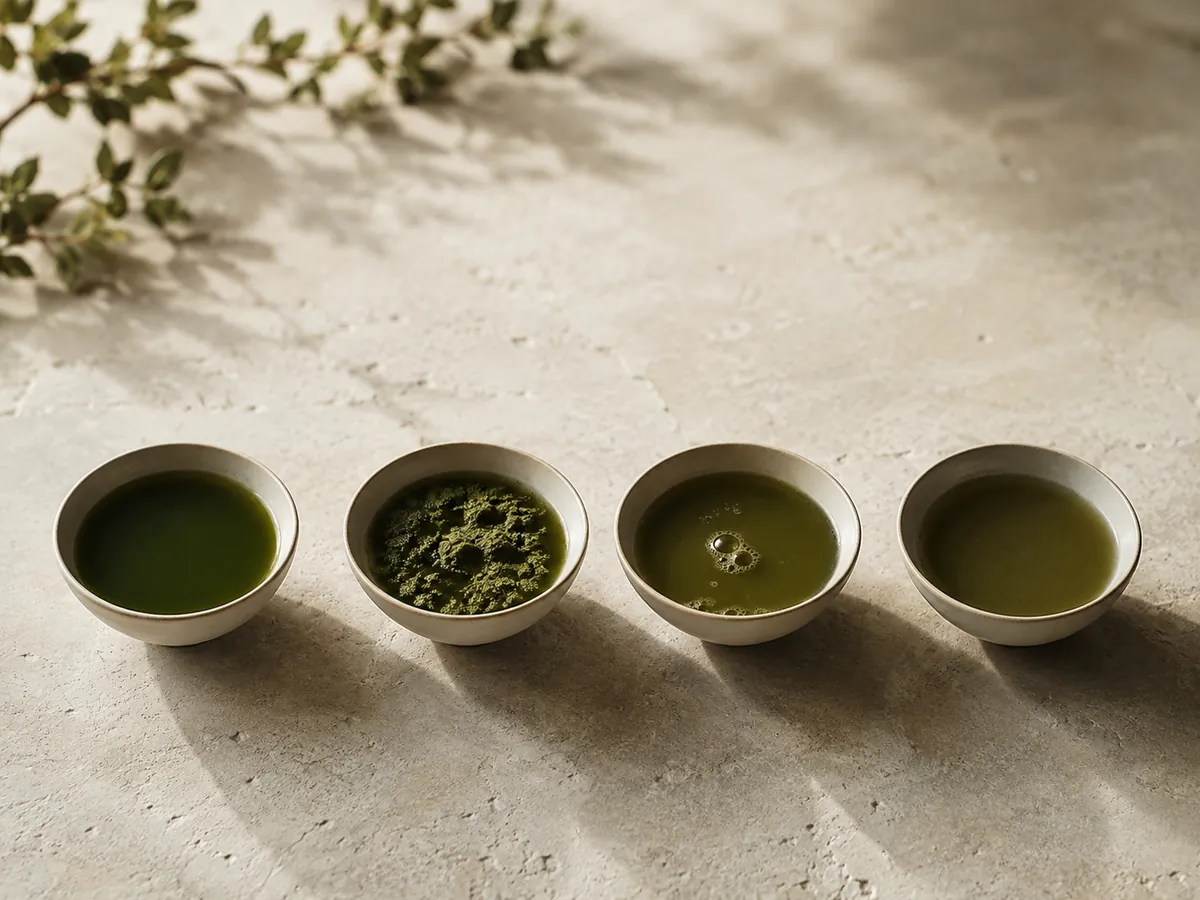
There is a fast order for running the checks, and it costs a single bowl. Smell the dry powder first: sweet and marine means the tin is sound and the problem is technique, while hay or dust means nothing further down the list applies.
Then look at the bowl before tasting it. Lumps mean unsifted, no foam means the wrong vessel or the wrong motion, and a thin flat surface with neither of those usually means an under-dose.
Taste last, and change one thing only. Harsh and drying with a good-smelling powder is almost always water temperature, and the whisking sequence covers what to change it to before anything else gets adjusted.
Grams, not spoons
A teaspoon of matcha is not a fixed quantity, and that quietly causes a large share of the bitterness cases above.
Fine powder compacts. A teaspoon scooped from a freshly opened tin and a teaspoon scooped from one that has been carried around a cupboard for a month can differ by close to double, and the second one makes a harsh bowl for a reason the drinker cannot see.
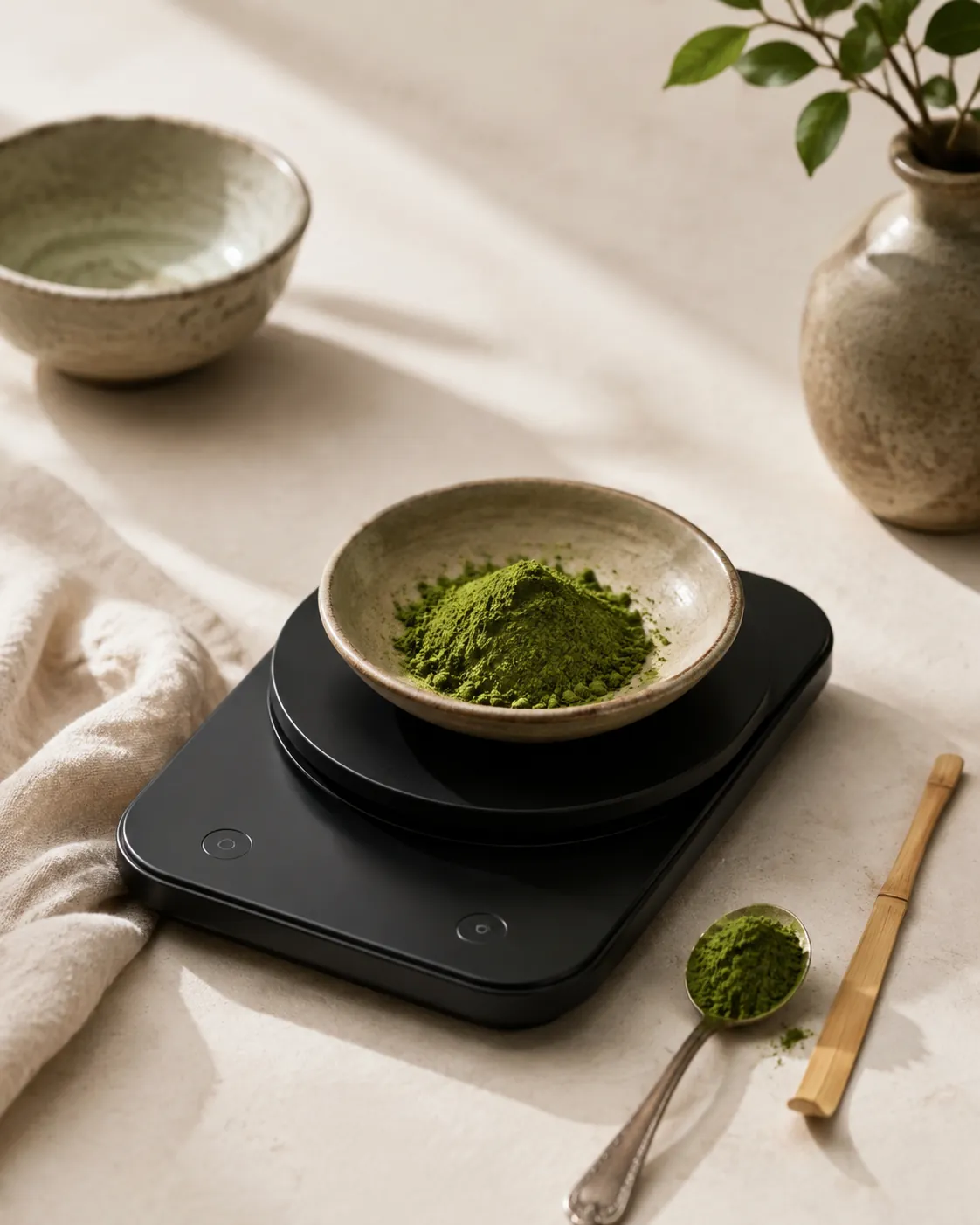
Weights that actually work
- Usucha, thin
- 2 g to 70 ml of water
- Koicha, thick
- 4 g to 30 ml
- A chashaku scoop
- About 1 g, so two scoops for thin tea
- A level teaspoon
- 2 to 4 g depending on compaction
- Latte
- 2 g, whisked in 40 ml of water before any milk
A cheap kitchen scale reading to 0.1 g removes the single largest uncontrolled variable in the whole process. Everything else on this page becomes interpretable once the dose is fixed, because a change in water temperature can be judged against a constant rather than against a guess.
Dose also decides which drink you are making at all. Two grams is the thin preparation usucha describes and four grams in half the water is koicha, and drifting between them by accident is the commonest reason a familiar tin suddenly tastes wrong.
Splitting, sourness and plant milk
Milk drinks fail differently from a plain bowl, and the failure usually comes from the milk rather than from anything that happened to the powder.
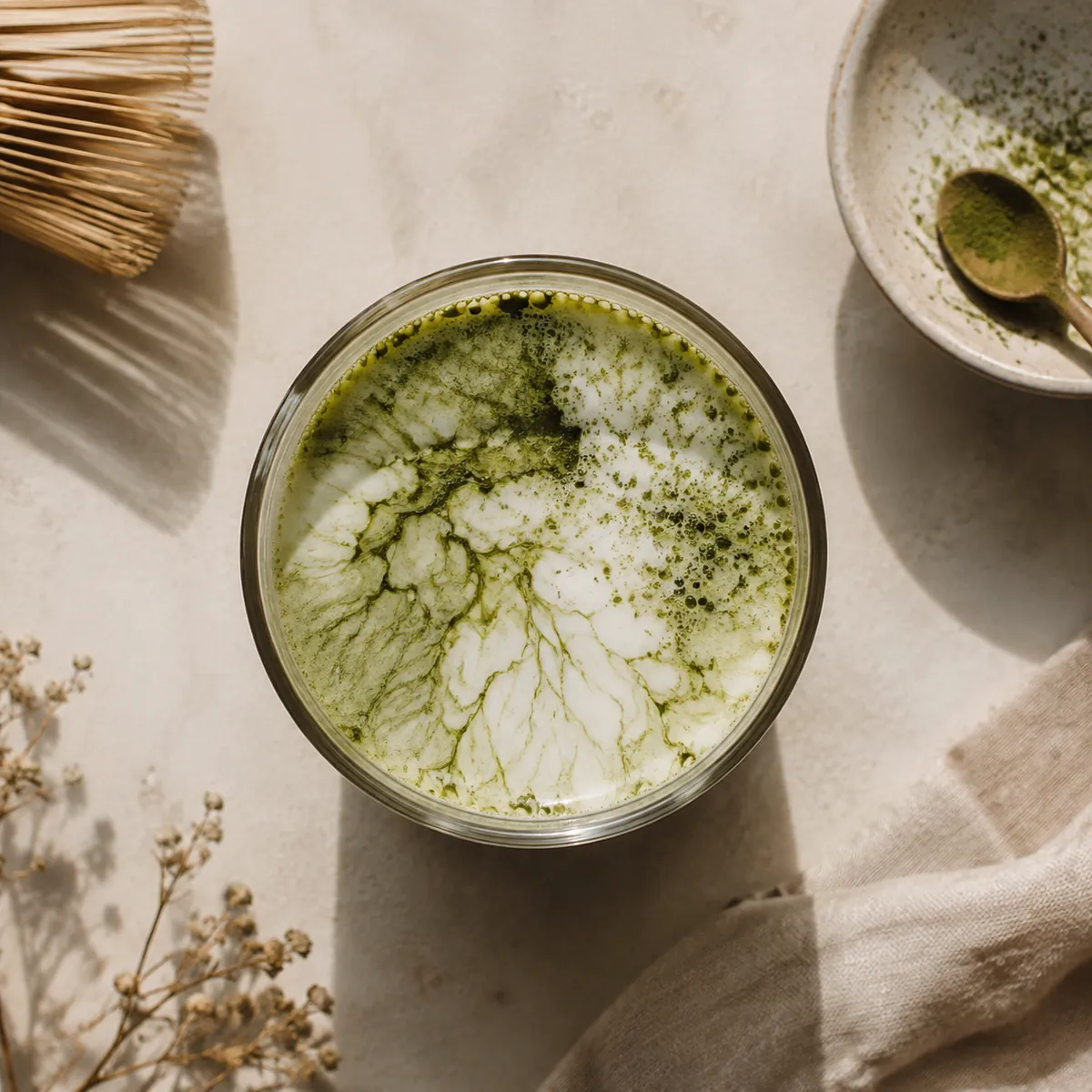
Matcha is mildly acidic and hot plant drinks are unstable in acid, so the mixture can break into a grainy, slightly sour mess that tastes of neither ingredient. That is the mechanism why plant milk curdles sets out, operating at a lower temperature than coffee needs to trigger it.
- Whisk the matcha in water first, then add milk. Never whisk powder straight into milk.
- Keep the milk under 65 C. Matcha lattes do not want coffee temperatures.
- Use a barista formulation if you are using oat, soy or almond.
- Add the matcha to the milk rather than the milk to the matcha, which curdles less.
- If it splits anyway, the milk is the variable to change, not the powder.
Barista formulations exist precisely for this, and a barista oat milk is stabilised against exactly the acidity that breaks a standard one. Temperature is the other half, since heat and acid together do what neither does alone.
A soapy or perfumed note is a different fault again and it rarely comes from the tea. Some almond milk and rice drinks carry it on their own, and it becomes obvious against something as clean and savoury as matcha.
When the powder is the limit
Everything above assumes the powder is sound, which is an assumption worth testing before another adjustment gets made at the bowl.
Culinary grade is made from later-harvest leaf and built to be tasted through milk and sugar, so whisked plain it will be astringent and thin however carefully it is prepared. That is the product working as designed rather than a technique problem, and no adjustment turns it into a drinking tea.
The reverse mistake costs more. Buying ceremonial grade for a milk drink buries the delicacy that justified the price, and a bowl and a latte want different powders rather than better and worse versions of the same one.
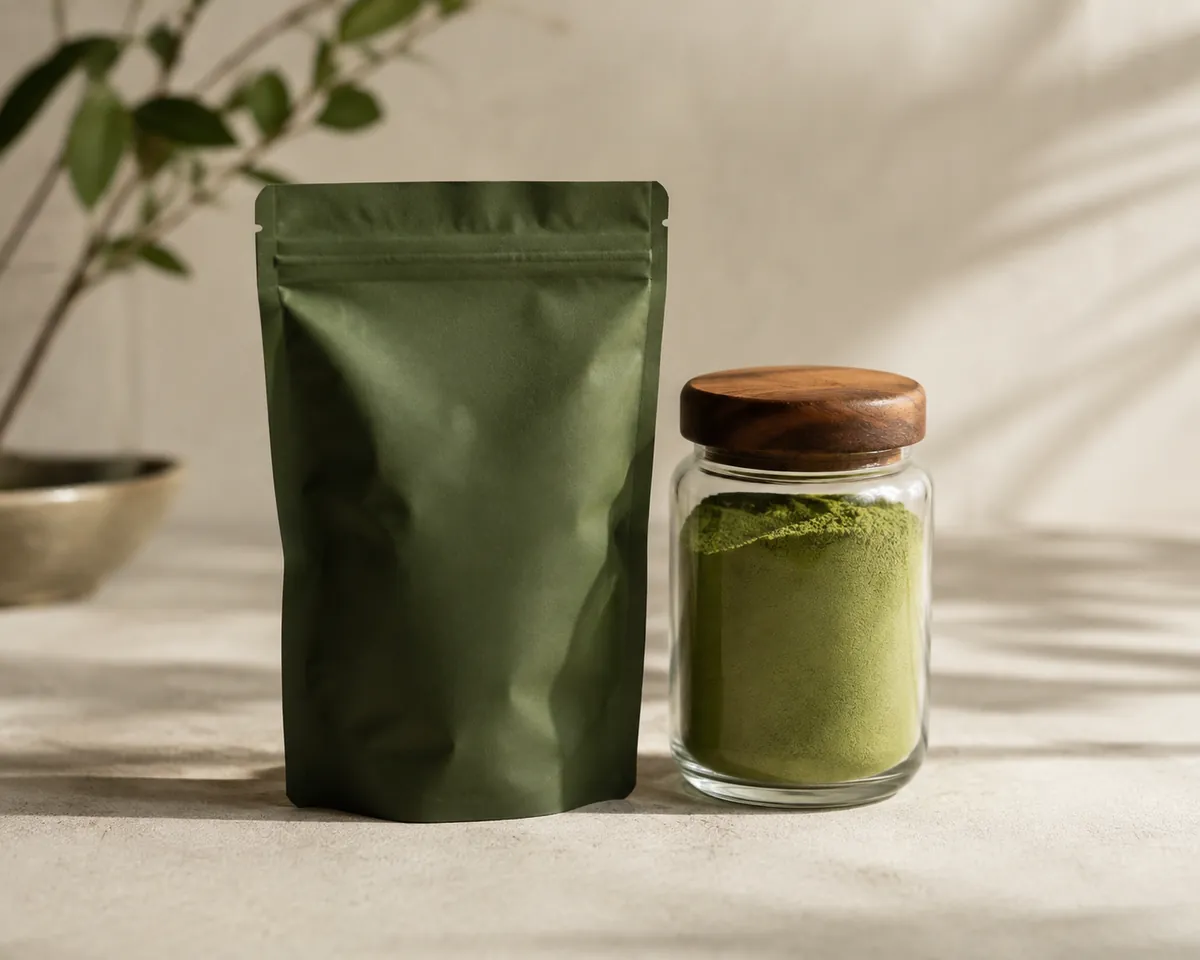
A new tin can also arrive already past its best, and nothing on the label makes that obvious. Milling is where the clock starts, good sellers mill in small runs and ship quickly, and a large importer may hold ground powder for months while the best-before date is calculated from packing rather than from the mill.
- Look for a harvest year or a milling date, not only a best-before.
- Nitrogen-flushed or vacuum-sealed packaging is a real signal of care.
- Small tins are better than large ones, since the clock restarts on opening.
- A seller who names the harvest, the region and the cultivar is usually handling it properly.
- Clear packaging is a bad sign whatever else is on the label; light degrades matcha quickly.
If a powder smells of hay on the day the seal is broken, the fault is upstream of the kitchen entirely. Buy a small tin from a new seller before a large one, because it is the only reliable test and it costs a fortnight rather than a season.
Rescuing a bowl already in front of you
Diagnosis is most of this page.
Sometimes the bowl is already made and the question is narrower: what can be done with this one, right now, before it goes down the sink.
| The bowl | What to do | What it costs you |
|---|---|---|
| Too bitter | Add about 50 ml of hot water | Weaker, but it improves more than it thins, because astringency registers harder than sweetness |
| Still harsh after dilution | Add warm milk | You now have a latte rather than a repaired bowl, which is what later-harvest powder is sold for |
| Beyond either | Bake with it, or blend it into a smoothie | It stops being a drink, but nothing is thrown away |
Dilution is the effective fix for astringency. Adding 50 ml of hot water halves the concentration of everything in the bowl, and because a drying grip registers more strongly than sweetness at low levels, the drink improves by more than it weakens.
Milk is the other route and it changes the drink rather than repairing it. The proteins bind the catechins doing the drying, which is the same reason a matcha latte is built on powder that would be harsh on its own.
What does not work is more whisking, more powder or hotter water. All three push in the direction the bowl has already gone, and adding powder to a bowl that is too astringent is the single most common instinct and the least useful one.
Changing one thing at a time
People stay stuck because they change everything at once and learn nothing from the result.
Make two bowls from the same tin and alter exactly one variable between them: the water temperature, or the dose, or sifted against unsifted. Taste them side by side rather than a day apart, since memory does the comparing very badly across that gap.
Four experiments that cover almost everything
- TemperatureOne bowl at boiling, one at 75 C. Same powder, same dose, back to back.
- DoseTwo level scoops against one heaped teaspoon, both at 70 ml.
- SiftingSifted against straight from the tin, everything else identical.
- VesselA wide bowl against a mug, whisked the same way for the same time.
Four experiments take about twenty minutes in total and produce something more durable than a better bowl. What they leave behind is a diagnosis you can reuse, which matters because the next tin will behave slightly differently from this one.
The same discipline is what separates a real fault from a preference. A bowl that is too astringent for you at 75 C may be exactly right for somebody else, in the same way green tea bitterness divides people who brew the identical leaf at the identical temperature.
Common questions
Why is my matcha so bitter?
Most often water temperature. Matcha wants 70 to 80 C and boiling water scalds it. Using too much powder is the next most likely cause: 2 g per 70 ml is a standard serving and a heaped teaspoon is nearly double that.
Why is my matcha gritty even after whisking?
Clumps. Matcha compacts in the tin and the outside of a clump wets while the inside stays dry, so whisking moves them around rather than breaking them. Sift it through a fine sieve before adding any water.
Why does my matcha taste of hay?
It has oxidised. That is not a technique problem and no brewing adjustment recovers it. Check the colour: dull olive or brown-green means the powder is spent and only fit for baking or a latte.