Which Cinnamon Belongs in a Drink, Cassia or Ceylon?
Most of what is sold as cinnamon is cassia, a related bark that is harder, hotter and roughly twice as assertive. In a drink that difference decides the recipe.
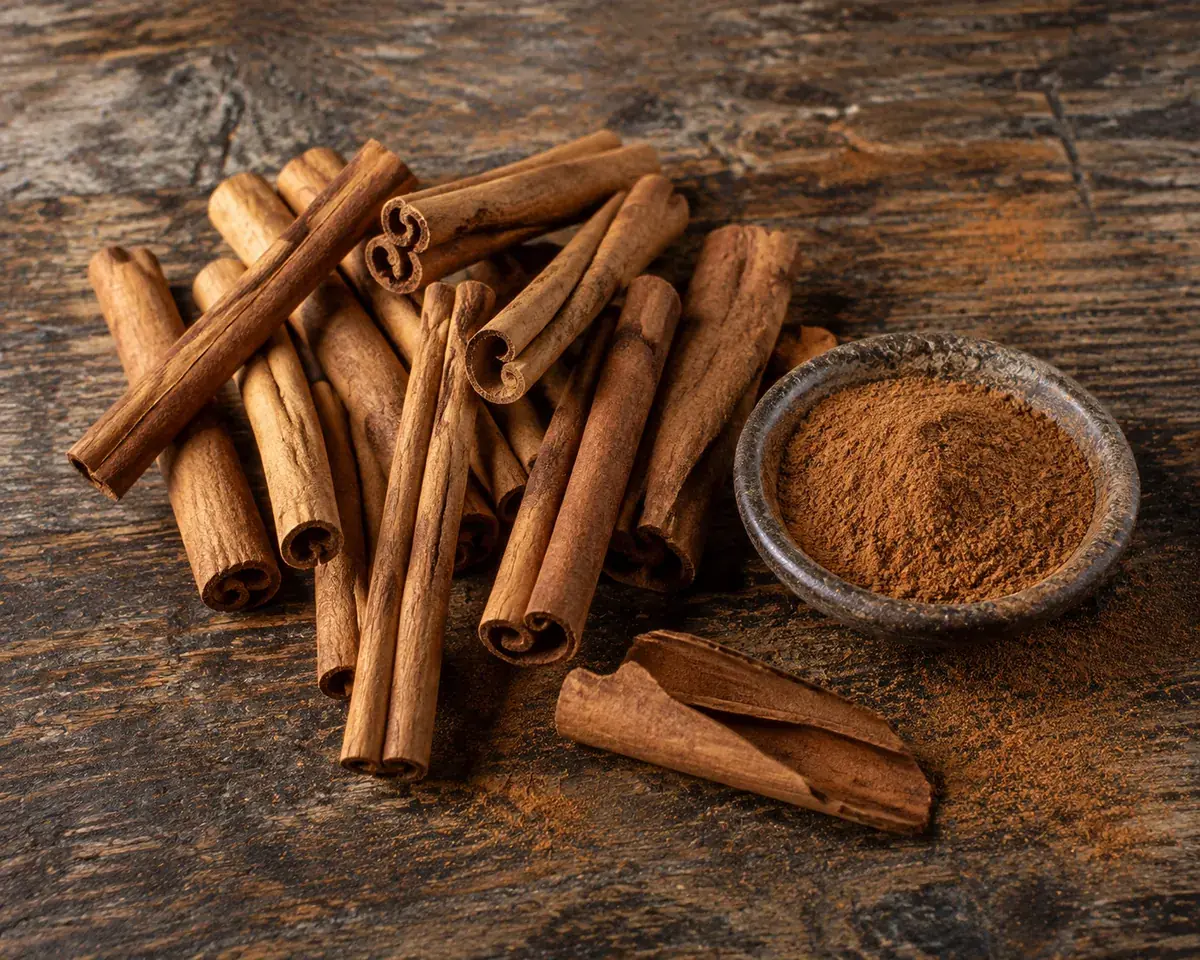
Two different barks are sold as cinnamon, and telling them apart matters far more in a drink than in baking, where sugar and fat blunt the difference between them.
True cinnamon, Cinnamomum verum, is also called Ceylon cinnamon or canela. Cassia, from several related species, is what most shops sell simply as cinnamon.
They are not graded versions of the same thing: they come from different trees, they are processed differently, and one is roughly twice as strong as the other.
Cinnamon in a drink, at a glance
- Two species groups
- Ceylon, from C. verum. Cassia, from three other Cinnamomum species
- Strength
- Cassia is about twice as assertive as Ceylon
- Flavour compound
- Cinnamaldehyde, which is volatile and fades quickly once ground
- Dissolves
- Not at all. Ground cinnamon floats or settles, never disperses
- Extraction
- Needs simmering, not steeping. Bark is dense and the oils are not water-soluble cold
- Stick keeps
- A year or more sealed. Ground fades in three or four months
- Cold drinks
- A syrup, or a long cold steep. Never a dusting
Two barks, one word on the label
Identification takes a second once you know what to look at, which matters because labels routinely fail to distinguish them.
| Cassia | Ceylon | |
|---|---|---|
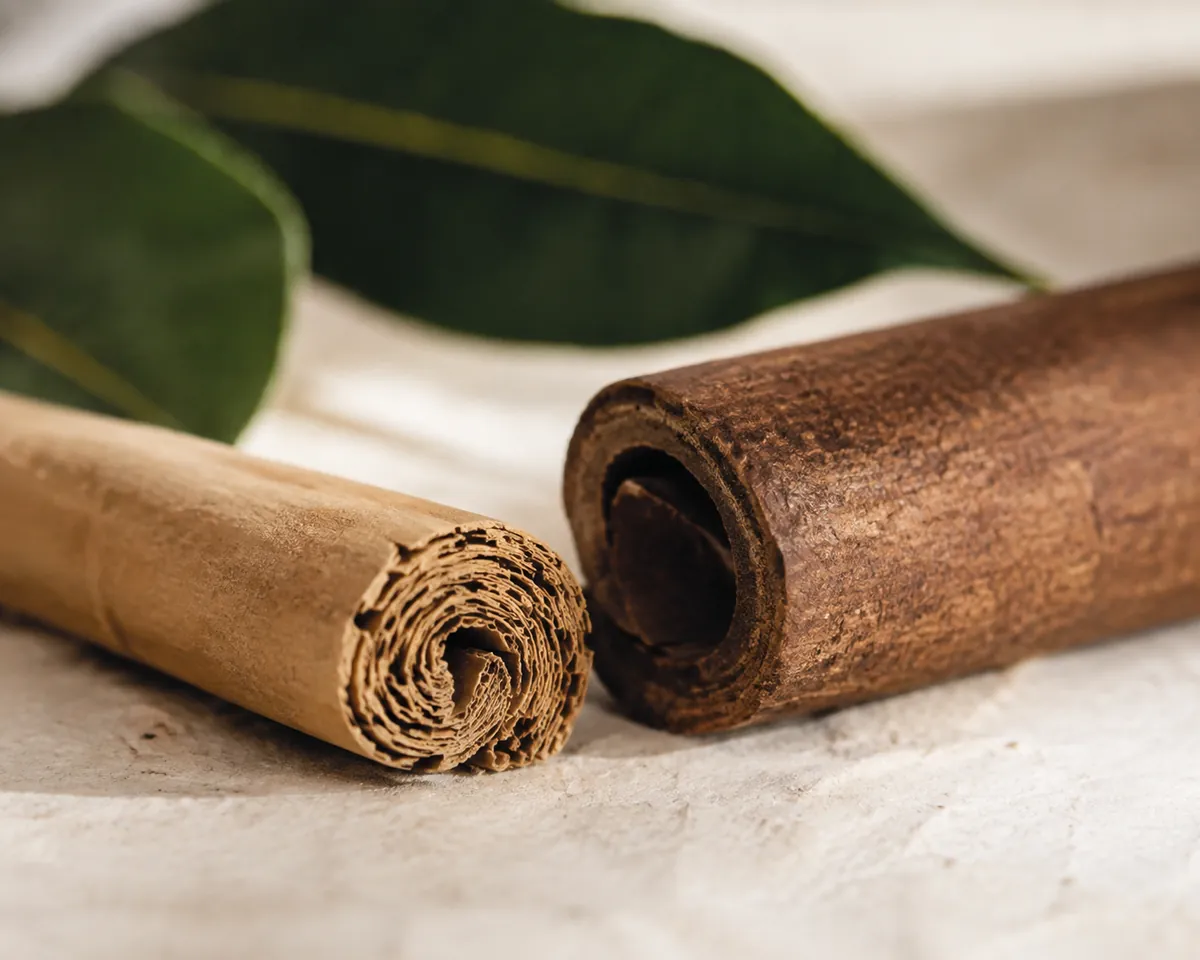
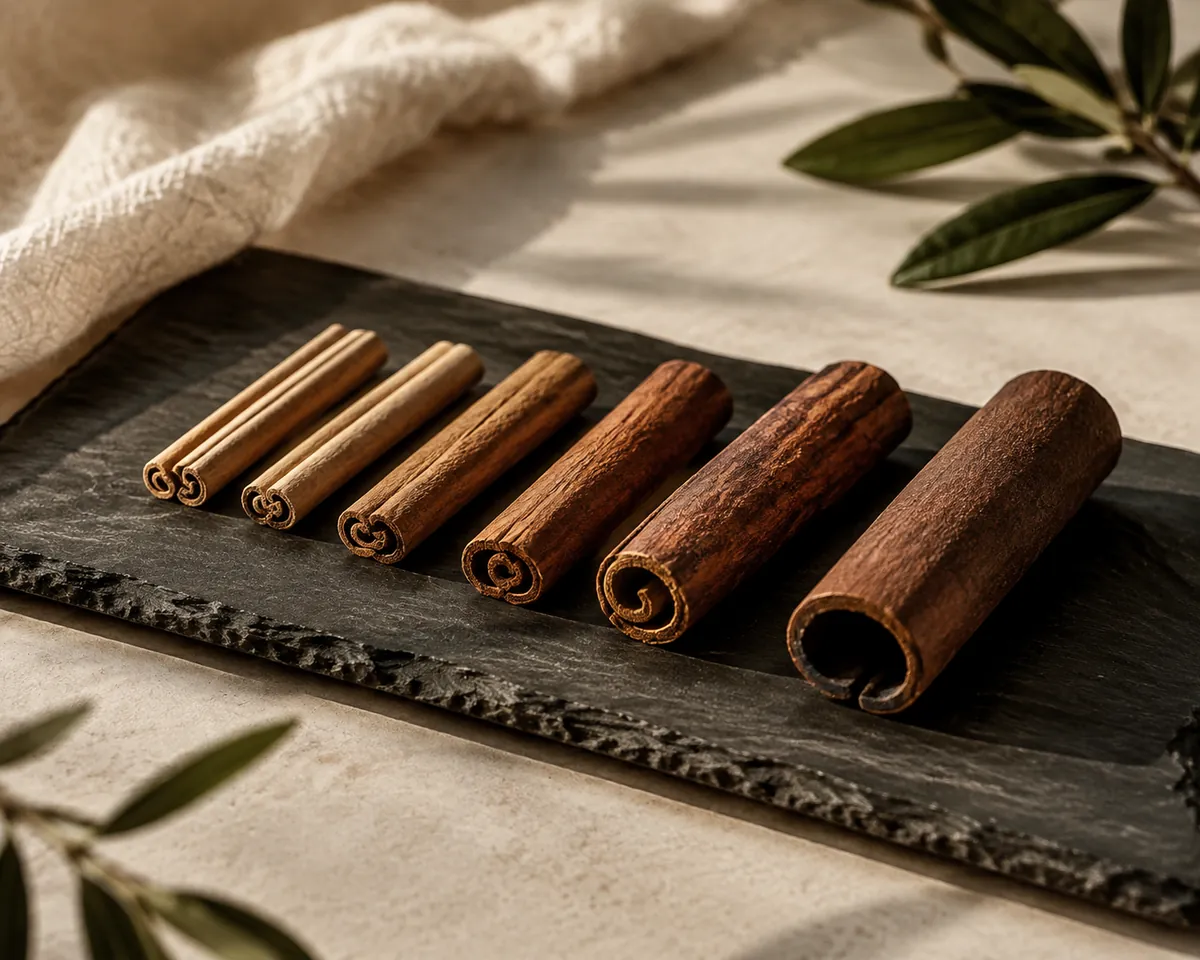
| The quill | One thick, hard, tightly curled layer | Many thin papery layers, like a cigar |
| Colour | Dark red-brown | Light tan |
| Snapping it | Hard. It resists | Crumbles easily between the fingers |
| Flavour | Hot, sharp, intense | Delicate, floral, sweeter |
| Ground | Darker and redder | Paler and browner |
| Price | Low | Noticeably higher |
The layers are the giveaway. A stick that looks like a single rolled tube is cassia; one that looks like rolled paper is Ceylon.
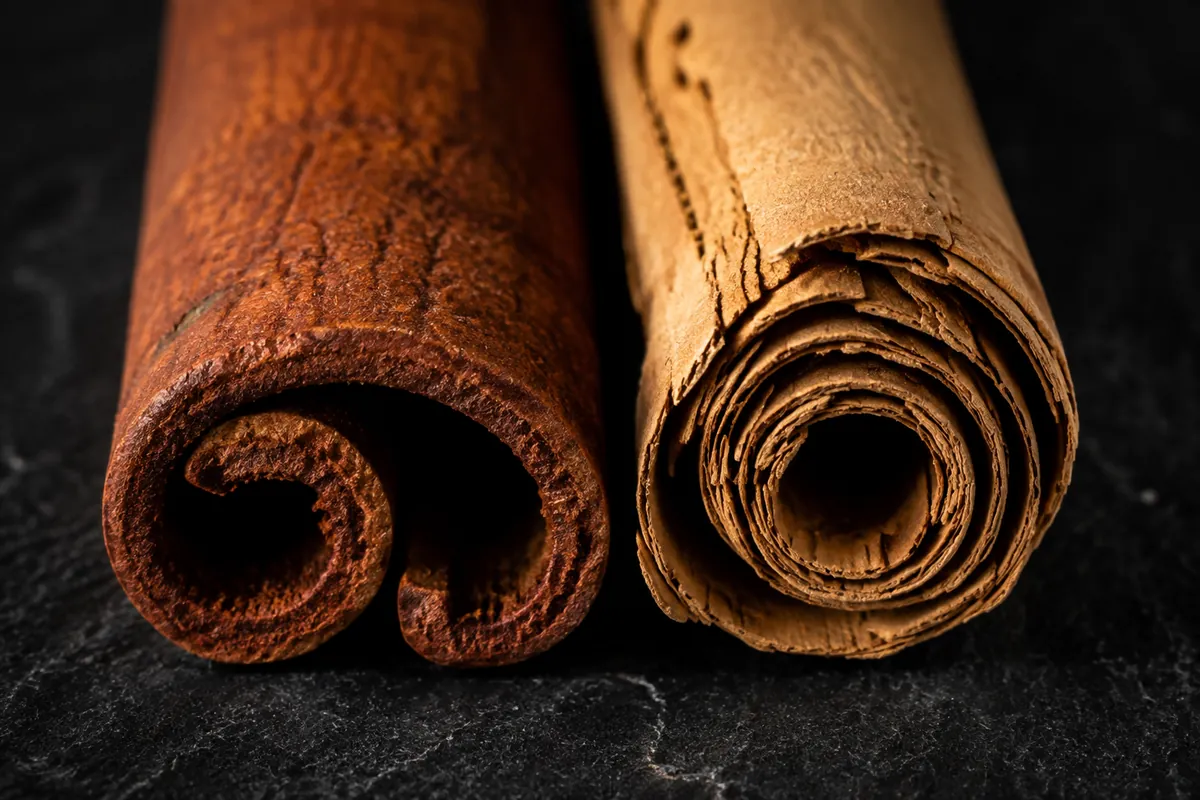
Which one belongs in a given drink follows from whether cinnamon is meant to lead or support. Cassia is roughly twice as assertive, so the two are not interchangeable by count, and a recipe written for Ceylon and made with cassia comes out tasting of cinnamon and very little else.
Ceylon
Delicate infusions, milk drinks, Mexican hot chocolate, anything where cinnamon plays a supporting part.
Either
Coffee, where the dose matters considerably more than the species does.
Neither, ground
Cold drinks. Ground cinnamon does not dissolve and floats as scum on the surface.
Why the quills look so different
Processing explains every physical difference on this page, and the two barks are handled in almost opposite ways.
Ceylon is cut from young shoots. The rough outer bark is scraped off so that only the thin inner bark is used, and those damp sheets are laid inside one another and rolled by hand into a quill that dries into the familiar papery, multi-layered stick.
Cassia is stripped from older bark in thicker pieces and simply dried, and the piece curls into a single hard tube on its own with no rolling and no scraping at all. That is the whole reason a Ceylon quill crumbles where a cassia stick resists a knife: one is layers of thin inner bark, the other is a slab of whole bark with the woody outer layer still attached.
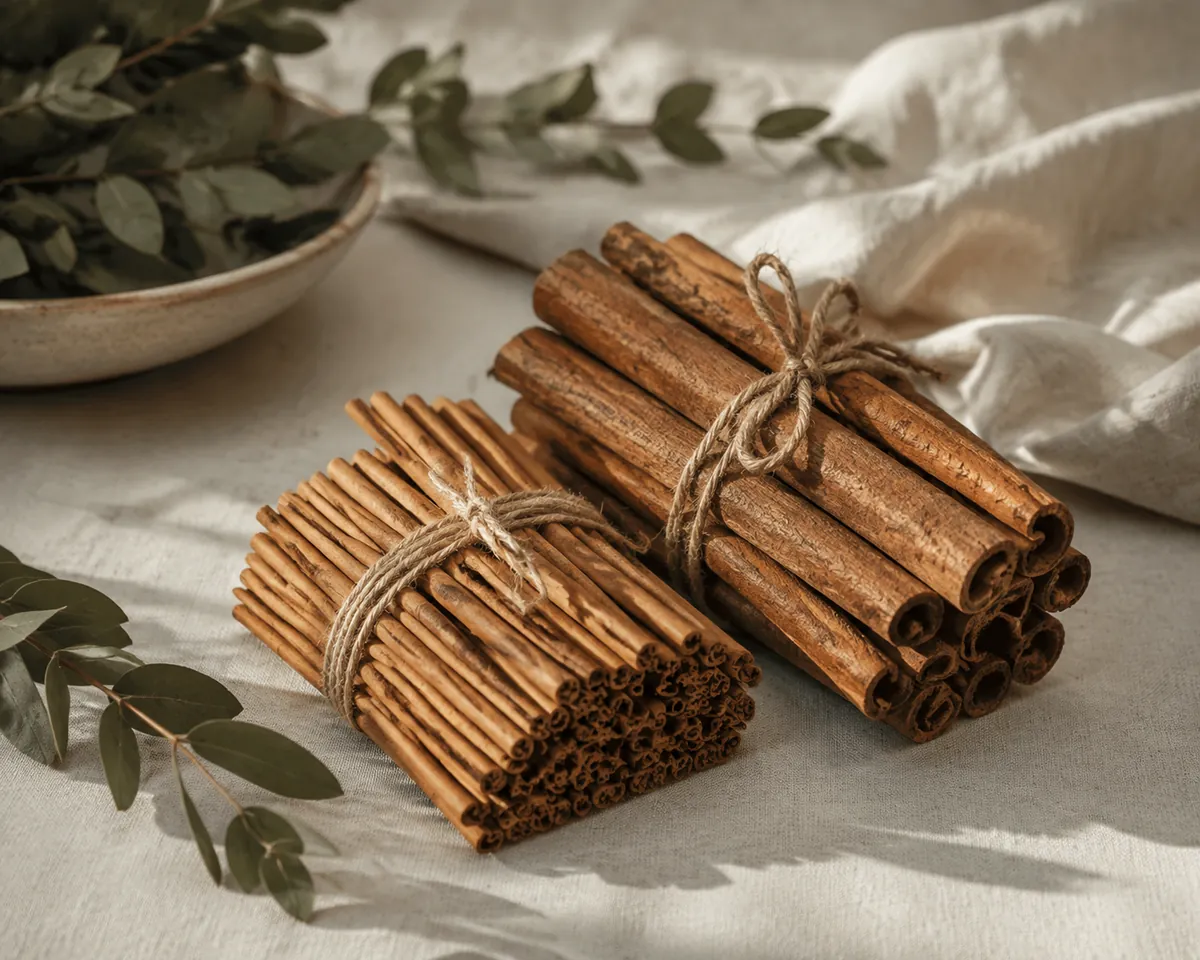
Because Ceylon is rolled by hand from graded sheets, it can be sorted by diameter in a way cassia cannot.
Ceylon grades, finest first
- Alba
- Under 6 mm diameter. The finest and most expensive
- Continental
- 6 to 16 mm, in several sub-grades
- Mexican
- Slightly coarser, and the grade traditionally exported to Mexico
- Hamburg
- The coarsest quills, often bought for grinding
- C5, M5, H1
- Sub-grade codes within those bands, by diameter and quill count
Those grades describe thickness rather than quality. A thinner quill comes from a younger shoot and carries proportionally more delicate inner bark and less woodiness, so the flavour gap between Alba and Hamburg is real and much narrower than the price gap.
For anything simmered alongside other spices, a mid-grade is the sensible buy.
The four barks actually on the shelf
Cassia is not a single plant. Three species are sold under the name and they differ from one another nearly as much as they differ from Ceylon, which is why two jars both labelled ground cinnamon can taste noticeably unalike.
| Species | Sold as | Origin | Character |
|---|---|---|---|
| C. verum | Ceylon, true cinnamon, canela | Sri Lanka, southern India | Delicate, floral, citrus notes |
| C. cassia | Chinese cassia | China, Vietnam | Sharp, hot, the standard cassia |
| C. burmannii | Korintje, Indonesian | Sumatra | Sweet and mild for a cassia. Most US supermarket cinnamon |
| C. loureiroi | Saigon, Vietnamese | Vietnam | Highest in cinnamaldehyde. Intensely hot and sweet |
Saigon is the one worth going out of your way for if you want cassia at its best. It carries noticeably more cinnamaldehyde than Chinese cassia and reads as sweeter rather than merely hotter, which is exactly what a spiced syrup or a mug of maple-sweetened coffee wants.
Korintje is what most jars marked simply ground cinnamon contain, particularly in North America, and it is the mildest of the three cassias. That is a large part of why so few people ever notice the species distinction: the cassia they have met is the gentle one, and the gap to Ceylon is smaller than the table above suggests.
Stick or ground, and how fast each fades
Form decides both the flavour and whether the cinnamon works at all, which makes it the more consequential choice of the two.
A stick infuses cleanly. Its oils release slowly into hot liquid, the bark holds together, and it can be lifted out when the flavour is where you want it.
Ground cinnamon does not dissolve in anything: in a hot drink it suspends briefly and settles, and in a cold one it floats. That single fact is why cinnamon belongs in the grounds before brewing, or in a syrup, rather than dusted onto a finished cup.
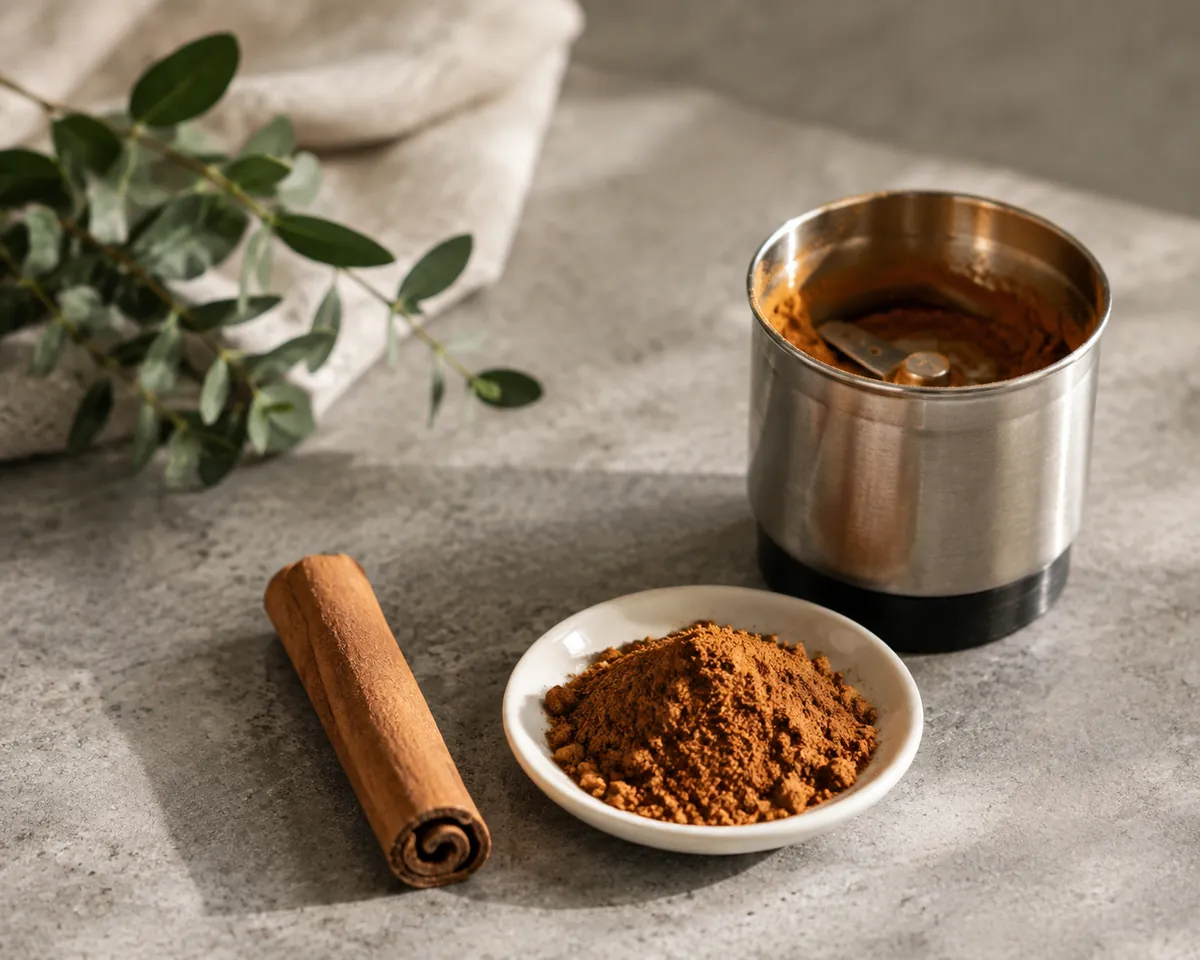
Fading runs on a schedule set entirely by form. Whole quills hold for a year or more sealed away from light, because the bark is itself the packaging, while ground cinnamon starts losing aromatics the moment it is milled and is flat within three or four months.
The test is the packet: cinnamon you have to hold to your nose has gone, and no quantity of it will flavour a drink properly. The same logic governs keeping loose tea, where surface area and air do the damage rather than time alone.
Used sticks can be rinsed, dried and given one more pass at a milder infusion. A stick simmered twice has very little left in it, so the second outing belongs somewhere cinnamon is a background note rather than the subject.
Getting flavour out of something this dense
Bark does not give up its oils to a soak, and that constraint decides every method below.
Simmering is the direct route for a hot drink: five to ten minutes with the stick in the liquid produces a clear, rounded flavour. Steeping without heat extracts almost nothing, because the material is dense and its oils are not water-soluble at room temperature, which is the same constraint that makes ginger tea a decoction rather than an infusion.
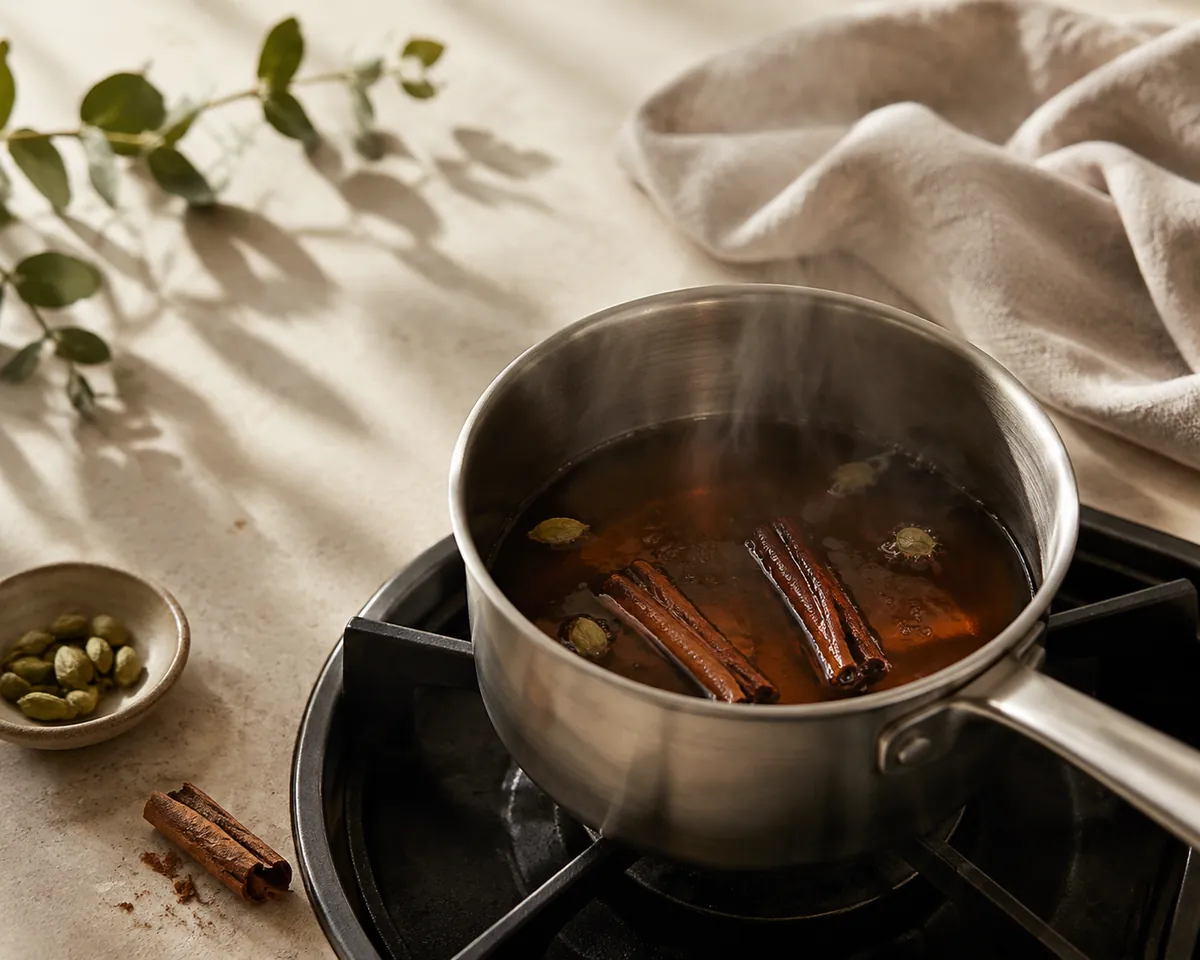
Cinnamon syrup
- Cinnamon
- 2 cassia sticks, broken, or 4 Ceylon quills
- Sugar and water
- 200 g each
- Method
- Simmer 10 minutes with the bark in, then cool and strain
- Keeps
- About three weeks refrigerated
- Use
- Anything cold, where ground cinnamon would float
Working amounts, per litre of drink
- Chai, cassia
- 1 stick, broken, simmered with the other spices
- Chai, Ceylon
- 2 quills, for the same effect
- Mulled apple, cassia
- 2 sticks, and remove them after 20 minutes
- Cinnamon in coffee grounds
- A pinch of freshly ground, per cup, before brewing
- Simmering time
- 10 minutes for a stick. Longer turns it woody and bitter
Over-simmering is the fault nobody expects, since bark looks like something that cannot be over-extracted. Past about fifteen minutes cassia turns dry and tannic in exactly the way an over-steeped black tea does, so lifting the stick out is part of the recipe rather than tidying up afterwards.
The same ten-minute ceiling applies when the bark is simmered into a masala chai alongside stronger spices. A mulled drink left on the hob with its spices in gets harsher for as long as it sits there.
Cold drinks are a syrup problem
Everything that makes cinnamon work in a hot drink stops working the moment the liquid is cold, and there are only three responses.
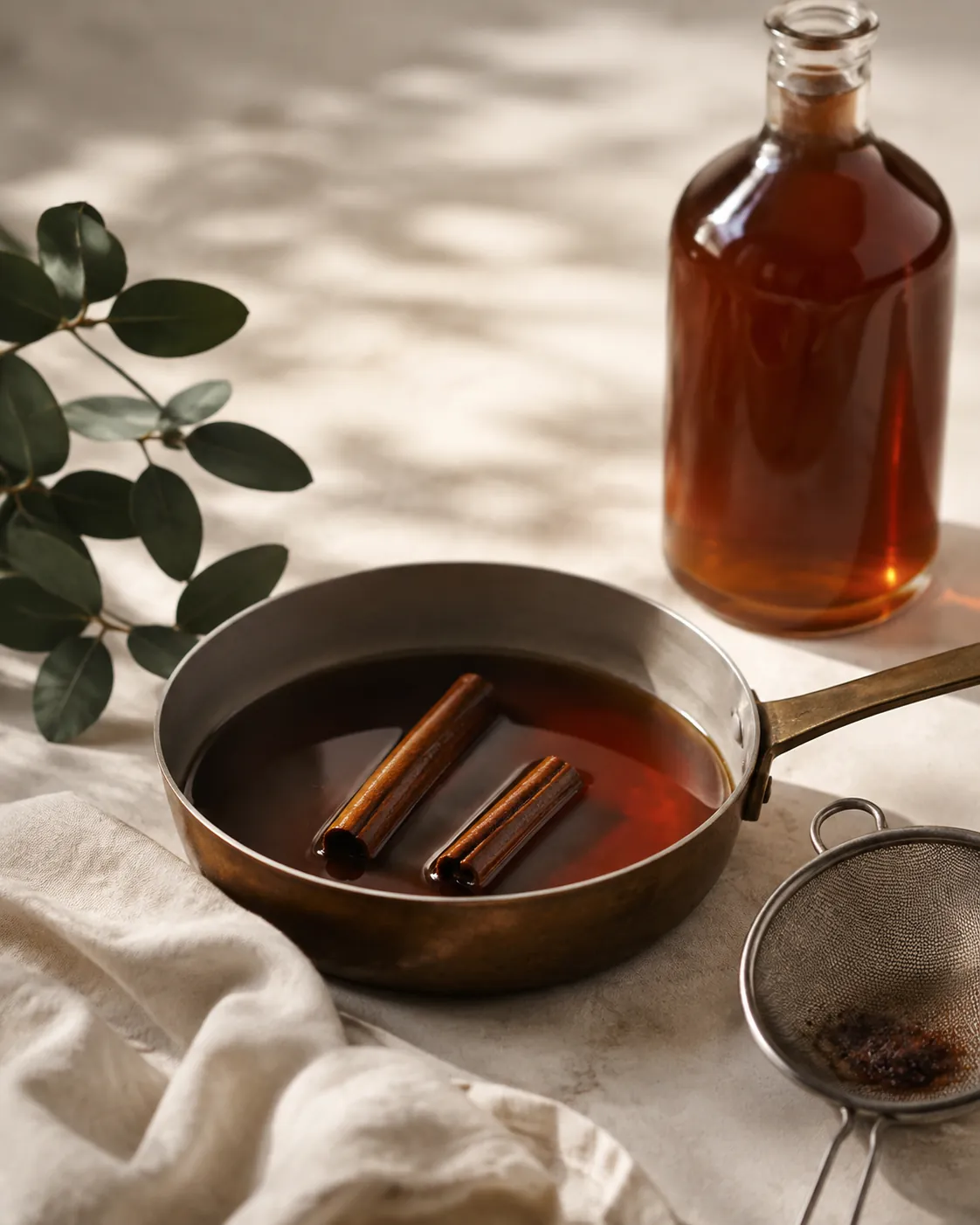
The syrup above is the reliable one, and it is the only route that puts cinnamon evenly through a cold glass. Three weeks in the fridge covers an iced coffee habit, an Italian soda or a jug of cold-brewed tea, and it doses like a flavoured simple syrup, which is exactly what it is.
Infusing the milk is the second and the most overlooked: warm milk with a broken stick for ten minutes, strain it, and you have an evenly flavoured milk that still steams and foams normally for a latte.
Dusting is the third, and it is a garnish rather than a flavouring. Powder sits on foam, so a dusted cappuccino tastes of cinnamon on the first sip and of coffee for the rest of the cup.
The exception worth knowing is cold brew, where twelve hours of contact does the work heat would otherwise have to. A broken stick dropped in with the grounds at the start gives a clean, evenly spiced brew with none of the grit, because time has substituted for temperature in the same way it does in a cold-steeped tea.
In coffee, and why dusting fails
Cinnamon and coffee is the commonest pairing on this page and the one most often done in the way that works least well.
Sprinkling ground cinnamon over a finished cup puts it exactly where it cannot help: on the surface, where it neither dissolves nor disperses, so the first mouthful is spiced and the remaining nine are not.
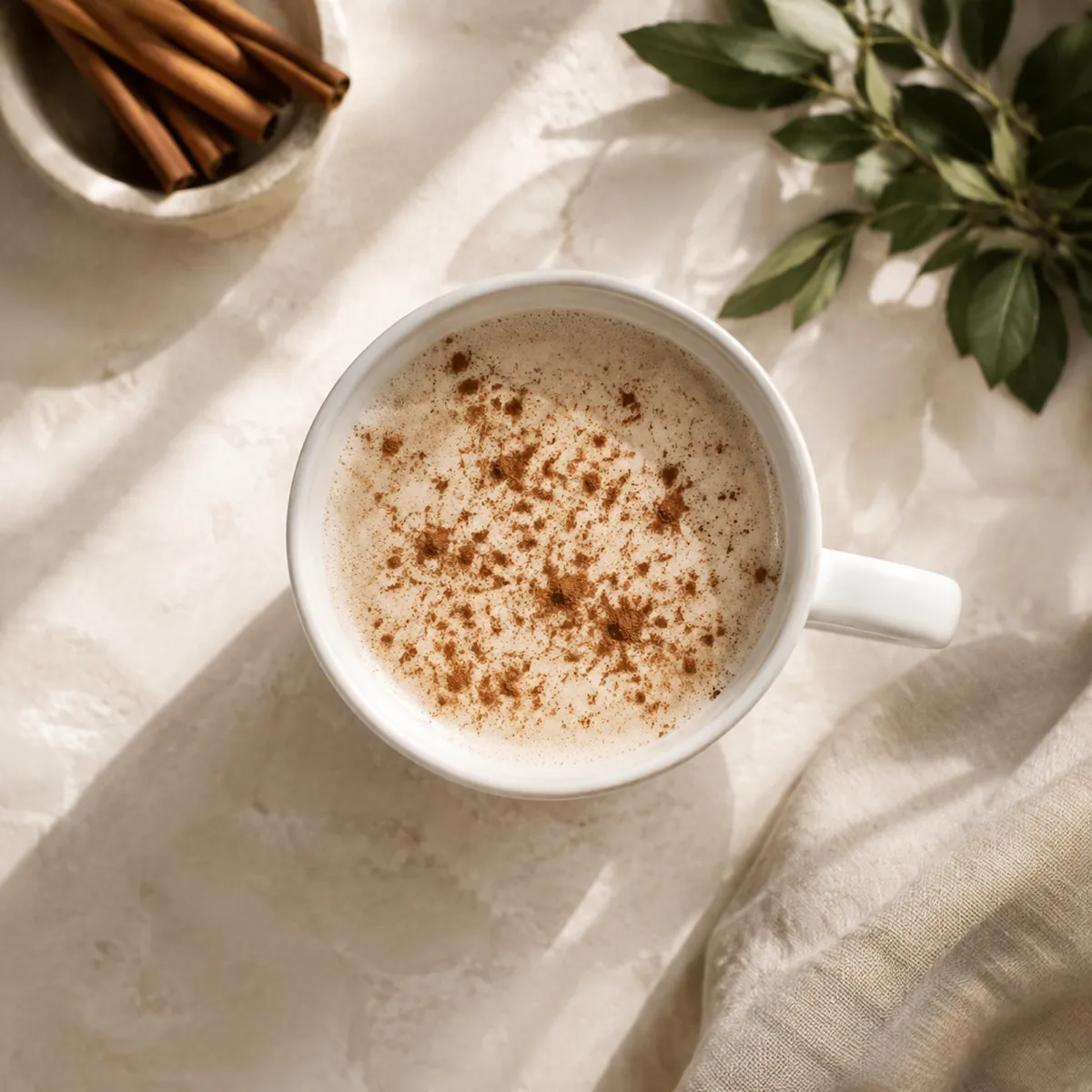
Three ways that do work
- In the grounds
- A pinch of freshly ground cinnamon per cup, stirred into the dry coffee before brewing
- In the pan
- One broken stick simmered with the water for a Turkish or decoction-style brew
- As a syrup
- 10 to 15 ml of the syrup above, which is the only route that works in an iced coffee
- In the milk
- A stick warmed in the milk for ten minutes, then strained
- Not on top
- Ground cinnamon dusted on foam is a garnish, not a flavouring
Brewing it with the grounds is the cleanest method for filter coffee, since the cinnamon meets hot water for the whole brew time and the paper catches the particles, so the cup ends up flavoured rather than gritty. A French press does the same job with a coarser result, because the mesh lets the fines through.
Roast level then sets the dose. A dark roast needs an assertive cinnamon to register at all against its own bitterness, while a light roast is overwhelmed by half as much, and that gap is wider than the gap between the two species.
Oil, extract and powder
Three concentrated forms exist, they behave nothing like each other, and none of them is a dilution of another.
Extract is bark steeped in alcohol. It carries the aroma without the texture problem, which makes it the one form that will flavour a cold drink evenly with a few drops, where no amount of powder ever will.
Cinnamon oil is the essential oil and it is enormously stronger again: recipes that call for it work in single drops, and treating it like extract produces something inedibly hot rather than merely strong.
Powder keeps one clear advantage, and it is about suspension rather than solubility. In something thick enough to hold particles, such as a stovetop cocoa or a smoothie, ground cinnamon stays distributed instead of settling out, and it contributes texture as well as flavour.
In anything thin and clear it is the wrong form, and the recipe wanted one of the other two.
Buying it, and what the packet tells you
Cinnamon is cheap enough that buying well costs almost nothing, which makes the usual arguments about value irrelevant here.
- Look at the quill: many thin layers is Ceylon, one thick tube is cassia.
- Check for the words Ceylon, true cinnamon or canela if you want the delicate one.
- Buy sticks rather than ground, and grind as you need it.
- Smell it through the packet. Good cinnamon is sweetly aromatic; old cinnamon smells of dust.
- Buy small quantities of anything already ground, since it fades within months.
Most supermarkets stock only cassia and label it cinnamon, so Ceylon generally means a spice shop or an order placed online. That trip is worth making once if you drink delicate infusions or make Mexican-style chocolate, where the whole point of the drink is that the cinnamon supports rather than dominates.
In an ordinary hot chocolate the distinction matters far less, since cocoa is loud enough to absorb either bark.
Whole sticks are also the more forgiving purchase for anyone who uses cinnamon occasionally. A jar of ground bought for one recipe is stale before the second, whereas quills bought at the same time are still worth grinding a year later, and they pair with cardamom pods bought on the same principle.
Coumarin, stated and left there
One compositional difference between the two barks is worth stating plainly and without drawing any conclusion from it.
Cassia contains coumarin, a naturally occurring compound, at levels substantially higher than those found in Ceylon cinnamon. Several national food safety bodies have published guidance on it, and that guidance is the reason Ceylon is sometimes specified by name in recipes that would otherwise be indifferent to the species.
For the purposes of this page the difference that matters is the one you can taste and the one you pay for: cassia is stronger and cheap, Ceylon is more delicate and dearer, and which of those a drink wants is a question about flavour.
Common questions
What is the difference between cassia and Ceylon cinnamon?
Cassia is a thick single-layered hard quill, dark red-brown, hot and roughly twice as assertive. Ceylon is a thin many-layered quill that crumbles easily, light tan, delicate and sweeter. Most cinnamon sold is cassia.
Which cinnamon should I use in drinks?
Ceylon where cinnamon supports other flavours, such as Mexican hot chocolate or milk drinks. Cassia where cinnamon leads, such as chai, mulled drinks or a spiced syrup that must survive dilution.
Why does ground cinnamon float on my drink?
It does not dissolve in anything. In a hot drink it suspends briefly then settles; in a cold one it floats. Simmer a stick instead, or make a cinnamon syrup, and add ground cinnamon to coffee grounds before brewing rather than to the cup.