What Is Rooibos? A South African Shrub, and Not a Tea
Rooibos is an infusion made from a shrub that grows in one region of South Africa. It is not tea, contains no caffeine, and is almost impossible to over-steep.
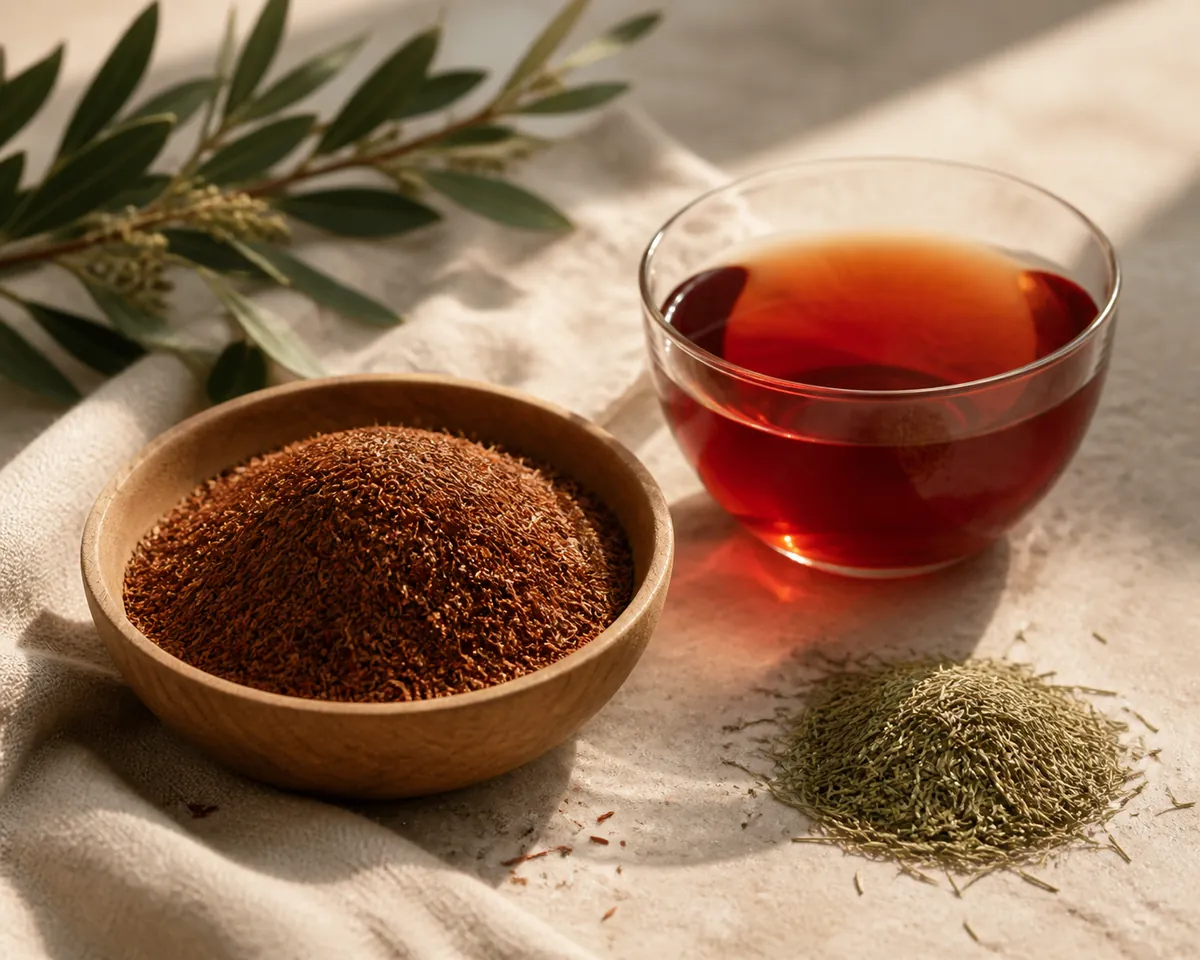
Rooibos is made from Aspalathus linearis, a needle-leaved shrub in the legume family. It grows commercially in one place: the Cederberg region of South Africa's Western Cape, where the combination of acidic sandy soil and a hot dry summer suits it.
Because it is not the tea plant, calling rooibos a tea is a convenience of language. The more precise word is tisane, and it explains the two things people most want to know: there is no caffeine in it, and it does not behave like tea in the pot.
Rooibos at a glance
- What it is
- An infusion of the needle-like leaf and fine stem of a fynbos shrub
- Where it grows
- The Cederberg, South Africa. Nowhere else at commercial scale
- Two forms
- Red, oxidised before drying. Green, dried straight away
- Caffeine
- None, and none was ever removed
- Tannin
- Low, which is why it will not turn bitter or curdle milk
- Water
- Fully boiling, five to ten minutes
The plant, and why it grows in one place
Aspalathus linearis is a fynbos shrub adapted to ground that would starve most crops: poor, acidic, sandy soil under a long dry summer. It fixes its own nitrogen, which is how it survives there, and its leaves are needles rather than blades.
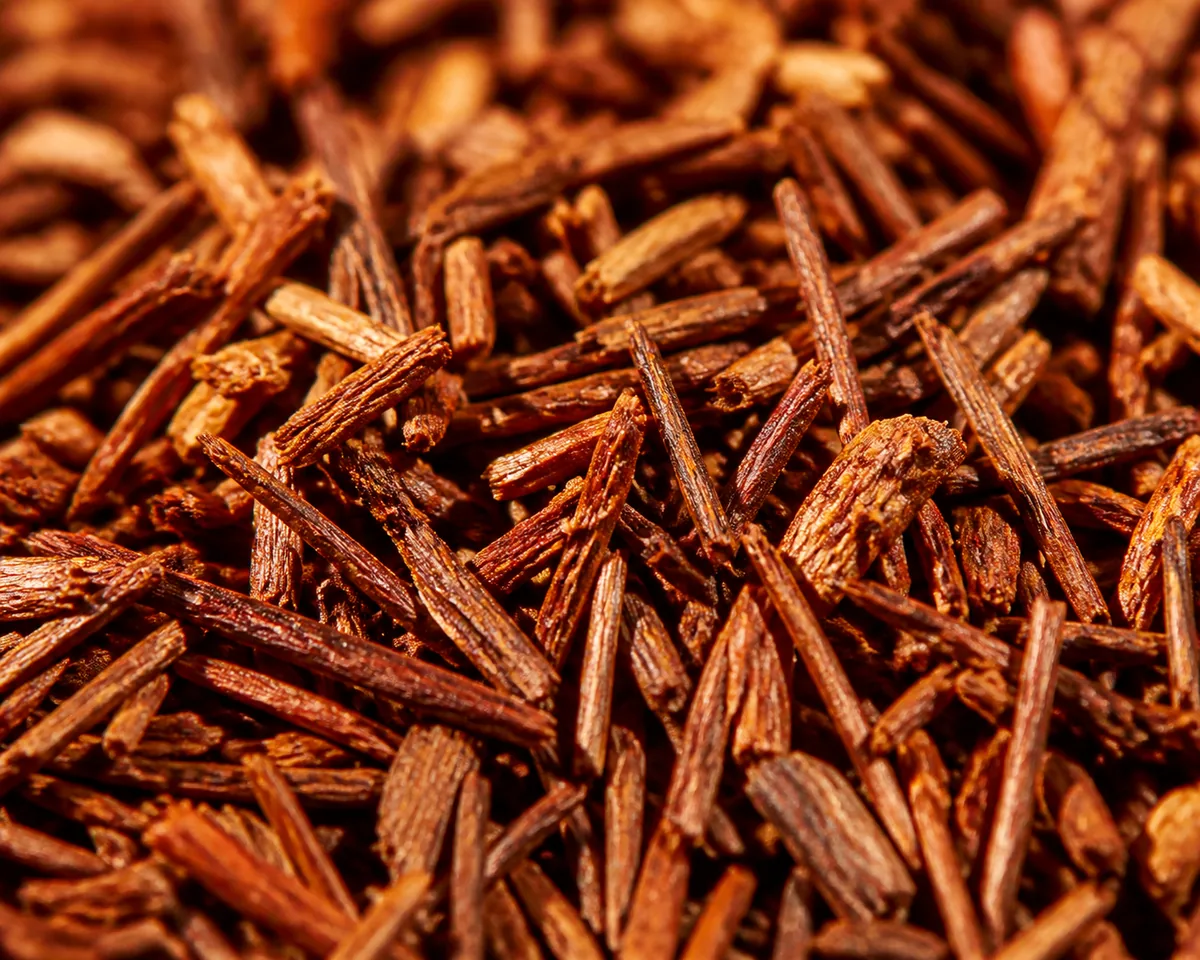
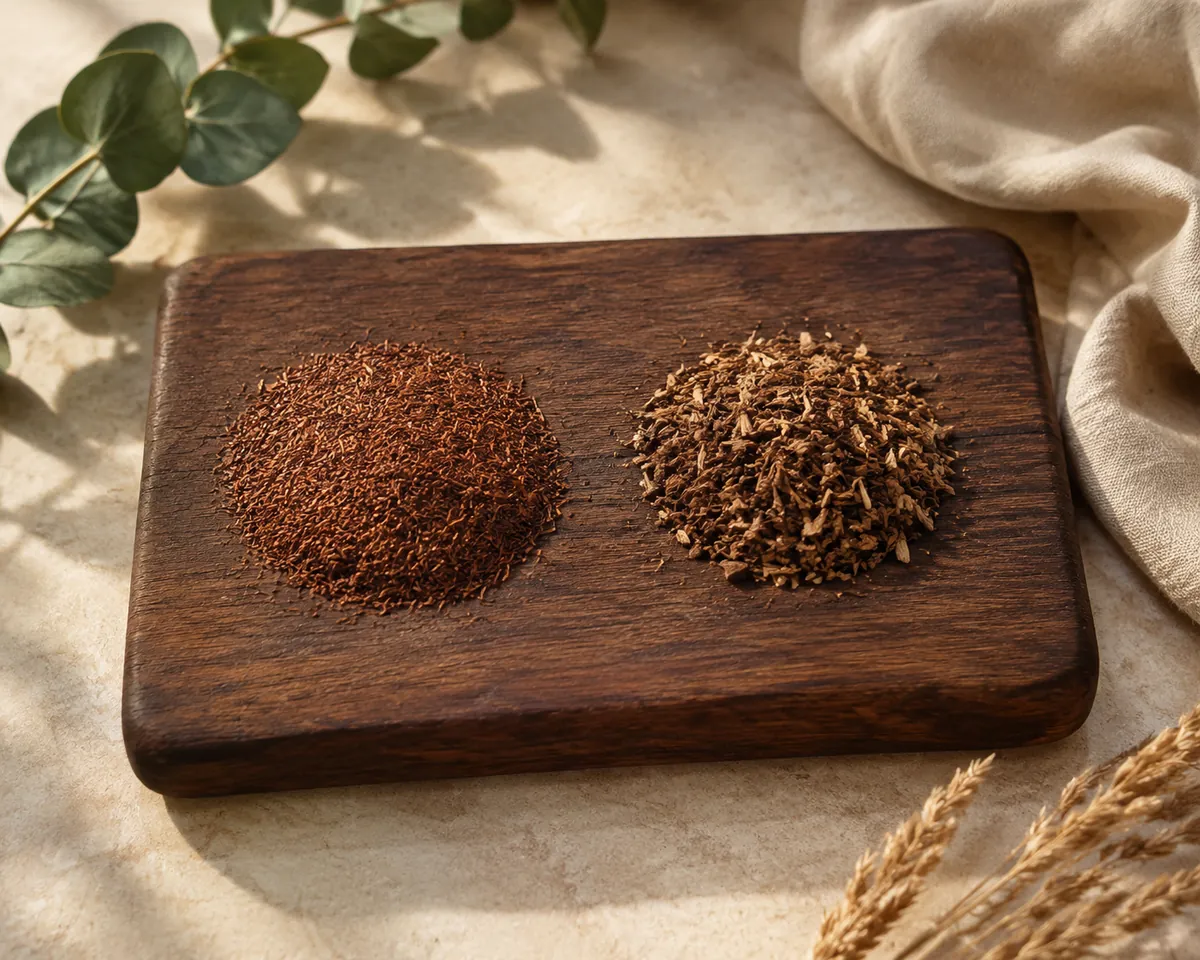
That is why dry rooibos looks like fine chopped twigs rather than like tea.
Growers outside the Cederberg have tried repeatedly and not succeeded at scale. That makes rooibos one of the very few drinks with a genuinely single origin, and it is the basis of its protected designation in South Africa.
The consequence is that rooibos reached the rest of the world late. It was drunk locally in the Cederberg long before anyone traded it, and until the 1930s the plant was gathered from the wild rather than farmed, which caps an industry at the size of whatever grows on its own.
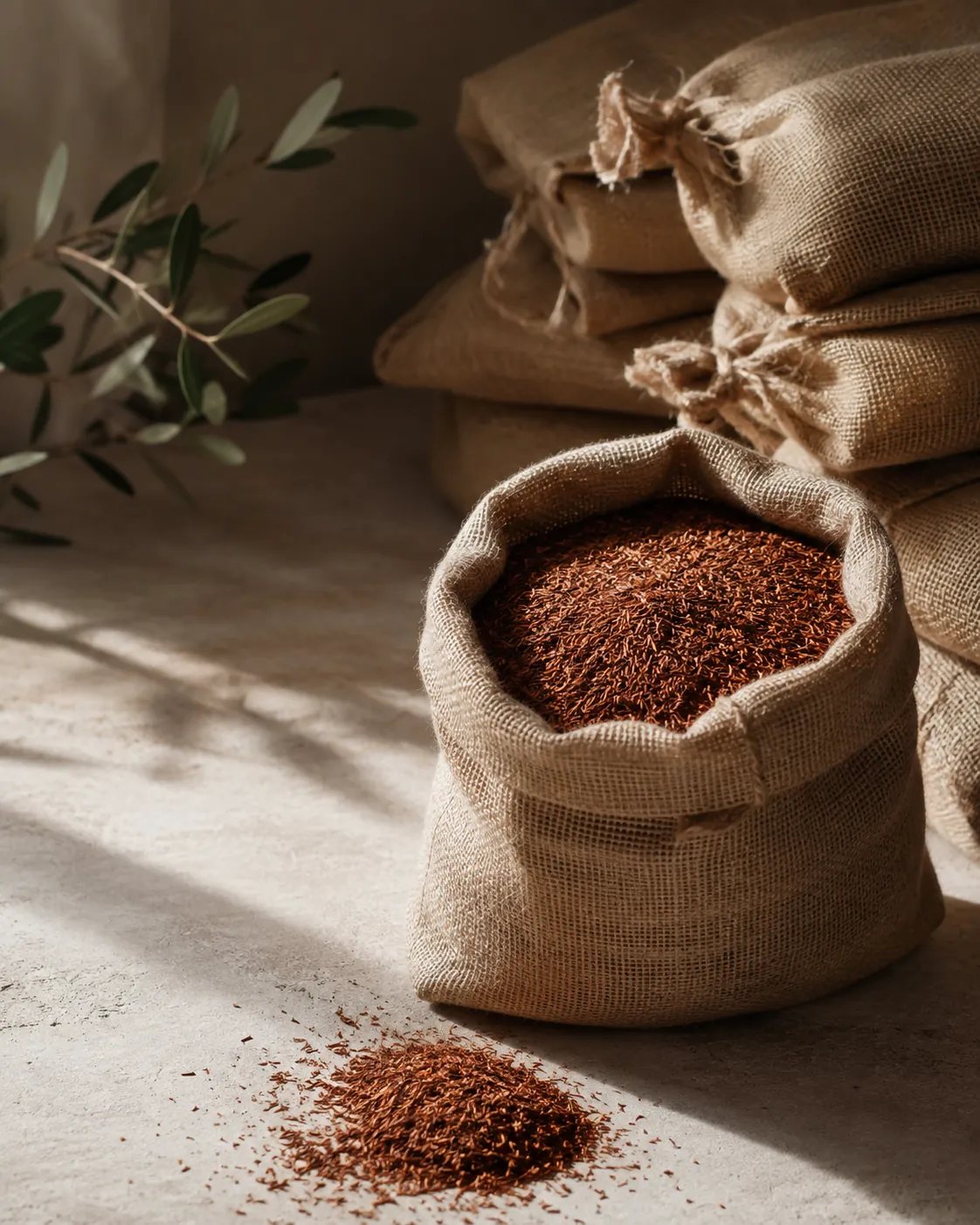
Commercial cultivation began after a botanist and a local doctor worked out how to germinate the seed reliably. Exports grew slowly for decades and then accelerated sharply from the 1990s, driven by demand for caffeine-free drinks in Europe and North America.
That is recent enough that rooibos is still absent from a great deal of older tea writing.
Red and green, and what the oxidation does
After harvest, the leaves and fine stems are cut and bruised. What happens in the next few hours decides which of the two products you end up with, and the difference in the bag is dramatic enough that people routinely assume they are looking at two different plants.
From bush to bag
- CutThe bushes are cut by hand in summer, taking the young growth rather than the woody stems.
- BruiseThe cut material is chopped and bruised, which breaks the cell walls and starts oxidation.
- Wet and heapFor red rooibos the bruised material is dampened and left in heaps, turning from green to deep red-brown.
- Sun dryIt is spread in the open to dry, which fixes the colour and stops the process.
- Sift and gradeThe dried material is sifted by particle size, then steam pasteurised.
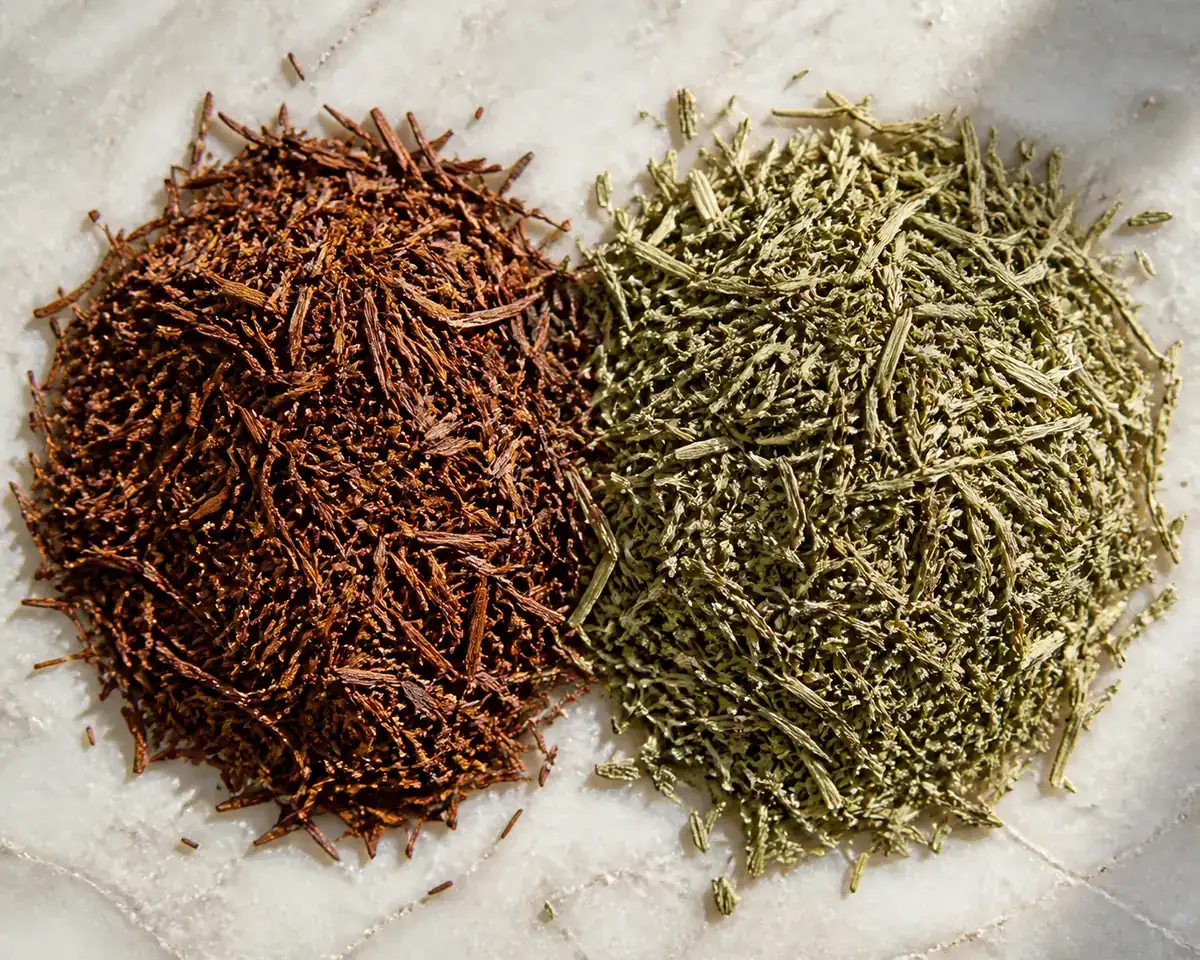
Green rooibos skips the wetting and heaping entirely and goes straight to drying. That single omission is the whole difference between the two products.
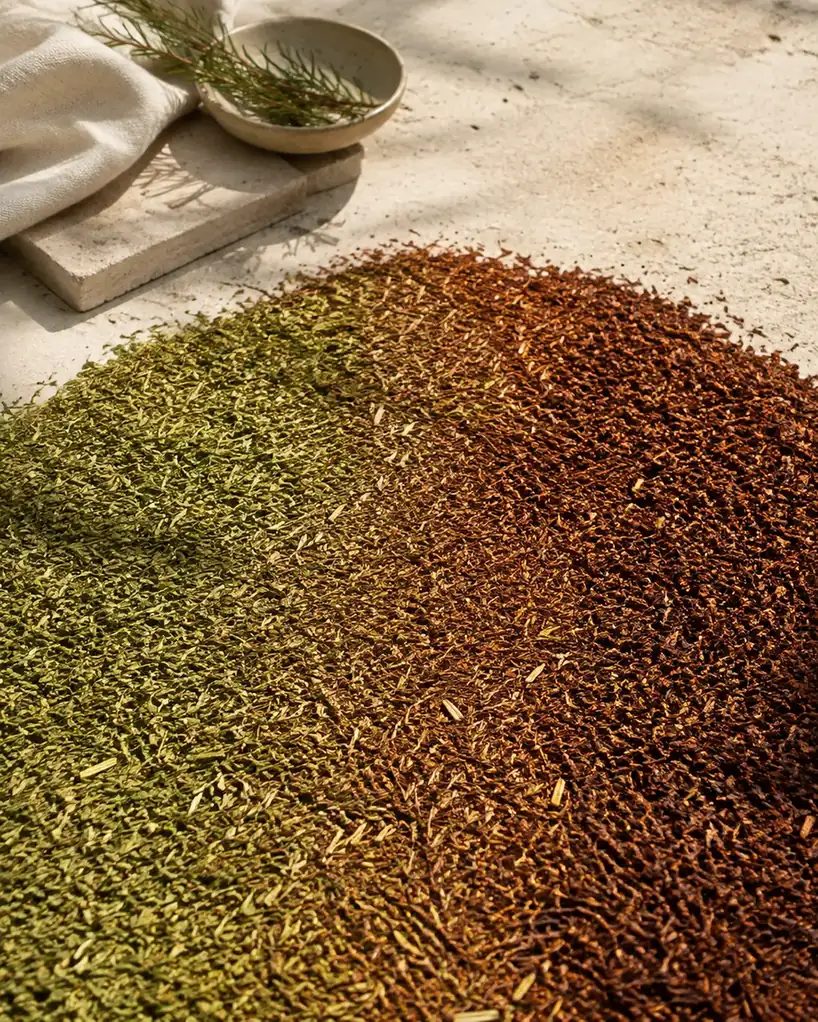
| Red rooibos | Green rooibos | |
|---|---|---|
| Processing | Left to oxidise before drying | Dried quickly, oxidation prevented |
| Colour | Deep red-brown | Pale green-gold |
| Flavour | Sweet, woody, vanilla, slightly nutty | Lighter, grassier, more delicate |
| Availability | The common form, in most shops | Less common, usually specialist |
The relationship mirrors black and green tea exactly, and for the same reason: whether the leaf is allowed to react with oxygen before it is dried. Red is by far the more widely sold, and it is what people mean when they say rooibos without qualifying it.
Where rooibos sits against tea
- Green rooibosDried straight after cutting
- Green teaHeat applied within hours
- OolongPartly oxidised
- Red rooibosHeaped and fully oxidised before drying
- Black teaCarried to full oxidation
The oxidation step happens in the open air on concrete, not in a controlled room. Rooibos is an agricultural product with more batch variation than most teas, and that is worth remembering before blaming your kettle for a cup that came out different.
What rooibos tastes like
Red rooibos is naturally sweet, with a woody, faintly vanilla character and a smooth rounded body. There is very little astringency in it, which is the first thing anyone arriving from black tea notices.
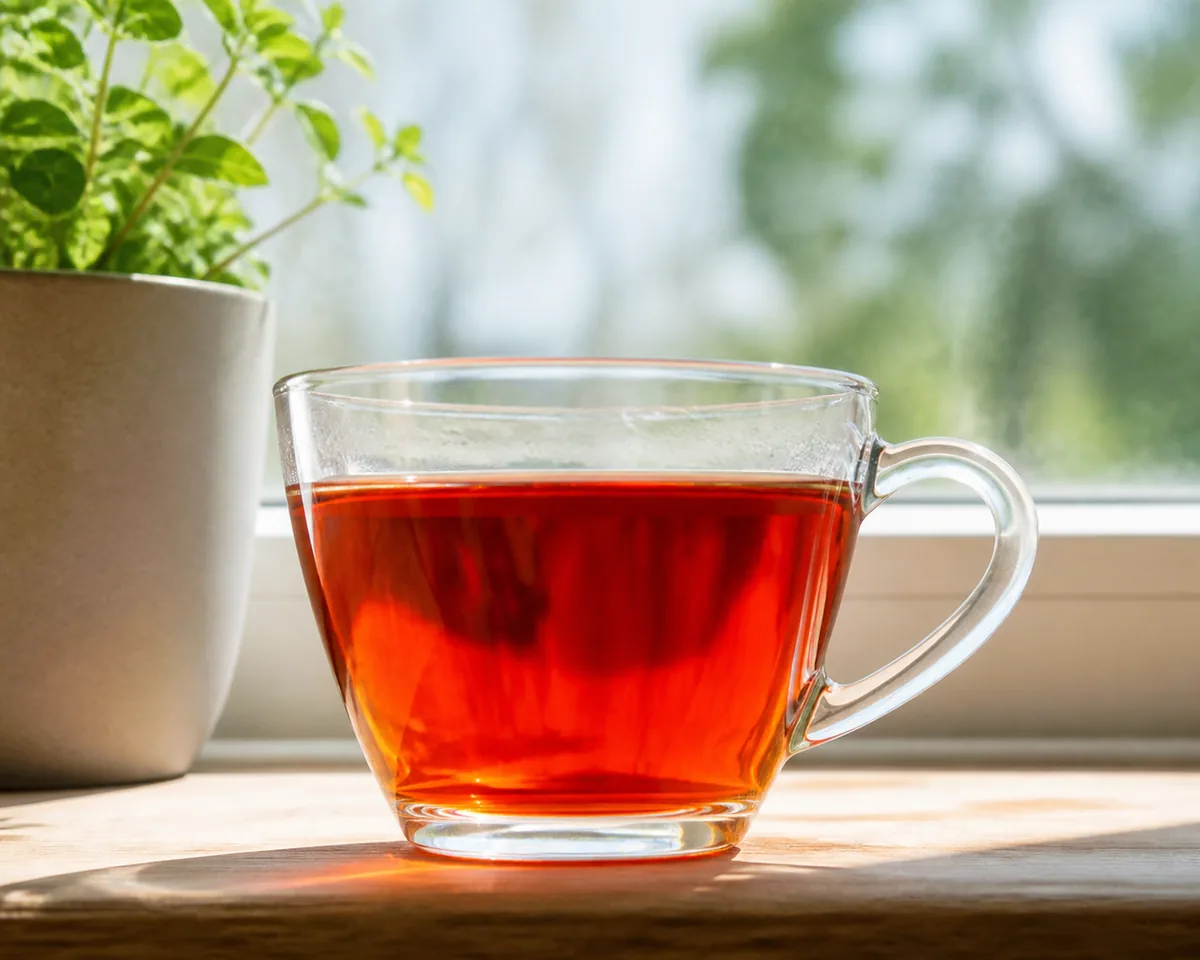
That smoothness comes down to tannins, or rather to their near-absence. Rooibos carries far less of the tannic material that makes a strong black tea drying, so it stays round however long you leave it sitting.
Set that against why green tea tastes bitter, where the same class of compound is the entire problem.
Green rooibos is a different drink and worth trying once on its own terms. It is lighter, grassier and noticeably more delicate, closer in profile to a light green tea than to the red version sitting next to it on the shelf.
What rooibos tastes like breaks both profiles down further.
How to brew it, and what it takes
Use fully boiling water and do not hurry it. Rooibos needs the heat to extract properly, and unlike a green tea there is nothing delicate in it that scalding will damage.
Starting point
- Water
- 100 C / 212 F, fully boiling
- Steep
- 5 to 10 minutes
- Leaf
- 2 to 3 g per 200 ml
- Vessel
- Anything. There is no temperature window to hold
Because there is no window to miss, rooibos is the most forgiving thing you can put in a pot, and your water matters less here than for almost any tea. The only real mistake is under-steeping it, which produces a thin, faintly woody cup that convinces people they do not like rooibos.
It also takes additions better than nearly any other tisane, which follows directly from that low tannin content.
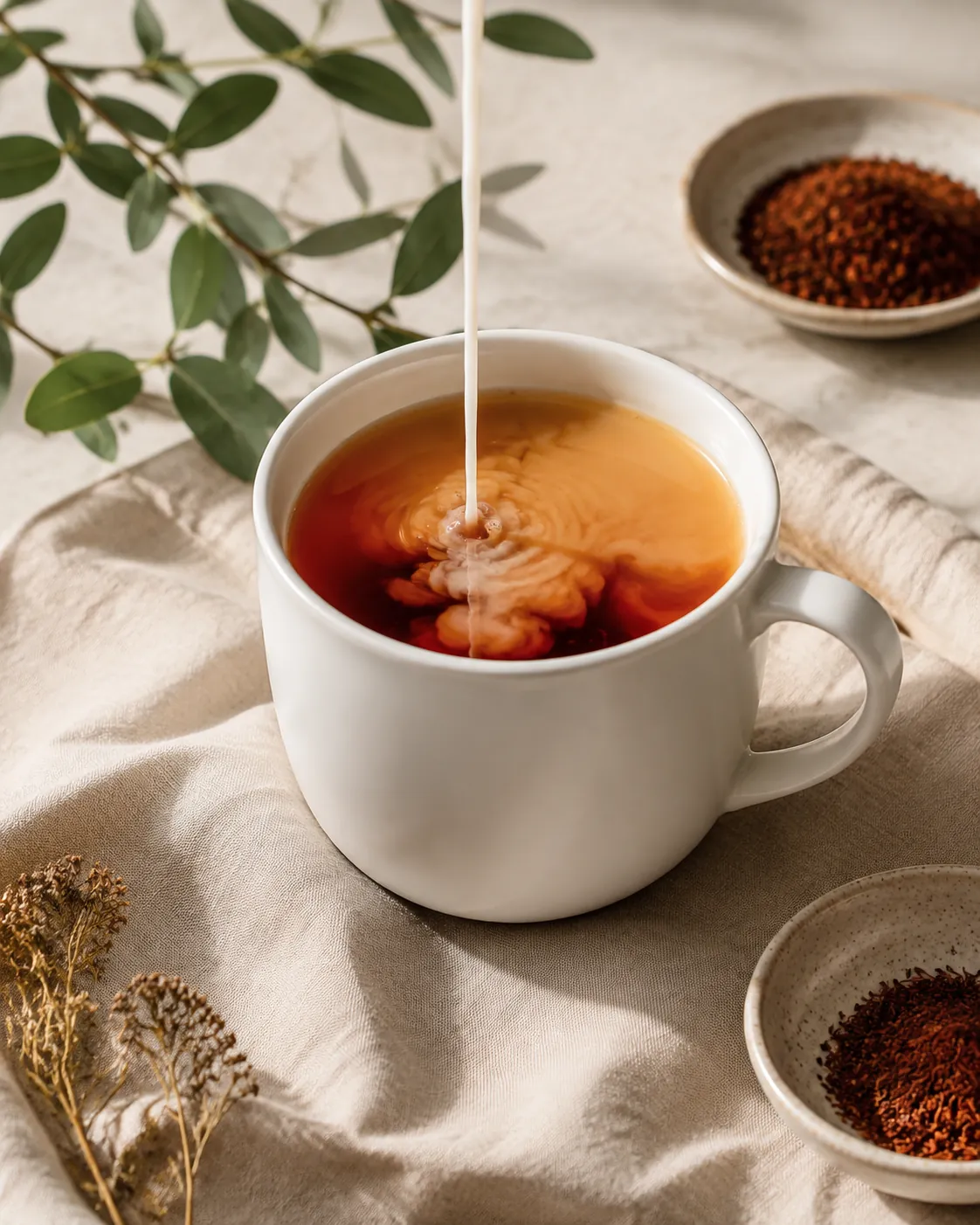
- With milk. Works properly, unlike most herbal infusions, because there is no tannin to turn the cup chalky.
- Iced. Holds its flavour, since there is no astringency waiting to sharpen as it cools.
- With lemon. Fine, though the acidity flattens some of the vanilla character.
- As a latte. Red espresso, finely ground rooibos brewed under pressure, is a real fixture in South African cafes.
- Spiced. It carries cinnamon and cardamom comfortably, which is why rooibos versions of chai are common.
The one thing it does not take is standing unattended in a pot for an hour with the leaf still in it. That does not turn it bitter.
It turns it flat, and making rooibos covers the difference.
Why people reach for it, and what it is not
The honest answer is that rooibos is a full-flavoured hot drink with no caffeine in it, and that is a small category. Most caffeine-free options are floral or minty.
Rooibos is one of very few that is deep and malty enough to sit comfortably where a black tea would.
Those are practical reasons rather than health ones, and three assumptions travel alongside them that do not hold up.
- It is not tea. It comes from a different plant entirely, which is why tisane is the more accurate word.
- It is not decaffeinated. The plant never produced caffeine, so nothing was removed. That is a different thing from a decaf tea, which retains a small residue.
- Red bush is not a variety. Rooibos is Afrikaans for red bush, so a packet using either name is selling the same product.
The middle point is the one that matters most in practice. Anyone avoiding caffeine deliberately should know that decaffeinated tea and rooibos are not equivalent, because one had something taken out of it and the other never had it.
Reading a packet, and what the grades mean
Most rooibos on a shelf is red, standard cut and entirely unremarkable, which is fine. A handful of words on the packet change what you are buying, and most of the rest is decoration.
- Green rooibos means unoxidised, and it tastes nothing like the red you are probably expecting.
- A grade name such as super or choice, or a cut marking such as long cut, tells you the particle size.
- Organic and Fairtrade marks are supply-chain claims and say nothing about flavour.
- Rooibos is a protected designation, so the origin is genuinely single rather than blended across countries.
- Flavoured blends are very common, and vanilla or citrus is often added to a leaf that is already sweet.
The grade names look like quality rankings and are not. Rooibos is graded by particle size and appearance, so a super grade is longer and more even than a standard cut rather than better in any way you would taste.
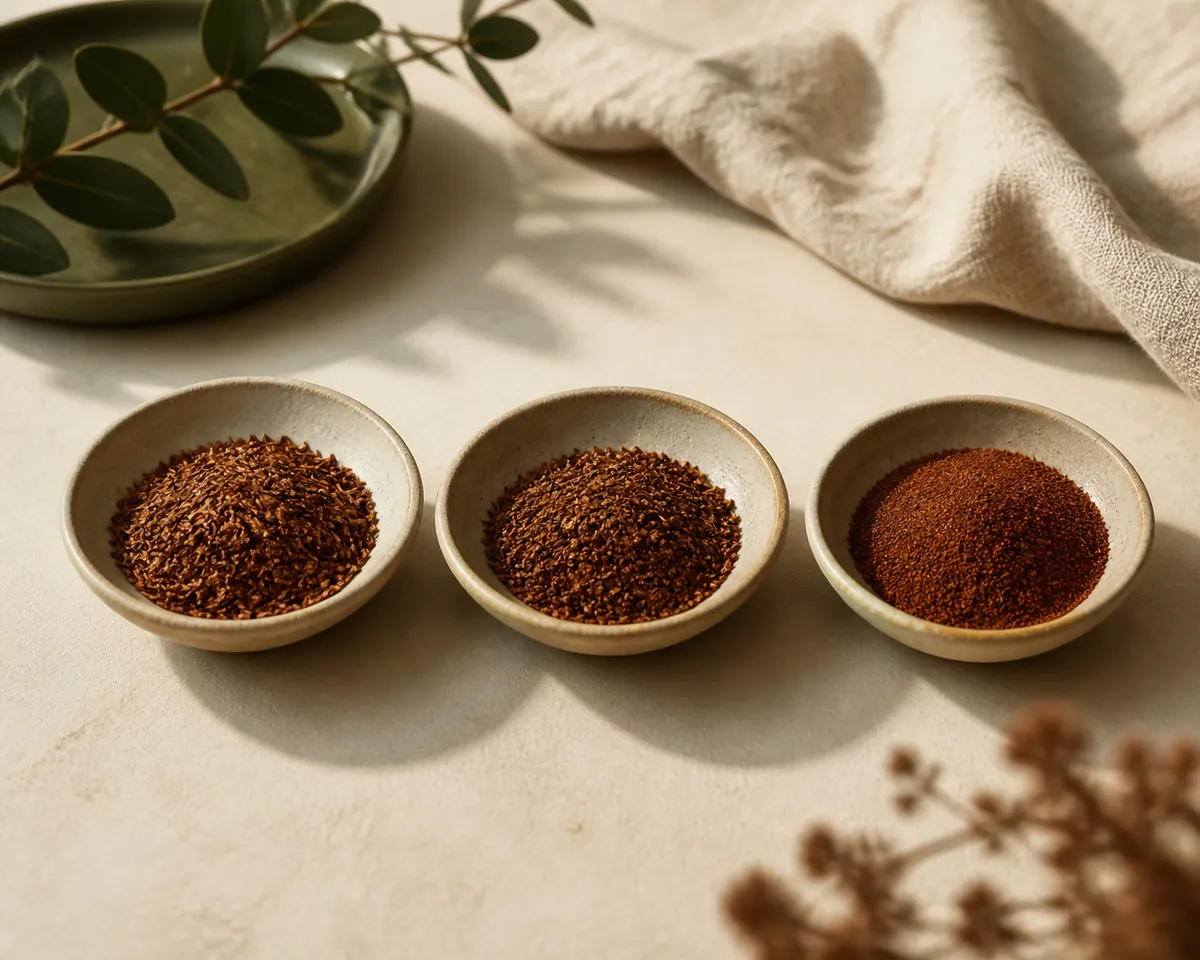
| Grade | What it is | Brews |
|---|---|---|
| Super grade | Long, even, deep red needles | Slowly, with the cleanest flavour |
| Choice grade | Shorter cut, still even | The common loose-leaf grade |
| Standard | Mixed lengths with more fine material | Faster and slightly duller |
| Fines and dust | Small particles | Very fast, and what most tea bags contain |
Particle size decides brewing speed, not quality. A bag of rooibos dust reaches full strength in two minutes where a super grade wants five or more, which is exactly why people who switch from bags to loose leaf often think the loose leaf is weak.
It is the grade, not the leaf, and rooibos problems covers the rest of that list.
Caffeine, tannins and what the leaf carries
Two of the three things people ask about rooibos are compositional, and both have short straightforward answers that hold regardless of brand or grade.
Rooibos contains no caffeine at all. This is not the result of a decaffeination step; the plant simply does not produce the compound, which is a meaningfully different situation from a decaffeinated tea where a small residue always remains.
Rooibos and caffeine sets that against the numbers for tea and coffee.
It is also low in the tannins that make black tea astringent. That single fact explains why milk does not turn chalky in it, why it does not go bitter on a long steep, and why it survives being reheated in a way that a pot of black tea does not.
Naming what is in a plant is a description of the plant, and it stops there.
Honeybush, and the other fynbos infusions
Rooibos has close relatives, and if you like it they are the obvious next thing on the shelf. Honeybush comes from the same fynbos region and the same legume family, from several Cyclopia species, and it is processed in exactly the same way.
Honeybush
Sweeter and rounder than rooibos, with a honey and faint apricot note. Processed identically.
Buchu
Sharply medicinal and aromatic, an acquired taste, usually blended rather than drunk alone.
Cape snowbush
Herbal and slightly camphorous, uncommon outside South Africa.
Rooibos espresso
Not a separate plant. Finely ground rooibos brewed under pressure as a caffeine-free espresso substitute.
Honeybush is the one most likely to be stocked alongside rooibos, and the closest thing to a direct swap. It is sweeter, slightly softer in body, and harder to find, since the plant is still partly wild-harvested in a way rooibos stopped being decades ago.
The others are worth knowing about mainly so that you recognise them in a blend. Buchu in particular turns up in South African herbal mixes and accounts for a medicinal note that people otherwise blame on the rooibos.
Where it sits among caffeine-free infusions
Rooibos is the most widely sold caffeine-free infusion in the world, and it behaves less like a herbal tea than like a tea with the caffeine left out. That is the whole reason it survives milk when the others do not.
Rooibos
Sweet, woody, full bodied. The closest caffeine-free stand-in for a black tea.
Peppermint
Sharp and cooling, dominated by menthol, and it fades in an open pot where rooibos does not.
What rooibos has over all of them is robustness. It takes milk, survives a long steep, reheats without going harsh and holds its character iced, which is a combination none of the others manage together.
What it lacks is acidity. That is precisely why hibiscus blends with it so often and so successfully: one brings tartness and colour, the other brings body and sweetness, and the two cover each other's gaps almost exactly.
Why it barely goes stale
Rooibos is the most forgiving thing on a tea shelf, and the reason follows straight from how it was made.
Red rooibos has already been fully oxidised and then sun dried, so there is very little left in it that contact with air can change.
It keeps for two to three years in an ordinary sealed container, at room temperature, without any of the care that green tea demands. Heat and damp will eventually flatten it, but a jar in a cupboard is genuinely enough, and there is no need for the fridge or a vacuum seal.
Green rooibos is the exception inside the exception. Being unoxidised, it behaves much more like a green tea and fades noticeably within a year, so buy it in small quantities and drink it.
Storing rooibos covers both cases and the one situation that does ruin a bag: absorbing the smell of something else in the cupboard.
Common questions
Does rooibos contain caffeine?
No. Rooibos comes from Aspalathus linearis rather than the tea plant, and it is naturally caffeine free.
What is the difference between red and green rooibos?
Red rooibos is allowed to oxidise before drying, which makes it sweet, woody, and deep red. Green rooibos is dried quickly to prevent oxidation, giving a lighter, grassier infusion.
Can you over-steep rooibos?
Not really. It carries far fewer tannins than black tea, so a longer steep makes it deeper rather than harsh. Five to ten minutes in boiling water is a normal range.