Black tea vs Rooibos
Black Tea vs Rooibos: How Close the Caffeine-Free One Gets
Most people compare these because they want their normal tea without the caffeine. Rooibos gets closer than anything else, and it stops short in one specific way.
Black tea is Camellia sinensis, oxidised and tannic. Rooibos is a South African legume shrub with no caffeine and very little tannin, which is why it is sweeter, impossible to over-brew, and the only caffeine-free infusion that takes milk convincingly. It substitutes well for milky evening tea and poorly for anyone who drinks black tea for its briskness.
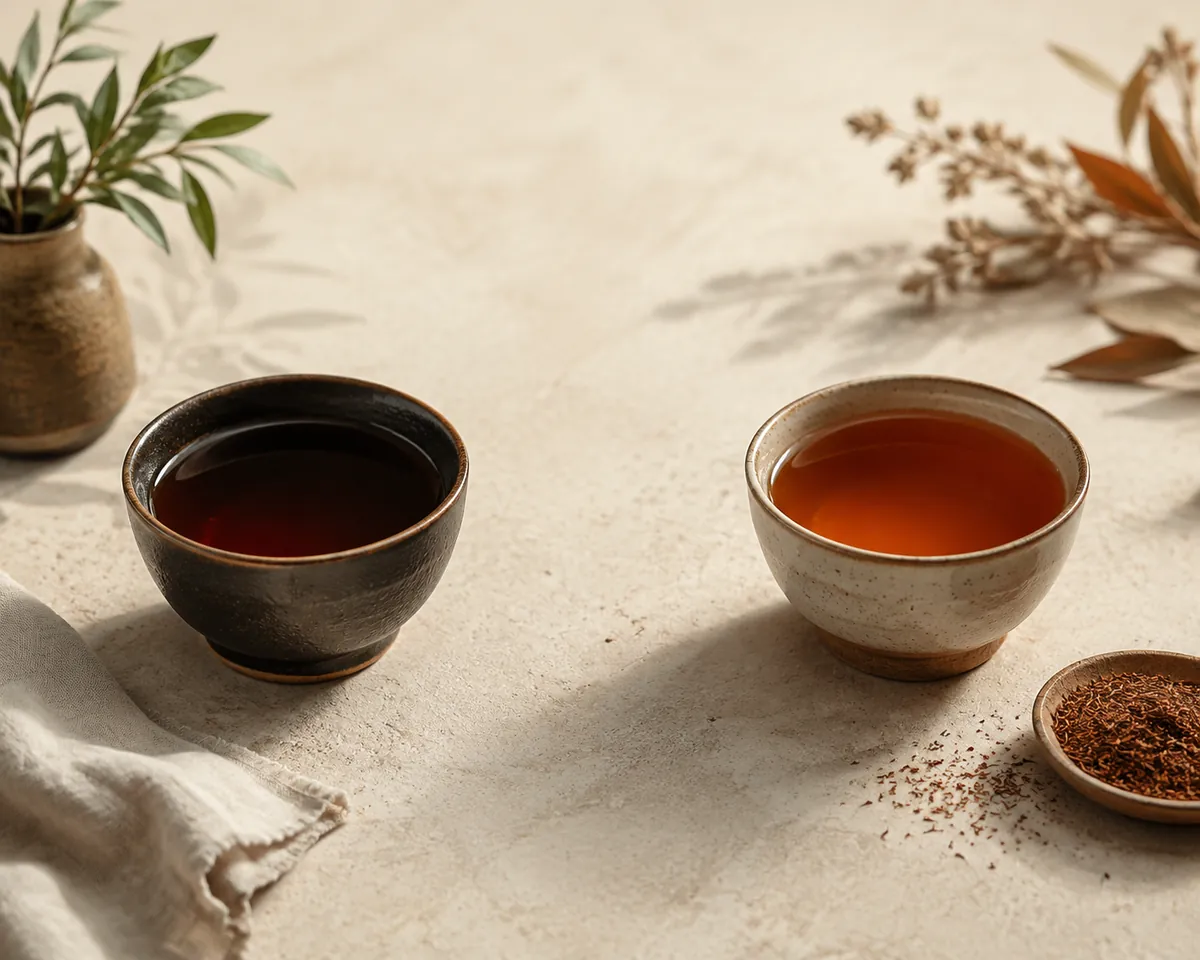
Side by side
| Attribute | Black tea | Rooibos |
|---|---|---|
| Plant | Camellia sinensis, the tea plant | Aspalathus linearis, a Cape legume shrub |
| Caffeine | Around 47 mg per 8 fl oz | None, at any strength |
| Tannin | High, and it rises with steeping | Very low |
| Liquor | Coppery red to deep brown | Orange-red, slightly lighter |
| Taste | Brisk, malty, drying | Sweet, woody, faintly vanilla |
| Water | 95 to 100 C | Boiling |
| Steep | 3 to 5 minutes | 5 to 10, and longer does no harm |
| Over-steeps | Yes, and quickly | No |
| Takes milk | Yes | Yes, unusually for a tisane |
| Keeps, once opened | A year or two | Two to three years |
| Price range | Very wide, from commodity to fine grade | Narrow, and low throughout |
Caffeine is the entire reason this pairing exists
Almost nobody sets these two beside each other out of botanical curiosity, and the question underneath the search is nearly always about dropping the caffeine without dropping the cup. Rooibos is what gets handed to that person.
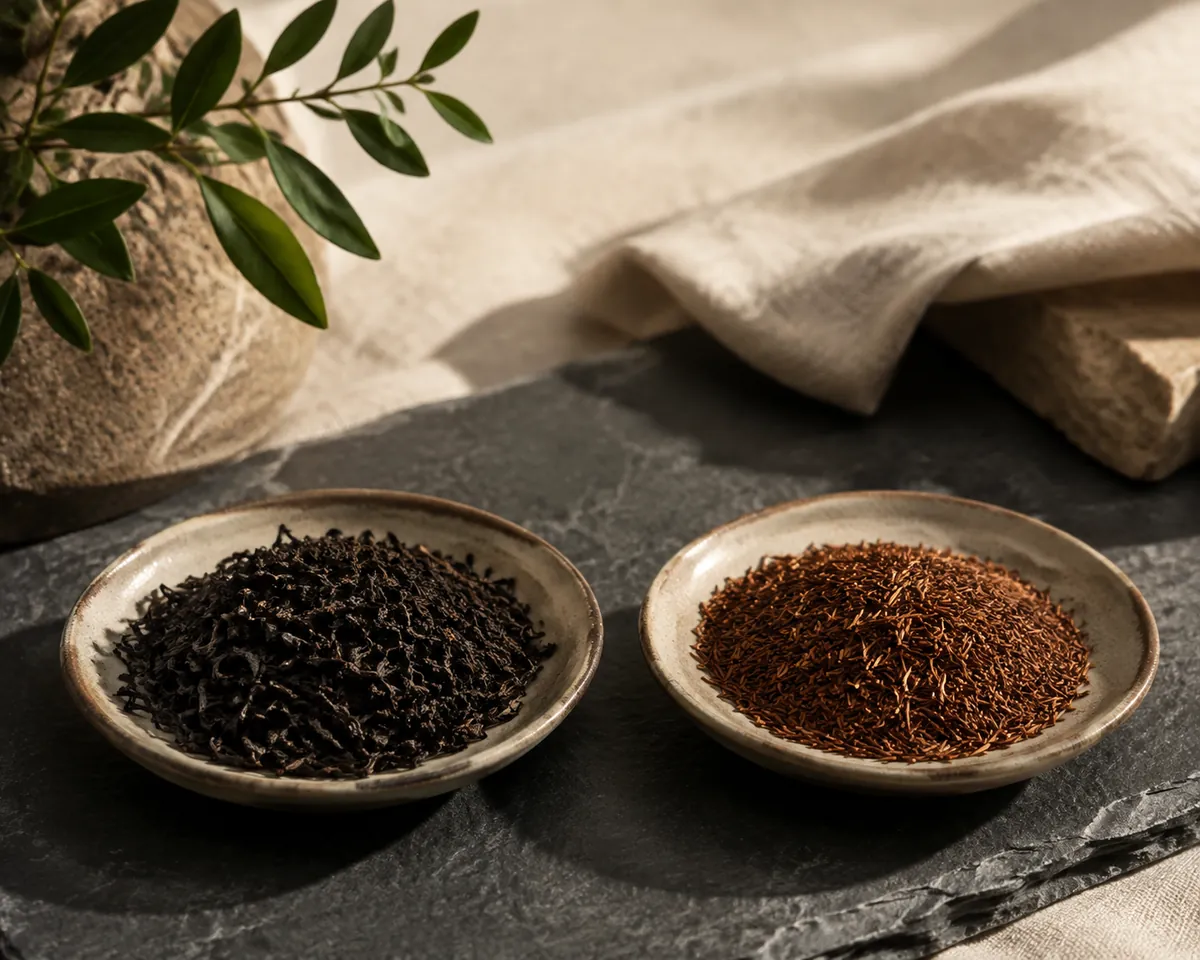
It is the only caffeine-free infusion that behaves like black tea at a kitchen table. It brews dark, it carries body, it takes milk without the flavour falling apart, and it does not spoil while a pot stands through a long meal.
The two plants are unrelated and not even close. One is Camellia sinensis, an evergreen grown from northern India to Kenya, and the other is Aspalathus linearis, a legume shrub from one stretch of the Western Cape.
Rooibos was never decaffeinated, because there was no caffeine in it to remove. That is a different proposition from decaffeinated black tea, where a wet process carries aromatics out alongside the alkaloid and the finished cup usually tastes flatter than the leaf it came from.
That absence is why rooibos is the evening drink in houses that drink tea all day, and why it is poured for children in South Africa much as barley tea is across East Asia.
On this one axis there is no argument to have, since rooibos wins by having nothing to take out.
Sweeter in, briskness out
Sweeter, rounder, never sharp. Rooibos arrives with a woody, faintly vanilla character and a body that fills the mouth without pulling at it, which is why people who take sugar in tea often find they need less of it here.
What it cannot supply is briskness, the drying edge that makes a strong Assam feel like a wake-up call. That edge comes from tannins converted during oxidation, and there is very little tannin in the Cape shrub to convert.
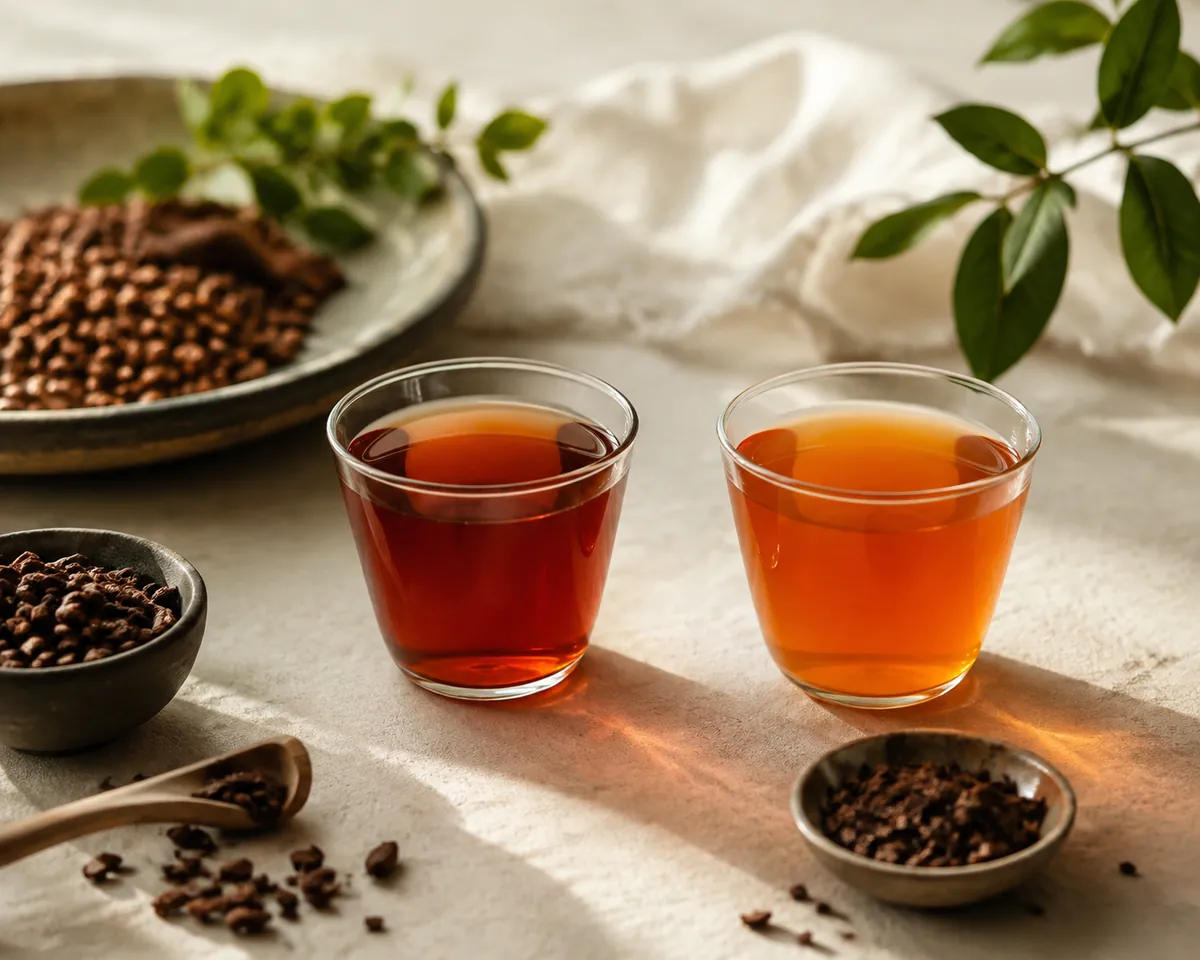
The same fact runs in both directions. Low tannin is why the drink is sweet, why it is smooth, and why no brewing adjustment produces astringency that was never in the leaf to begin with.
That drying finish sits at the centre of black tea's taste, and briskness is the one quality that does not transfer.
Someone who drinks it strong and unsweetened notices the gap in the first mouthful, and someone who takes milk and two sugars frequently does not, because those additions were already covering the edge that rooibos flavour lacks.
It also changes what food the cup suits. Black tea cuts through fat and sugar where rooibos sits alongside them, so a rich pudding that tea would clean off the palate is merely accompanied.
Nor does it stand in for coffee, whatever a packet suggests, because nothing in it is roasted or bitter and its nearest neighbour at that end of the shelf is honeybush.
Can rooibos ever taste bitter?
Nothing you do at the kettle turns rooibos harsh, and that is the largest practical difference between the two.
| Black tea | Rooibos | |
|---|---|---|
| Water | 95 to 100 C | Boiling, always |
| Steep | 3 to 5 minutes | 5 to 10, and longer does no harm |
| Over-steeping | Turns astringent and drying | Gets stronger, never harsher |
| Left in the pot | Ruined within ten minutes | Fine for half an hour |
| Reheating | Tastes stewed | Survives it |
| Second infusion | Weak | Works, and holds up well |
The compounds that punish a forgotten mug of tea are barely present in the Cape shrub, so its failure mode is a strong cup rather than a nasty one. Strength you can dilute.
Astringency you cannot.
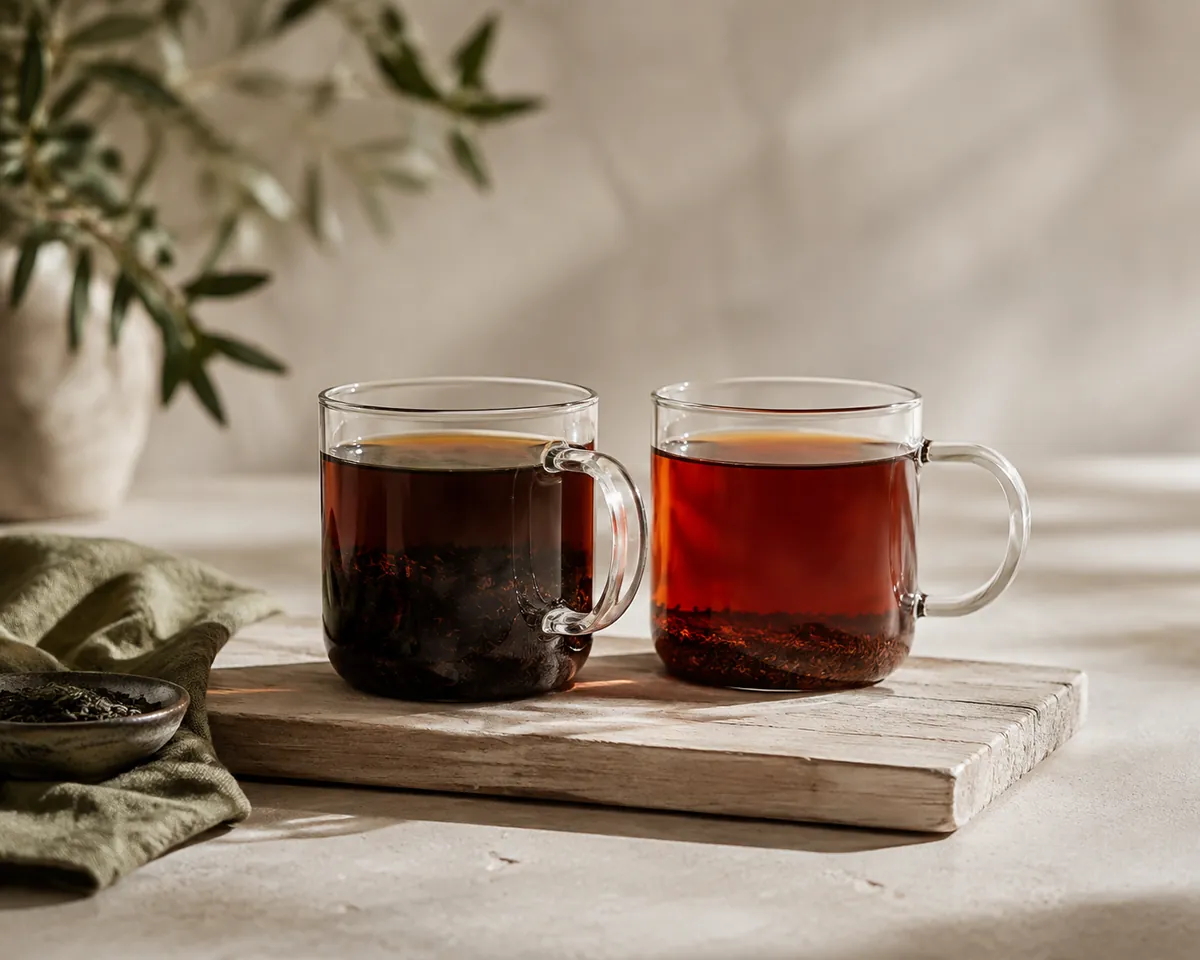
That makes it the better pot for a table people are still talking around, and the better choice for anyone who habitually walks away from a timer. The water rules differ for the same reason: black tea rewards attention to steeping temperature, and rooibos simply wants a rolling boil and time.
The trade is real rather than free. Forgiveness comes from having fewer compounds to extract, which is also why the cup never develops the sharpness a strong builder's brew has, and it is worth reading the ordinary black tea faults to see which of them you are actually escaping.
The builder's tea test, and where the swap holds
For most people switching, the honest question is not whether the two taste alike but whether the substitute survives the way they actually drink tea at seven in the morning, with milk, in a large mug.
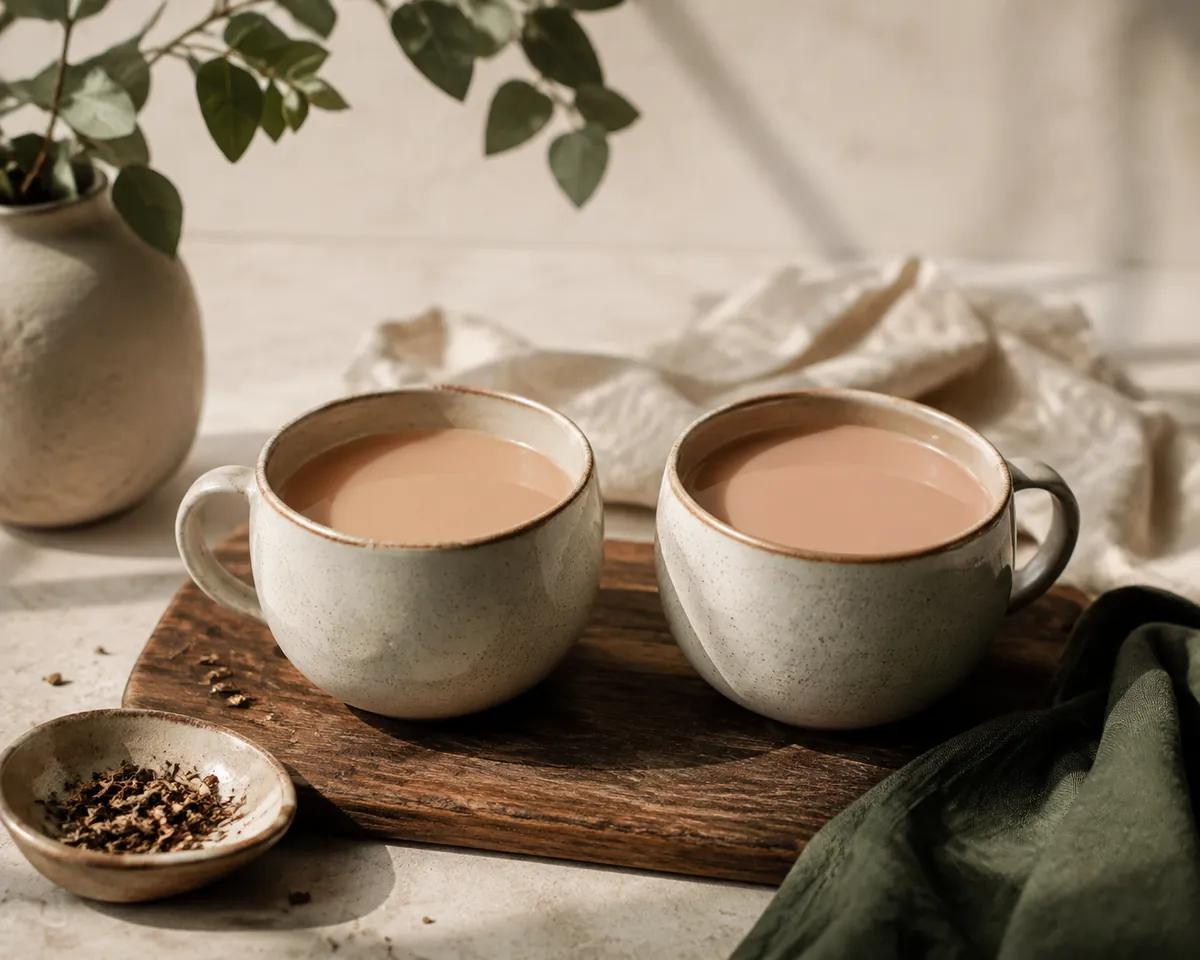
Rooibos takes milk comfortably, which almost no other caffeine-free infusion manages. Chamomile or peppermint with milk in it is an unpleasant drink, and rooibos with milk is simply rooibos with milk.
Where it gives ground is scale. A strong black tea brew holds its own against a great deal of milk, and rooibos at the same steep is still gentler, so the ratio wants pulling back toward less milk rather than pushing forward with more leaf.
Evening tea with milk
The best case, and the substitution rooibos was reached for in the first place.
A pot on the table
Better than black tea, since it cannot spoil while people talk.
Iced and sweetened
Works well, and it holds character cold where black tea can go cloudy.
Late at night
The obvious case, and the reason most households own a box.
Sweetening is where the swap most often goes wrong in the first week. The cup arrives sweeter than tea does, so two sugars carried over from an old habit tip it into something cloying, and honey does the same thing more slowly.
- Brew it longer than you brewed tea. Five to ten minutes, and it will not punish you.
- Cut the sugar before you decide you dislike it, since rooibos arrives sweeter.
- Use less milk than you would in builder's tea, or the drink disappears under it.
- Buy loose leaf or a long-cut bag rather than dust, which is where the flat cups come from.
- Try it plain once, hot, before adding anything.
One region against a dozen countries
Geography explains most of what separates the two on price, consistency and range.
| What differs | Rooibos | Black tea |
|---|---|---|
| Growing area | The Cederberg mountains north of Cape Town, and effectively nowhere else | India, Sri Lanka, China, Kenya, Turkey and a dozen more countries |
| Altitude | One narrow band | Sea level to about two thousand metres |
| Spread of character | Uniform, because there is effectively one terroir | Enormous, since an Assam and a Darjeeling taste nothing alike |
| Price | Cheap and stable | Spans supermarket blends to single-estate lots |
| Supply risk | High, because a bad Cederberg season moves the world price | Low, since buyers shift origin |
Rooibos grows commercially in one place, the Cederberg mountains north of Cape Town, in fynbos soil under wet winters and very dry summers. Attempts to establish it elsewhere have largely failed, and the plant depends on soil microbes that do not travel with the seed.
Tea is the opposite case. It spans a malty Assam at near sea level and a thin, muscatel Darjeeling at two thousand metres, and those two share a species and almost nothing else, which is why a tea drinker can spend years inside the category without exhausting it.
That single-origin concentration is what makes one drink uniform and cheap while the other spans an enormous range, and there is no rooibos terroir tier because there is effectively one terroir. It also leaves the supply thinner, since one poor Cederberg season moves the world price in a way no single tea region can, because a tea buyer simply books elsewhere.
Two or three years in the tin, and pennies a cup
Both keep far better than most people assume, for reasons that are not quite the same reasons, and the practical upshot is that a forgotten tin of either is usually still worth opening.
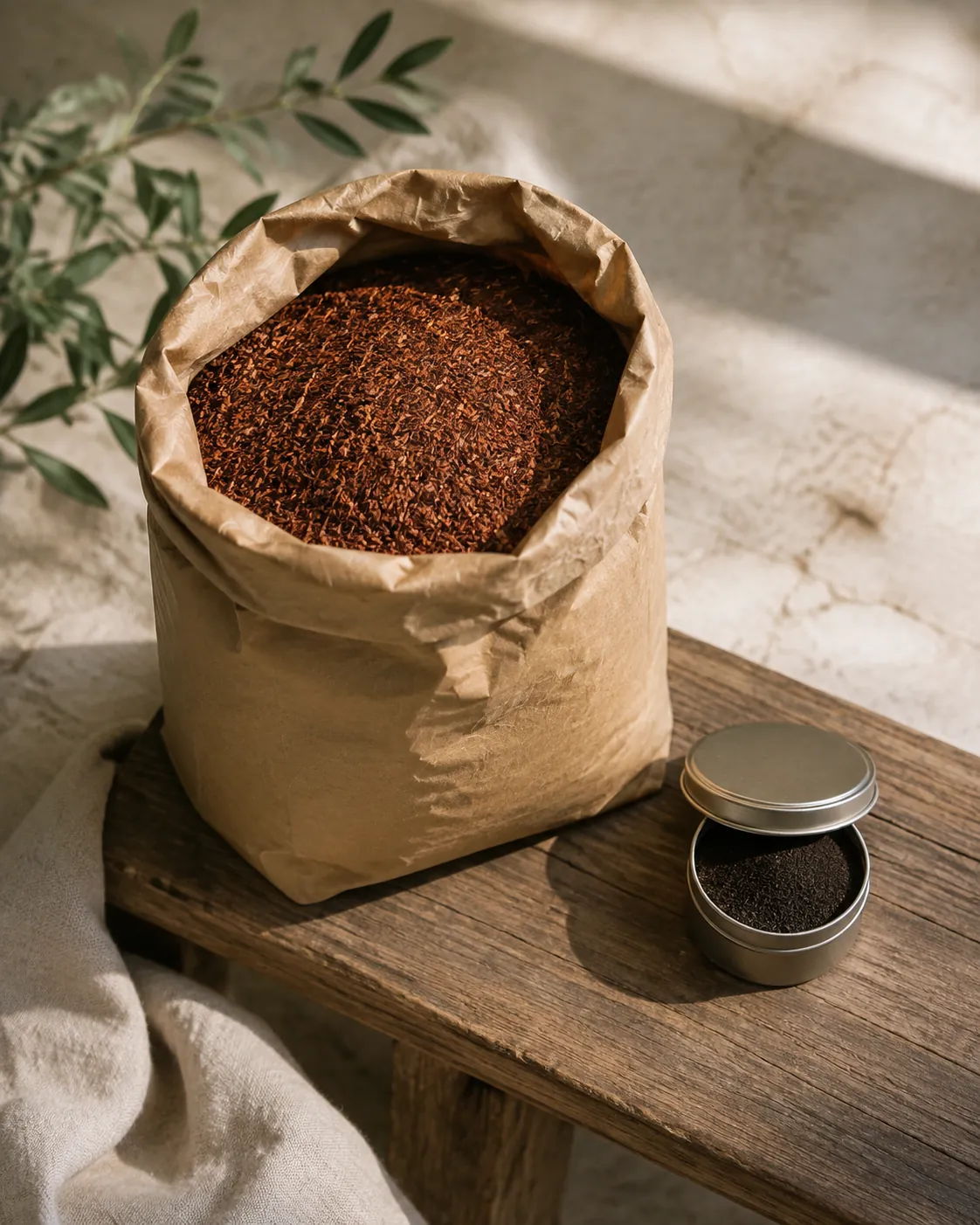
Black tea is fully oxidised, so little is left to react, and a sealed tin holds a year or two without much loss. The containers that matter are covered under storing loose leaf, and tea sits at the forgiving end of that page.
Rooibos is steadier still, being very low in volatile compounds, and two to three years passes without much change if the bag is closed and dry. Neither is remotely as perishable as green tea, which is the useful contrast, and the detail of the bag and the tin sits on storing rooibos.
On price the shrub wins outright, and the reason is agricultural rather than a verdict on the drink. It is harvested mechanically at scale in one region and sold into a market that never developed a fine-grade tier, so the gap between a cheap bag and a good one is small, buying the better one costs little, and the thing worth checking on the packet is the cut rather than the grade.
Green rooibos mirrors the split on the tea side
Rooibos has its own oxidised and unoxidised forms, and the divide runs almost exactly parallel to the one that separates the world's teas.
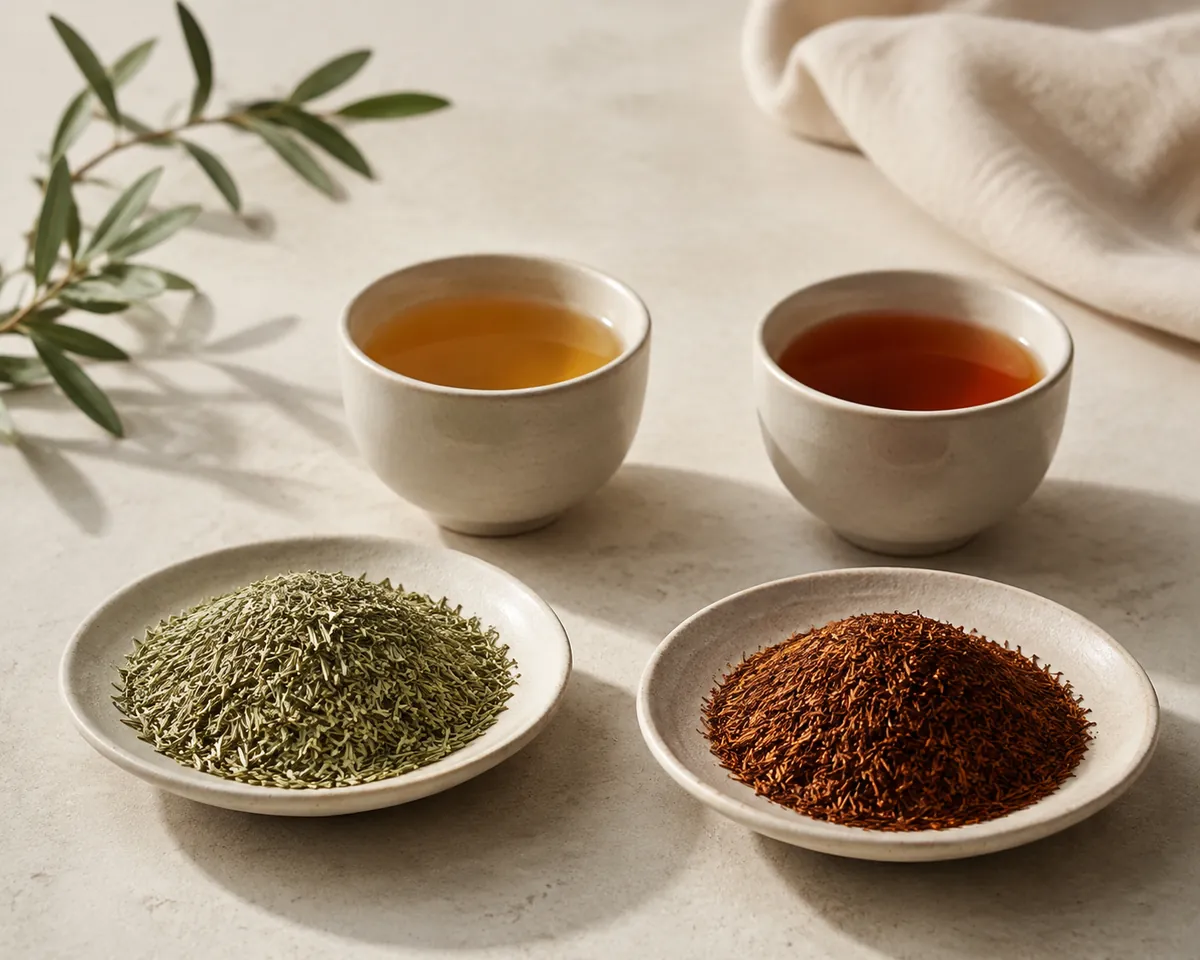
Standard rooibos is bruised and cut, then left to oxidise, which turns it that reddish brown and builds the sweet woody character this page has been describing. Green rooibos skips the step and goes straight to drying, so it brews pale gold, tastes grassier and lighter, and costs noticeably more because the processing is fussier and the yield lower.
The two axes, side by side
- Green teaHeated early to stop oxidation. Grassy, astringent, brews cool
- Green rooibosDried immediately. Grassy, sweet, no astringency
- OolongPartly oxidised, spanning both ends
- Red rooibosFully oxidised. Sweet, woody, full bodied
- Black teaFully oxidised. Brisk, malty, tannic
One asymmetry is worth noticing inside the symmetry. Oxidation makes tea rounder and less astringent as it goes, which is the whole subject of black tea against green.
It makes rooibos sweeter without altering how forgiving it already was, because the tannins that punish an over-steeped cup were never there to convert.
The practical use of that is narrow and real. Anyone who has settled on rooibos and finds it cloying should try the green form before writing off the category, in the way a tea drinker who wants less tannin without losing body reaches for an oolong rather than abandoning tea.
Chilled, and only one of them clouds
Both are drunk cold. Only one has a problem doing it.
Black tea brewed hot and then chilled quickly goes hazy, because caffeine and tannins bind and drop out of solution as the temperature falls. The cloud is harmless and unattractive, and it is why so many iced tea recipes call for citrus, which lowers the pH enough to clear it.
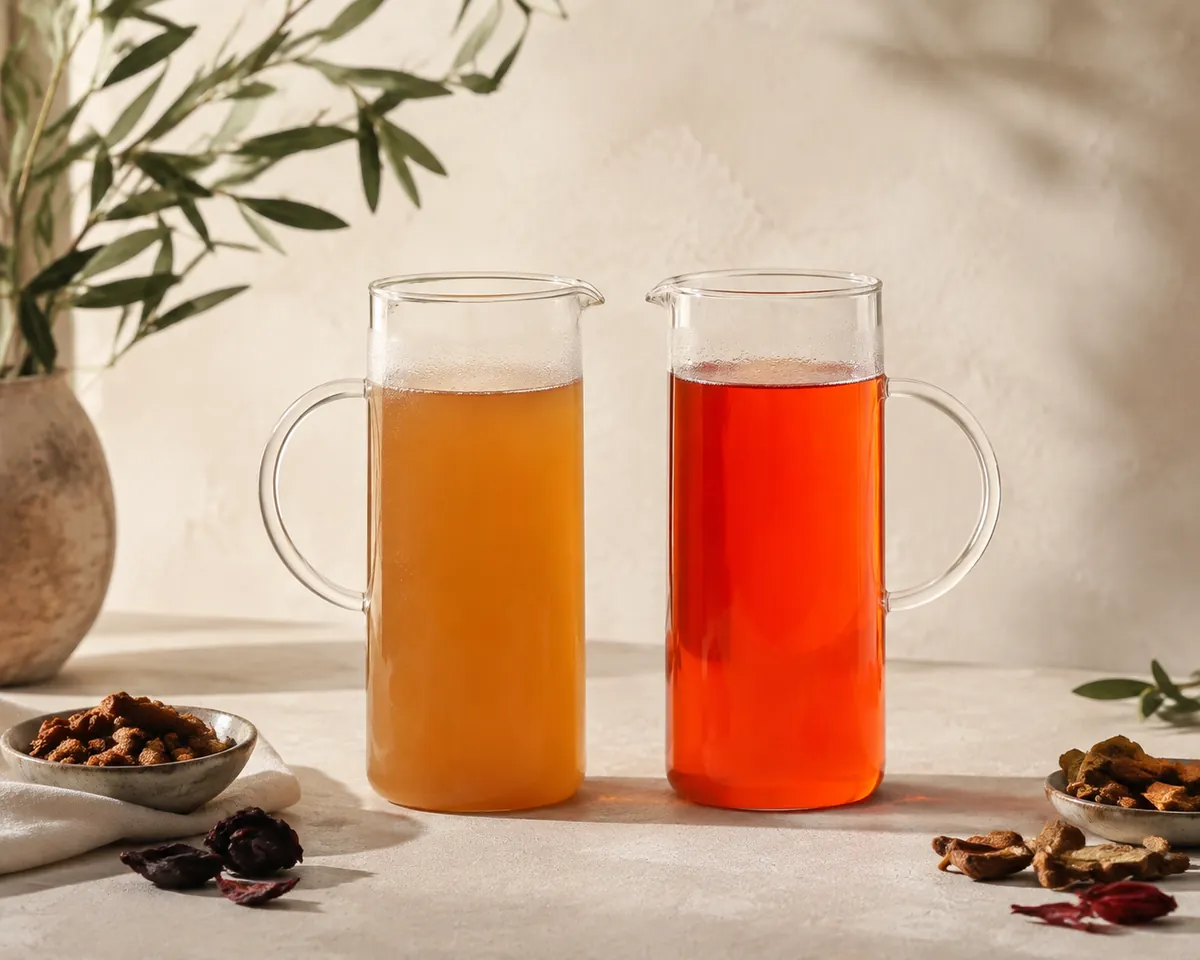
Rooibos cannot cloud, carrying almost none of either compound. It chills clear, holds its colour, and keeps its character in the fridge for two days where a jug of tea dulls inside one.
That makes the shrub the better base for a jug meant to last a hot week, and the better base for anything sweetened, since it needs less sugar to start with. Where tea claws some of that back is dilution, because brewed strong it survives ice melting into it, and a rooibos jug built at drinking strength turns watery faster than its colour suggests.
Three assumptions that spoil the swap
Most of the disappointment reported by people who tried rooibos once and went back to tea traces to one of three beliefs, all of them reasonable and all of them wrong.
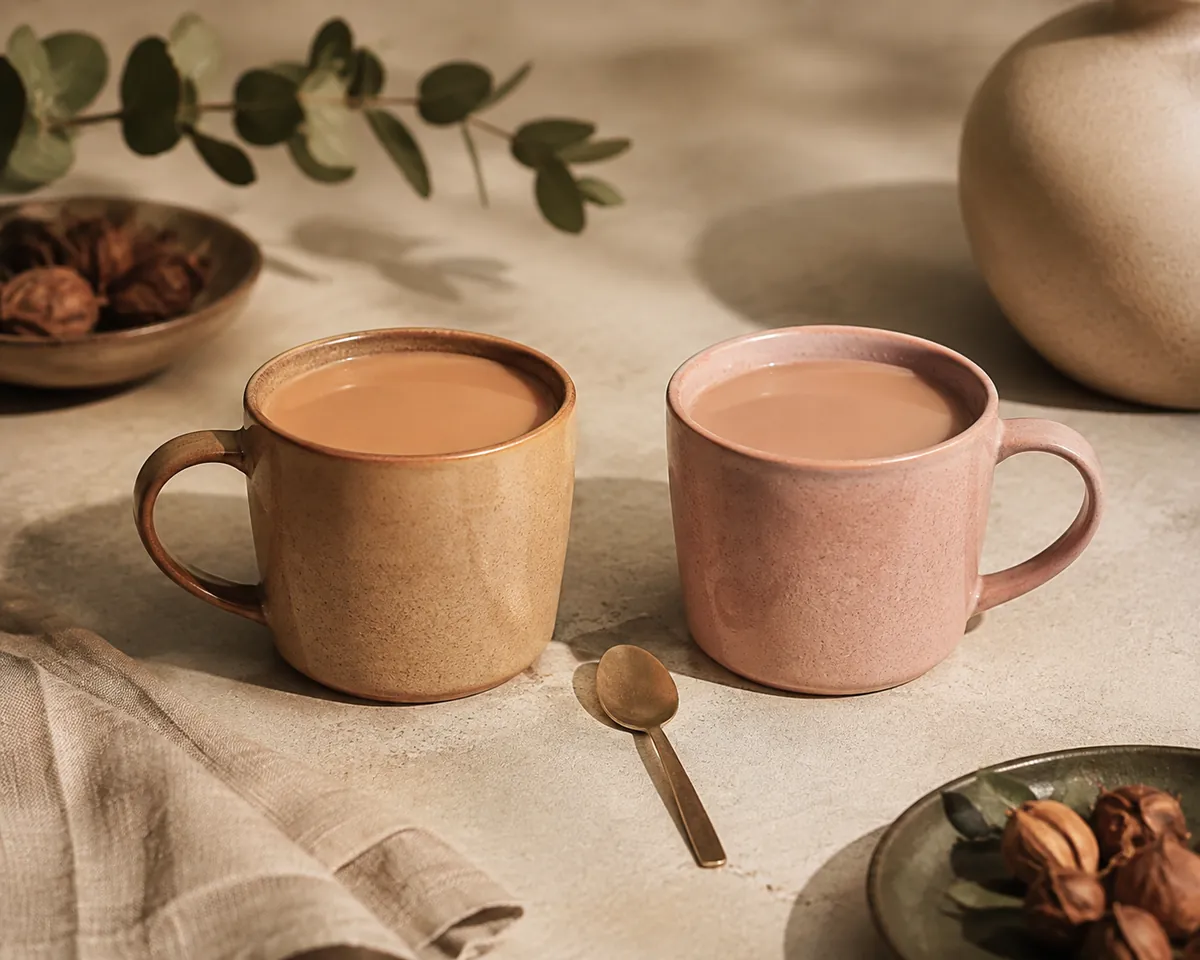
- That rooibos is a kind of tea. It is a legume shrub from the Cape, unrelated to the tea plant, and calling it red tea is a translation convention rather than a botanical claim.
- That it is decaffeinated. It never contained caffeine, which is a different thing from having it removed, and it is why rooibos keeps its flavour where decaf tea loses some.
- That caffeine-free means delicate. It is the most robust drink in its category, taking milk, surviving a long steep, reheating, and keeping for years.
The third belief is the one that decides whether the swap works. Nearly every other caffeine-free option is lighter than black tea in every respect at once.
This one is lighter in a single respect, which happens to be the respect people were trying to change.
Where that leaves the alternatives is fairly clear. Someone wanting the same trick with a sweeter and more floral result is describing honeybush, and someone who wants a drink that is frankly not tea at all will find chamomile and peppermint heading firmly in the opposite direction.
A first attempt that lands badly is usually a brewing problem rather than a verdict, and the faults worth ruling out are listed under rooibos problems before the box goes to the back of the cupboard.
Keep black tea if
You drink it strong and unsweetened, and the drying finish is the part you like.
Switch to rooibos if
You want the same mug in the evening, with milk, and caffeine is the only objection.
Own both if
One is the morning drink and the other is the pot that sits on the table after dinner.
Neither wins on
Keeping. A sealed tin of either outlasts the year most cupboards give it.
Common questions
Is rooibos actually a tea?
No. It comes from Aspalathus linearis, a legume shrub grown in the Cederberg region of South Africa, and has no relation to Camellia sinensis. Red tea is a common name rather than a botanical description.
Does rooibos have any caffeine at all?
None. It is naturally caffeine-free rather than decaffeinated, which is a different thing: decaf black tea has been through a process that removes caffeine and some flavour with it, and still retains a small residue of 2 to 15 mg per cup.
Can I put milk in rooibos?
Yes, and it is one of the few caffeine-free infusions that takes it well. Use less milk than you would in strong black tea, since rooibos is gentler and disappears under a heavy pour.
Will rooibos taste like my usual builder's tea?
Not exactly. It is darker and fuller than most caffeine-free options and sweeter and softer than black tea, with none of the drying briskness. Drinkers who take milk and sugar notice the gap least.