Caffeine in Matcha, and Why Drinking the Leaf Changes It
Matcha is the only tea where the leaf itself is consumed rather than infused. That single fact is why its caffeine figure sits so far above brewed green tea made from the same plant.
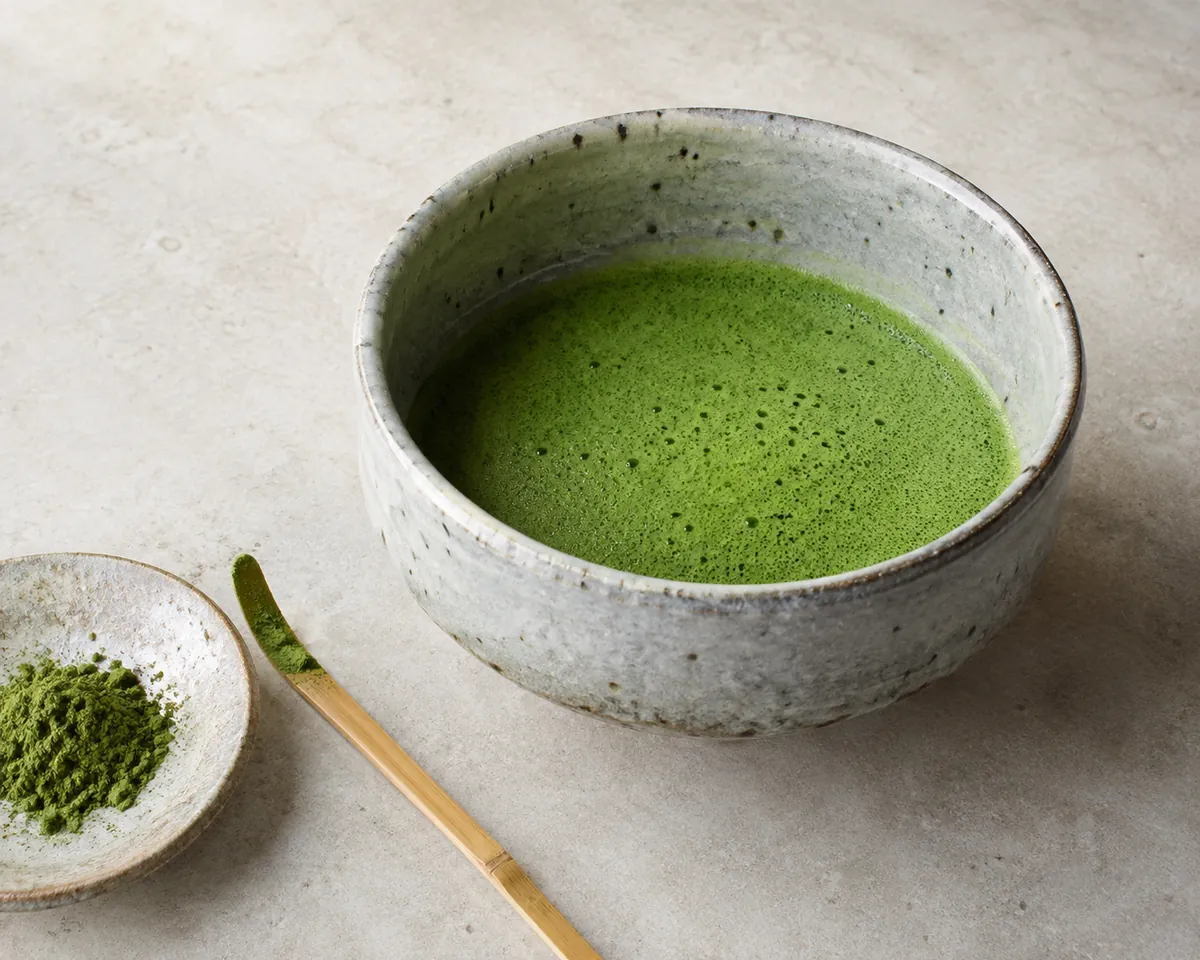
A standard 2 g serving of matcha carries roughly 60 to 70 mg of caffeine. Brewed green tea, made from the same species and often from a similar weight of leaf, carries about 28 mg per cup.
Nothing about the plant explains that gap. It exists because matcha is drunk as suspended leaf rather than as an infusion strained off one, and every figure on this page follows from that single fact.
Whole leaf against an infusion
An infusion gives you a share of the leaf, and a suspension gives you all of it.
Hot water pulls perhaps half the caffeine out of a leaf in a few minutes and the rest goes into the bin with the spent tea. Ground into powder and whisked, the same leaf has nothing left over, because there is no stage at which anything is strained out.
Where the caffeine goes
- Brewed teaHot water extracts a proportion of the caffeine from the leaf.
- DiscardedThe spent leaf still holds a meaningful share, and is thrown away.
- MatchaThe leaf is ground to powder and suspended in the water.
- ConsumedNothing is strained out, so the entire caffeine content is drunk.
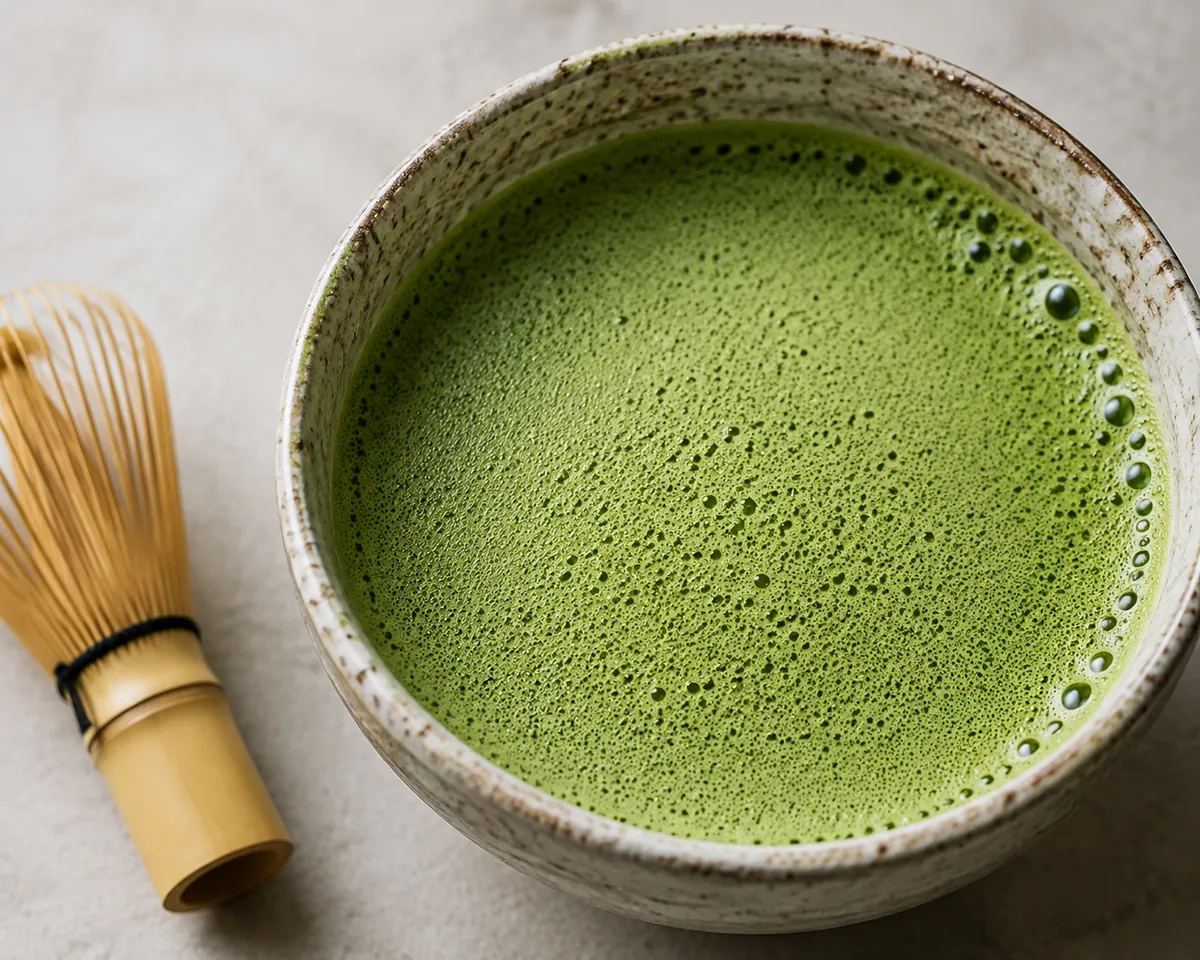
Gram for gram of dry leaf, matcha and a good green tea are broadly similar in caffeine content. The whole difference in the cup is how much of that leaf actually reaches you.
That also removes the extraction variable entirely, which is what makes matcha unusually predictable. Two grams is exactly twice one gram, with no steeping time, water temperature or leaf grade sitting in between to blur the arithmetic, and the green tea and matcha comparison rests on the same structural point that what matcha is sets out in full.
Where a bowl sits against coffee and tea
Numbers only mean something beside other numbers.
Placed against the drinks people actually choose between at eight in the morning, a bowl of matcha lands in the middle of the range rather than at either end of it.
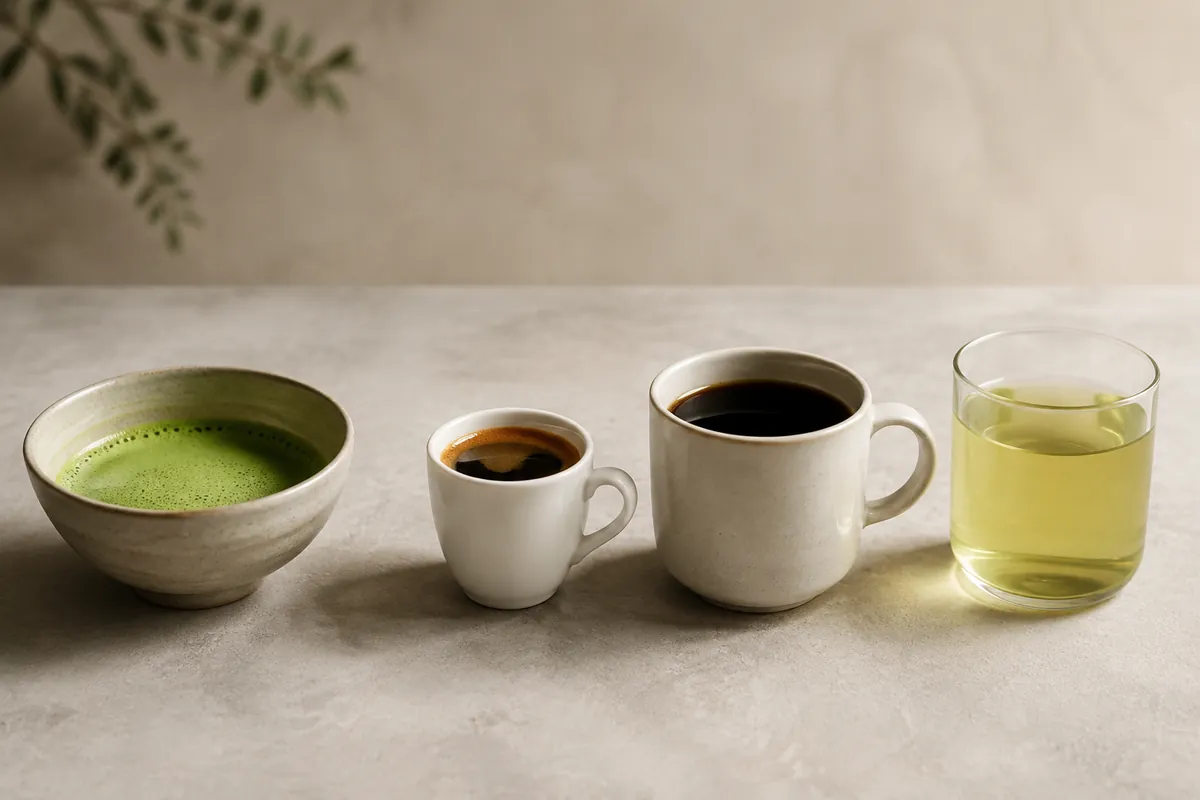
A standard bowl is broadly comparable to a single espresso shot and sits well below a mug of filter coffee. It is roughly double a cup of steeped green tea and somewhat above a cup of black tea.
A fair comparison holds the serving constant, and most published ones do not. By volume matcha is far more concentrated than brewed tea, since 2 g of leaf goes into 70 ml rather than 200 ml; by serving it sits near an espresso; by dry weight of leaf it is unremarkable.
None of those three framings is wrong, and they answer different questions. Arguments about whether matcha is high or low in caffeine usually turn out to be arguments about which of them was being used, which is the same confusion caffeine by brew method untangles for coffee.
Dose, and the scoop that quietly doubles it
Four variables move the figure and the first of them swamps the other three, which is why two people drinking the same powder can be an espresso apart without either doing anything unusual.
What changes matcha's caffeine, most first
- DoseDirect and linear. 4 g is exactly twice 2 g
- PreparationKoicha uses roughly double the powder of usucha
- ShadingThree to four weeks of cover raises caffeine in the leaf
- HarvestFirst harvest leaf is generally higher than later pickings
- CultivarReal but small next to the others
Shading, harvest and cultivar are all genuine and all modest. Covering the bushes for three to four weeks raises caffeine in the leaf along with everything else the shade builds, so a heavily shaded first-harvest powder sits at the top of the range and a later picking somewhat lower.
None of that competes with the scoop. A generous scoop of a modest matcha carries more caffeine than a careful scoop of an expensive one, which is why grade is close to irrelevant to this question and why weighing is the only way to know what is in the bowl.
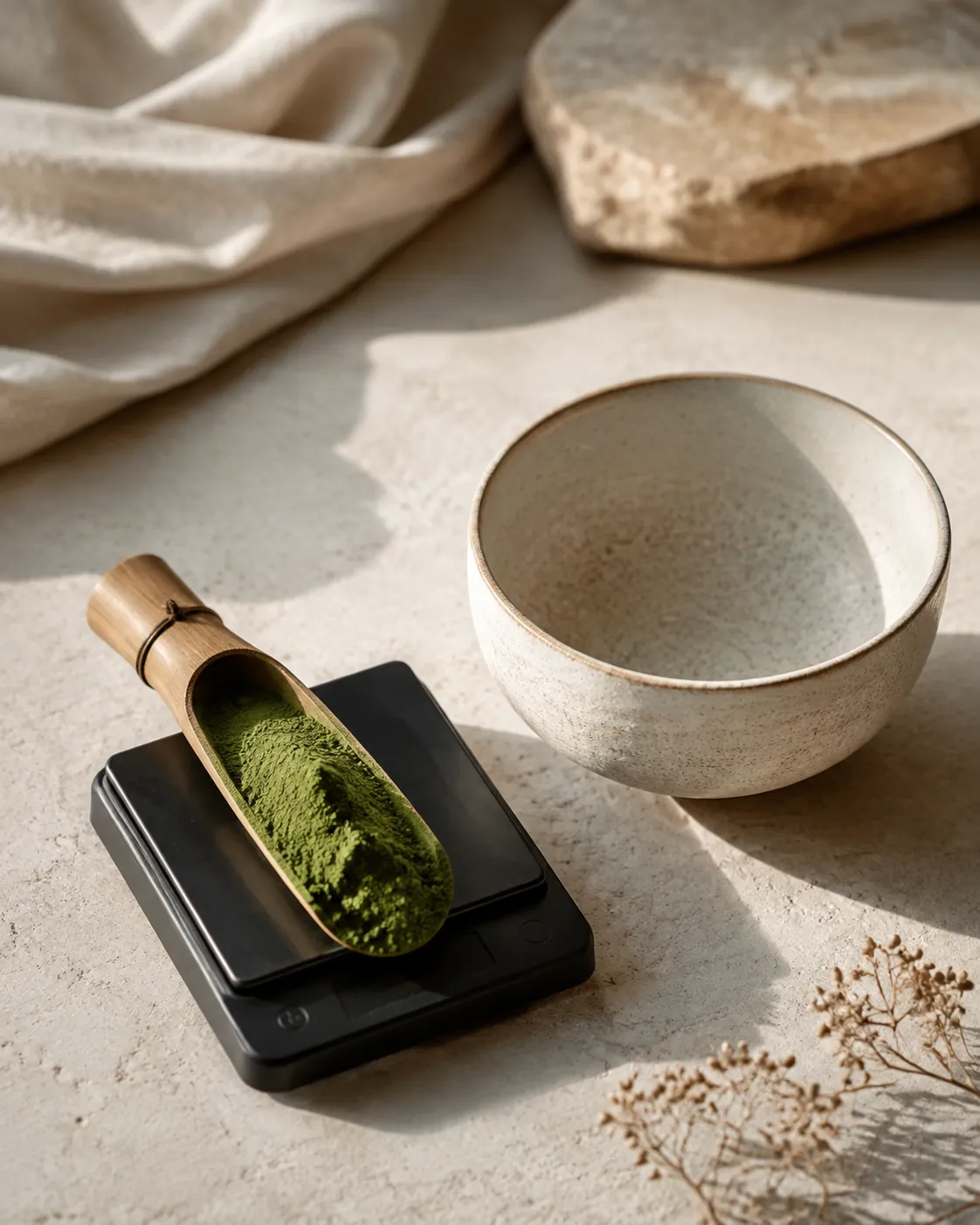
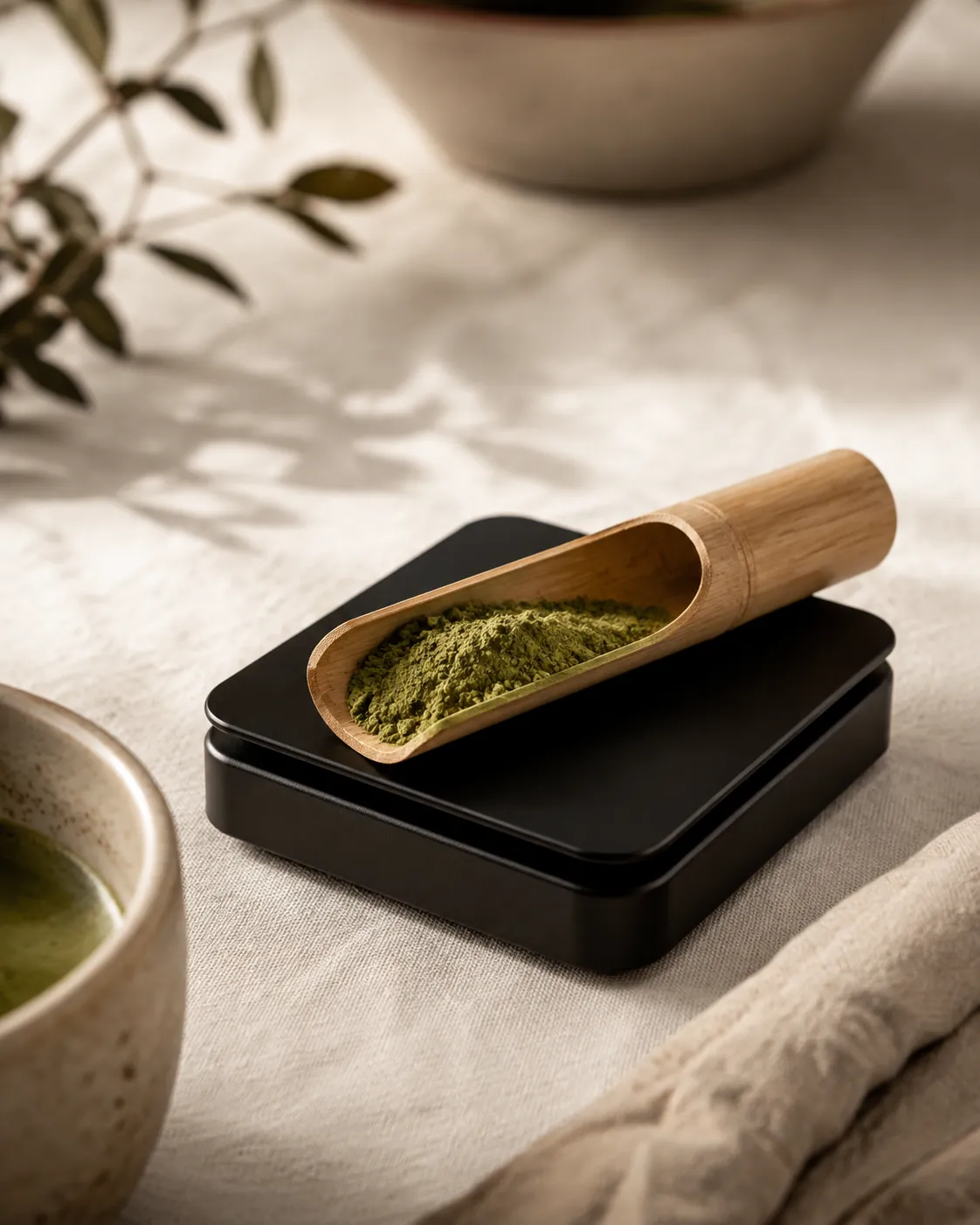
- Weigh rather than scooping; a bamboo chashaku scoop holds roughly 1 g but varies.
- Two level chashaku scoops is the conventional dose for thin tea, around 2 g.
- A heaped teaspoon is closer to 3 to 4 g, which is a substantially stronger drink.
- A latte usually uses more powder than a bowl does, not less.
- Keep the dose constant if you are comparing two matchas for flavour.
Most people underestimate what they are using, because fine powder compacts in the tin and a teaspoon is not a fixed quantity. Switching from two level scoops to one heaped teaspoon nearly doubles the caffeine without feeling like a different drink at all, and how to whisk matcha covers how usucha is measured at the counter.
Usucha, koicha and twice the powder
The two traditional preparations differ by enough to be worth separating in any comparison.
| Usucha | Koicha | |
|---|---|---|
| Matcha | About 2 g | About 4 g |
| Water | 70 ml | 30 ml |
| Caffeine | Roughly 60 to 70 mg | Roughly 120 to 140 mg |
| Texture | Thin, foamed | Thick, kneaded |
| Grade required | Good | The best only |
Thick tea is not simply a stronger version of thin tea. It is twice the leaf in less than half the water, so koicha exceeds a mug of brewed coffee on its own and does so in about thirty millilitres.
Anyone comparing matcha with coffee should therefore say which preparation they mean, since the two sit on opposite sides of a filter mug. Almost all matcha drunk outside a tea room is the thin form, which is the figure most tables quote without saying so.
A milk drink lands in the same band as thin tea rather than below it. Cafes making them with culinary grade typically use 2 to 3 g of powder, so the caffeine is comparable to a bowl even though the drink is four times the volume.
Why published figures disagree so widely
Anyone comparing sources on this subject will find figures running from about 35 mg to well over 130 mg, and almost all of that spread is explainable rather than contradictory.
Serving size is the main culprit. A figure quoted per gram, per teaspoon, per bowl and per large takeaway cup are four different measurements, and sources frequently do not say which one they used.
Why two sources can both be right
- Per gram
- Roughly 30 to 35 mg of caffeine per gram of matcha
- Per 2 g serving
- Roughly 60 to 70 mg, the thin-tea standard
- Per heaped teaspoon
- Roughly 90 to 130 mg, since a teaspoon holds more
- Per thick-tea serving
- Roughly 120 to 140 mg at 4 g
- Per milk drink
- Usually 2 to 3 g of powder, so 60 to 100 mg
Leaf variation accounts for the rest. Shading duration, harvest timing and cultivar all move the caffeine content of the dry powder before anybody measures out a serving, and a heavily shaded ceremonial grade genuinely sits above a late-picked one.
Cafes widen the spread further, because almost none of them states a dose. A drink built on anything from 1.5 g to 4 g is normal, and the gap between the bottom and the top of that range is larger than the gap between a single and a double espresso, with nothing about the cup to tell you which you have.
Pre-sweetened blends are the last complication and the least visible. A powder that is half sugar delivers half the matcha at the same scoop, and those blends are common in high-volume cafes because they dissolve readily and taste consistent from one drink to the next.
What else is in a 2 g bowl
Compounds other than the stimulant are worth naming, because they are the reason matcha gets discussed differently from coffee.
In a 2 g bowl of thin tea, approximately
- Caffeine
- 60 to 70 mg
- L-theanine
- 20 to 40 mg, and higher in shaded first-harvest leaf
- Catechins
- 200 to 300 mg, chiefly EGCG
- Theobromine
- Present in small quantities, well below cocoa's
- Chlorophyll
- Substantial, and the source of the colour rather than any flavour
Theanine is the figure that separates matcha from a brewed tea numerically as well as descriptively. Shading raises it in the leaf and drinking the whole leaf delivers all of it, where a pot leaves a share behind in the strainer along with the caffeine.
The catechin figure is the one people find surprising, and it is the same compound family responsible for astringency. A bowl carries several hundred milligrams of them, which is why a poor powder tastes so aggressively drying and why what matcha tastes like spends as long on astringency as on sweetness.
Every figure above is compositional and describes the powder rather than anybody drinking it. Nothing here is a statement about effects, and the ranges are wide because the leaf itself varies.
Three bowls a day, and how far a tin goes
Single-serving figures are the wrong unit for a drink people have more than one of.
Three bowls of thin tea at 2 g each is 6 g of powder and somewhere around 180 to 210 mg of caffeine, which is roughly two mugs of filter coffee spread across a morning. One bowl of thick tea at 4 g approaches a double espresso on its own.
The same arithmetic answers a question about shopping rather than caffeine. A 30 g tin is about fifteen bowls, which is a fortnight at one a day and rather less than a week for anyone drinking three.
That number decides more than it looks like it should. A tin large enough to last a light drinker two months is a tin that will be dull for its second half, so storing matcha and daily consumption are the same problem approached from two directions.
Cold water does not lower it
Cold brewing lowers one and not the other.
A leaf tea genuinely carries less caffeine when brewed cold, because cold water extracts slowly and a proportion of the caffeine stays locked in the leaf. That is a real effect and it is why a jug of cold brew coffee behaves the way it does.
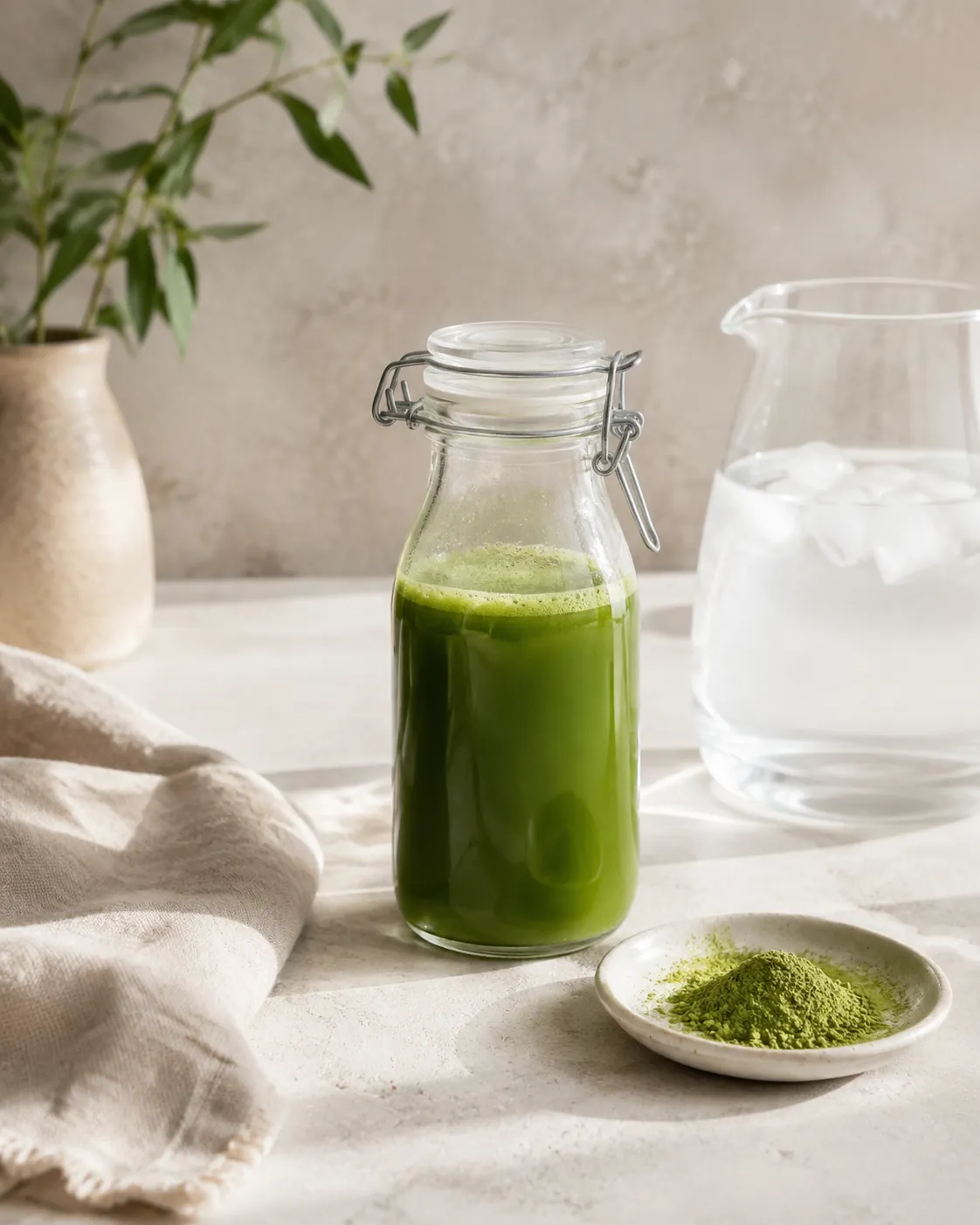
Nothing is extracted in matcha, so nothing can be left behind. Two grams of powder shaken into cold water delivers exactly what two grams of powder shaken into hot water delivers, and the temperature changes only the texture and the speed at which it disperses.
An iced matcha therefore carries the caffeine of the powder that went into it, whatever the ice and the milk do to the volume. The rules that govern a brewed tea simply do not transfer to a suspension, and this is the correction most worth carrying between the two drinks.
Milk drinks, big cups and what is in a can
Dilution changes concentration rather than total, which is the same arithmetic a barista applies when a single shot is stretched into a taller cup.
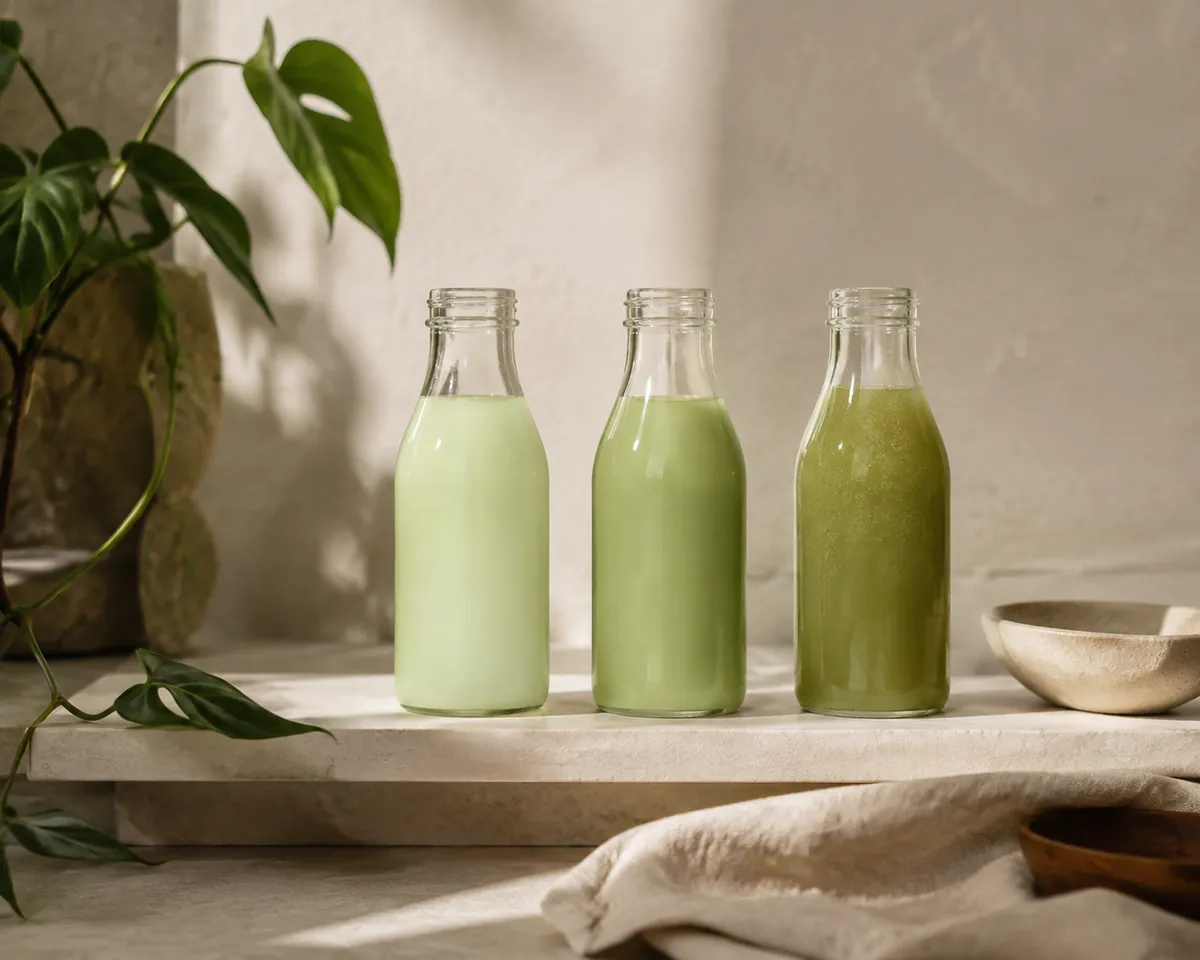
A matcha latte built on 2 g of powder carries the caffeine of 2 g of powder whether it arrives in 150 ml or in 400 ml. The larger cup tastes weaker and is not, in the way an americano is not weaker than the espresso inside it.
Ready-to-drink matcha is where the figure becomes genuinely unknowable. A canned drink may contain 0.5 g of powder or 3 g, the label states sugar and rarely states matcha, and some products use a matcha-flavoured green tea extract that is a brewed tea behaving like one.
Colour is no help at all in a bottle, since it can come from added chlorophyll or from a green powder that is not matcha. Where a producer prints grams of matcha per serving the arithmetic on this page applies unchanged, and where none is printed the honest answer is that nobody outside the factory knows.
Decaffeinated matcha, and why it is rare
Decaffeinated matcha exists, it is uncommon, and there is a structural reason for that.
Decaffeination is carried out on green leaf before processing. That leaf then still has to be shaded, steamed, de-veined and stone milled, and the decaffeination step degrades exactly the amino acids and chlorophyll the shading weeks were meant to build.
What decaffeination costs a powder
- Colour
- Duller, closer to olive than jade, before the tin is even opened
- Sweetness
- Reduced, because theanine is among the first casualties
- Aroma
- Flatter, with less of the marine note
- Shelf life
- Shorter, since the powder starts further along the same curve
- Availability
- Limited, and usually only from larger producers
The result is generally duller in the bowl and flatter on the finish than a comparable regular powder, and it fades faster once opened. It is a reasonable option where caffeine is the deciding factor, and it is not a like-for-like substitute in the way decaf coffee has become one.
Naturally caffeine-free drinks sit somewhere else entirely. A rooibos infusion has none to begin with and needs no process to remove any, though it is a completely different drink and no substitute for matcha in flavour, texture or use.
Common questions
How much caffeine is in a serving of matcha?
Roughly 60 to 70 mg in a standard 2 g serving, which is broadly comparable to a single espresso. Koicha, using about 4 g, roughly doubles that.
Why does matcha have more caffeine than green tea?
Because the leaf is consumed rather than infused. Brewing extracts only a proportion of the caffeine and the spent leaf is discarded; matcha is suspended powder, so the entire content of the leaf is drunk.
What affects matcha's caffeine most?
Dose, by a wide margin, and it is linear: 4 g carries exactly twice what 2 g does. Shading and harvest matter too, but switching grades changes the figure far less than adding another gram of powder.