What Is Peppermint Tea? A Hybrid of Watermint and Spearmint
Peppermint is a hybrid, a natural cross between watermint and spearmint. That accident of botany is why it carries so much menthol and why it tastes cold in the mouth.
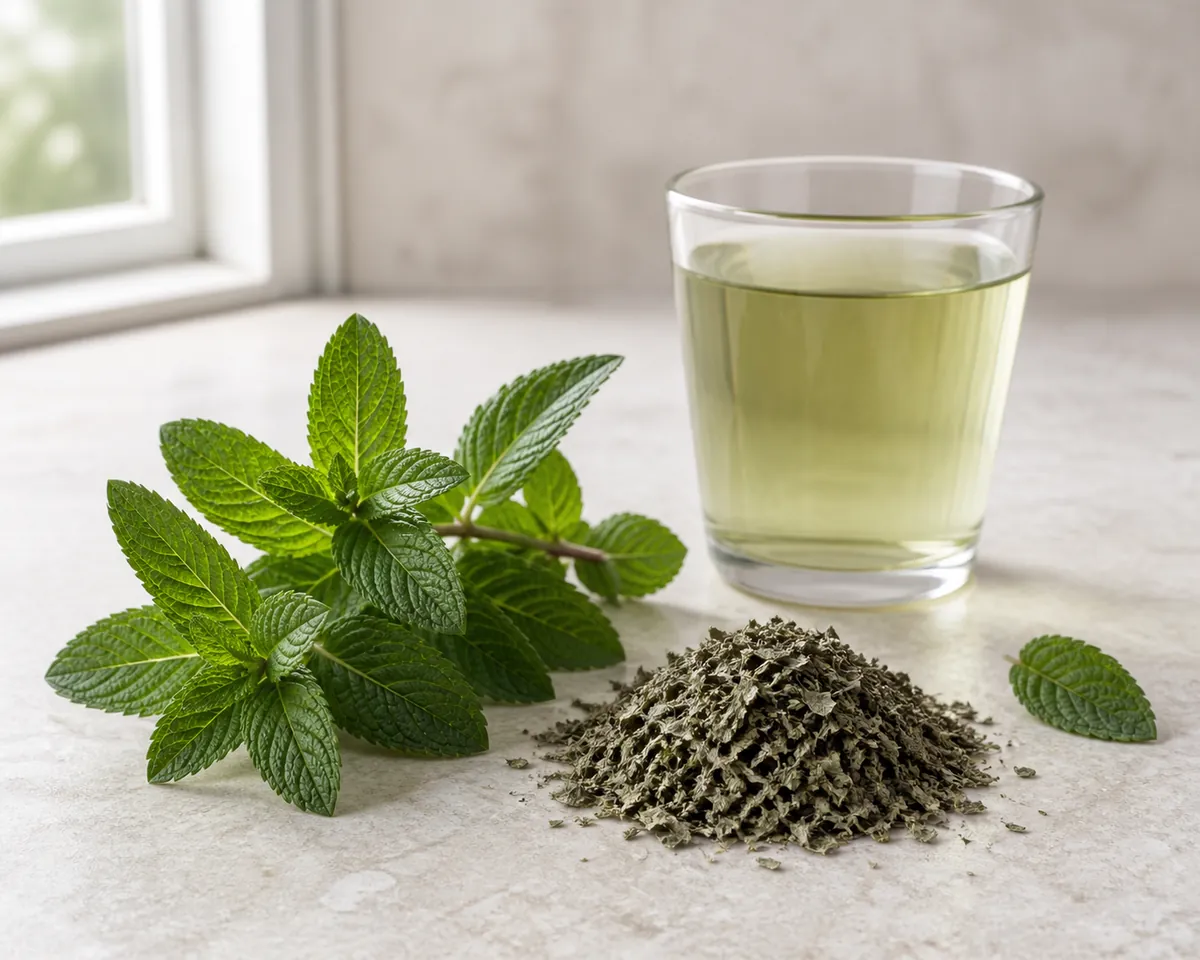
Peppermint tea is an infusion of the leaves of Mentha × piperita. The multiplication sign in that name is doing real work: peppermint is a hybrid, not a species in its own right.
It is a natural cross between watermint and spearmint, and it inherits from both in ways you can taste. What it inherited most usefully is menthol, at a concentration neither parent reaches, and nearly everything distinctive about the drink follows from that single compound.
Peppermint tea at a glance
- What it is
- An infusion of the dried or fresh leaf of a mint hybrid
- The plant
- Mentha x piperita, a natural cross of watermint and spearmint
- Menthol
- The dominant compound, at levels far above spearmint. It creates the cold sensation
- Menthone
- A sharper, slightly medicinal note that sits behind the menthol
- Propagation
- The hybrid barely sets viable seed, so it spreads by cuttings and runners
- Water
- Boiling, five to seven minutes, covered
- Keeps
- Roughly a year of good material in an opaque airtight tin
The hybrid, and the compound that carries it
Because the cross happened between two plants with different oil chemistry, peppermint ended up with a profile that neither watermint nor spearmint produces alone. That accident is the reason it is the mint people mean when they say mint without qualifying it.
The cooling is a trick of perception rather than temperature. Menthol binds to the same receptor that reports cold, so the nerve fires while the liquid in the mouth is plainly hot. The sensation lingers after you swallow, which is why a mouthful of cool water afterwards seems startlingly cold.
Menthol is also cheap at scale, stable in storage, and recognisable to anyone. It signals clean and fresh with no learning asked of the buyer, which is what a mass-market product wants.
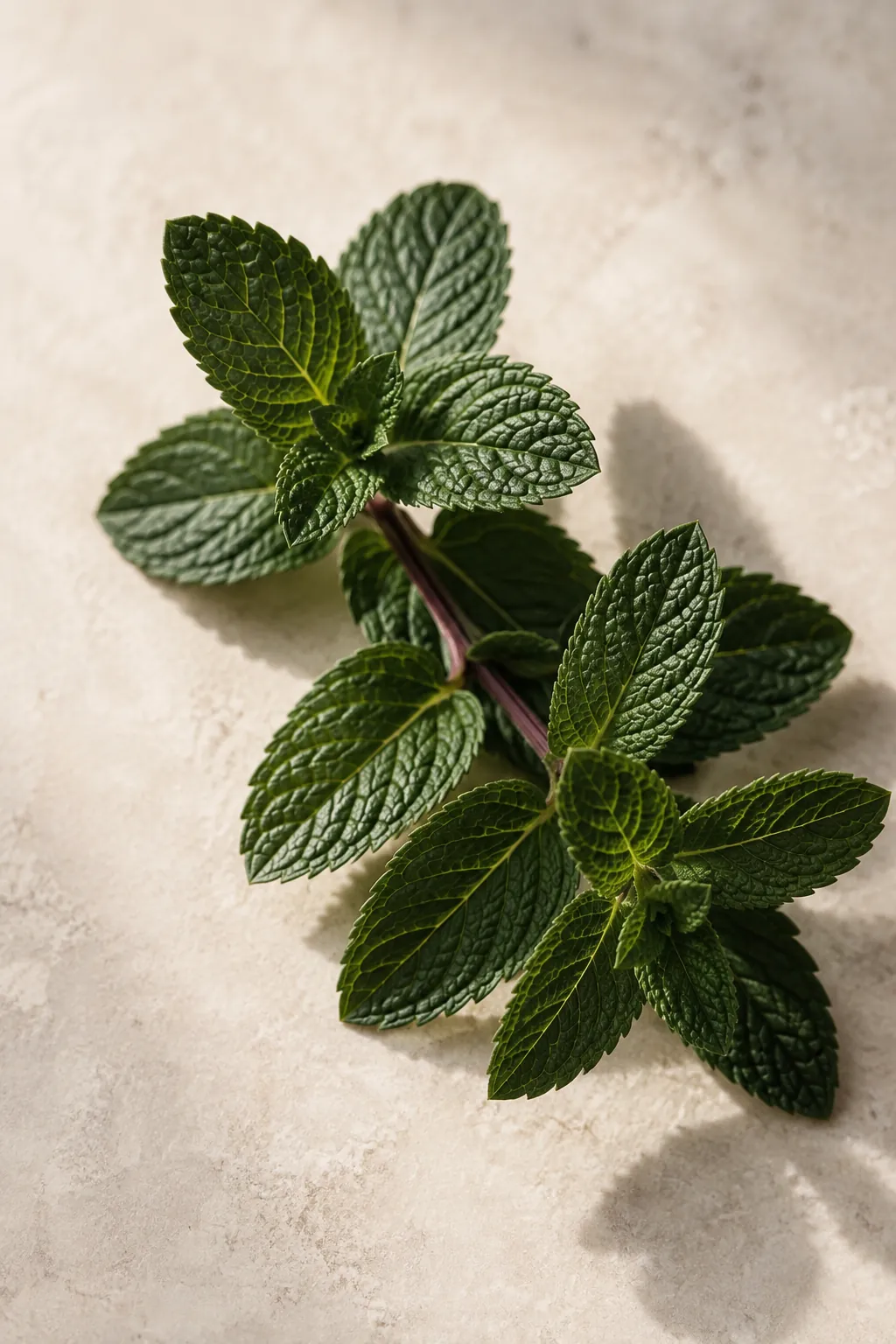
That ubiquity works against the infusion. Most people's reference point is confectionery or toothpaste, both of which use isolated menthol rather than leaf, so a leaf infusion tastes oddly soft and green beside them.
Drinking it alone from whole leaf resets that expectation, and peppermint's flavour is worth meeting on its own terms.
Where spearmint takes over from peppermint
The two get confused constantly. The difference is easy to hear once someone states it, and it comes down to which oil the plant makes in quantity.
| Peppermint | Spearmint | |
|---|---|---|
| Plant | Mentha x piperita, a hybrid | Mentha spicata, a species |
| Menthol | High | Very low |
| Taste | Sharp, cold, almost sweet-hot | Soft, sweet, herbaceous |
| Cooling | Strong and lasting | Mild |
| Typical use | Tea, confectionery, oils | Cooking, Middle Eastern mint tea |
Moroccan mint tea is made with spearmint. It is gunpowder green tea with spearmint and sugar, and substituting peppermint gives something quite different and much colder.
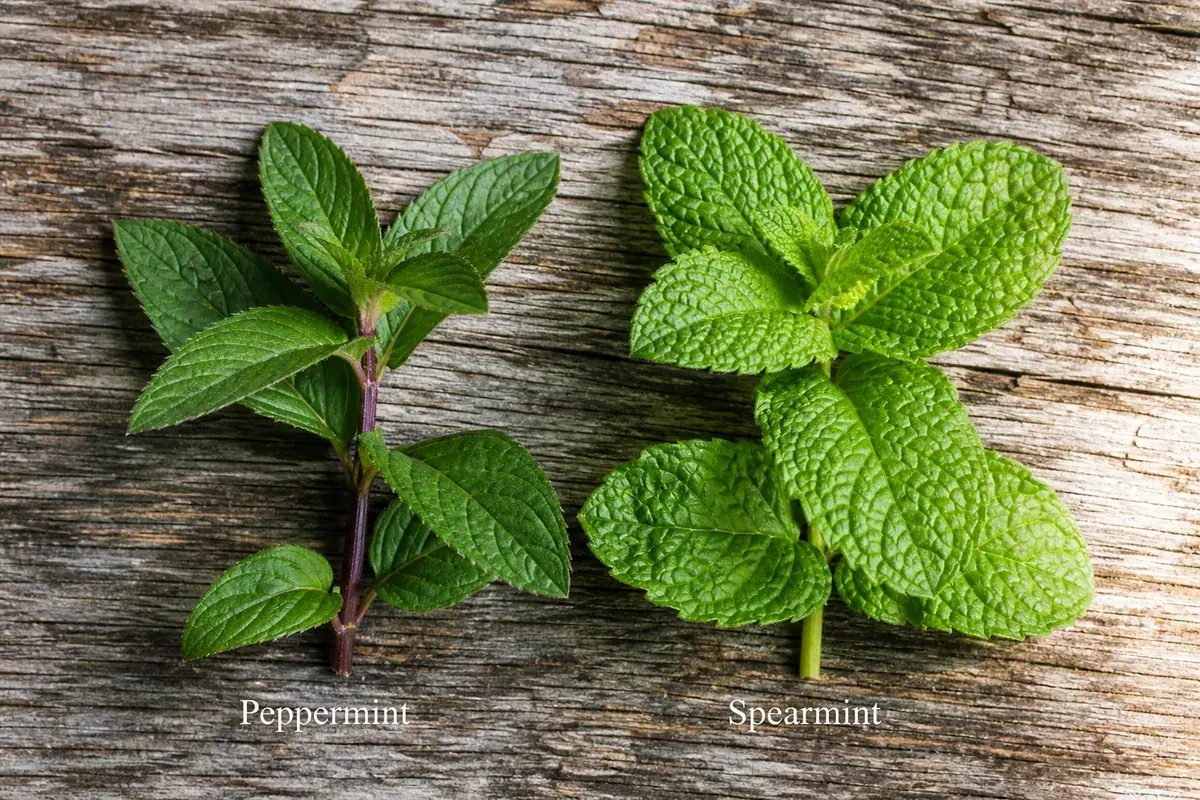
Spearmint leads on carvone instead of menthol, which reads as sweet and herbaceous rather than cold. The swap is not a matter of degree, and putting peppermint where a recipe wanted spearmint overwhelms whatever it was meant to lift.
If a recipe says mint without qualifying it, and the context is cooking or a cold drink, spearmint is almost always what is meant. A packet marked only mint tells you nothing at all about which of the two you have bought, which is a different problem from the one black tea drinkers face with unnamed blends.
What the cut of the leaf does to the cup
Peppermint infusion is more variable than its reputation suggests, and the variable is the material rather than the method.
Good dried peppermint gives a clean cold sweetness with a green, slightly peppery edge behind it. Poor material gives something closer to toothpaste: menthol arriving with none of the leaf underneath it.
How the character shifts with material
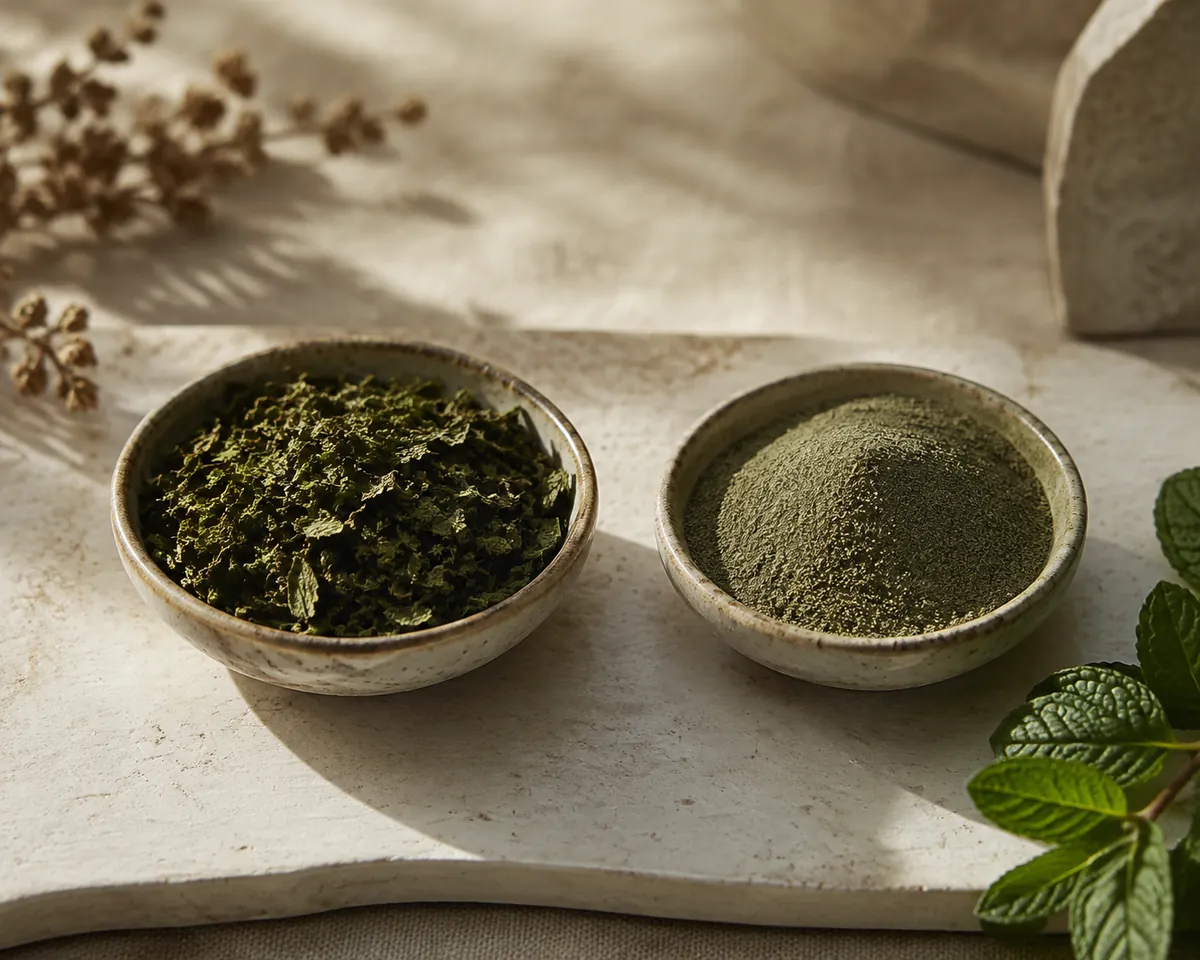
- Whole dried leafRounded, green, sweet, with the cooling as one part
- Roughly cutStill balanced, brews faster
- Cut and siftedMenthol leads, the green notes thin out
- Fine particlesSharp and medicinal, close to a mouthwash
The mechanism is surface area. Menthol sits in oil glands on the leaf surface, so the more the leaf has been broken up in processing, the faster those glands give up their contents and the less of the slower, greener extraction ever reaches the cup.
- Look for large recognisable leaf pieces rather than green powder.
- Colour should be a deep grey-green. Bright green often means it was dyed or dried too hot.
- Smell it through the packet. It should read as sweet and cold, not sharply medicinal.
- Avoid material with a lot of stem, which contributes bitterness and no mint character.
- Check the harvest date if one is given. Menthol fades steadily after about a year.
Price is not the constraint. Peppermint is cheap enough that decent loose leaf costs little more than bags, and the gap in the cup is wider than for almost anything else in the herbal range.
Buying by appearance rather than by brand is the single change that improves it most.
Most of the complaints collected in peppermint faults trace back to grade rather than to technique.
Covered pots, and the two minutes that decide it
Temperature barely matters here. A lid and a timer do.
Peppermint tolerates water straight off the boil, since nothing in the leaf is delicate enough for scalding to damage. What it does not tolerate is a long steep in an open cup.
Starting point
- Water
- Boiling, or just off it
- Steep
- 5 to 7 minutes for dried leaf
- Dried leaf
- 2 g per 250 ml
- Fresh leaves
- A generous handful, roughly 10 to 15 leaves, lightly bruised
- Vessel
- Covered, since menthol is volatile and leaves with the steam
Menthol is volatile enough that an uncovered mug loses a noticeable amount of it to the room in the first two minutes. A saucer laid over the cup is sufficient; all it has to do is make the steam condense and fall back in.
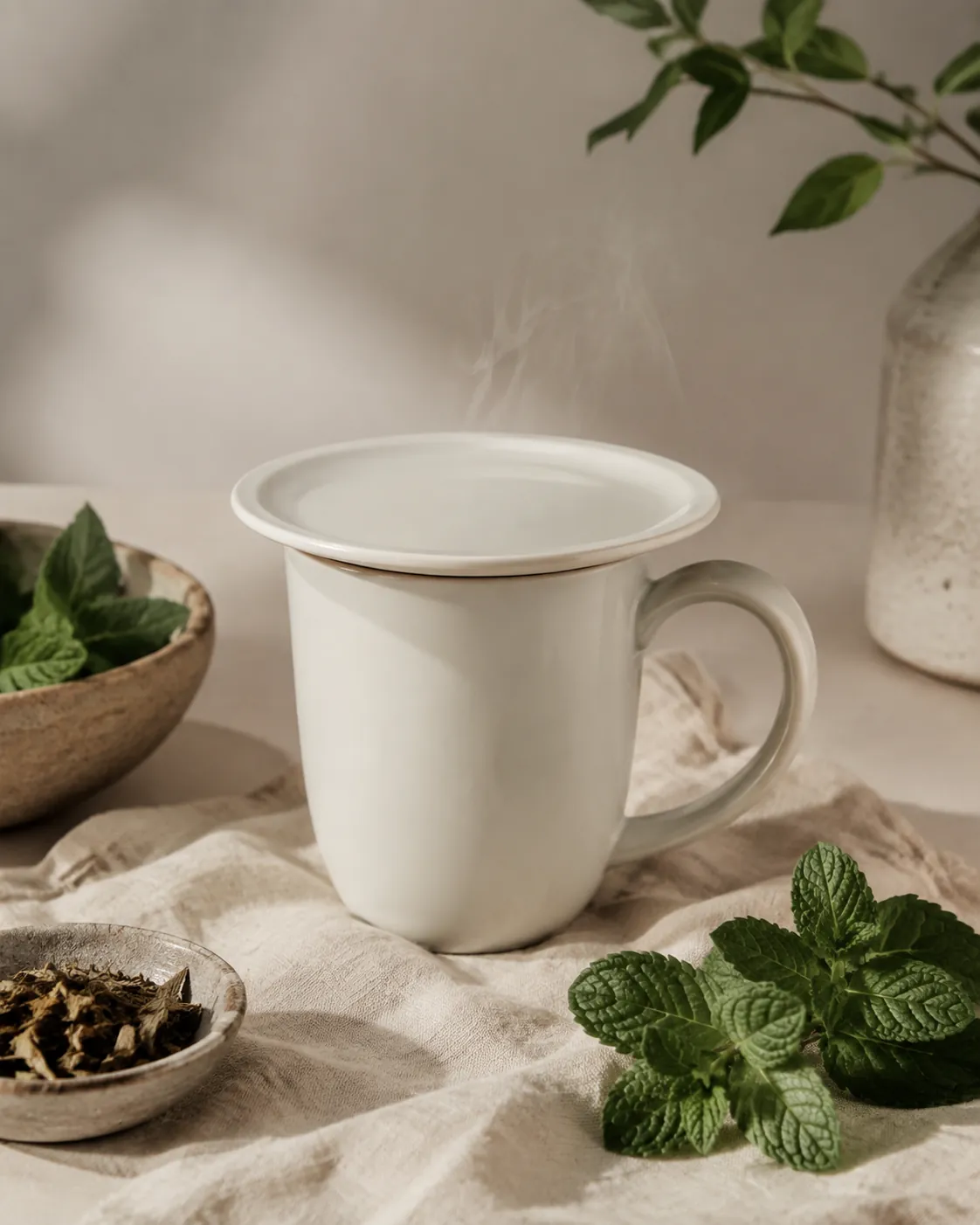
The same habit pays off with chamomile flowers, whose apple note escapes in exactly the same way, so it is worth carrying between the two.
Past about ten minutes, dried peppermint develops a flat bitterness under the menthol that the cold note does not cover. It is a leaf bitterness rather than a tannic one, so it does not sharpen on the tongue the way an over-steeped black tea does; it simply sits there and dulls everything.
For a stronger cup, add leaf rather than minutes. Making peppermint tea sets out proportions that scale without crossing that line.
Fresh leaf against dried, and what freezing keeps
Fresh leaves and dried leaves make two different drinks rather than a good version and a compromise, because a good deal of the menthol develops and concentrates while the leaf dries.
Fresh peppermint gives a softer, greener, less intense infusion, and it takes far more volume to reach the same strength. The green and peppery notes come forward, with the cold sensation sitting behind them instead of leading.
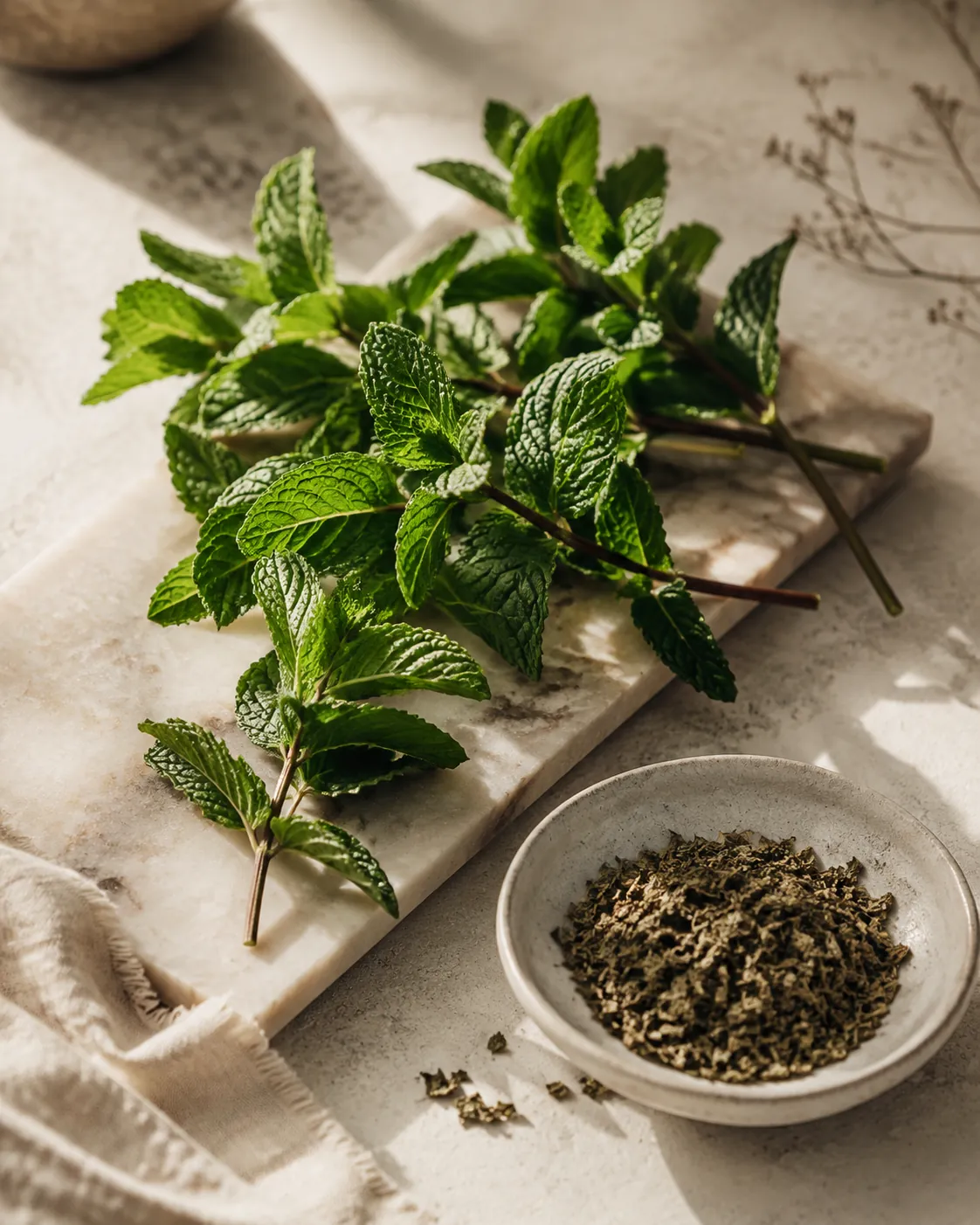
Dried leaf
More concentrated menthol, sharper and colder, available year round. The standard for peppermint tea.
Fresh leaf
Softer, greener, more delicate. Needs far more volume for the same intensity.
Frozen
Works better than expected. Freeze whole leaves and use them straight from frozen.
Peppermint extract
Not a substitute. It is menthol without the leaf, and it tastes like it.
Frozen leaf is the surprise on that list. Ice crystals rupture the cells much as bruising does, so the leaves give up their oils at once and can go into the pot without thawing.
If you grow fresh mint, the fresh version is worth making on its own terms rather than as a stand-in. A handful of leaf and two grams of dried are not the same drink at any ratio, and no adjustment to the steeping time closes the gap.
Drying your own, and how fast the menthol goes
Home-dried peppermint can beat most of what is sold, and the method needs no equipment.
Cut whole stems, tie them loosely, and hang them upside down somewhere dark, dry and airy. Darkness matters because light degrades the oils, and airflow matters because a dense bundle moulds at the centre.
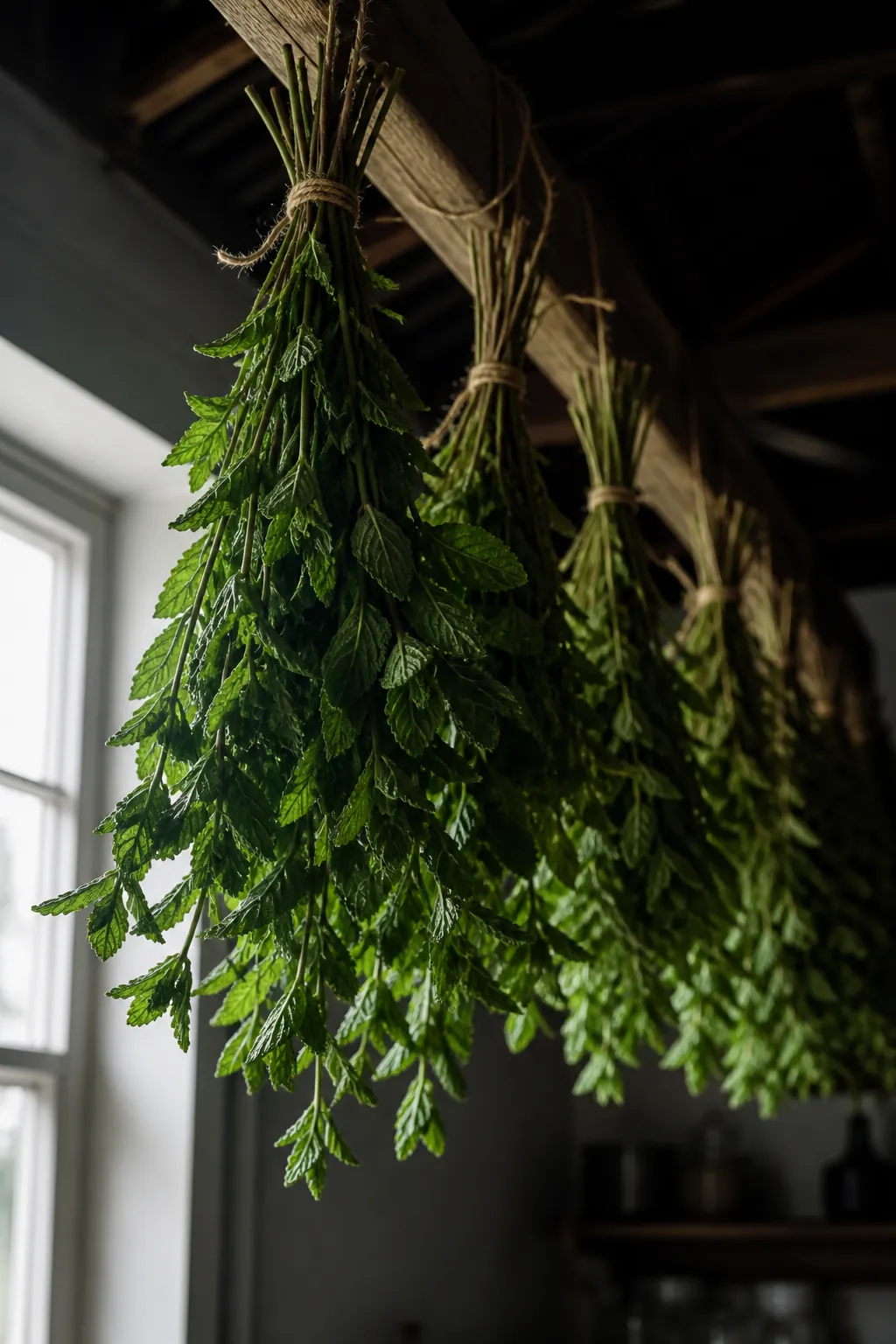
Ovens and dehydrators both work, and both cost you aroma, because menthol leaves with heat as readily as it leaves with steam. Air drying takes a week or two and gives noticeably better material for the trouble.
What no method stops is the slow loss afterwards. Menthol escapes over time and with every opening of the container, and what remains is green, faintly bitter leaf without the cold note that made it worth drinking.
An opaque airtight tin kept away from heat gives roughly a year of good material and longer of usable material. The container logic is common to every dried herb, and storing loose-leaf tea sets it out in full.
Peppermint's own case has one wrinkle: the volatile it loses is the one it is bought for, so it fades in character before it fades in strength. Storing peppermint covers what that looks like month by month.
Iced peppermint, and why the cold doubles up
Cold suits it unusually well.
The cooling sensation and the actual chill reinforce each other, which is not true of most flavours. An infusion that tastes merely pleasant hot can be genuinely refreshing over ice.
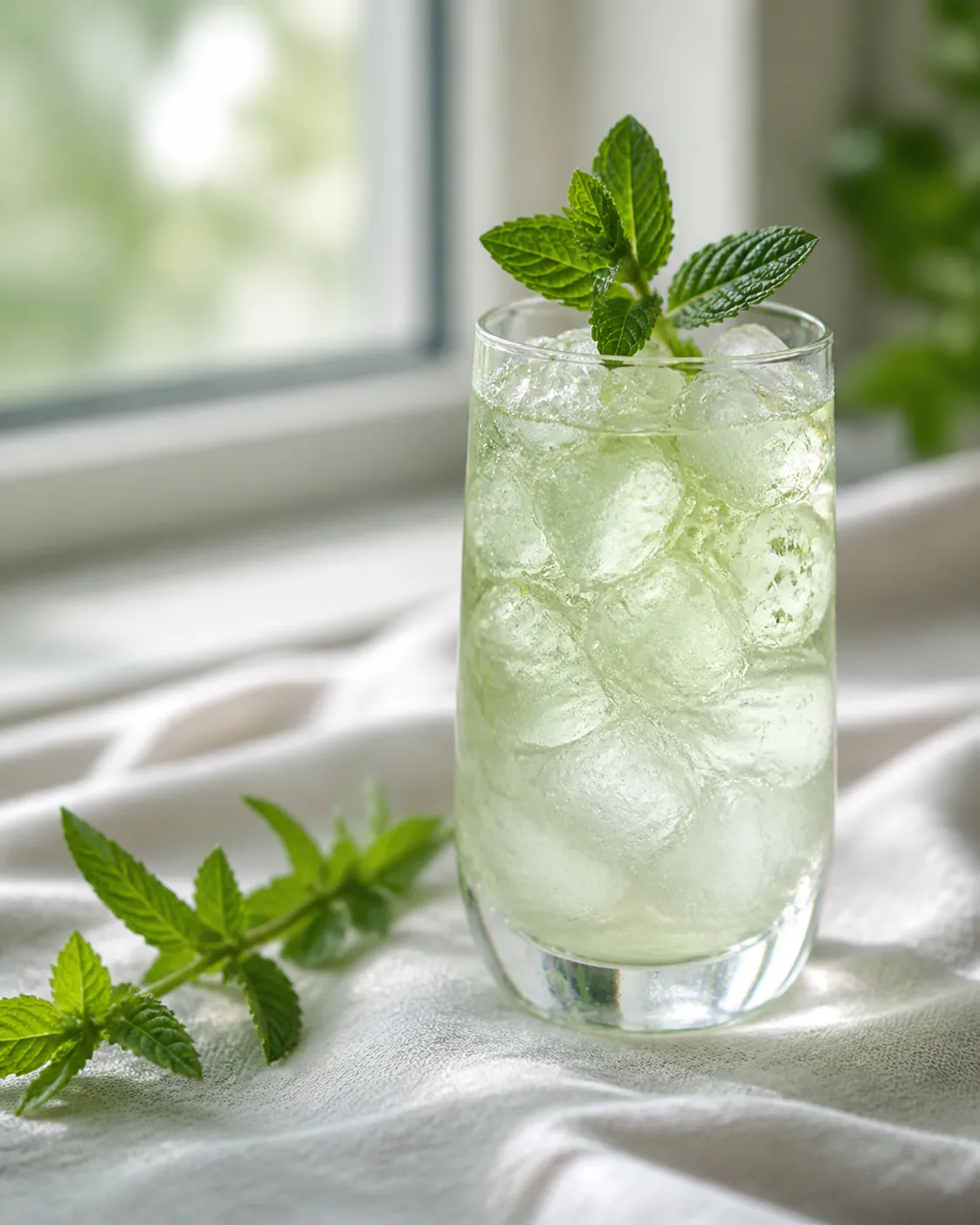
Iced peppermint
- Method
- Brew at double strength, then pour over a full glass of ice
- Dried leaf
- 4 g per 250 ml of water
- Steep
- 6 to 7 minutes, then cool
- Alternative
- Cold brew 4 g per 500 ml for 6 hours in the fridge
Brewing at double strength matters more than it sounds. A full glass of ice dilutes by roughly half as it melts, so a normal infusion poured over it arrives thin and tastes of almost nothing.
Cold brewing gives a softer result with less of the medicinal edge, for the same reason cold extraction softens everything else, including cold brew coffee. The long cool steep pulls menthol readily and leaves more of the sharper menthone behind in the leaf.
Serve it in a wide glass rather than a mug where you have the choice. A large part of what you are drinking arrives through the nose, and a narrow opening keeps it in the vessel.
A loud voice in any blend
Peppermint is a difficult blending partner, and it is worth knowing why before buying a mixture built on it.
Menthol dominates. In a blend, peppermint erases whatever sits beside it unless it is a small minority of the material, which is why so many mint blends taste simply of mint.
The pairings that survive are the ones with something equally assertive on the other side: liquorice root, a heavy roasted grain, or fresh ginger. Putting it next to something delicate wastes the delicate thing entirely.
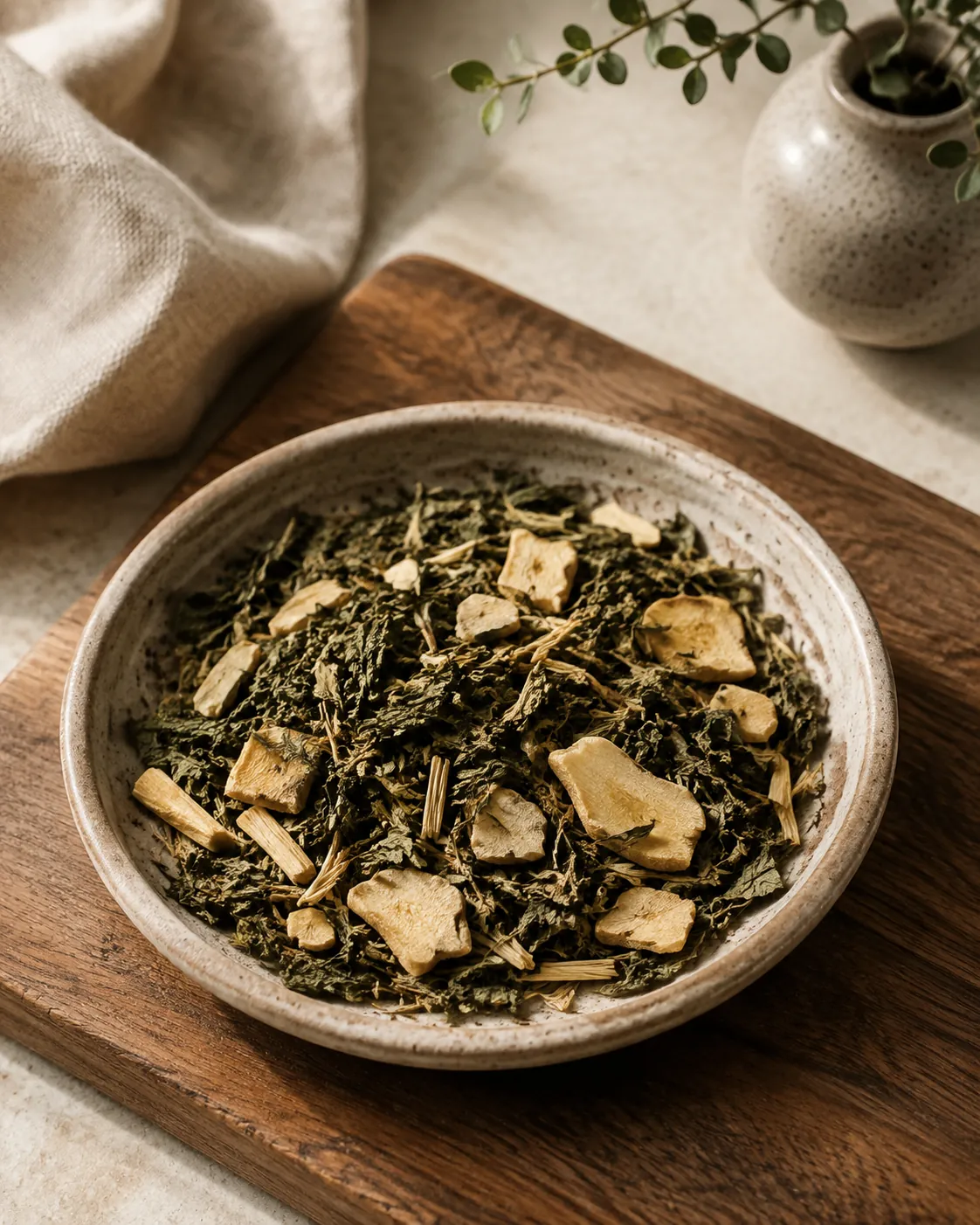
Additions to the finished cup behave the same way, and the list of things that improve a mint infusion is short.
Milk
Does not work. There is no tannin for the milk protein to bind to, so the cup turns flat and faintly savoury.
Sugar
Blunts the cooling that is the whole point of the drink.
Citrus
Fights the menthol rather than lifting it, and dulls the green notes with it.
Ginger
The one addition that holds its own, because it is as assertive as the mint.
Sugar blunts the cooling that is the point of the drink, and lemon fights the menthol rather than lifting it. Plain and hot, or plain and very cold, are the two states in which peppermint is actually good.
Set that against hibiscus, which blends into almost anything because tartness and colour add to a mixture rather than replacing what was already there.
Peppermint beside chamomile and rooibos
Placing peppermint against the two infusions it most often shares a shelf with makes its character easier to judge than any description of the drink standing on its own.
| Peppermint | Chamomile | Rooibos | |
|---|---|---|---|
| Plant part | Leaf | Flower head | Leaf and stem |
| Intensity | High | Low | Medium |
| Dominant note | Cold menthol | Apple and honey | Sweet, woody, slightly vanilla |
| Blends well | Poorly, it dominates | Yes, as a base | Yes |
| Serve cold | Excellent | Good | Good |
Rooibos is the one that survives peppermint in a bag, because its body and sweetness sit underneath the menthol instead of competing with it on the same axis.
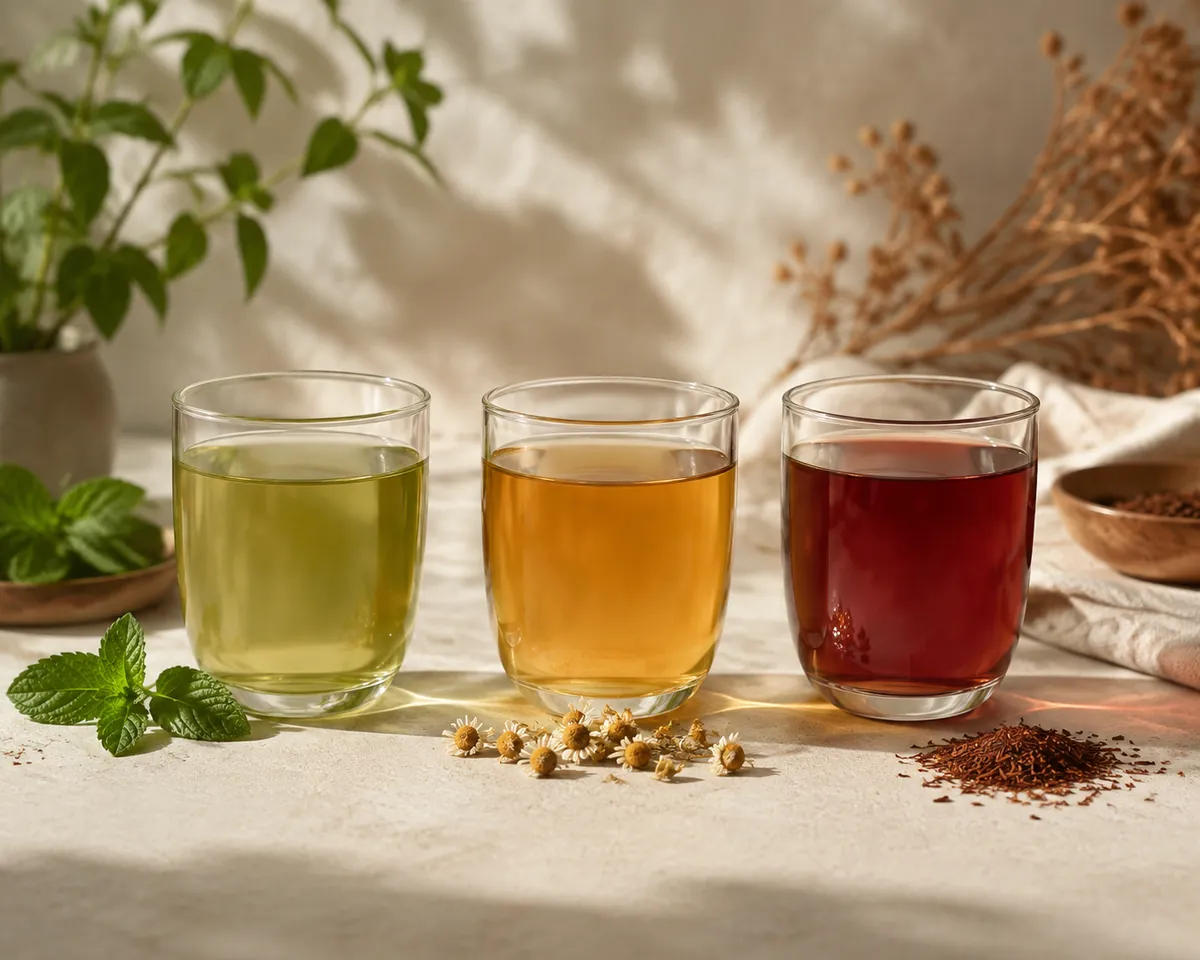
Chamomile is the one that gets smothered, and a mixed bag of the two is usually peppermint with a faint apple ghost behind it. Chamomile against peppermint takes that pairing apart properly.
Of the wider group, honeybush behaves much as rooibos does under a mint, while a roasted grain infusion is the only one that reliably answers back.
Judged on demands rather than on flavour, peppermint is the least demanding of the three, since it needs no care with water temperature and very little with timing.
Growing a plant that will not stay put
Peppermint is one of the easiest herbs to grow and one of the most aggressive.
Because the hybrid is effectively sterile, it spreads by runner rather than by seed. Those runners travel underground and will take over a bed within two seasons if nothing stops them.
- Plant it in a container, or sink a bottomless pot into the bed to contain the runners.
- Give it damp soil and part shade. Watermint is one of its parents and it likes moisture.
- Pinch out flower buds. Once it flowers the leaf turns noticeably more bitter.
- Harvest in the morning after dew has dried, when the oil content in the leaf is highest.
- Divide it every two or three years, since a congested clump loses vigour.
Buy a named plant rather than seed. Seed sold as peppermint produces variable seedlings that usually land closer to spearmint, because the true hybrid does not come true from seed.
Flowering is the point to watch. The plant redirects its energy into the flower head and the leaf turns noticeably more bitter, which is why commercial peppermint is cut just before bloom rather than after it.
Water chemistry matters far less for this infusion than for a delicate leaf tea, since menthol carries through almost anything that comes out of a tap, though brewing water still sets the baseline for everything else you make.
What a peppermint packet does not tell you
Two words on the front do most of the misleading.
"Mint tea" is the first, and it is no guarantee of peppermint at all. It often means spearmint, or a mixture of the two, which is a genuinely different drink rather than a lesser one.
"Natural flavouring" is the second. A peppermint product listing flavouring alongside the leaf is topping up thin material with isolated menthol, and that is the main reason cheap peppermint tastes like confectionery.
What the words on a peppermint packet mean
- Mint tea
- Not a guarantee of peppermint. Often spearmint, or a mixture
- Natural flavouring
- Isolated menthol added to thin leaf
- Peppermint leaf
- The single ingredient you actually want
- Best-before
- Describes safety, not aroma. Menthol fades well before it
- Harvest or packed date
- The figure that predicts how the cup will taste
What you want on the label is one ingredient: peppermint leaf. A green tea base also brings caffeine into a drink many people choose precisely because it has none, which is the ground peppermint and caffeine covers.
Origin is rarely printed and rarely matters. Peppermint is grown commercially across the United States, India, Egypt and much of Europe, and the region tells you far less about the cup than the grade of the leaf and how recently it was dried.
The one date worth hunting for is a harvest or packed date. Menthol fades on a schedule the best-before label does not describe, and a packet dated two years ago will taste noticeably flatter whatever the expiry says.
Common questions
Is peppermint tea the same as mint tea?
Not necessarily. Mint tea can mean peppermint or spearmint, and Moroccan mint tea is green tea with spearmint. Peppermint is a specific hybrid with far more menthol, so it tastes noticeably colder and sharper.
Why does peppermint tea feel cold?
Menthol binds to the receptor that detects cold temperature, so the nerve reports cold even though the drink is hot. It is a sensation rather than an actual temperature change.
Can you make peppermint tea from fresh leaves?
Yes, and it is a different drink: softer, greener and less intense, because much of the menthol concentrates during drying. Use a generous handful of lightly bruised leaves rather than chopping them.