What Is Jasmine Tea? Why Good Jasmine Holds No Flowers
Good jasmine tea contains no jasmine. The flowers are laid against the leaf overnight, removed, and replaced with fresh ones, sometimes seven times over.
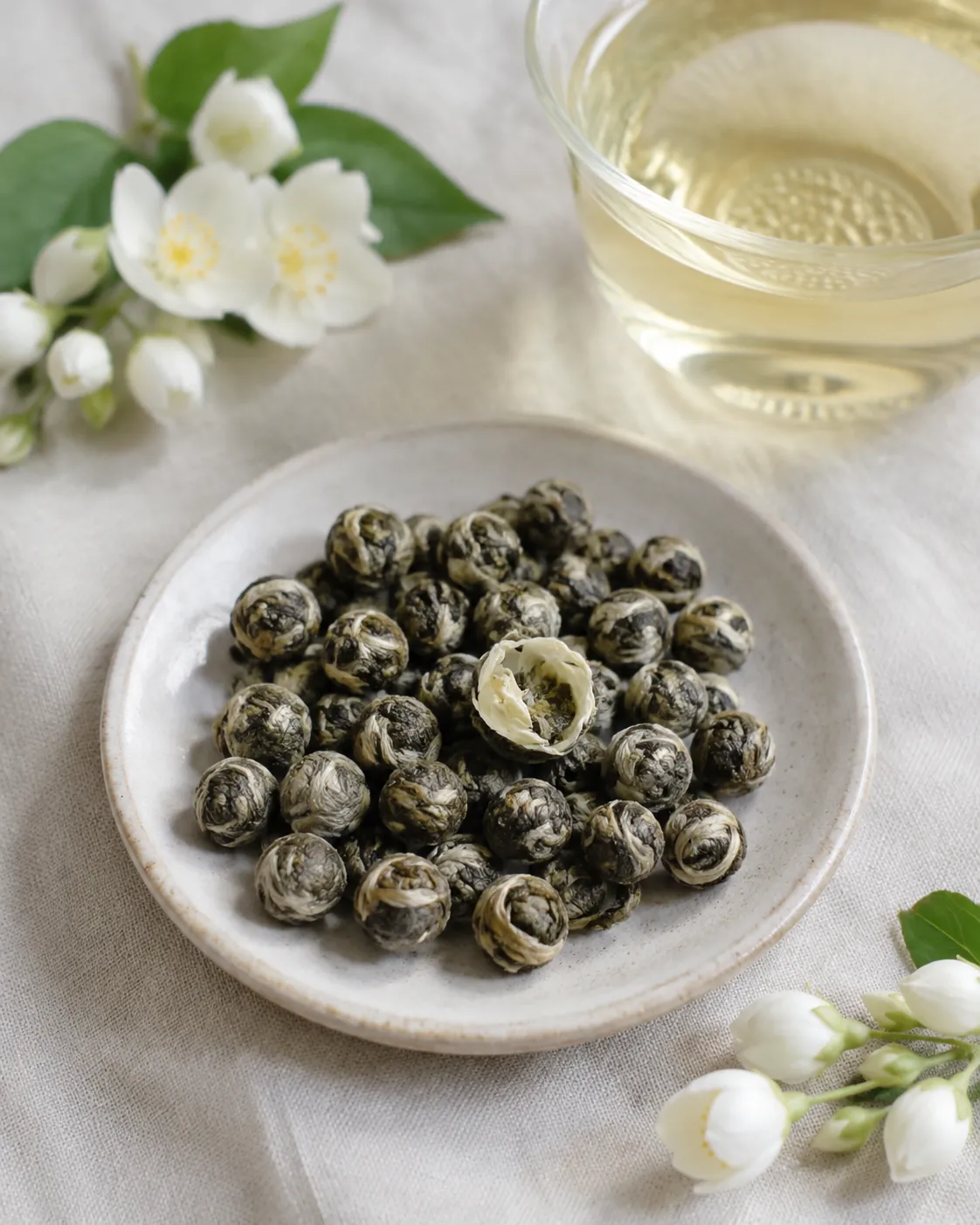
Jasmine tea is tea that has absorbed the scent of fresh jasmine flowers. In the traditional process the flowers are physically removed afterwards, so the finished tea usually contains no visible blossom at all.
Tea sold with white petals scattered through it is generally the cheaper approach, where the flowers are left in for appearance rather than because they did any work.
Jasmine tea at a glance
- What it is
- Finished tea that has absorbed aroma from fresh jasmine blossom
- Usual base
- Green tea, most often from Fujian. White, black and oolong bases exist
- The flower
- Jasminum sambac, which opens at night and is used the same evening
- Quality variable
- The number of scenting cycles, from one or two up to seven or more
- Water
- 75 to 85 C, following the base rather than the scent
- Steep
- 2 to 3 minutes loose, 3 to 4 for pearls
- Keeps
- Around a year, and the aroma goes before the tea does
How scenting works, and how flavouring imitates it
Everything about this tea rests on one property of dried leaf, which is that it takes up aroma from the air around it readily. That is a nuisance in a storage tin and the entire basis of the method here.
One scenting cycle
- WaitJasmine buds are picked by day and held until they open in the evening.
- LayerOpened flowers are laid in alternating layers with dried tea leaf.
- RestThe pile sits overnight while the leaf absorbs the aroma.
- SeparateSpent flowers are sifted out the next morning.
- DryThe leaf is gently re-dried to remove moisture the flowers added.
That entire cycle is then repeated with fresh flowers. The number of repetitions is the main quality variable in the category, running from one or two for cheap tea up to seven or more for the best.
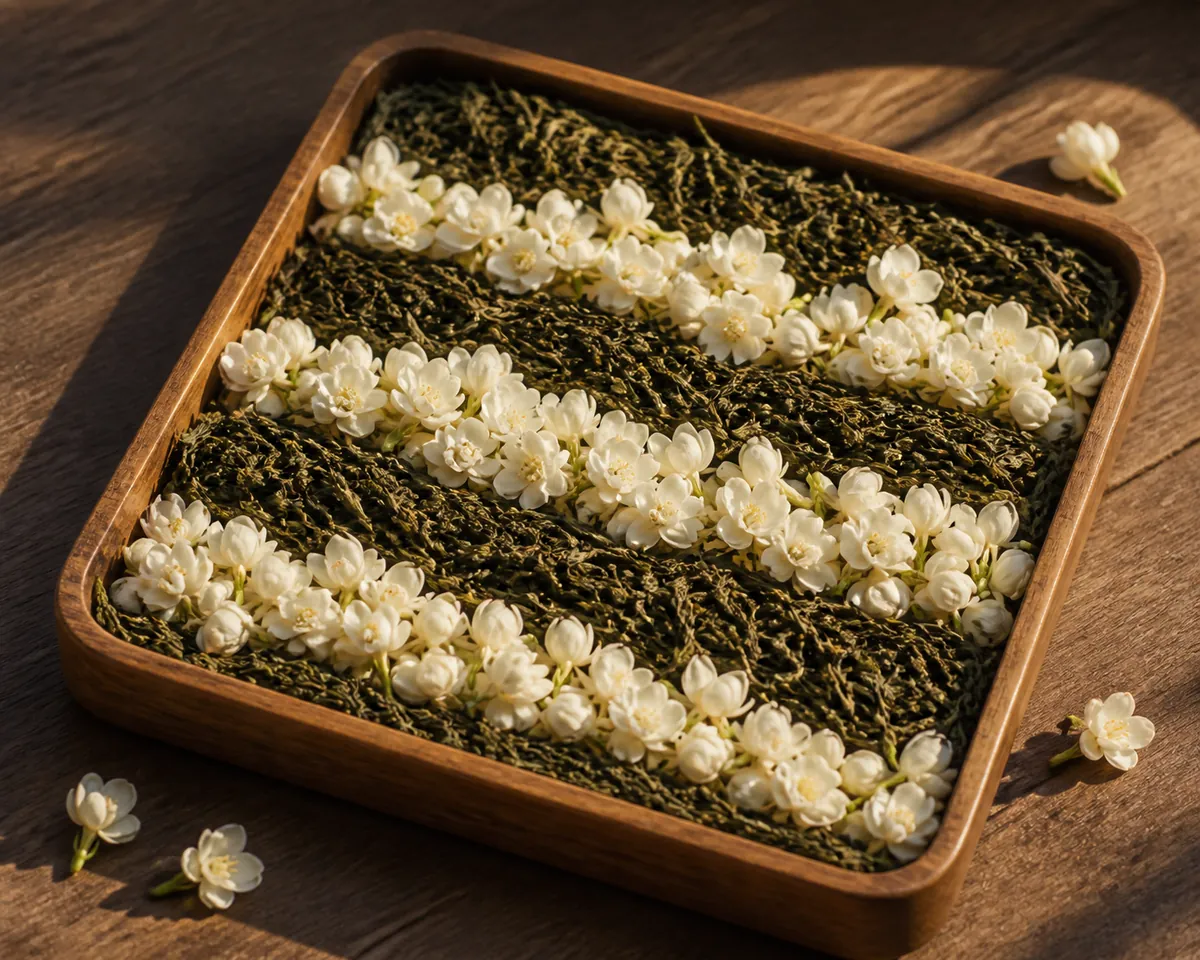
Each cycle costs a night, a fresh batch of flowers and another re-drying. That accumulation of cost is why properly scented jasmine is expensive, and why a much faster substitute exists alongside it on every shelf.
| Traditionally scented | Flavoured | |
|---|---|---|
| Method | Layered with fresh flowers, repeatedly | Sprayed with jasmine oil or flavouring |
| Flowers in the packet | Usually none, or a few for show | Often present as decoration |
| Aroma | Rounded, sweet, develops as it brews | Sharp and immediate, sometimes soapy |
| Cost | High | Low |
| Label clue | Scented, or a stated number of cycles | Natural flavouring in the ingredients |
The soapy quality that puts people off jasmine tea is almost always a flavoured product rather than the flower. Real scenting does not produce it, and anyone who has decided they dislike the style has usually met only the sprayed version.
Which jasmine, and why the work happens after dark
Two species are used, one of them dominates, and they do not smell the same.
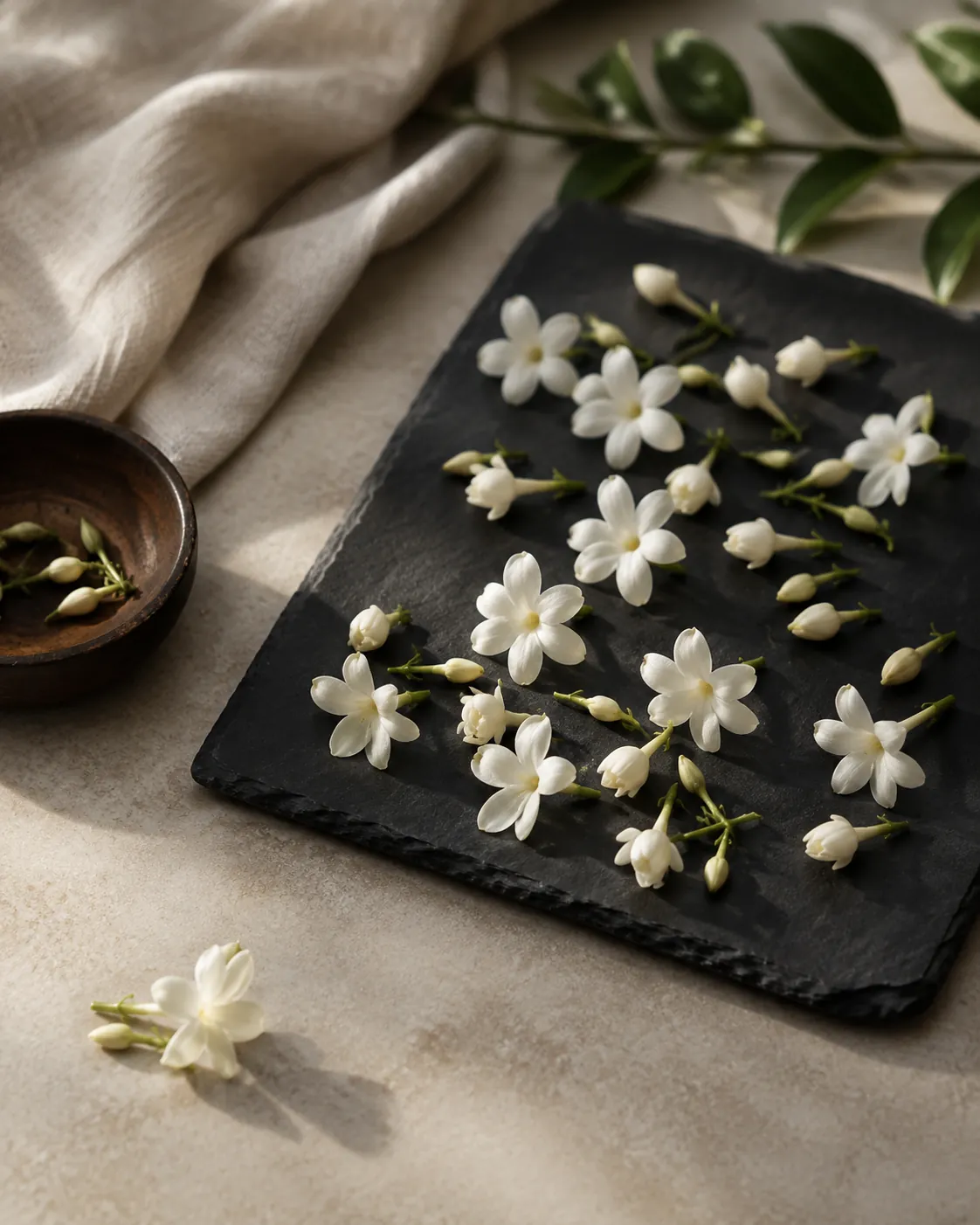
Jasminum sambac, Arabian jasmine, is the standard for Chinese jasmine tea. Its flowers are small, waxy and intensely sweet, and they open at night, which is the reason scenting is nocturnal work.
Jasminum officinale, common jasmine, appears more often in perfumery and only occasionally in tea. It is lighter and greener and gives a less honeyed result, which is worth knowing if a tea smells thinner than expected.
Why the flowers are picked by day and used at night
- Picking
- Buds are gathered in the afternoon, still closed
- Holding
- They are spread and cooled so they do not open early
- Opening
- The buds open in the evening, releasing aroma over several hours
- Layering
- Scenting begins as they open, which is when they give most
- Timing
- The whole cycle is dictated by the flower, not by the factory
A flower that has already opened and faded is spent. Production therefore runs overnight through the summer flowering season and stops when the season does, which is why nobody makes traditionally scented jasmine tea in February.
The base tea, and the names on a Chinese packet
Scent is applied to a finished tea, so what lies underneath decides at least half of what you taste.
Green tea is the usual base, most often from Fujian, and it gives the clean light cup most people picture. White tea bases are sweeter and more delicate and cost more, while black and oolong bases exist and are much less common.
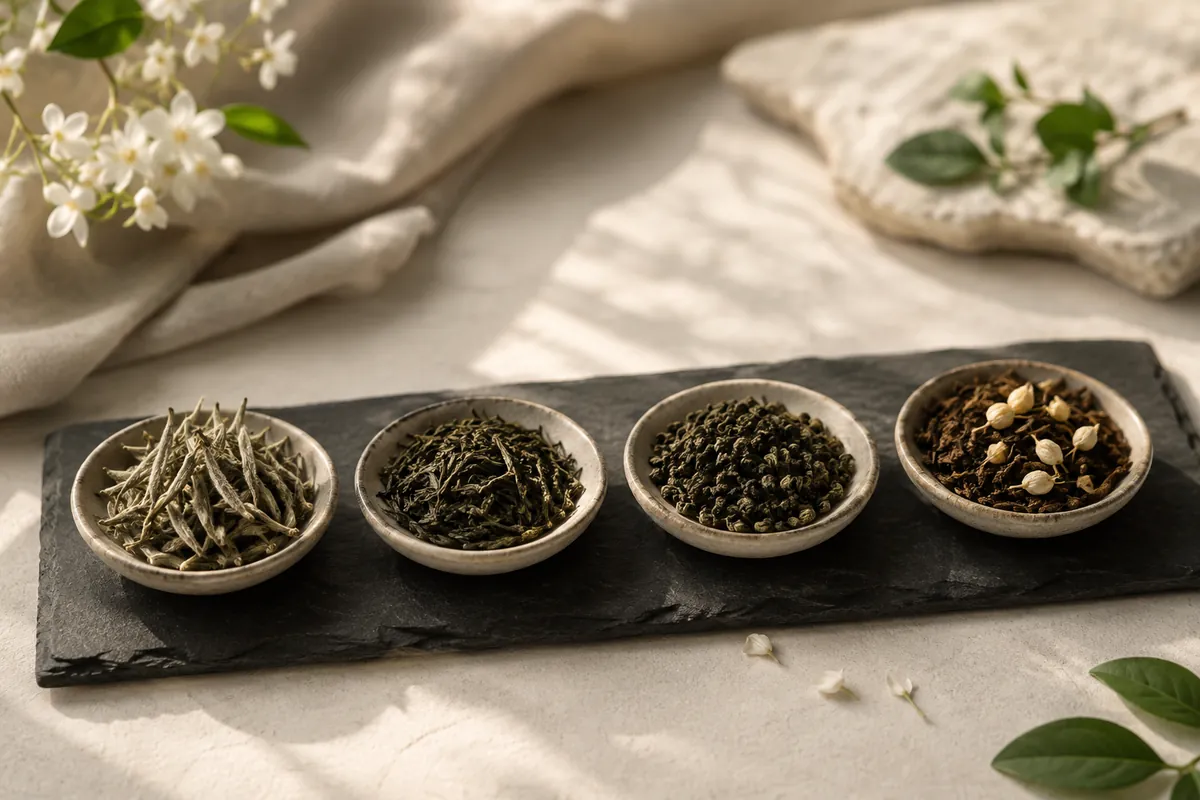
The Chinese names on a packet look poetic and describe something concrete, which makes them worth learning as a set rather than skipping.
| Name | Means | What it indicates |
|---|---|---|
| Yin Hao | Silver down | Bud-heavy leaf with visible white hairs. High grade |
| Mao Feng | Downy peak | Bud and one leaf. A step below Yin Hao |
| Bi Tan Piao Xue | Snow on green pond | Sichuan style, flowers deliberately left in |
| Long Zhu | Dragon pearl | Hand-rolled into balls |
| Xiang Pian | Fragrant petal | A general term, usually lower grade |
Bi Tan Piao Xue is the exception to the no-flowers rule. It leaves blossom in by design as part of the style, so visible petals there are not the cost-cutting signal they are everywhere else, and how jasmine tastes treats the two styles separately for that reason.
Brewing it as its base, and what pearls change
Jasmine follows the rules of whatever it was made from, which for most of it means the rules for green tea.
Starting point
- Water
- 75 to 85 C
- Steep
- 2 to 3 minutes for loose leaf, 3 to 4 for pearls
- Leaf
- 3 g per 200 ml
- Pearls
- Fewer than you expect, since they expand considerably
- Infusions
- Two or three, and pearls give more
Boiling water is the common mistake and it costs twice. It scalds a green base into bitterness, exactly as why green tea bitters describes, and it drives off the aromatic compounds that the scenting existed to put there, so steeping temperature matters more here than for a robust tea.
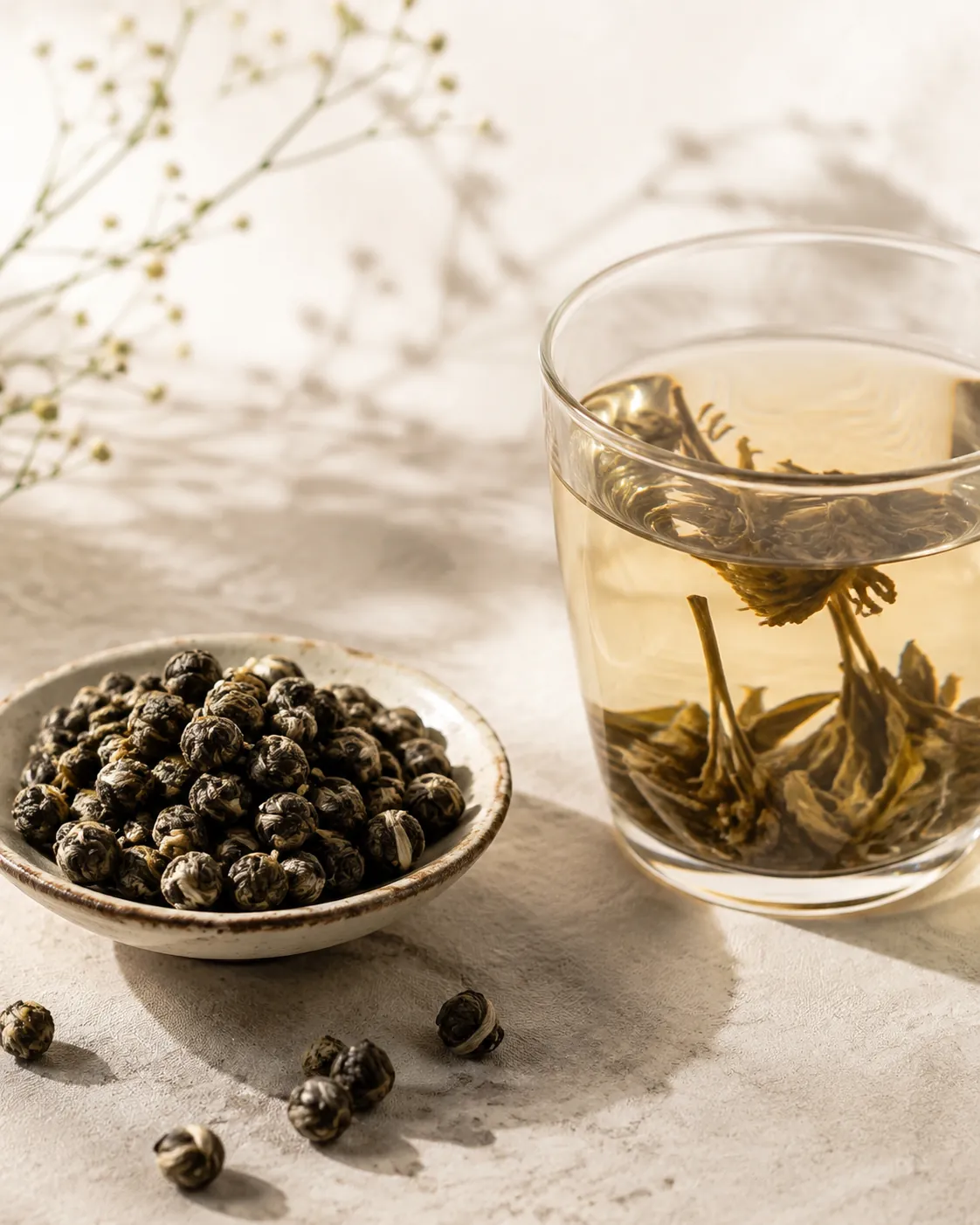
Pearls are made by rolling scented leaf and bud into small spheres by hand, each holding two or three whole leaves around a bud. They brew differently rather than better: the rolling protects the leaf, so they release slowly and give three or four good infusions where loose scented tea gives two.
The first steep needs longer while they open, and a gaiwan makes that easy to judge because you can watch them unfurl. Other shapes are mostly display, and blooming teas tied around a dried flower are sold on what they do in the pot rather than on the leaf inside them.
Buying it, and why you should buy it small
A handful of checks separate a properly scented tea from a perfumed one, and none of them requires tasting it first.
- Look for the number of scenting cycles, which good sellers state.
- Prefer tea with no flowers in it, or only a token few.
- Check the ingredients for flavouring, which indicates the oil-sprayed method.
- Smell the dry leaf. It should be sweet and floral, never sharp or soapy.
- Note the base tea. Green is standard and white is the premium option.
Quantity is the decision most people get wrong. Jasmine fades faster than the tea underneath it, because the aroma was added rather than grown, and the scenting compounds are volatile and sit on the leaf rather than inside it.
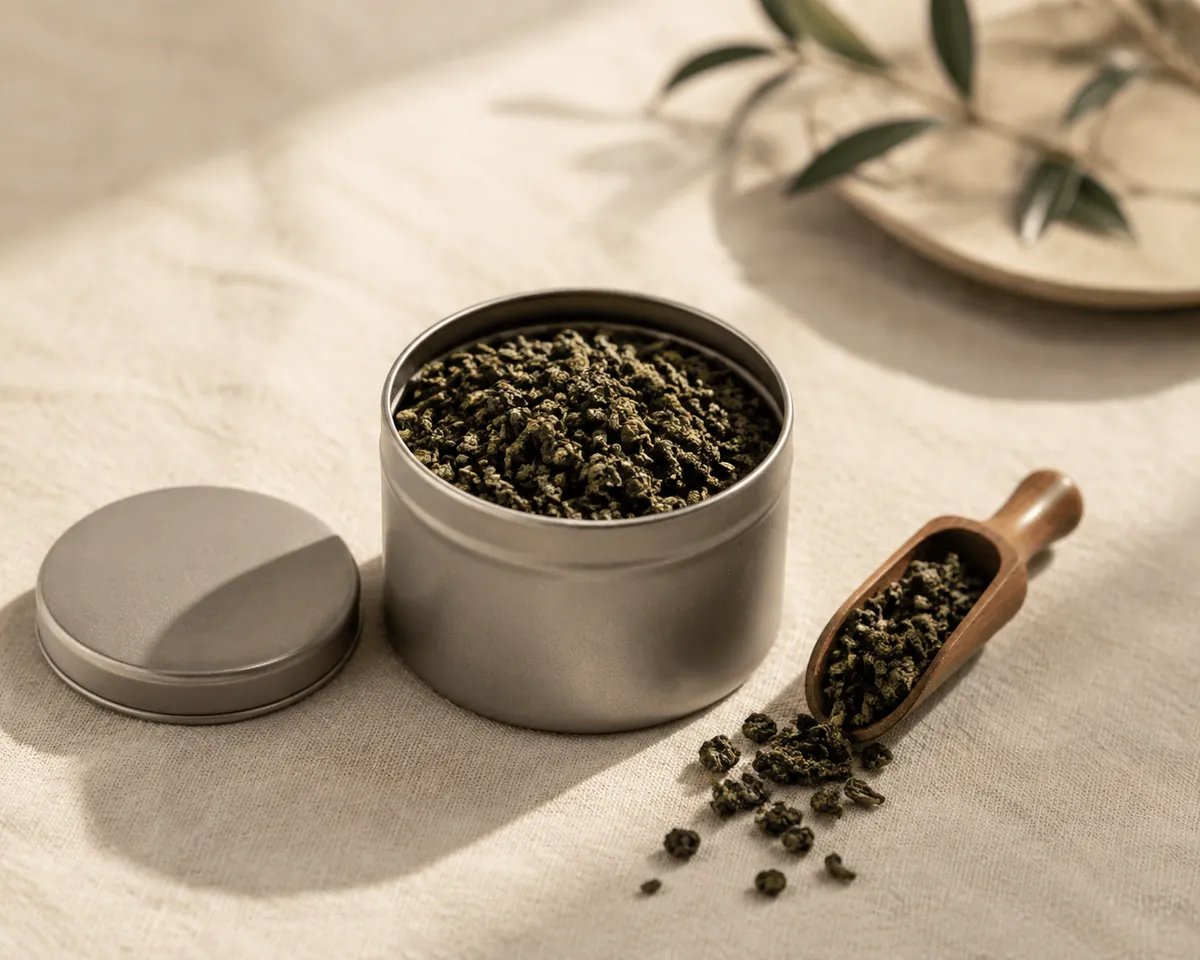
A sealed opaque tin holds a good jasmine for roughly a year. A year-old one still tastes of tea and much less of jasmine, which is a slow disappointment rather than an obvious fault and the reason a large bargain packet is usually a false economy.
Keep it well away from anything else aromatic. A scented tea both loses its own aroma and picks up others readily, so it is the worst possible neighbour for a spice jar, and storing jasmine covers what storing loose-leaf tea does not.
Where it is made, and who else makes it
Two Chinese regions produce most of it and they are not interchangeable.
Fujian is the historic home, particularly around Fuzhou, and its jasmine tea is usually built on a green base with a refined, delicate character. Prices there are correspondingly higher and the scenting cycle counts are the ones most often stated.
Guangxi, and Hengxian county in particular, now produces an enormous share of the world's jasmine tea. It grows the flowers at scale and supplies most of the mid-market, which is where the majority of supermarket jasmine comes from.
Fuzhou, Fujian
The traditional origin. Refined, and usually more expensive.
Hengxian, Guangxi
The volume producer. Good value, and the source of most supermarket jasmine.
Sichuan
Smaller production, often with a distinctive base tea and flowers left in.
Vietnam
Growing quickly, and generally flavoured rather than traditionally scented.
Vietnam sits at the value end and India produces jasmine-scented teas in the northeast, usually on a black tea base, which reads quite differently from the Chinese green-based standard. Taiwan makes small quantities of scented oolong, which is a separate and often excellent proposition.
Country is the wrong thing to buy on. A tea scented over several nights with real flowers costs more than one sprayed with oil wherever it was made, and both are sold under the same two words.
How much caffeine is in jasmine tea
The flowers contribute none of it, so the number follows whatever was scented.
Scenting adds aroma and nothing else. A jasmine green therefore sits exactly where an unscented green tea of the same grade and leaf size would sit, and no amount of extra scenting moves it.
Brewing style shifts the figure further than the base does. Short repeated steeps put less into each cup than one long western steep of the same leaf, which is a useful lever given how many cups a session produces, and jasmine caffeine works through both patterns.
Nothing about the smell predicts the number, which catches out anyone who assumes a floral tea must be a gentle one.
Iced and cold-brewed
Cold suppresses aroma, and jasmine is very nearly all aroma, so the method matters more here than for any other iced tea.
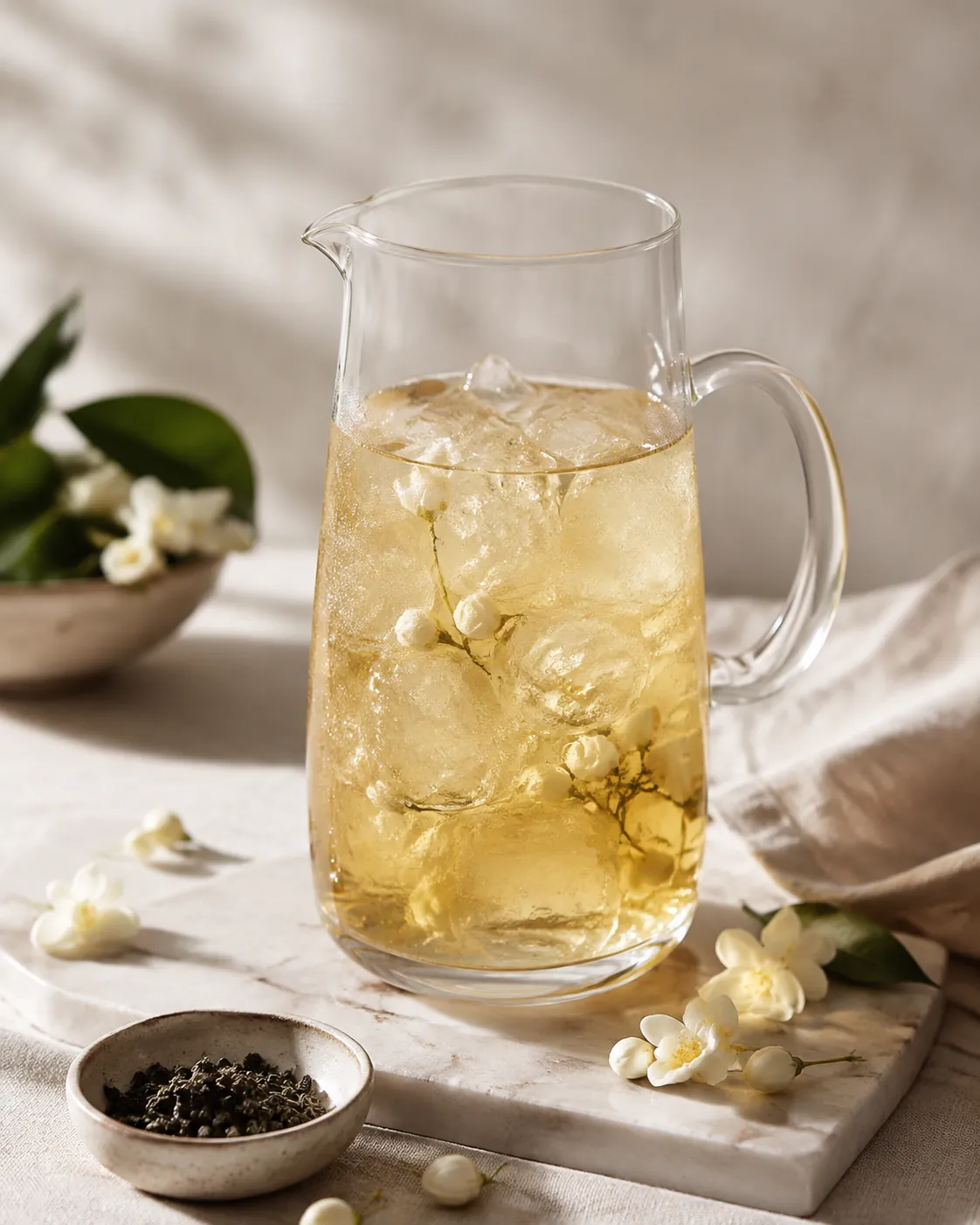
Pouring hot jasmine over ice throws away a great deal of what was paid for. The aroma leaves with the steam and the melt dilutes what survives, which is the worst of both routes.
Cold brewing keeps far more of it. Six to eight hours in the fridge at 8 g per litre gives a pale, intensely floral infusion with no astringency at all, and it is the clearest demonstration on the site of what cold extraction does for an aromatic tea.
The middle route is to brew hot at double strength and chill it quickly in the fridge rather than over ice. That keeps more aroma than pouring over ice and less than cold brewing, and it is the one to use when the jug is needed the same afternoon rather than the next morning, as iced tea sets out for the other styles.
At the table, and where it does not belong
Jasmine has a defined role in Chinese meals and a narrower one everywhere else, which is worth knowing before buying a large tin of it.
It is the standard tea with dim sum, where its floral lift cuts through fried and rich dishes without adding any weight of its own. That pairing is the reason most people outside China have tasted it at all.
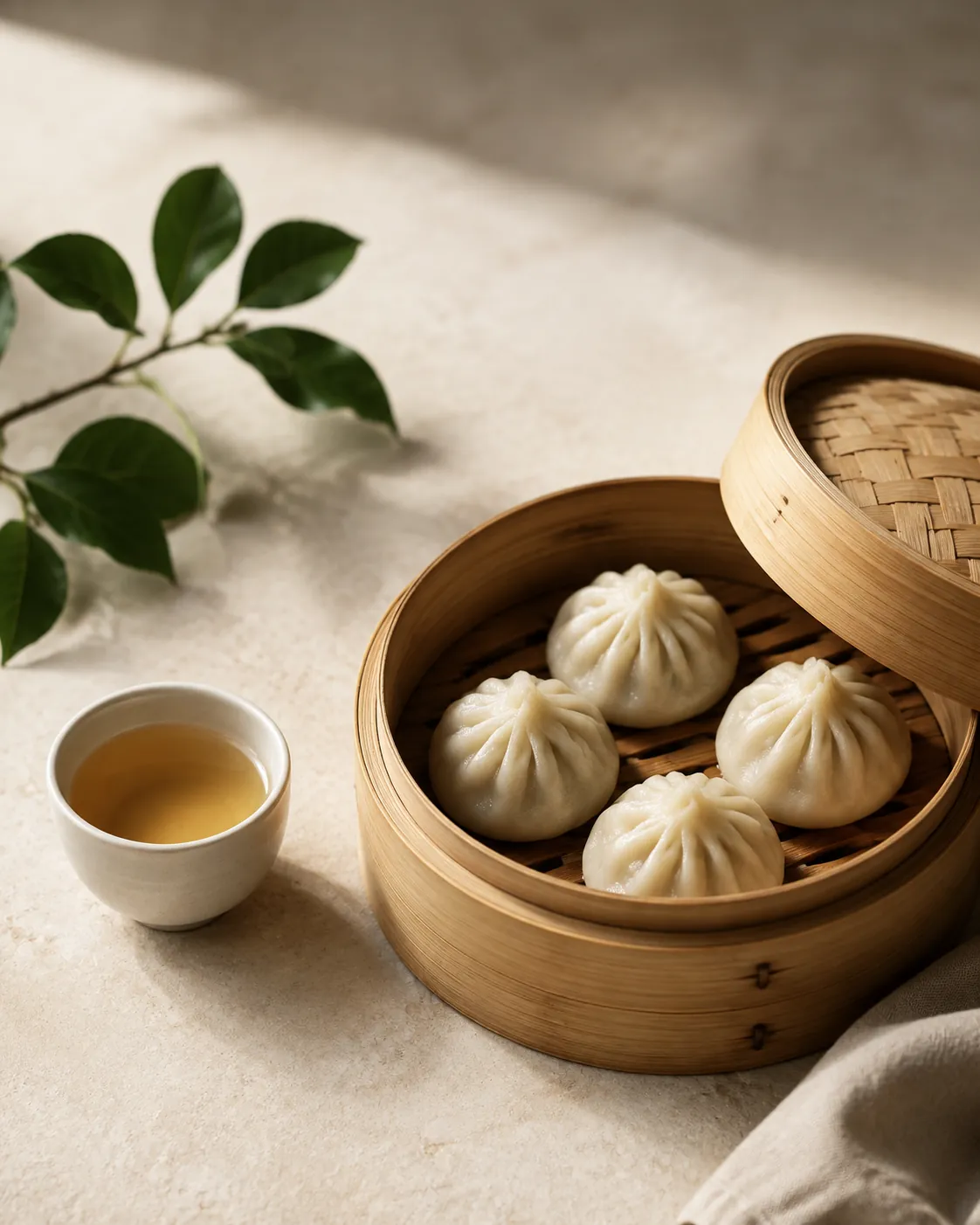
Dim sum
The classic pairing. Floral lift against fried and rich dishes, with no weight of its own.
After a meal
At a lower temperature and a shorter steep than a restaurant pot usually gets.
Alone and hot
Where the aroma has room to arrive before anything competes with it.
Milk or sugar
No. There is no tannin for milk to bind to and sugar buries the flowers.
Restaurant jasmine is frequently over-brewed, which is why so many people remember the tea as bitter rather than floral.
What it does not take is milk or sugar. There is no tannin structure for milk to bind to and sugar buries the floral notes completely, and jasmine problems is largely a list of things added to it that should not have been.
Its best setting is alone and hot, where the aroma has room to arrive before anything else competes with it. That is a narrower brief than its popularity suggests, and it explains why a tea everybody has tried is one relatively few people keep in the cupboard.
The blends it appears in
Jasmine is used as a component at least as often as it is drunk on its own, and the blends behave differently from the plain tea.
- Jasmine with green tea, the standard and the one worth buying
- Jasmine pearls, rolled by hand and worth the premium once
- Jasmine with white tea, lighter and more expensive for less scent
- Jasmine in a bagged blend, where the scent is usually added as oil
- Jasmine with mint or citrus, which fights rather than supports it
Jasmine with green tea is not really a blend, since the base is green tea already. What is sold under that description usually means scented leaf mixed with unscented green to bring the price down, which dilutes the cycles somebody paid for.
Jasmine and mint appears across North Africa and the Middle East, where the floral and the cooling notes sit together without competing. It is brewed stronger and sweeter than a Chinese jasmine would ever be, and the tea underneath is chosen to survive that treatment.
Bubble tea is the largest commercial use by volume. The tea there is brewed very strong and sweetened heavily, which suits a robust scented tea and wastes a careful one, and it is a large part of why cheap jasmine has a market at all.
Making jasmine tea covers the concentrations those drinks assume.
Against the other aromatic teas
Aroma is the reason people buy several teas on this site, and the group divides on a single question, which is whether the smell came from outside the leaf or was made inside it.
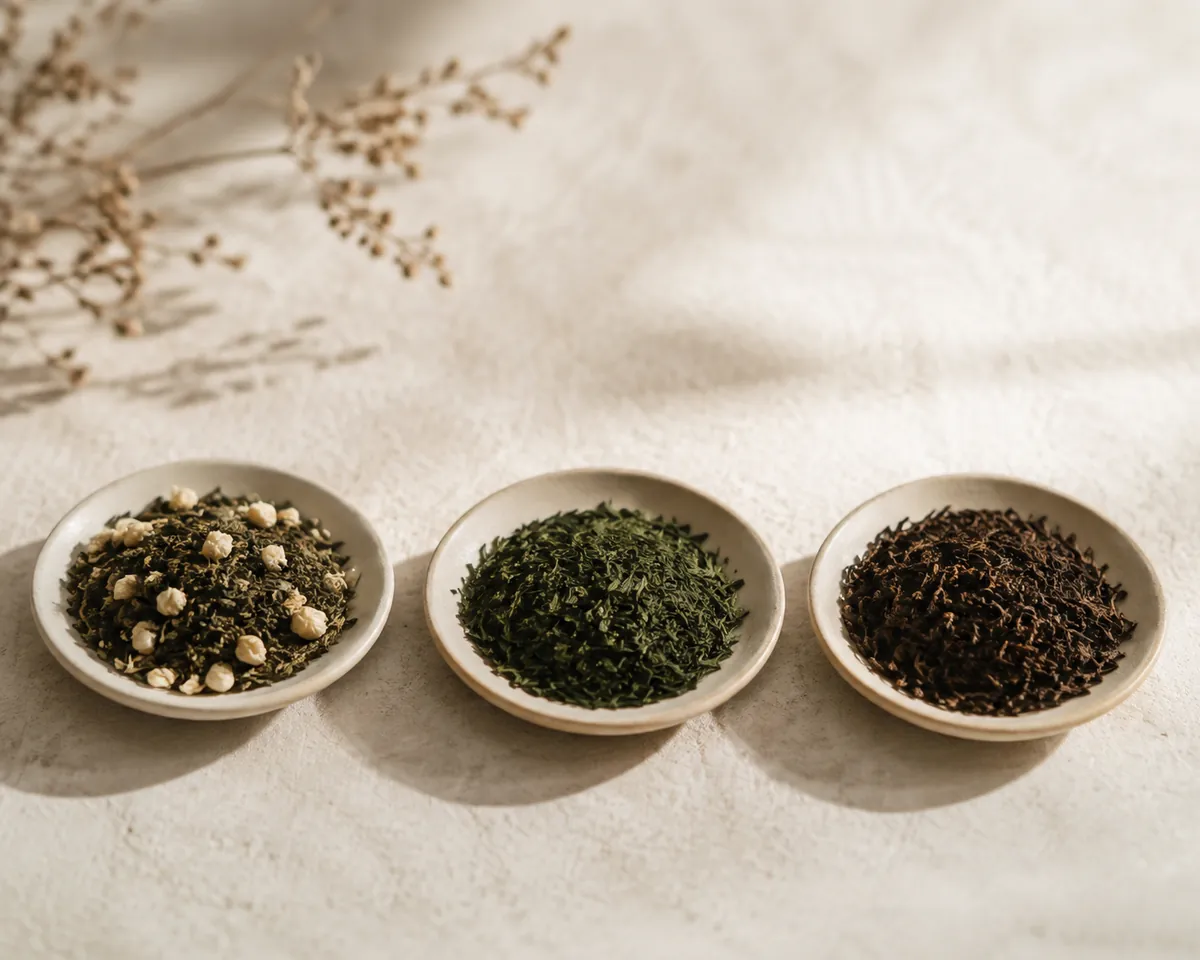
Scented teas take their aroma from an external source. Jasmine takes it from the flowers and Earl Grey takes it from bergamot oil, and in both cases the aroma sits on the surface of the leaf and fades faster than the tea beneath it.
Aromatic teas carry their character from processing instead. Hojicha smells strongly of roast because the leaf was roasted, and that aroma is stable for a year where jasmine's is measurably weaker after six months.
The practical consequence is a different buying pattern for two products that sit side by side on a shelf. Scented tea is bought small and often, processed-aromatic tea can be bought in quantity, and following the wrong one of those rules is how a good jasmine ends up tasting of nothing much.
Common questions
Does jasmine tea contain jasmine flowers?
Traditionally scented jasmine tea usually contains none. The flowers are layered with the leaf overnight, then sifted out, and the cycle is repeated with fresh flowers. Visible petals often indicate a cheaper product where they were left in for appearance.
Why does some jasmine tea taste soapy?
That is characteristic of jasmine-flavoured tea, made by spraying oil or flavouring onto the leaf, rather than tea scented with real flowers over repeated nights. Check the ingredients list for flavouring.
What are jasmine dragon pearls?
Leaf and buds hand-rolled into small balls before or during scenting. They are usually good tea because the rolling is skilled work, but the shape itself is not a grade: scenting cycles and base leaf decide quality.