What Is Celery Juice? Pressed Stalks and Almost Nothing Else
Celery juice is the pressed liquid of celery stalks and almost nothing else. It yields more freely than any juice except cucumber, it tastes savoury rather than sweet, and it falls apart in the glass faster than most.
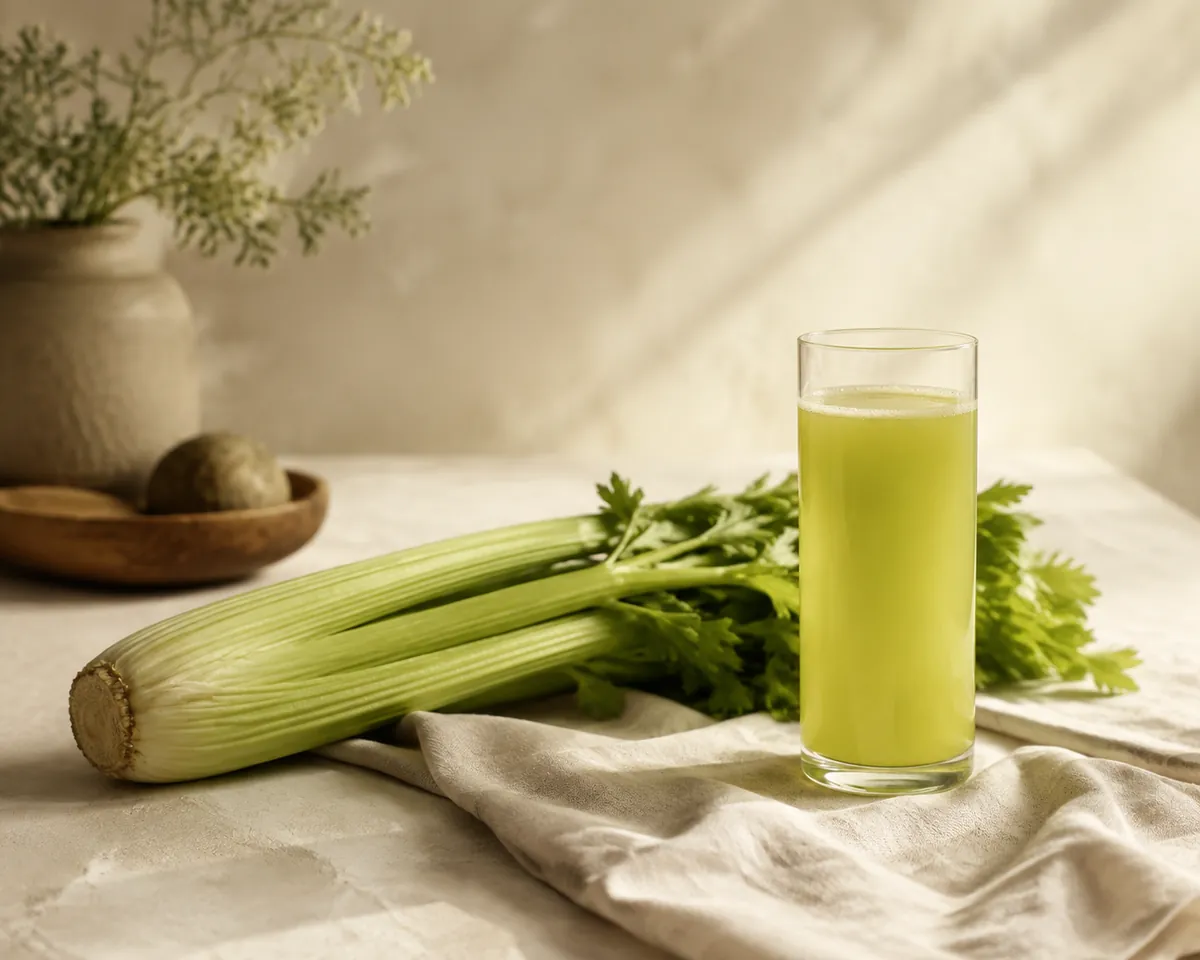
Celery juice is the liquid pressed out of celery stalks, with the strings and the crushed fibre thrown away. That is the whole definition, and it is a shorter one than the drink's reputation suggests.
What sets it apart is how differently it behaves from every other juice in the kitchen. It yields enormously, it tastes savoury rather than sweet, and it falls apart in the glass faster than almost anything else you could press.
Celery juice at a glance
- What it is
- The pressed liquid of celery stalks, with the pulp discarded
- Yield
- Very high. Celery is around 95 per cent water
- From one head
- Roughly 400 to 500 ml from a large head of 700 to 900 g
- Taste
- Grassy and green, with a distinct savoury, salty edge
- Colour
- Pale yellow-green, turning olive within the hour
- Best drunk
- Within about twenty minutes of pressing
What comes out of the stalk
Celery is roughly 95 per cent water by weight, and a juicer's job here is close to the simplest it ever gets: separate that water from the strings holding it in place. Very little is lost in the process.
That puts celery at the opposite end of the scale from the leaves it usually shares a recipe with.
A bag of spinach gives a disappointing splash, and a single head of celery fills a glass on its own, which is exactly why it turns up as the volume base in so many recipes over at green juice.
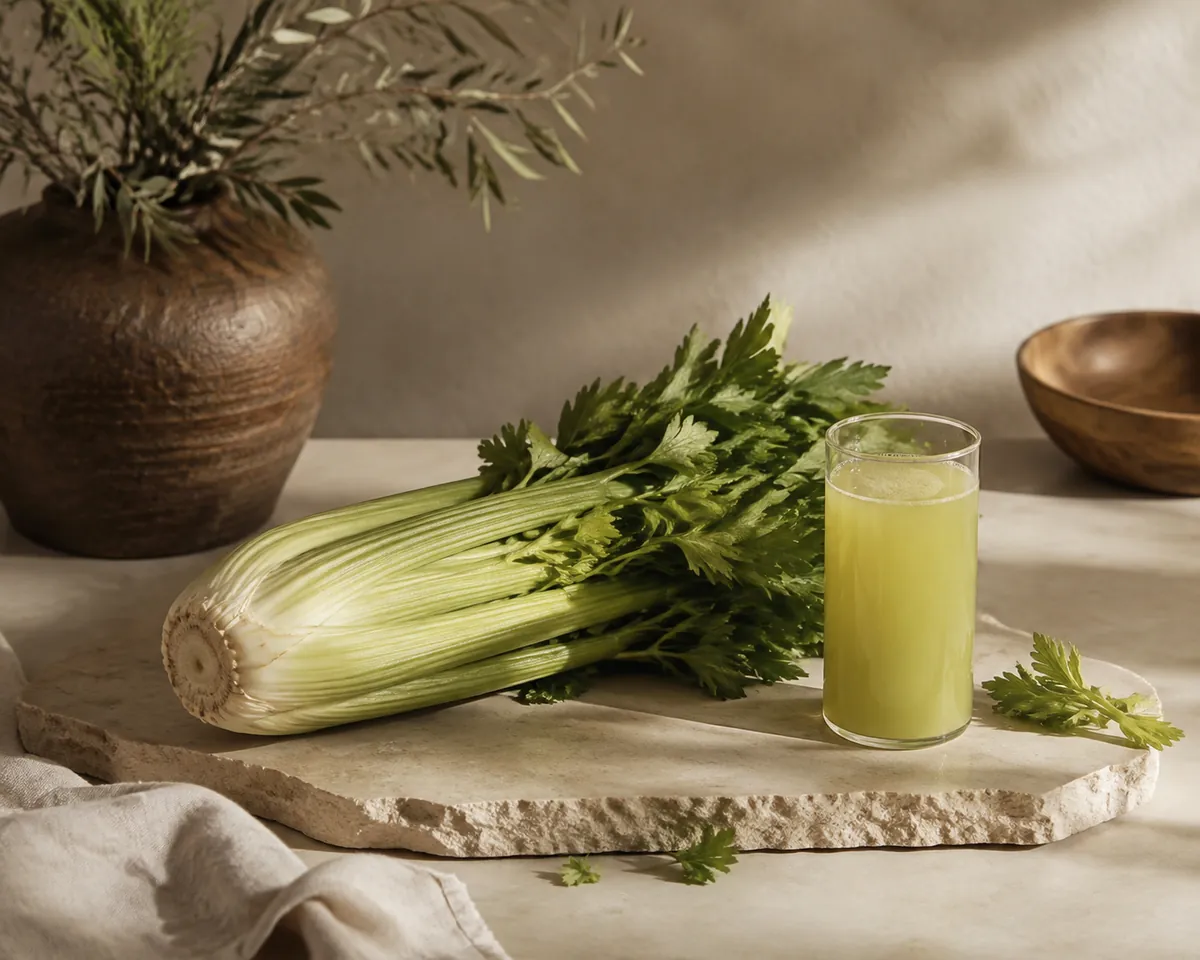
The pulp that comes out the other side is unusually dry and unusually plentiful in volume, since celery is mostly structure and water with little in between. What to do with juicing pulp in general is covered under green juice, and the honest answer for celery is the same one it gives.
Why it tastes savoury rather than sweet
Nothing else in the juicer tastes like this. Where apple juice is sweet and carrot juice is sweet in a rounder, earthier way, celery arrives green, grassy and unmistakably salty, and first-time drinkers usually describe it as tasting like a soup base rather than a juice.
Two things produce that impression. Celery carries more sodium and other mineral salts than most vegetables, so the saline note is real rather than an illusion.
There is also almost no sugar in the stalk to sit against it.
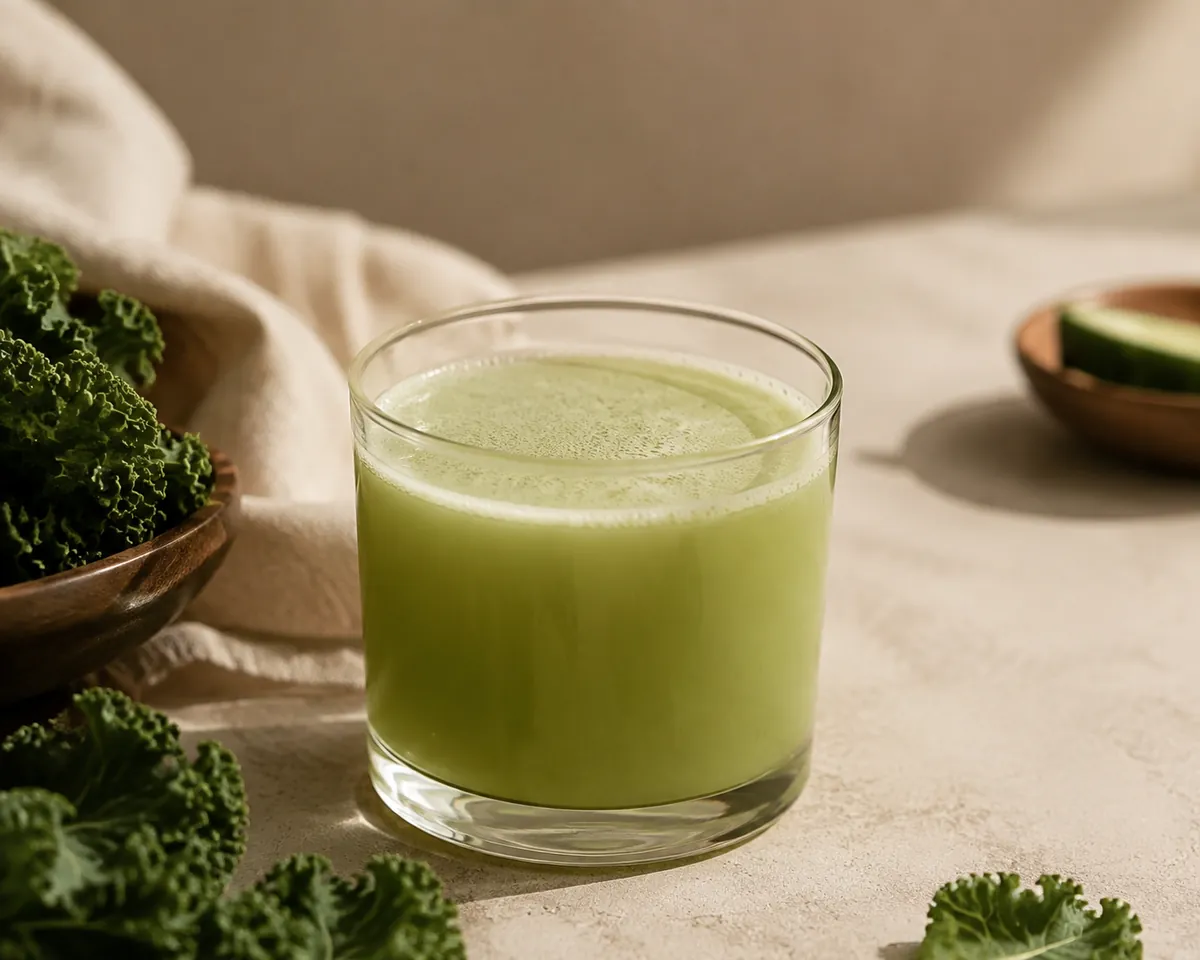
The aroma is the other half. The compounds responsible are the phthalides that give a raw stalk its smell, and juicing concentrates them, so the glass smells considerably more of celery than the vegetable does on a board.
Saline
The defining note, and the reason it reads as savoury.
Grassy
Green and vegetal, closest to the smell of cut stems.
Bitter
A low background bitterness, stronger from the outer ribs.
Faintly sweet
Present but slight, and gone once the juice sits.
Peppery
An aromatic bite at the finish, particularly from the leaves.
That flavour profile decides what the juice is good for. It works as a savoury base and as a thinner for sweeter juices, and it does not work as a stand-in for anything fruit-led.
What celery juice tastes like goes further into the individual notes.
Which part of the head you use
A head of celery is not one ingredient. The outer ribs, the pale inner heart and the leafy tops differ enough that a glass made from one is noticeably different from a glass made from another.
Outer ribs are the darkest green, the toughest, the most fibrous and the most strongly flavoured, with more bitterness and more of the aromatic bite. The pale heart at the centre is tender, milder and slightly sweeter.
The leaves are the most intense part of the plant and the most bitter thing in the head by a wide margin.
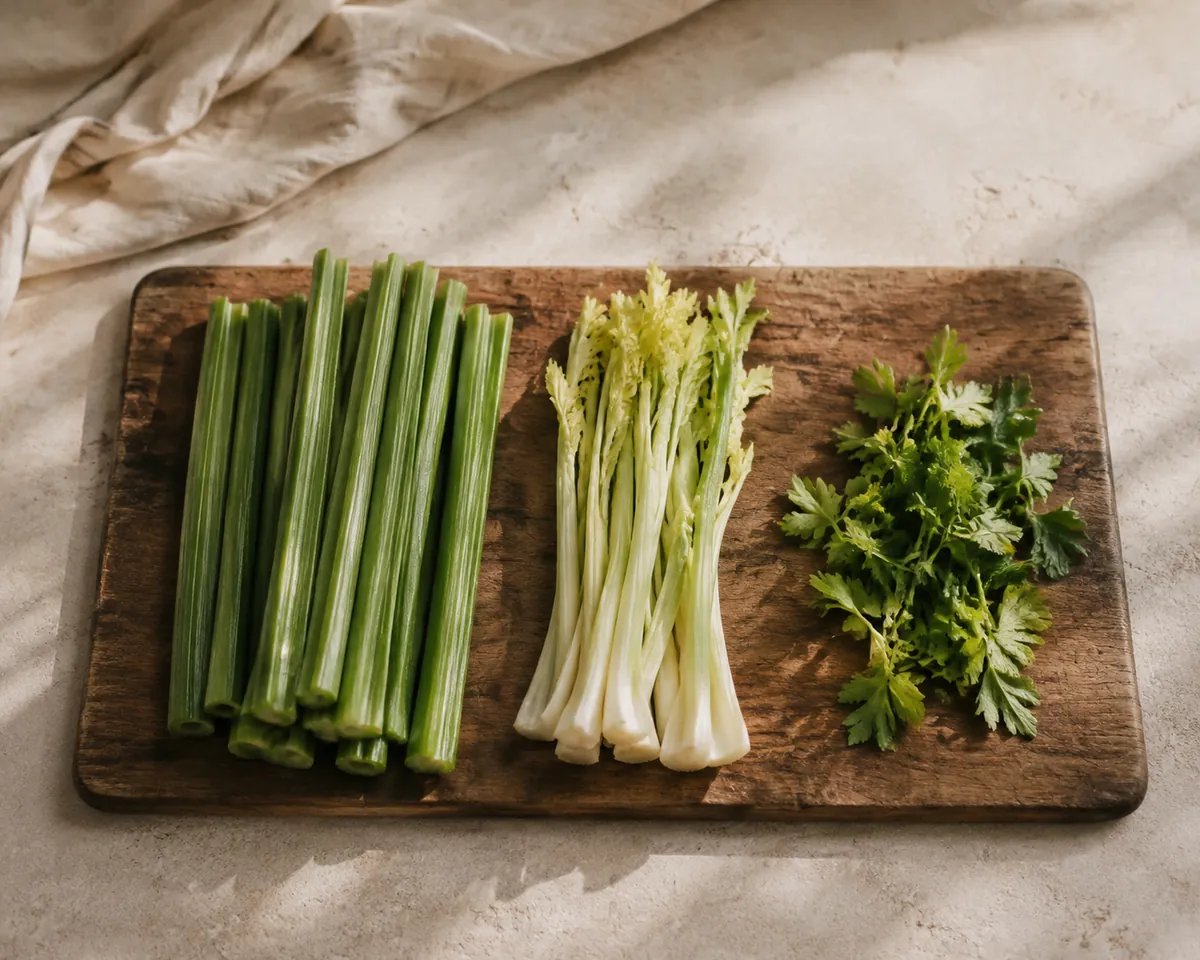
| Part | Yield | Flavour | Use it |
|---|---|---|---|
| Outer ribs | Highest | Strong, green, more bitter | Yes, and they are most of the head |
| Pale heart | Good | Mild, tender, faintly sweet | Yes, and it softens the glass |
| Leaves | Low | Very bitter, aromatic | Sparingly, or not at all |
| Base of the head | Good | Fine, but it holds grit | Yes, once washed thoroughly |
Using the whole head is the normal approach and gives a balanced glass. Where a first attempt came out harsh, the leaves are usually the culprit rather than the celery itself, and leaving most of them out is a bigger improvement than any amount of dilution.
The base of the head deserves its own mention because it is where grit collects. Soil works its way down between the ribs as the plant grows, and a head juiced without separating and rinsing the stalks produces a glass with a faint sandiness that no straining afterwards removes.
What the first hour does to it
Pour a glass and watch it for ten minutes. A pale foam rises to the top, a heavier layer settles at the bottom, and the bright yellow-green of the first minute starts drifting towards olive.
None of that is spoilage. It is oxidation and separation happening quickly, and celery juice does both faster than most, because it is thin, it foams readily and there is no pectin or starch to hold anything in place.
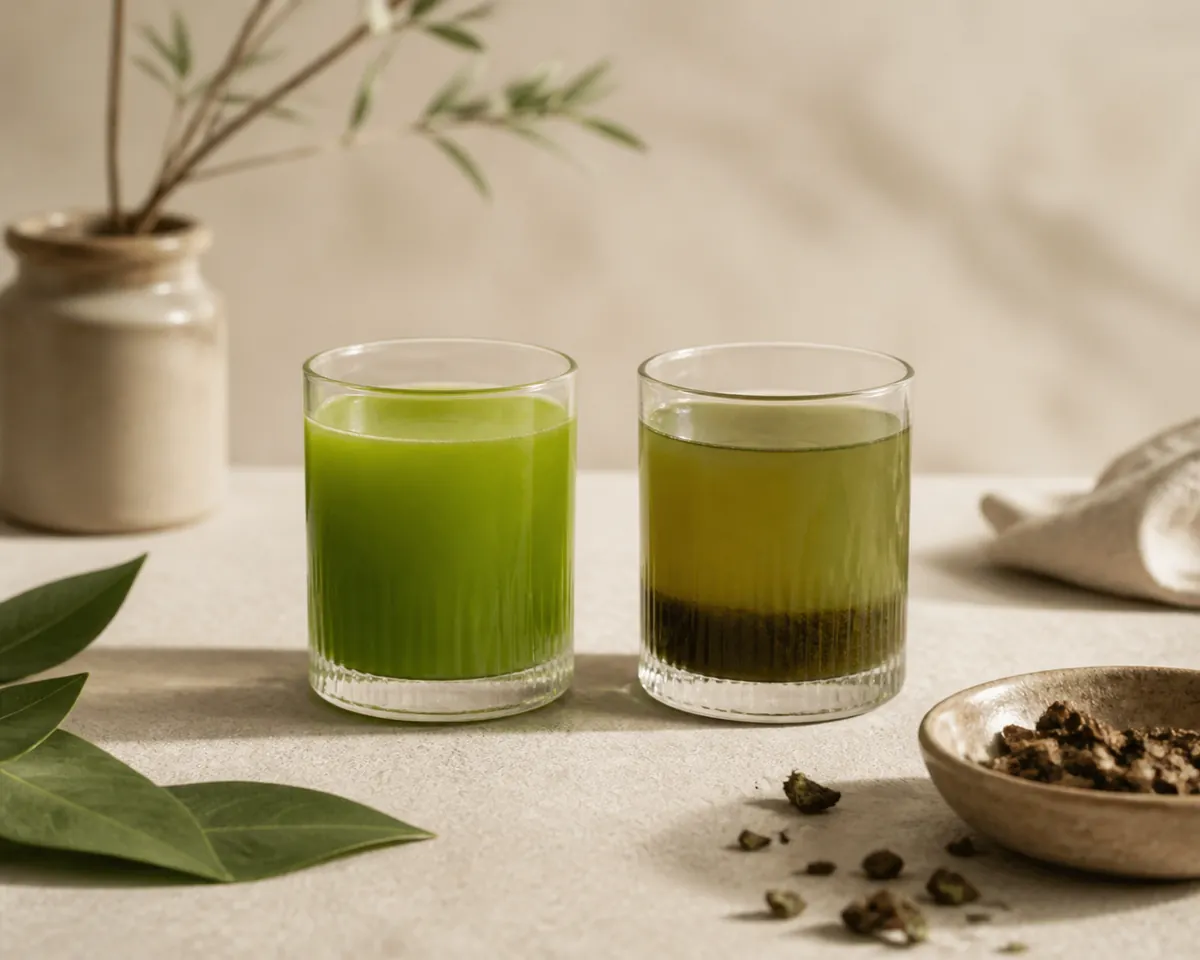
What happens after pressing
- Minute oneBright, aromatic, lightly foamed. This is the best it will be.
- Ten minutesThe foam thins, the juice begins to separate into layers.
- Half an hourColour dulls towards olive. The fresh green aroma flattens.
- A few hoursFully separated, noticeably more bitter, and flat on the nose.
- A dayStill drinkable if it has been cold and sealed, but a different drink.
The practical rule is to pour it into the glass you are going to drink from and drink it. Celery juice is at its best inside about twenty minutes, and everything after that is managed decline. A masticating machine slows the process a little by whipping less air through the juice, which is one of the differences set out under cold-pressed juice.
How to get the most out of a head
Preparation is short, and two details do most of the work. Wash the stalks separately rather than the head whole, and cut everything into lengths of two or three centimetres before it goes anywhere near the chute.
The cutting is not about fitting.
Celery strings are long and tough, and a full-length stalk fed into a juicer sends those strings around the auger or the shredding disc in a single wrap that stalls the machine, which is the commonest reason a first attempt ends in a dismantled juicer on the worktop.
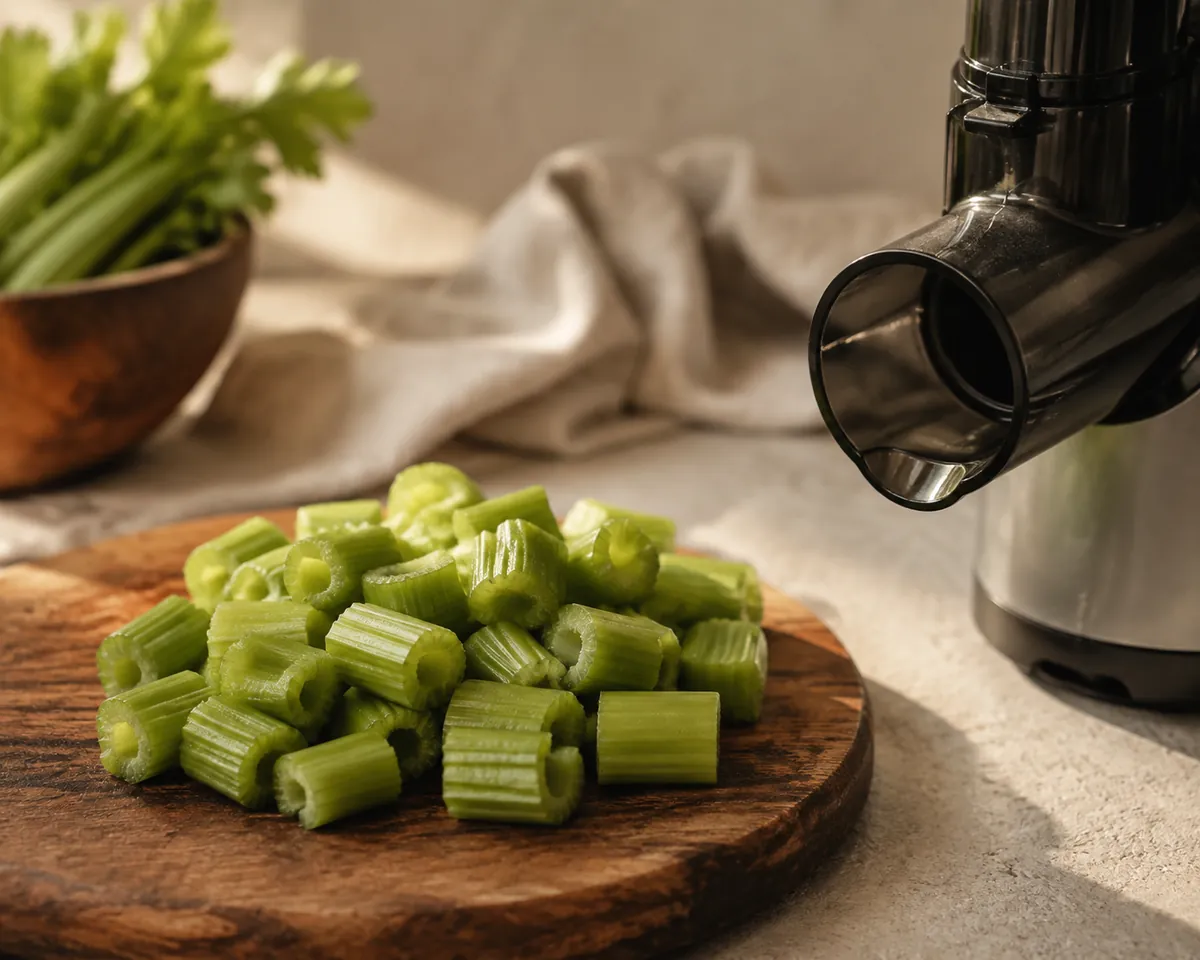
From head to glass
- SeparateBreak the ribs apart at the base rather than juicing the head whole.
- WashRinse each rib, paying attention to the pale end where grit collects.
- TrimTake off the root end and most of the leaves. Keep a few if you like the bite.
- CutTwo to three centimetre lengths, so nothing can wrap.
- FeedSlowly and steadily, alternating thick pieces with thin ones.
- PourStraight into the glass. Do not decant, do not stand it on the side.
Feeding slowly matters more with celery than with hard produce. A juicer pushed too fast sends stalks through half-crushed, and on a vegetable this watery that is a straightforward loss of yield rather than a slower press.
Where there is no juicer, a blender and a straining cloth work perfectly well, and celery is one of the better candidates for that method because there is so much liquid to recover. The wider question of which machine to buy is answered under green juice, which is the drink that actually depends on it.
How long it keeps, and in what
Fresh is the honest answer, and the useful question is what to do when fresh is not possible. Celery juice keeps for about twenty-four hours in a domestic fridge and can be pushed to two days, at a cost you will taste.
Three things do the damage. Air in the bottle, light, and temperature, in roughly that order of importance for a juice this thin, and air is by far the worst of the three.
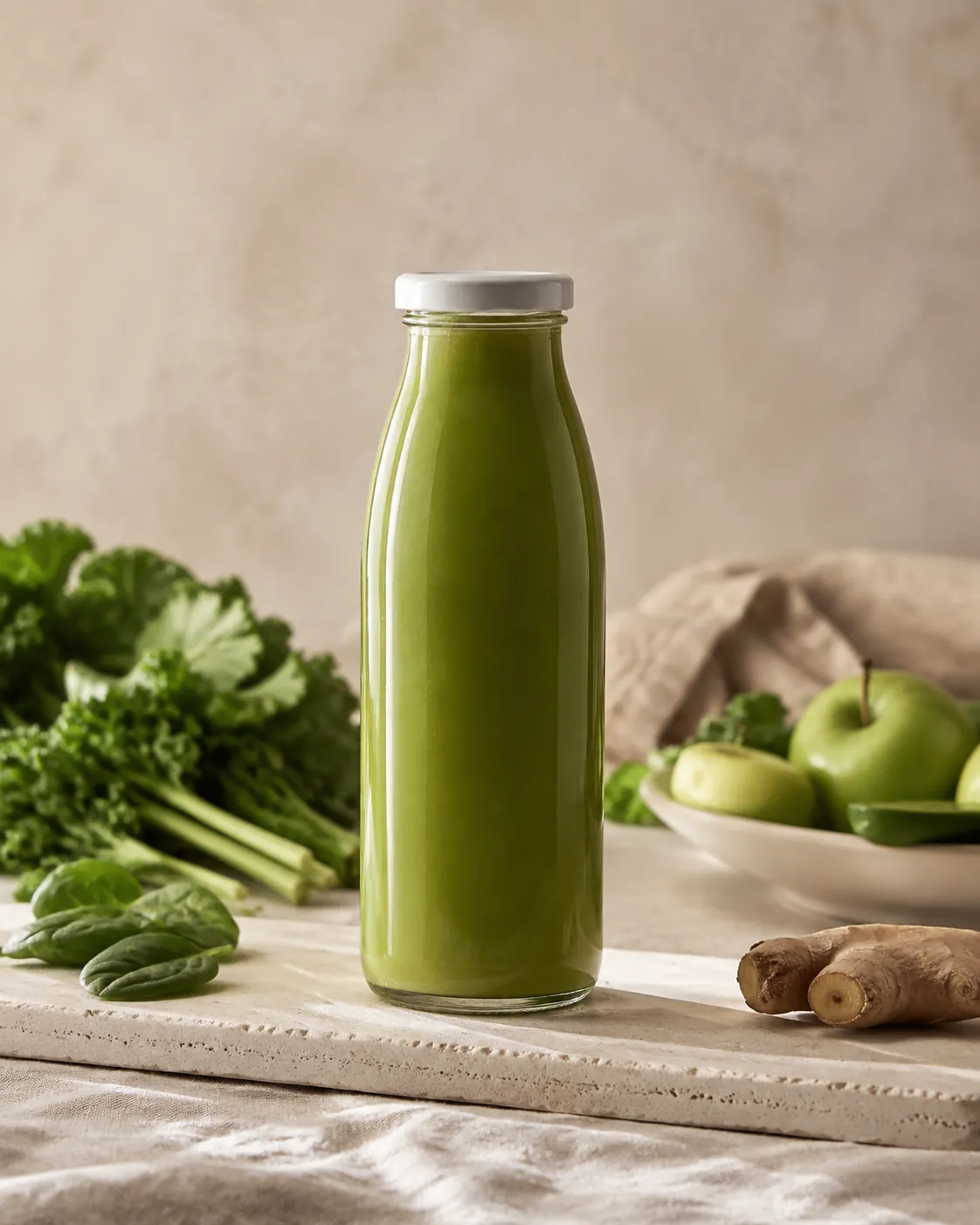
- Fill the bottle to the very brim so there is no air trapped above the juice.
- Use glass rather than plastic, and a lid that genuinely seals.
- Keep it at the back of the fridge rather than in the door.
- Shake it before pouring, since it will have separated completely.
- Judge it by smell. A sour or fermented note means it is finished.
Freezing is the better option for anything beyond a day, and it works reasonably here because the texture was never the point. Frozen in a small container with no headroom, celery juice holds its flavour for a few weeks and thaws cloudy and separated, which a shake fixes.
What it will not survive is being made in the morning for the evening on a worktop. Storing celery juice covers the containers in more detail, and a warm separated glass is the first entry in what goes wrong.
The short version is that a full sealed bottle in the cold is the only arrangement that buys real time.
What it mixes with, and what it fights
Celery is a base rather than a headline, which is the most useful thing to understand about mixing it. Its job in a blend is to supply volume and a savoury spine, and it is unusually good at both.
Cucumber is the natural partner, since it yields as freely and tastes of almost nothing. Apple is the standard sweetener, and a small one is enough.
Anything acidic lifts the whole glass out of its slightly flat, soupy register.
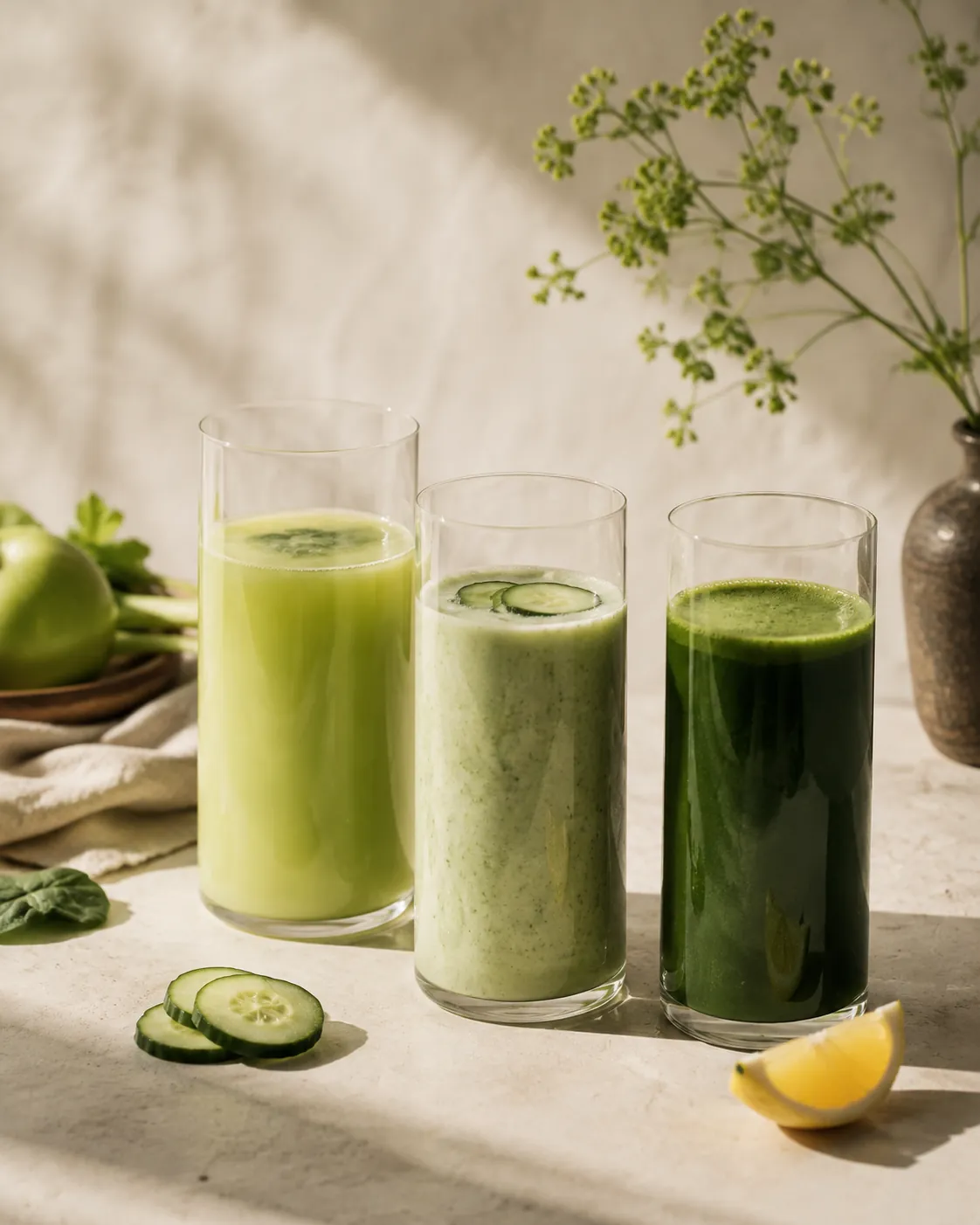
| Addition | Proportion | What it does |
|---|---|---|
| Cucumber | Up to half | Adds volume and softens the celery note |
| Apple | A quarter or less | Sweetens. More than that buries the celery |
| Lemon | A squeeze | Lifts it and slows the colour change |
| Ginger | A thumb | Heat and aroma against the grassiness |
| Mint | A few leaves | Freshens a glass that reads too vegetal |
| A pinch of salt | Very little | Leans into the savoury character rather than fighting it |
What it fights is anything rich or creamy. Celery juice against a milk or a nut drink is thin, savoury and separated all at once, and it belongs nowhere near a berry smoothie, where the fibre and the sweetness are doing an entirely different job.
Sparkling water is the one unexpected pairing worth trying. Celery, lemon and soda water over ice is closer to a savoury soft drink than to a juice, and the bubbles carry the aroma in a way the flat version does not.
Buying it, and what a limp head tells you
Limp celery is the whole problem. A rib that bends without snapping has already lost water to the air, and water is the entire product here, so a tired head yields visibly less and tastes duller for it.
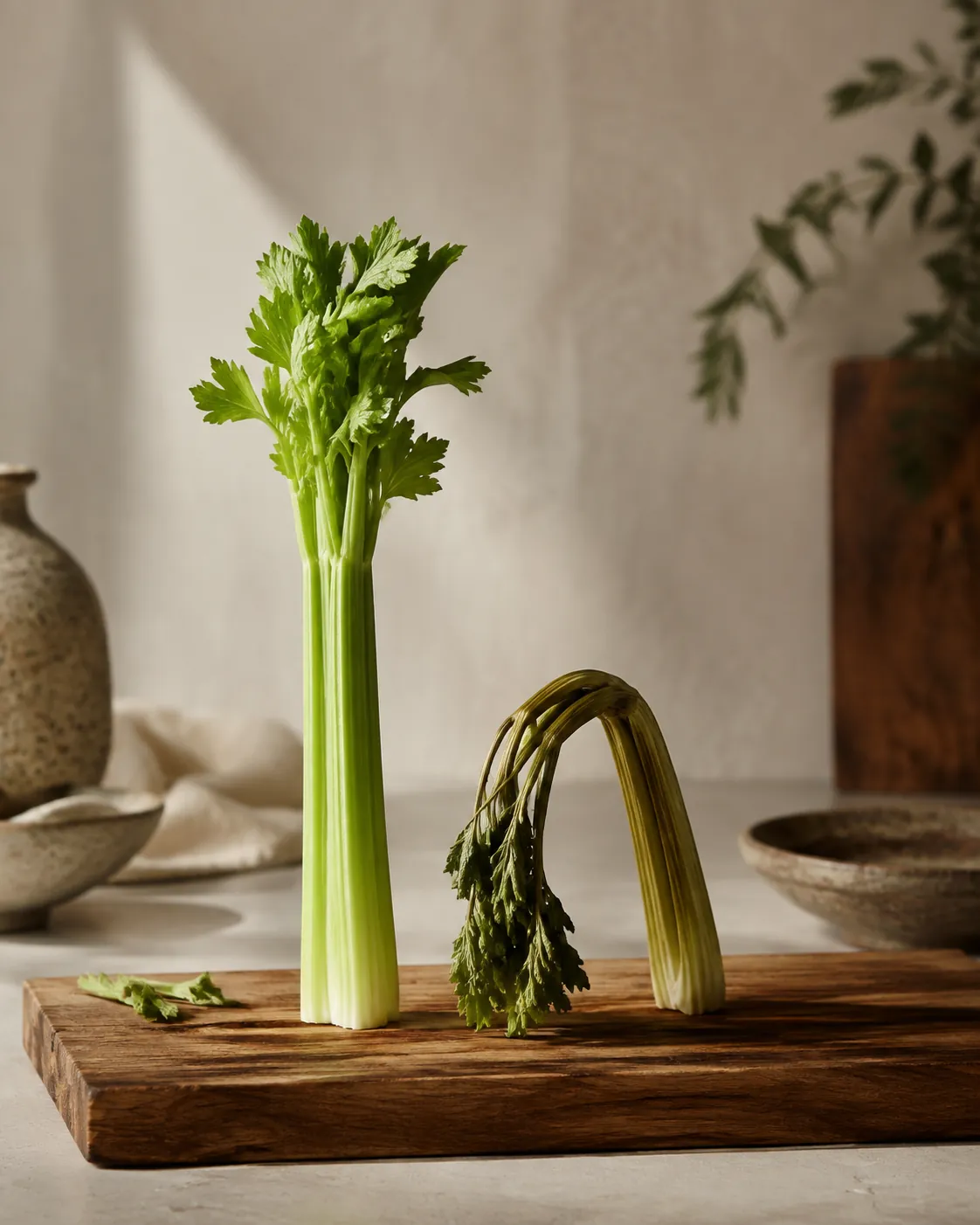
- Pick a head whose ribs snap rather than bend when you flex one gently.
- Look for a tight, compact head rather than one splayed open at the top.
- Check the leaves. Fresh, upright leaves are the clearest sign of a recent cut.
- Avoid heads with brown or slimy patches at the base.
- Pale hearts are milder and darker outer ribs are stronger, so buy for the glass you want.
Storage before juicing matters almost as much as the choice. Celery loses water fast in a fridge drawer, and wrapping the head in foil rather than leaving it in its plastic sleeve keeps it crisp for well over a week, because the foil slows moisture loss without trapping the ethylene that softens it.
A head that has already gone limp can be brought most of the way back. Cut the ribs into lengths and stand them in cold water for an hour or two, and they will take up enough water to snap again.
The recovery is genuine rather than cosmetic, and the yield comes back with it.
What celery juice gets confused with
Several things share the name and are not the drink, and two of them are frequently substituted for it by mistake in recipes.
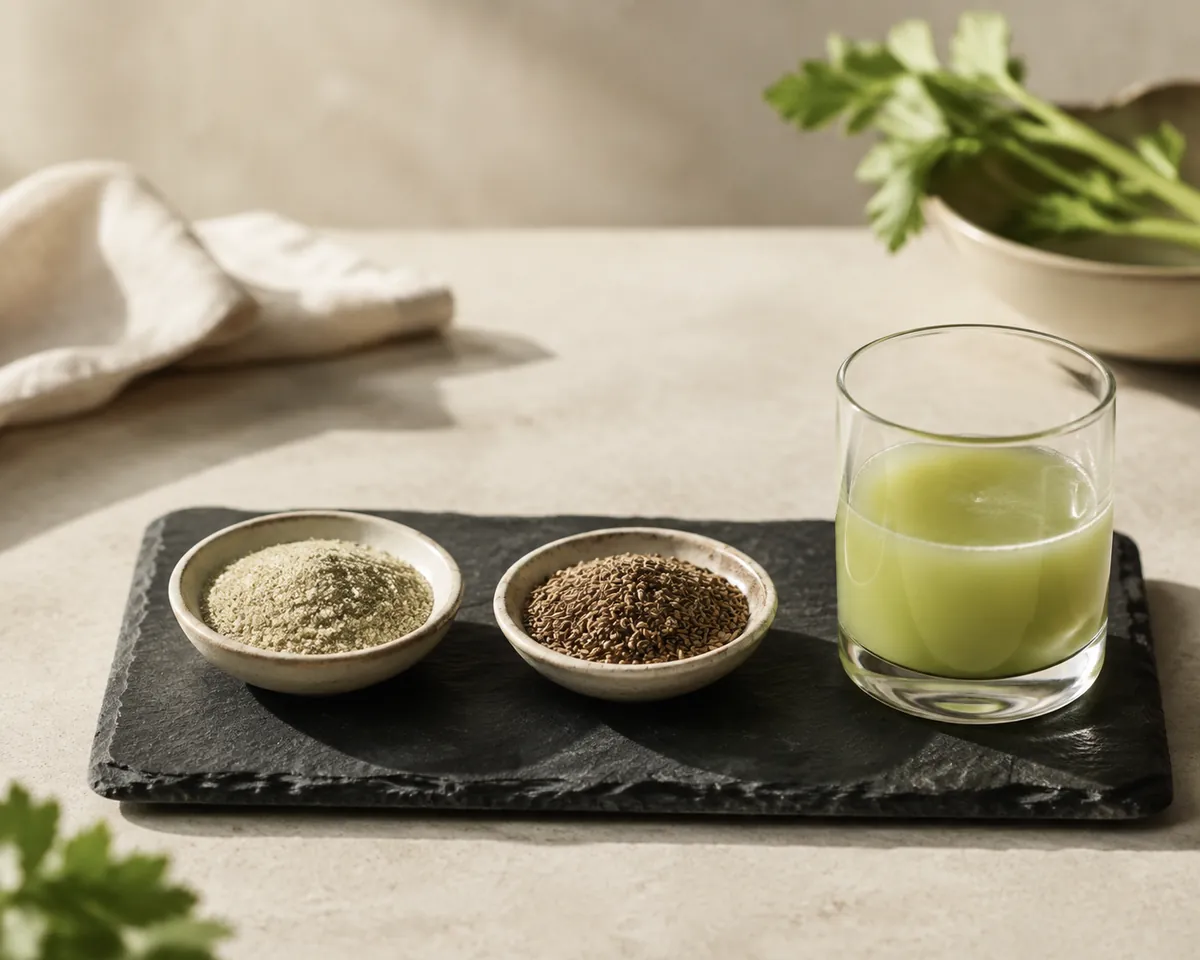
Celery salt
Ground celery seed mixed with salt. A seasoning, and not a liquid at all.
Celery seed
The seed of a different, wilder variety of the plant. Intensely aromatic, and bitter.
Celery soda
A sweetened carbonated soft drink flavoured with celery seed. A different category entirely.
Celery juice concentrate
A processed ingredient used in food manufacture, not something poured into a glass.
The seed confusion is the one that spoils a drink. Celery seed comes from smallage rather than from the stalk celery in a shop, and it is powerfully bitter in a way the stalk never is.
A recipe calling for a pinch of it is not describing the same flavour as a glass of pressed stalks.
The overlap with green juice is the more common mix-up and the less consequential one. Celery juice made alone is a single-ingredient drink, and a green juice is a recipe, so the two are related in the way a lemon is related to a lemonade.
Set against the other vegetable juices
Placed next to the juices it shares a shelf with, celery is the outlier on two axes at once: it is the easiest to extract and the least sweet by a distance.
Vegetable and fruit juices by yield
That combination is why celery ends up as the base of so many recipes rather than as the point of them. It contributes volume at very little cost, it sweetens nothing, and it leaves room for whatever else is going into the glass.
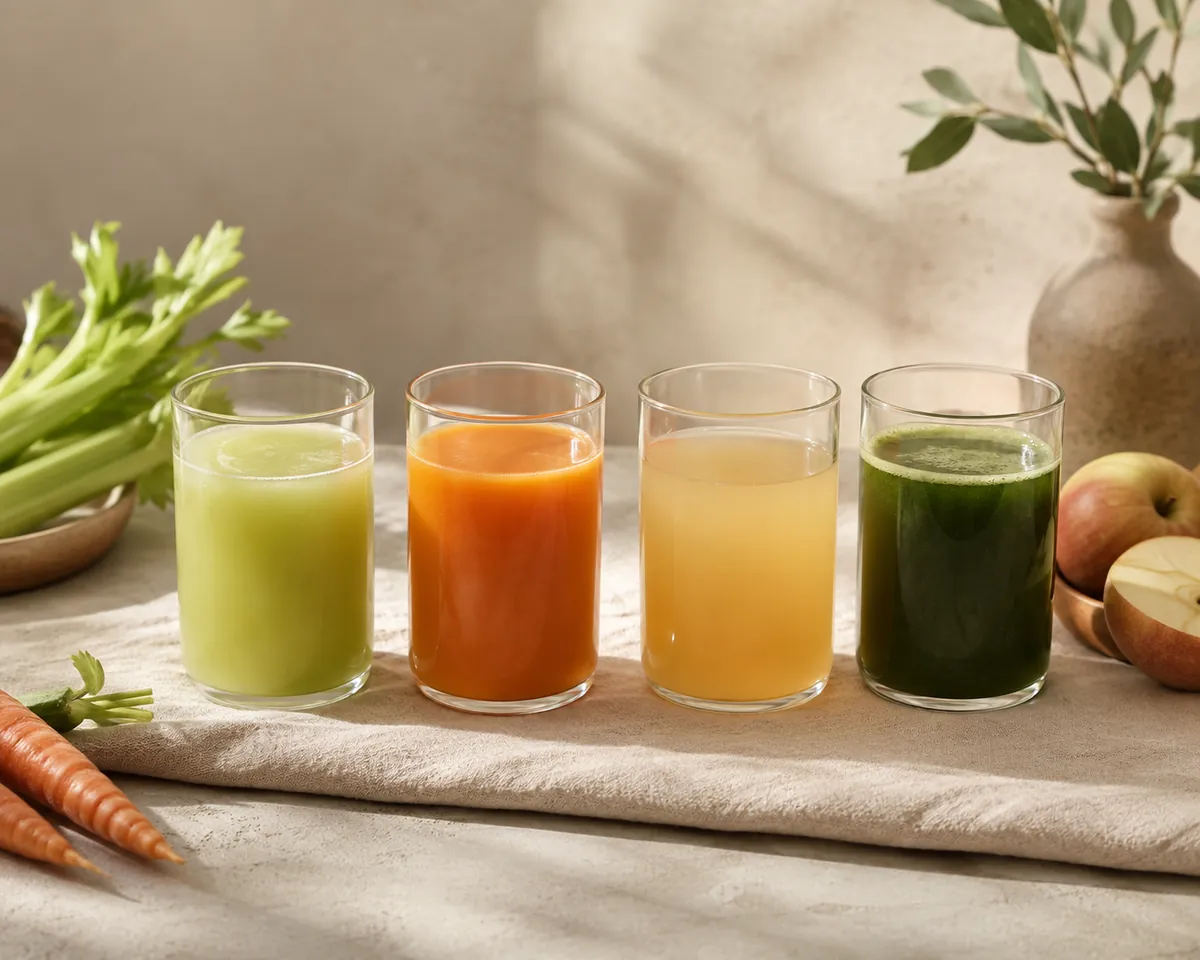
Where it stands entirely apart is on flavour. Every other common juice is sweet, and celery is savoury, which puts it closer in spirit to a chilled vegetable broth than to anything else in this collection.
Whether that is appealing is a matter of taste rather than technique, and making celery juice is short enough that finding out costs one head of celery and five minutes.
Common questions
How much juice does one head of celery give?
Roughly 400 to 500 ml from a large head of 700 to 900 g, which is a full glass from a single head. Celery is around 95 per cent water, so it yields more freely than almost anything else you can press, and only cucumber gives more.
Why does celery juice taste salty?
Celery carries more sodium and other mineral salts than most vegetables, so the saline note is real rather than an illusion, and there is almost no sugar in the stalk to sit against it. The phthalides that give a raw stalk its smell are concentrated by juicing, which is why the glass smells more strongly of celery than the vegetable does on a board.
How long does celery juice keep?
It is at its best within about twenty minutes of pressing. Sealed in a glass bottle filled to the brim and kept cold, it holds for around twenty-four hours and can be pushed to two days, by which point it has separated, dulled towards olive and turned more bitter. Freezing in a full container is the better option beyond a day.