Oolong, the Middle Ground
Oolong sits between green and black tea, partially oxidised across a range so wide that two oolongs can taste almost nothing alike.
Oolong is the widest category in tea and the least useful single word in it. It covers everything between green and black, which means two teas both correctly labelled oolong can share almost nothing: one lightly oxidised, floral and close to a green tea, the other oxidised far along and roasted on top of that until it reads as darker than many black teas.
Two independent variables produce that range. Oxidation is allowed to run anywhere from roughly ten per cent to eighty, and roasting is then applied separately, from none at all to heavy and repeated. A light oxidation with a heavy roast and a heavy oxidation with no roast are different teas that a shelf label will not distinguish.
That is why buying oolong by name rather than by category matters more here than anywhere else in tea, and why the same leaf rewards short repeated steeps in a small vessel more than a single long one in a mug. The guide below sets out the range, the rolling that produces the characteristic pellets, and where in it any given packet is likely to sit.
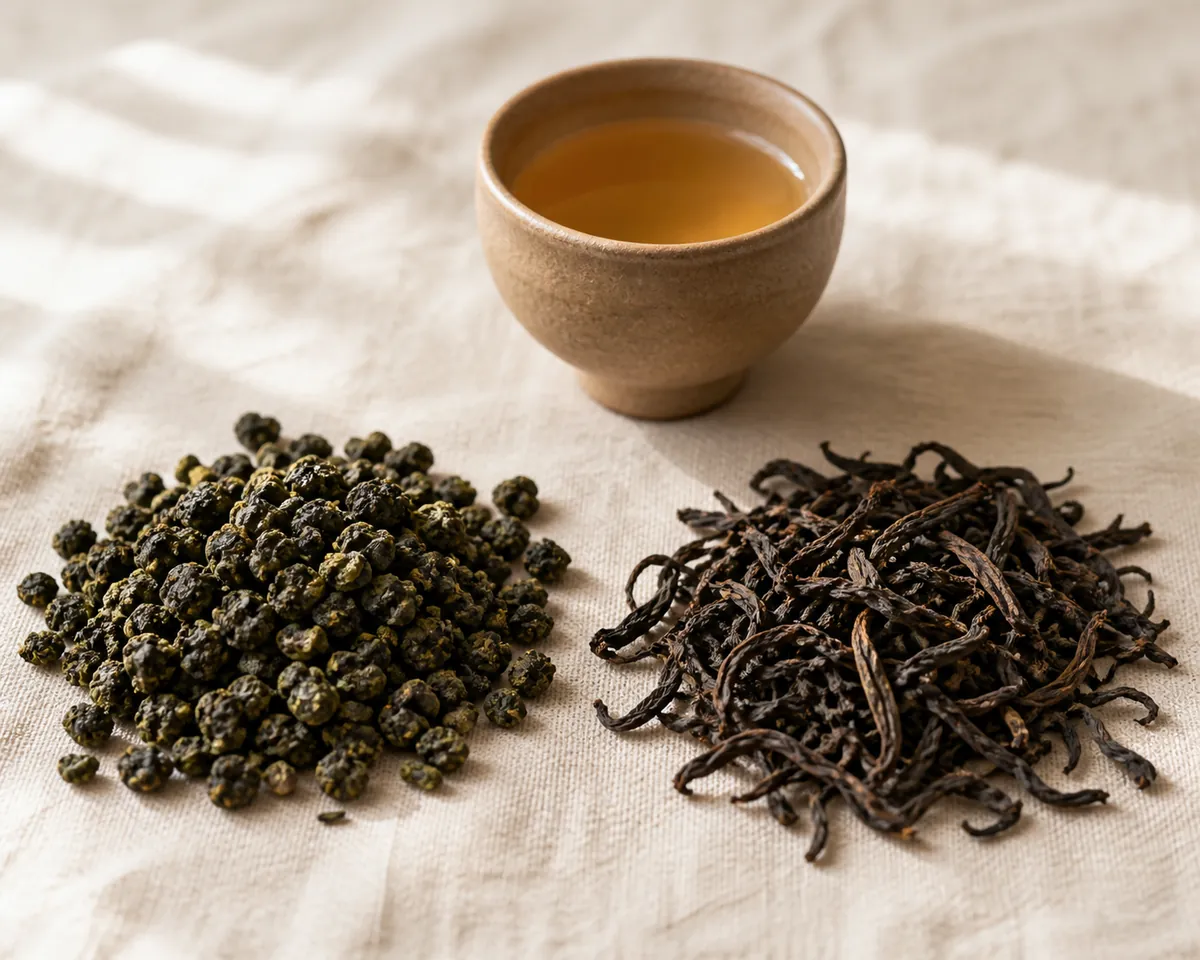
Rolling is the other variable, and it is visible before you buy. Ball-rolled oolongs arrive as tight pellets that open over several infusions, giving a cup that changes noticeably between the first steep and the fourth. Strip-rolled oolongs are long and twisted, open faster, and give more of themselves at once.
That is why the small-vessel method suits the category. Short infusions in a gaiwan or a small pot let a rolled leaf unfurl across a session, and each pour tastes different from the last, where a single long steep in a mug flattens the whole range into one cup.
Price behaves differently here too. A cheap green tea is usually a young leaf and a cheap black tea is usually broken, but a cheap oolong is most often a leaf that was oxidised and roasted quickly to hit a flavour that normally takes time. It tastes of the shortcut, and that is the fault to look for.